Malaysia Hospital Equipment And Supplies Market Size, Share & Growth Rate
The Malaysia Hospital Equipment And Supplies Market was estimated at USD 189 Million in 2025 and is projected to reach USD 246 Million by 2032, growing at a CAGR of 3.8% from 2026 to 2032. This growth trajectory is primarily fueled by the nation's robust healthcare sector and increased government investment in healthcare infrastructure. Additionally, the aging population and a heightened demand for advanced medical technology have further accelerated the market's expansion, especially in light of the COVID-19 pandemic's lasting impact.
Malaysia Hospital Equipment And Supplies Market Year-wise Growth Rate and Key Drivers
This graph highlights how the Malaysia Hospital Equipment And Supplies Market has steadily grown over the years, supported by major growth factors.
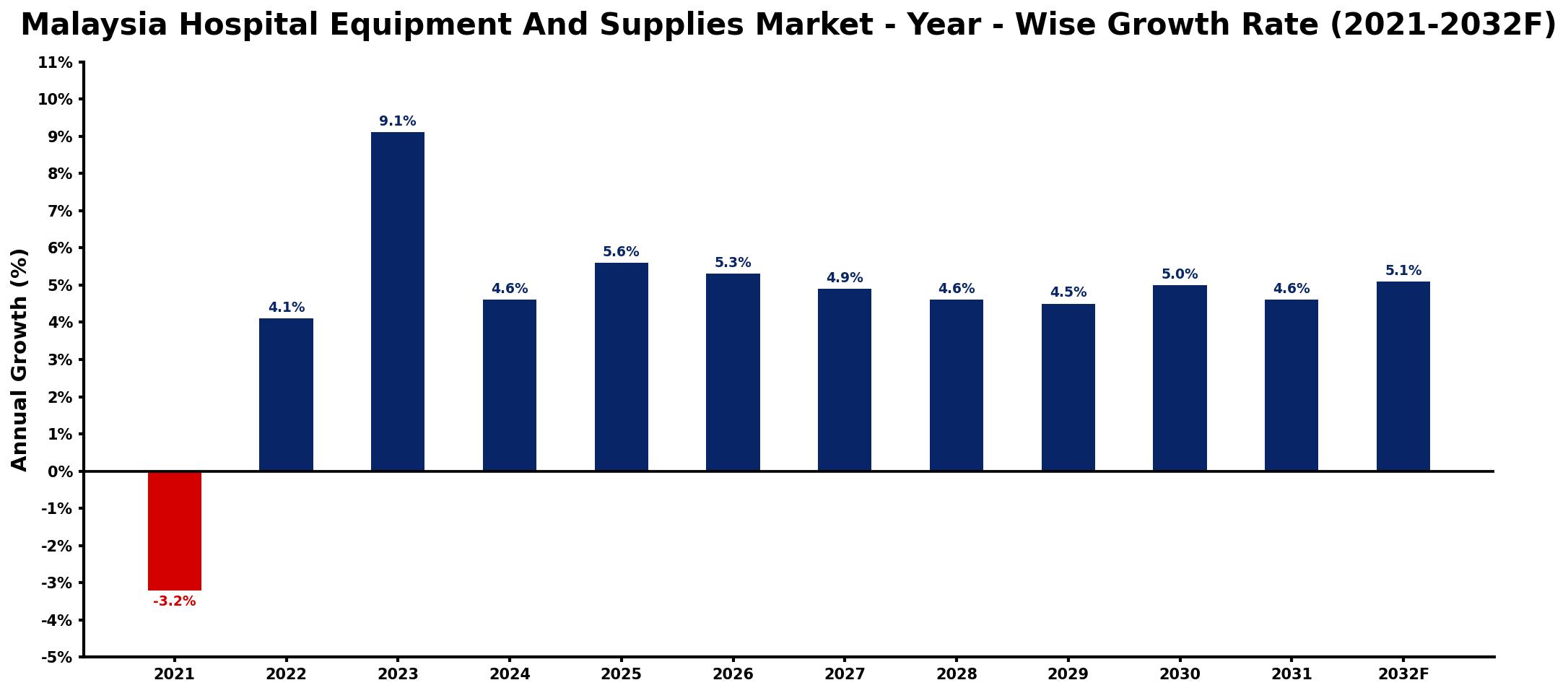
The table below presents the year‑wise growth rates along with the key drivers influencing the market
| Year | Growth Rate | Major Drivers |
| 2021 | -3.2% | decreased healthcare investments and spending |
| 2022 | 4.1% | rising demand for medical technologies |
| 2023 | 9.1% | expansion of telehealth services adoption |
| 2024 | 4.6% | increased healthcare infrastructure projects |
| 2025 | 5.6% | growing focus on preventive care |
| 2026 | 5.3% | enhanced government healthcare funding |
| 2027 | 4.9% | surge in aging population requirements |
| 2028 | 4.6% | advancements in digital health solutions |
| 2029 | 4.5% | growing regional consumption patterns |
| 2030 | 5.0% | increased emphasis on patient safety |
| 2031 | 4.6% | growing demand for personalized medicine |
| 2032 | 5.1% | enhanced global health partnerships |
Note: Market size estimations and growth projections presented in this report are based on 6Wresearch's proprietary forecasting methodology, utilizing the latest available industry data, government publications, and primary research inputs.
Malaysia Hospital Equipment And Supplies Market Synopsis
In recent years, Malaysia has seen a significant transformation in its healthcare landscape. The demand for hospital equipment and supplies is surging, driven by an expanding population and an increase in healthcare spending. This evolution is not just a response to current needs, but also a strategic move towards future readiness in healthcare services.
The COVID-19 pandemic highlighted vulnerabilities in the healthcare system, prompting both public and private sectors to invest heavily in enhancing infrastructure and preparedness. This ongoing commitment to modernization has further propelled the market, paving the way for both established and new entrants in the medical supplies sector.
Malaysia Hospital Equipment And Supplies Market Key Takeaways
- The market is expected to grow due to increased healthcare infrastructure and investment.
- Aging demographics are driving demand for specialized medical technologies.
- The COVID-19 pandemic has permanently altered the landscape, emphasizing the need for advanced equipment.
- Opportunities exist for innovation in local manufacturing and supply chain diversification.
- Government policies are increasingly supporting healthcare facility expansion and modernization.
Evaluation of Restraints in Malaysia Hospital Equipment And Supplies Market
Despite promising growth, the market faces several restraints. A key issue is the challenge of maintaining supply chain efficiency, particularly in emergency situations where critical supplies may be scarce. Additionally, managing costs while complying with evolving healthcare regulations presents a significant hurdle for providers. These factors could potentially slow down the momentum gained in recent years, necessitating strategic planning and flexibility from market participants to navigate these constraints.
Malaysia Hospital Equipment And Supplies Market Trends
As the market evolves, several trends are shaping its future. There is a noticeable shift towards telehealth and remote patient monitoring, which is influencing the development of connected medical devices and diagnostic tools. Furthermore, eco-friendly and sustainable products are becoming a priority, prompting suppliers to innovate in environmentally responsible ways. Advanced technologies such as artificial intelligence and machine learning are also making inroads, enhancing diagnostic capabilities and operational efficiency within healthcare facilities.
Malaysia Hospital Equipment And Supplies Market Opportunities
Significant growth opportunities are emerging in the local manufacturing of hospital supplies, driven by the need for reduced reliance on international supply chains. Furthermore, investments in research and development can yield breakthroughs in medical technology, particularly in fields like telemedicine and personalized healthcare. The governments focus on expanding healthcare access provides a fertile ground for innovative companies looking to introduce cutting-edge solutions tailored to Malaysia's unique demographic and healthcare needs.
Government Initiatives in the Malaysia Hospital Equipment And Supplies Market
The Malaysian government has initiated several programs aimed at strengthening the healthcare sector, including investments in infrastructure and incentives for private sector participation. Efforts to modernize existing facilities and build new healthcare centers are part of a broader strategy to enhance health outcomes. Additionally, policies promoting local production of medical supplies are being introduced, aiming to boost self-sufficiency and ensure the availability of essential equipment during crises.
Future Insights of the Malaysia Hospital Equipment And Supplies Market
Looking ahead to 2026-2032, the Malaysia Hospital Equipment And Supplies Market is set to undergo significant transformation. With a continued focus on healthcare modernization and technology adoption, there will be ample scope for new entrants and established players alike. The aging population will necessitate advancements in specialized medical equipment, and ongoing government support will further enhance infrastructure. Overall, the market is positioned for steady growth driven by innovation and a strategic emphasis on health system resilience.
Malaysia Hospital Equipment And Supplies Market Latest Developments (2025 - 2026)
In the latest developments within the Malaysia Hospital Equipment And Supplies Market, a strong push for local manufacturing has gained traction, particularly in response to disruptions caused by global supply chain challenges. Several healthcare facilities are investing in state-of-the-art technologies to enhance operational efficiencies and patient care. Additionally, public-private partnerships are emerging as a key strategy for expanding healthcare access, fostering a collaborative approach to upgrading infrastructure and medical capabilities.
Malaysia Hospital Equipment And Supplies Market - Key Attractiveness of the Report
- 10 Years of Market Numbers
- Historical Data Starting from 2022 to 2025
- Base Year: 2025
- Forecast Data until 2032
- Key Performance Indicators Impacting the Market
- Major Upcoming Developments and Projects
Key Highlights of the Report:
- Malaysia Hospital Equipment And Supplies Market Outlook
- Market Size of Malaysia Hospital Equipment And Supplies Market, 2025
- Forecast of Malaysia Hospital Equipment And Supplies Market, 2032
- Historical Data and Forecast of Malaysia Hospital Equipment And Supplies Revenues & Volume for the Period 2022-2032F
- Malaysia Hospital Equipment And Supplies Market Trend Evolution
- Malaysia Hospital Equipment And Supplies Market Drivers and Challenges
- Malaysia Hospital Equipment And Supplies Price Trends
- Malaysia Hospital Equipment And Supplies Porter's Five Forces
- Malaysia Hospital Equipment And Supplies Industry Life Cycle
- Historical Data and Forecast of Malaysia Hospital Equipment And Supplies Market Revenues & Volume By Product for the Period 2022-2032F
- Historical Data and Forecast of Malaysia Hospital Equipment And Supplies Market Revenues & Volume By Sterilization And Disinfectant Equipment for the Period 2022-2032F
- Historical Data and Forecast of Malaysia Hospital Equipment And Supplies Market Revenues & Volume By Disposable Hospital Supplies Patient Examination Devices for the Period 2022-2032F
- Historical Data and Forecast of Malaysia Hospital Equipment And Supplies Market Revenues & Volume By Syringes And Needles for the Period 2022-2032F
- Historical Data and Forecast of Malaysia Hospital Equipment And Supplies Market Revenues & Volume By Application for the Period 2022-2032F
- Historical Data and Forecast of Malaysia Hospital Equipment And Supplies Market Revenues & Volume By OEMs for the Period 2022-2032F
- Historical Data and Forecast of Malaysia Hospital Equipment And Supplies Market Revenues & Volume By Aftermarket for the Period 2022-2032F
- Malaysia Hospital Equipment And Supplies Import Export Trade Statistics
- Market Opportunity Assessment By Product
- Market Opportunity Assessment By Application
- Malaysia Hospital Equipment And Supplies Top Companies Market Share
- Malaysia Hospital Equipment And Supplies Competitive Benchmarking By Technical and Operational Parameters
- Malaysia Hospital Equipment And Supplies Company Profiles
- Malaysia Hospital Equipment And Supplies Key Strategic Recommendations






































