Malaysia Hydrophobic and Superhydrophobic Materials Market Size, Share & Growth Rate
The Malaysia Hydrophobic and Superhydrophobic Materials Market was estimated at USD 391 Million in 2025 and is projected to reach USD 508 Million by 2032, growing at a CAGR of 3.8% from 2026 to 2032. This growth trajectory is fueled by the increasing demand for advanced protective coatings across various industries, including construction, automotive, and electronics. As Malaysian manufacturers seek to enhance product longevity and reduce maintenance costs, the adoption of these innovative materials is set to rise significantly.
Malaysia Hydrophobic and Superhydrophobic Materials Market Year-wise Growth Rate and Key Drivers
This graph highlights how the Malaysia Hydrophobic and Superhydrophobic Materials Market has steadily grown over the years, supported by major growth factors.
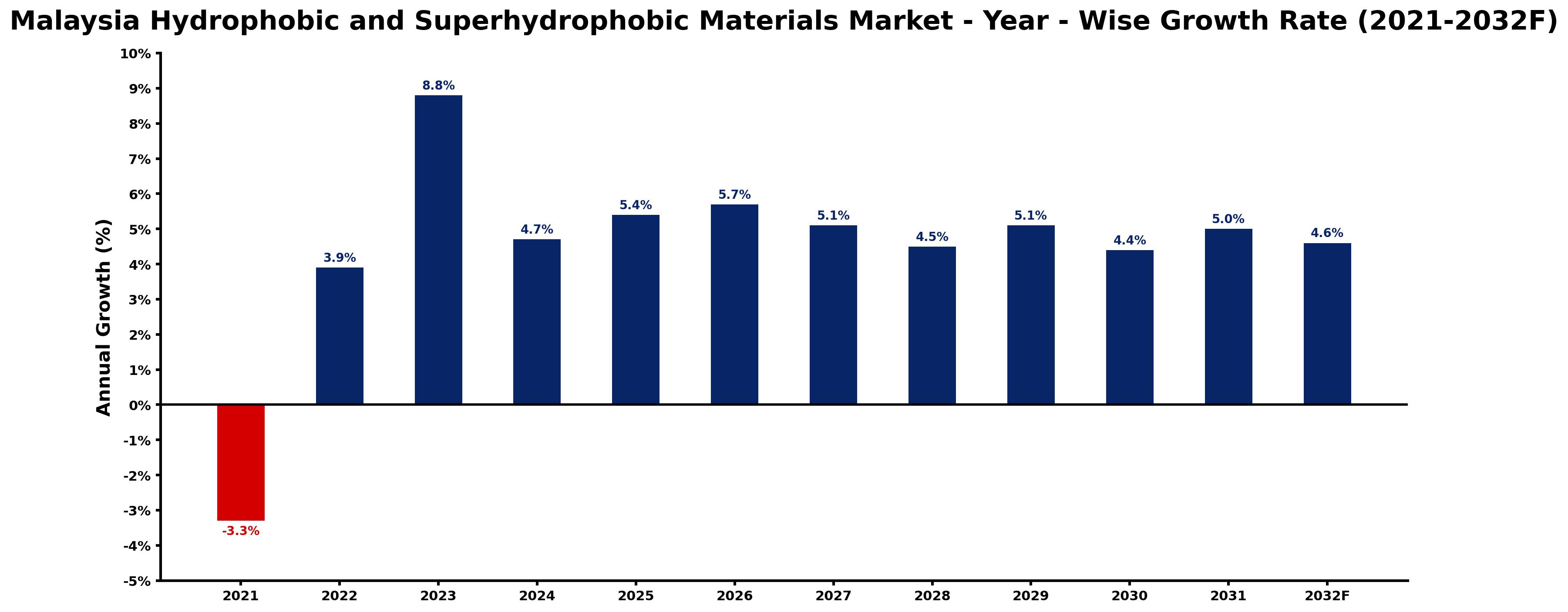
The table below presents the year‑wise growth rates along with the key drivers influencing the market
| Year | Growth Rate | Major Drivers |
| 2021 | -3.3% | Increasing industrial infrastructure investments |
| 2022 | 3.9% | Growing renewable energy integration projects |
| 2023 | 8.8% | Expansion of commercial construction activities |
| 2024 | 4.7% | Rapid growth in telecom and data center sectors |
| 2025 | 5.4% | Expansion of transportation and logistics networks |
| 2026 | 5.7% | Increasing industrial automation investments |
| 2027 | 5.1% | Increasing adoption of advanced technologies |
| 2028 | 4.5% | Government infrastructure modernization initiatives |
| 2029 | 5.1% | Growing urbanization and commercial development |
| 2030 | 4.4% | Growing urbanization and commercial development |
| 2031 | 5.0% | Growing urbanization and commercial development |
| 2032 | 4.6% | Growing renewable energy integration projects |
Note - Market size estimations and growth projections presented in this report are based on 6Wresearch’s advanced forecasting approach, validated with industry datasets as of June 2026.
Malaysia Hydrophobic and Superhydrophobic Materials Market Synopsis
Recently, the market for hydrophobic and superhydrophobic materials in Malaysia has shown substantial momentum, driven by technological advancements and heightened awareness regarding surface protection. However, as the industry continues to evolve, a focus on sustainability and eco-friendly solutions will shape its future trajectory.
Looking ahead, the market is likely to experience a shift towards more sophisticated formulations that not only repel water but also cater to varying environmental conditions. This evolution presents both challenges and opportunities as manufacturers navigate an increasingly competitive landscape.
Malaysia Hydrophobic and Superhydrophobic Materials Market Key Takeaways
- The market is witnessing robust growth due to rising demand for corrosion-resistant coatings in industrial applications.
- Technological advancements are paving the way for the development of eco-friendly hydrophobic materials.
- Growing investments in research and development are crucial for innovative product offerings.
- Strategic partnerships and collaborations will play a key role in expanding market reach.
- Increased awareness about the benefits of these materials is spurring their adoption in various sectors.
Evaluation of Restraints in Malaysia Hydrophobic and Superhydrophobic Materials Market
Despite its growth potential, the Malaysia Hydrophobic and Superhydrophobic Materials Market faces notable restraints. One significant challenge is the high cost associated with advanced material development and application, which can deter small to medium enterprises from adopting these technologies. Furthermore, regulatory concerns regarding chemical safety and environmental impacts may impose additional constraints on the manufacturing processes. These factors could limit the pace at which companies embrace hydrophobic and superhydrophobic solutions.
Malaysia Hydrophobic and Superhydrophobic Materials Market Trends
Key trends influencing the Malaysia market include a growing emphasis on nanotechnology to enhance material performance and durability. Additionally, there is an increasing focus on sustainable practices, driving the demand for environmentally friendly coatings. The integration of smart technologies into hydrophobic materials, such as self-cleaning surfaces or coatings with adaptive properties, is also gaining traction, indicating a transformative phase in material science.
Malaysia Hydrophobic and Superhydrophobic Materials Market Opportunities
Significant opportunities exist for investment and growth within the Malaysian hydrophobic and superhydrophobic materials market. The burgeoning construction sector, particularly in urban areas, presents a ripe landscape for the adoption of protective coatings. Additionally, as the automotive industry shifts towards more resilient materials, manufacturers of hydrophobic solutions are well-positioned to meet evolving demands. Collaboration with research institutions could further accelerate innovation and product development, creating avenues for enhanced market penetration.
Government Initiatives in the Malaysia Hydrophobic and Superhydrophobic Materials Market
The Malaysian government has been proactive in fostering innovation within the materials sector through various initiatives. Public spending on research and development, alongside support for technology-driven projects, is enhancing the capabilities of local manufacturers. Furthermore, policies aimed at encouraging sustainability in industrial practices are likely to create a conducive environment for the growth of hydrophobic and superhydrophobic materials, aligning economic objectives with ecological priorities.
Future Insights of the Malaysia Hydrophobic and Superhydrophobic Materials Market
From 2026 to 2032, the Malaysia Hydrophobic and Superhydrophobic Materials Market is poised for significant growth, driven by ongoing innovations and expanding applications. The push towards more durable, cost-effective solutions will enhance market viability, while the demand for sustainable products continues to rise. As industries adapt to changing environmental regulations and consumer preferences, a diverse range of applications will emerge, fundamentally shaping the market landscape.
Malaysia Hydrophobic and Superhydrophobic Materials Market Latest Developments (May 2025 - June 2026)
Recent developments in the Malaysia hydrophobic and superhydrophobic materials industry highlight a shift towards advanced coating technologies that emphasize durability and sustainability. Innovative product launches and collaborations between manufacturers and research institutions are paving the way for novel applications. Additionally, industry stakeholders are actively engaging in discussions on regulatory compliance and environmental responsibility, ensuring that upcoming offerings meet the highest standards.
Malaysia Hydrophobic and Superhydrophobic Materials Market - Key Attractiveness of the Report
- 10 Years of Market Numbers
- Historical Data Starting from 2022 to 2025
- Base Year: 2025
- Forecast Data until 2032
- Key Performance Indicators Impacting the Market
- Major Upcoming Developments and Projects
Key Highlights of the Report:
- Malaysia Hydrophobic and Superhydrophobic Materials Market Outlook
- Market Size of Malaysia Hydrophobic and Superhydrophobic Materials Market, 2025
- Forecast of Malaysia Hydrophobic and Superhydrophobic Materials Market, 2032F
- Historical Data and Forecast of Malaysia Hydrophobic and Superhydrophobic Materials Revenues & Volume for the Period 2022-2032F
- Malaysia Hydrophobic and Superhydrophobic Materials Market Trend Evolution
- Malaysia Hydrophobic and Superhydrophobic Materials Market Drivers and Challenges
- Malaysia Hydrophobic and Superhydrophobic Materials Price Trends
- Malaysia Hydrophobic and Superhydrophobic Materials Porter's Five Forces
- Malaysia Hydrophobic and Superhydrophobic Materials Industry Life Cycle
- Historical Data and Forecast of Malaysia Hydrophobic and Superhydrophobic Materials Market Revenues & Volume By Product for the Period 2022-2032F
- Historical Data and Forecast of Malaysia Hydrophobic and Superhydrophobic Materials Market Revenues & Volume By Anti-corrosion for the Period 2022-2032F
- Historical Data and Forecast of Malaysia Hydrophobic and Superhydrophobic Materials Market Revenues & Volume By Anti-wetting for the Period 2022-2032F
- Historical Data and Forecast of Malaysia Hydrophobic and Superhydrophobic Materials Market Revenues & Volume By Anti-icing for the Period 2022-2032F
- Historical Data and Forecast of Malaysia Hydrophobic and Superhydrophobic Materials Market Revenues & Volume By Self-cleaning for the Period 2022-2032F
- Historical Data and Forecast of Malaysia Hydrophobic and Superhydrophobic Materials Market Revenues & Volume By End user for the Period 2022-2032F
- Historical Data and Forecast of Malaysia Hydrophobic and Superhydrophobic Materials Market Revenues & Volume By Steel & Metal for the Period 2022-2032F
- Historical Data and Forecast of Malaysia Hydrophobic and Superhydrophobic Materials Market Revenues & Volume By Building & Construction for the Period 2022-2032F
- Historical Data and Forecast of Malaysia Hydrophobic and Superhydrophobic Materials Market Revenues & Volume By Automotive for the Period 2022-2032F
- Historical Data and Forecast of Malaysia Hydrophobic and Superhydrophobic Materials Market Revenues & Volume By Textile & Fabric for the Period 2022-2032F
- Historical Data and Forecast of Malaysia Hydrophobic and Superhydrophobic Materials Market Revenues & Volume By Others for the Period 2022-2032F
- Malaysia Hydrophobic and Superhydrophobic Materials Import Export Trade Statistics
- Market Opportunity Assessment By Product
- Market Opportunity Assessment By End user
- Malaysia Hydrophobic and Superhydrophobic Materials Top Companies Market Share
- Malaysia Hydrophobic and Superhydrophobic Materials Competitive Benchmarking By Technical and Operational Parameters
- Malaysia Hydrophobic and Superhydrophobic Materials Company Profiles
- Malaysia Hydrophobic and Superhydrophobic Materials Key Strategic Recommendations






































