Malaysia Industrial Analytics Market Size & Growth Rate (2026-2032)
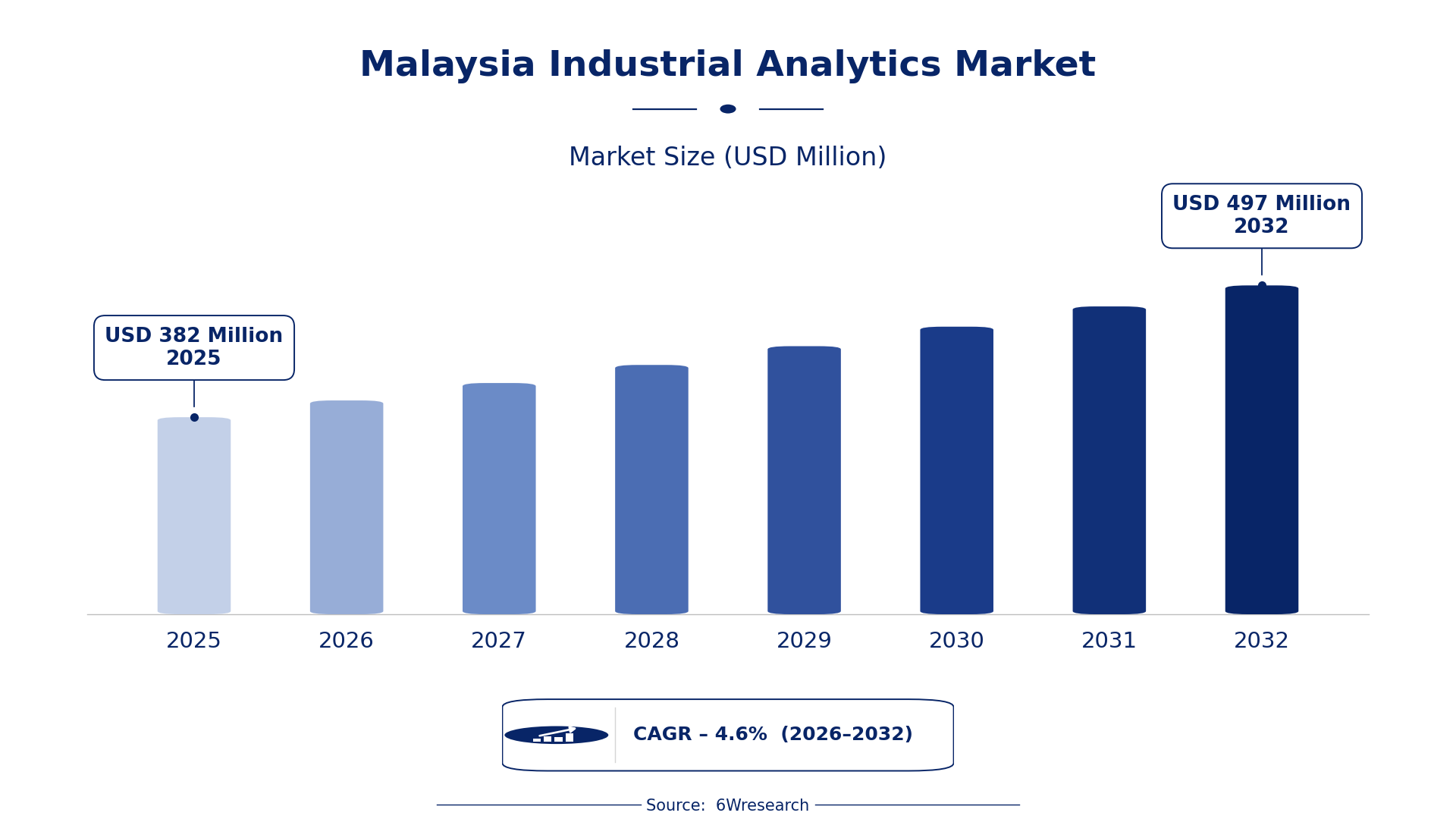
The Malaysia Industrial Analytics Market was estimated at USD 382 Million in 2025 and is projected to reach USD 497 Million by 2032, growing at a CAGR of 4.6% from 2026 to 2032.
Malaysia Industrial Analytics Market Synopsis
The driving force behind the Malaysia Industrial Analytics Market is the rapid adoption of Industry 4.0 principles. Companies are increasingly leveraging advanced analytics to optimize production processes and enhance operational efficiency. This trend is particularly pronounced in sectors such as manufacturing and energy, where data-driven decisions are becoming crucial for maintaining competitiveness.
As industries continue to digitize their operations, the demand for industrial analytics solutions is expected to rise. Organizations are recognizing the value of harnessing data generated from machinery and production lines to improve quality and streamline processes. This shift is not just a trend; it is transforming the core of industrial operations across Malaysia.
Malaysia Industrial Analytics Market Year-wise Growth Rate and Key Drivers
This graph illustrates the annual growth rates of the Malaysia Industrial Analytics Market from 2021 to 2032, highlighting a steady upward trajectory and projected expansion over the forecast period.
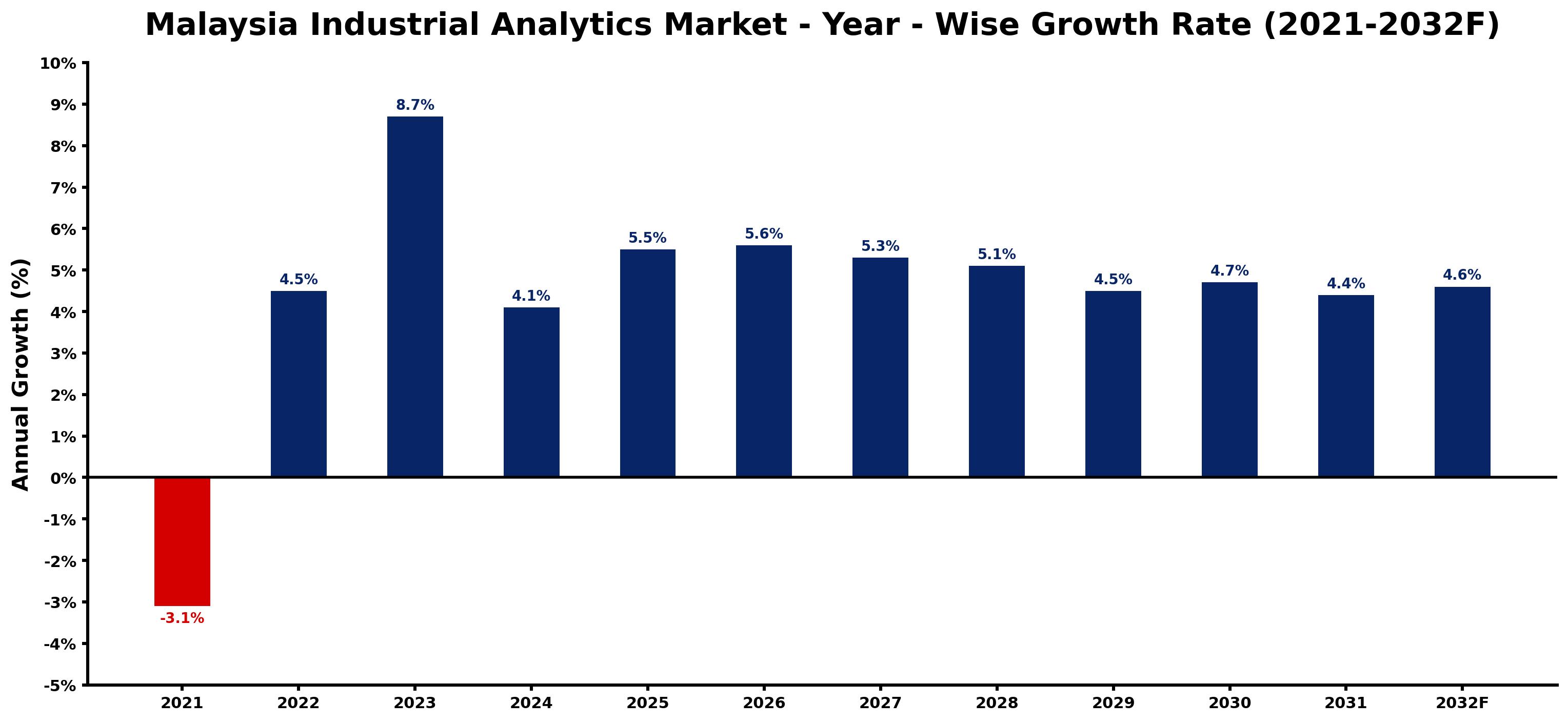
The table below presents the year‑wise growth rates along with the key drivers influencing the market
| Year | Growth Rate | Major Drivers |
| 2021 | -3.1% | MCO restrictions limited data collection efforts in factories. |
| 2022 | 4.5% | Government's Industry 4.0 initiative boosting analytics adoption. |
| 2023 | 8.7% | Increased demand for predictive maintenance in manufacturing sectors. |
| 2024 | 4.1% | Rise in smart factory implementations across Malaysian industries. |
| 2025 | 5.5% | Investment in data analytics training programs for workforce. |
| 2026 | 5.6% | Growth of logistics optimization efforts in supply chain. |
| 2027 | 5.3% | Emergence of local tech startups enhancing industrial analytics solutions. |
| 2028 | 5.1% | Government grants supporting AI-driven manufacturing projects. |
| 2029 | 4.5% | Enhancements in IoT integration for real-time data analytics. |
| 2030 | 4.7% | Focus on sustainability driving process optimization analytics. |
| 2031 | 4.4% | Partnerships between universities and industries fostering innovation. |
| 2032 | 4.6% | Growing focus on cybersecurity for industrial data protection. |
Note: Market size estimations and growth projections presented in this report are based on 6Wresearch's proprietary forecasting methodology, utilizing the latest available industry data, government publications, and primary research inputs.
Malaysia Industrial Analytics Market Key Takeaways
Below are some of the specific key takeaways from the market, including:
- The Malaysian Industrial Analytics Market is experiencing steady growth driven by Industry 4.0 adoption.
- Integration of advanced analytics solutions is essential for enhancing operational efficiency in manufacturing.
- Government initiatives are supporting the transition to advanced manufacturing technologies.
- The market is facing challenges in integrating legacy systems with modern analytics platforms.
- Skilled workforce shortages pose a significant barrier to the effective implementation of analytics solutions.
Evaluation of Restraints in Malaysia Industrial Analytics Market
Despite its potential, the Malaysia Industrial Analytics Market faces considerable restraints. A primary challenge lies in the integration of legacy systems with contemporary analytics solutions. Many firms still depend on older machinery that lacks compatibility with advanced platforms, making transitions cumbersome. Additionally, the talent pool remains a significant hurdle; the scarcity of professionals who possess expertise in both industrial processes and analytics limits organizations' ability to fully utilize these technologies. Addressing these gaps is crucial for unlocking the market's full potential.
Malaysia Industrial Analytics Market Trends
Several trends are shaping the Malaysia Industrial Analytics Market. A prominent trend is the rise of predictive maintenance, where analytics are used to anticipate equipment failures, thereby reducing downtime and maintenance costs. on top of that, organizations are increasingly adopting cloud-based analytics solutions, allowing for greater scalability and flexibility. The focus on sustainability is also influencing analytics, with companies seeking ways to minimize waste and optimize resource usage through data insights. These trends highlight the shift toward smarter, more efficient industrial operations.
Malaysia Industrial Analytics Market Opportunities
The future holds significant opportunities for growth in the Malaysia Industrial Analytics Market. As industries continue to invest in automation and smart technologies, there is a clear demand for innovative analytics solutions that can drive productivity. Companies that focus on developing user-friendly interfaces for analytics tools will likely gain a competitive advantage. Additionally, partnerships between technology providers and local firms could accelerate the adoption of tailored analytics solutions that cater to the unique needs of Malaysian industries.
Government Initiatives in the Malaysia Industrial Analytics Market
Government initiatives are playing a critical role in shaping the Malaysia Industrial Analytics Market. Recently, the Ministry of International Trade and Industry launched a program aimed at promoting advanced manufacturing technologies, encouraging firms to adopt analytics-driven solutions. Currently, the government is investing in infrastructure to support digital transformation across key sectors, which is crucial for fostering a conducive environment for analytics adoption. Looking ahead, there are plans to introduce incentives for companies that invest in workforce training, specifically targeting skills in analytics and data science, further strengthening the market's foundation.
Future Insights of the Malaysia Industrial Analytics Market
From 2026 to 2032, the Malaysia Industrial Analytics Market is expected to evolve significantly. With an increasing emphasis on data-driven decision-making, the market will likely see enhanced investments in analytics solutions. The ongoing digital transformation initiatives will continue to encourage industries to adopt smart manufacturing practices. As companies strive for greater efficiency and competitiveness, the integration of artificial intelligence and machine learning into analytics will also gain traction, fundamentally reshaping industrial operations in Malaysia.
Malaysia Industrial Analytics Market Latest Developments
In the past year, the Malaysia Industrial Analytics Market has witnessed several noteworthy developments. A leading regional operator completed the rollout of a new analytics platform aimed at improving production efficiency, which was launched in early 2025 and completed by late 2025. Ongoing projects include collaborations between technology vendors and local manufacturers to develop customized analytics solutions, which began in mid-2025 and remain underway. on top of that, a major technology vendor is expected to begin a comprehensive training program in the second half of 2026, aimed at addressing the skill gaps in the workforce.
Malaysia Industrial Analytics Market - Key Attractiveness of the Report
- 10 Years of Market Numbers
- Historical Data Starting from 2022 to 2025
- Base Year: 2025
- Forecast Data until 2032
- Key Performance Indicators Impacting the Market
- Major Upcoming Developments and Projects
Key Highlights of the Report:
- Malaysia Industrial Analytics Market Outlook
- Market Size of Malaysia Industrial Analytics Market, 2025
- Forecast of Malaysia Industrial Analytics Market, 2032
- Historical Data and Forecast of Malaysia Industrial Analytics Revenues & Volume for the Period 2022-2032F
- Malaysia Industrial Analytics Market Trend Evolution
- Malaysia Industrial Analytics Market Drivers and Challenges
- Malaysia Industrial Analytics Price Trends
- Malaysia Industrial Analytics Porter's Five Forces
- Malaysia Industrial Analytics Industry Life Cycle
- Historical Data and Forecast of Malaysia Industrial Analytics Market Revenues & Volume By Component for the Period 2022-2032F
- Historical Data and Forecast of Malaysia Industrial Analytics Market Revenues & Volume By Software for the Period 2022-2032F
- Historical Data and Forecast of Malaysia Industrial Analytics Market Revenues & Volume By Service for the Period 2022-2032F
- Historical Data and Forecast of Malaysia Industrial Analytics Market Revenues & Volume By Software for the Period 2022-2032F
- Historical Data and Forecast of Malaysia Industrial Analytics Market Revenues & Volume By Operational analytics for the Period 2022-2032F
- Historical Data and Forecast of Malaysia Industrial Analytics Market Revenues & Volume By Risk analytics for the Period 2022-2032F
- Historical Data and Forecast of Malaysia Industrial Analytics Market Revenues & Volume By Financial analytics for the Period 2022-2032F
- Historical Data and Forecast of Malaysia Industrial Analytics Market Revenues & Volume By Marketing analytics for the Period 2022-2032F
- Historical Data and Forecast of Malaysia Industrial Analytics Market Revenues & Volume By Customer analytics for the Period 2022-2032F
- Historical Data and Forecast of Malaysia Industrial Analytics Market Revenues & Volume By Workforce analytics for the Period 2022-2032F
- Historical Data and Forecast of Malaysia Industrial Analytics Market Revenues & Volume By Service for the Period 2022-2032F
- Historical Data and Forecast of Malaysia Industrial Analytics Market Revenues & Volume By Managed services for the Period 2022-2032F
- Historical Data and Forecast of Malaysia Industrial Analytics Market Revenues & Volume By Professional services for the Period 2022-2032F
- Historical Data and Forecast of Malaysia Industrial Analytics Market Revenues & Volume By Analytics Type for the Period 2022-2032F
- Historical Data and Forecast of Malaysia Industrial Analytics Market Revenues & Volume By Descriptive for the Period 2022-2032F
- Historical Data and Forecast of Malaysia Industrial Analytics Market Revenues & Volume By Diagnostic for the Period 2022-2032F
- Historical Data and Forecast of Malaysia Industrial Analytics Market Revenues & Volume By Predictive for the Period 2022-2032F
- Historical Data and Forecast of Malaysia Industrial Analytics Market Revenues & Volume By Prescriptive for the Period 2022-2032F
- Historical Data and Forecast of Malaysia Industrial Analytics Market Revenues & Volume By Organization size for the Period 2022-2032F
- Historical Data and Forecast of Malaysia Industrial Analytics Market Revenues & Volume By Large enterprises for the Period 2022-2032F
- Historical Data and Forecast of Malaysia Industrial Analytics Market Revenues & Volume By Small and medium-sized enterprises for the Period 2022-2032F
- Malaysia Industrial Analytics Import Export Trade Statistics
- Market Opportunity Assessment By Component
- Market Opportunity Assessment By Software
- Market Opportunity Assessment By Service
- Market Opportunity Assessment By Analytics Type
- Market Opportunity Assessment By Organization size
- Malaysia Industrial Analytics Top Companies Market Share
- Malaysia Industrial Analytics Competitive Benchmarking By Technical and Operational Parameters
- Malaysia Industrial Analytics Company Profiles
- Malaysia Industrial Analytics Key Strategic Recommendations






































