Malaysia Industrial Dryers for Agricultural Products Market Size, Share & Growth Rate
The Malaysia Industrial Dryers for Agricultural Products Market was estimated at USD 174 Million in 2025 and is projected to reach USD 228 Million by 2032, growing at a CAGR of 3.9% from 2026 to 2032. This growth trajectory is propelled by increasing agricultural production and a concerted focus on enhancing food security within the region. As Malaysias agriculture sector diversifies, the quest for efficient drying solutions, which preserve product quality and minimize waste, becomes increasingly paramount.
Malaysia Industrial Dryers for Agricultural Products Market Year-wise Growth Rate and Key Drivers
This graph highlights how the Malaysia Industrial Dryers for Agricultural Products Market has steadily grown over the years, supported by major growth factors.
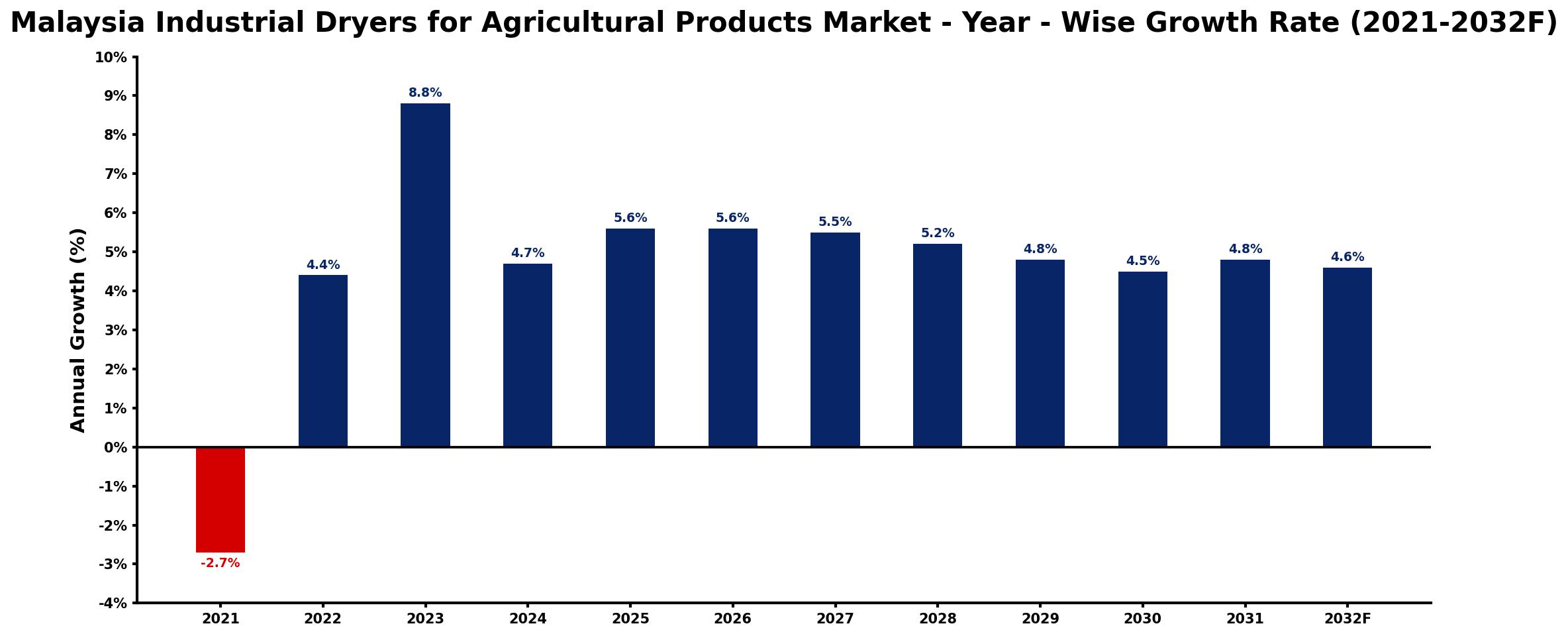
The table below presents the year‑wise growth rates along with the key drivers influencing the market
| Year | Growth Rate | Major Drivers |
| 2021 | -2.7% | weak end-use demand conditions |
| 2022 | 4.4% | rising demand for food preservation |
| 2023 | 8.8% | expansion of food processing facilities |
| 2024 | 4.7% | increased focus on sustainability practices |
| 2025 | 5.6% | growing interest in energy efficiency |
| 2026 | 5.6% | development of new market applications |
| 2027 | 5.5% | strengthening supply chain partnerships |
| 2028 | 5.2% | emergence of innovative drying techniques |
| 2029 | 4.8% | heightened awareness of food safety |
| 2030 | 4.5% | increased funding for research initiatives |
| 2031 | 4.8% | growing popularity of organic farming |
| 2032 | 4.6% | rising exports of processed goods |
Note: Market size estimations and growth projections presented in this report are based on 6Wresearch's proprietary forecasting methodology, utilizing the latest available industry data, government publications, and primary research inputs.
Malaysia Industrial Dryers for Agricultural Products Market Synopsis
The burgeoning agriculture sector is the strongest force shaping the Malaysia Industrial Dryers for Agricultural Products Market. This expansion drives the demand for reliable and efficient drying technologies that ensure the longevity and quality of agricultural outputs. Manufacturers are rising to the challenge, innovating to develop solutions that align with the evolving needs of the industry.
As food processing and preservation become more critical in safeguarding food supplies, the role of industrial dryers will only amplify. The export-oriented nature of the agricultural sector necessitates high-quality equipment that meets international standards, thus fuelling the market's growth potential.
Malaysia Industrial Dryers for Agricultural Products Market Key Takeaways
- The market is poised for steady growth, driven by increasing agricultural productivity and export demands.
- Energy efficiency and product quality are primary focuses for manufacturers developing new dryer technologies.
- Coping with seasonal crop variations remains a pivotal concern impacting market strategies.
- The post-COVID-19 landscape reveals renewed emphasis on food preservation, influencing purchasing patterns.
- Regulatory frameworks and governmental initiatives play a crucial role in shaping market dynamics.
Evaluation of Restraints in Malaysia Industrial Dryers for Agricultural Products Market
The market faces notable restraints, particularly around energy consumption and the imperative for high product quality. While advancements in technology may offer solutions, achieving energy-efficient drying processes that do not compromise safety or quality is a significant hurdle. Additionally, the seasonality of agricultural output presents logistical challenges, as these industries must bridge the gap between harvest and market demand with effective storage and drying solutions.
Malaysia Industrial Dryers for Agricultural Products Market Trends
A shift towards automation and digital technologies is transforming the drying process landscape. Modern industrial dryers are increasingly equipped with smart sensors and control systems, allowing for precise monitoring and optimization of drying conditions. Furthermore, sustainability is becoming a major focus, as manufacturers strive to create eco-friendly solutions that minimize waste and reduce energy consumption.
Malaysia Industrial Dryers for Agricultural Products Market Opportunities
There is significant room for growth within niche segments, such as specialty crop drying, that cater to emerging agricultural trends. Additionally, opportunities abound in the development of hybrid drying technologies that combine traditional methods with modern techniques. The ongoing push for organic and sustainably sourced products further fuels demand for innovative drying solutions that align with these consumer preferences.
Government Initiatives in the Malaysia Industrial Dryers for Agricultural Products Market
The Malaysian government is keen on enhancing the agricultural sector through various initiatives aimed at improving productivity and food security. Programs that provide funding, technical support, and incentives for adopting advanced agricultural technologies are in place. These initiatives not only encourage innovation but also support farmers in acquiring modern equipment, including industrial dryers, to meet quality standards and boost export potential.
Future Insights of the Malaysia Industrial Dryers for Agricultural Products Market
Looking ahead to 2026-2032, the Malaysia Industrial Dryers for Agricultural Products Market is set to evolve significantly. The ongoing modernization of agricultural practices combined with heightened consumer awareness regarding food quality will spur demand for advanced drying solutions. Additionally, as Malaysias agricultural sector continues to align with global market trends, adherence to international standards will dictate the competitive landscape and drive further innovation in dryer technology.
Malaysia Industrial Dryers for Agricultural Products Market Latest Developments (2025 - 2026)
Recent developments in the market include a notable increase in partnerships between technology providers and agricultural producers to create tailored drying solutions that meet specific needs. Furthermore, manufacturers are focusing on integrating IoT features into their dryers, allowing for better real-time monitoring and management of drying processes. These advancements highlight a trend towards smarter, more efficient production methods that cater to a rapidly changing market landscape.
Malaysia Industrial Dryers for Agricultural Products Market - Key Attractiveness of the Report
- 10 Years of Market Numbers
- Historical Data Starting from 2022 to 2025
- Base Year: 2025
- Forecast Data until 2032
- Key Performance Indicators Impacting the Market
- Major Upcoming Developments and Projects
Key Highlights of the Report:
- Malaysia Industrial Dryers for Agricultural Products Market Outlook
- Market Size of Malaysia Industrial Dryers for Agricultural Products Market, 2025
- Forecast of Malaysia Industrial Dryers for Agricultural Products Market, 2032
- Historical Data and Forecast of Malaysia Industrial Dryers for Agricultural Products Revenues & Volume for the Period 2022-2032F
- Malaysia Industrial Dryers for Agricultural Products Market Trend Evolution
- Malaysia Industrial Dryers for Agricultural Products Market Drivers and Challenges
- Malaysia Industrial Dryers for Agricultural Products Price Trends
- Malaysia Industrial Dryers for Agricultural Products Porter's Five Forces
- Malaysia Industrial Dryers for Agricultural Products Industry Life Cycle
- Historical Data and Forecast of Malaysia Industrial Dryers for Agricultural Products Market Revenues & Volume By Type for the Period 2022-2032F
- Historical Data and Forecast of Malaysia Industrial Dryers for Agricultural Products Market Revenues & Volume By Hot Air Drying Equipment for the Period 2022-2032F
- Historical Data and Forecast of Malaysia Industrial Dryers for Agricultural Products Market Revenues & Volume By Heated Surface Drying Equipment for the Period 2022-2032F
- Historical Data and Forecast of Malaysia Industrial Dryers for Agricultural Products Market Revenues & Volume By Application for the Period 2022-2032F
- Historical Data and Forecast of Malaysia Industrial Dryers for Agricultural Products Market Revenues & Volume By Conveyer Drying Equipment for the Period 2022-2032F
- Historical Data and Forecast of Malaysia Industrial Dryers for Agricultural Products Market Revenues & Volume By Cabinet Drying Equipment for the Period 2022-2032F
- Malaysia Industrial Dryers for Agricultural Products Import Export Trade Statistics
- Market Opportunity Assessment By Type
- Market Opportunity Assessment By Application
- Malaysia Industrial Dryers for Agricultural Products Top Companies Market Share
- Malaysia Industrial Dryers for Agricultural Products Competitive Benchmarking By Technical and Operational Parameters
- Malaysia Industrial Dryers for Agricultural Products Company Profiles
- Malaysia Industrial Dryers for Agricultural Products Key Strategic Recommendations






































