Malaysia Industrial Flooring Market Size, Share & Growth Rate
The Malaysia Industrial Flooring Market was estimated at USD 285 Million in 2025 and is projected to reach USD 369 Million by 2032, growing at a CAGR of 3.8% from 2026 to 2032. This growth trajectory is supported by the rapid industrialization of Malaysia, particularly in manufacturing and logistics, where the demand for durable and low-maintenance flooring solutions is paramount. The surge in e-commerce has further catalyzed the need for enhanced warehouse and distribution facilities, thereby augmenting the industrial flooring sector.
Malaysia Industrial Flooring Market Year-wise Growth Rate and Key Drivers
This graph highlights how the Malaysia Industrial Flooring Market has steadily grown over the years, supported by major growth factors.
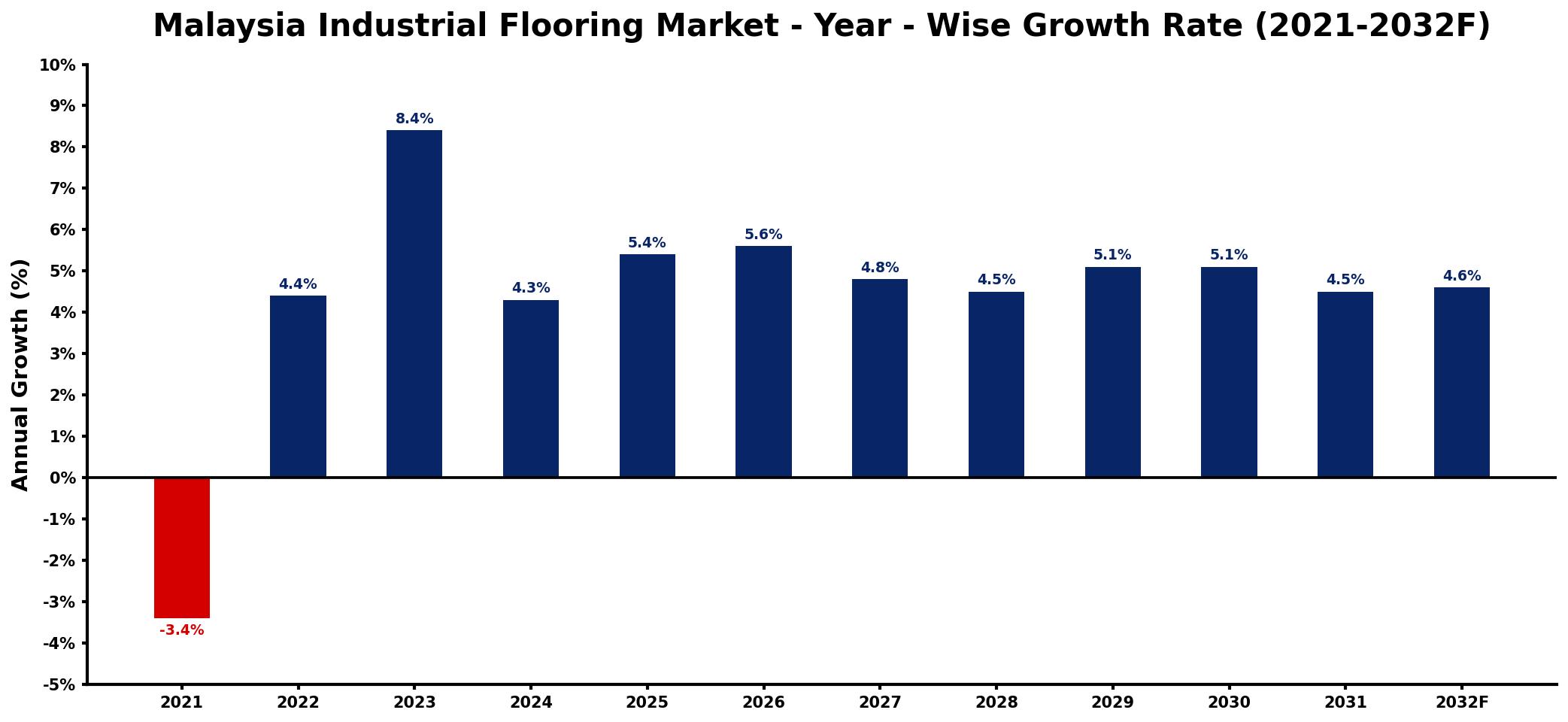
The table below presents the year‑wise growth rates along with the key drivers influencing the market
| Year | Growth Rate | Major Drivers |
| 2021 | -3.4% | decreased construction activity levels |
| 2022 | 4.4% | revival of manufacturing sector demand |
| 2023 | 8.4% | increased investment in infrastructure |
| 2024 | 4.3% | growing logistics and warehousing needs |
| 2025 | 5.4% | expansion of retail sector projects |
| 2026 | 5.6% | rising popularity of sustainable materials |
| 2027 | 4.8% | enhanced focus on safety standards |
| 2028 | 4.5% | growing adoption of automation technologies |
| 2029 | 5.1% | increased urbanization and development |
| 2030 | 5.1% | improved raw material availability |
| 2031 | 4.5% | increased foreign direct investments |
| 2032 | 4.6% | growing focus on energy efficiency |
Note: Market size estimations and growth projections presented in this report are based on 6Wresearch's proprietary forecasting methodology, utilizing the latest available industry data, government publications, and primary research inputs.
Malaysia Industrial Flooring Market Synopsis
The strongest force currently shaping the Malaysia Industrial Flooring Market is the robust growth of the manufacturing and logistics sectors. As these industries expand, the requirement for flooring that can endure heavy loads and frequent wear has become increasingly critical, pushing businesses to invest in high-quality industrial flooring solutions.
Furthermore, there is an ongoing emphasis on safety and hygiene within industrial environments. Companies are proactively seeking flooring materials that not only meet aesthetic and durability standards but also comply with health regulations, influencing purchasing decisions in the market.
Malaysia Industrial Flooring Market Key Takeaways
- The market is anticipated to experience steady growth, driven by the expansion of industrial sectors.
- Increasing investments in infrastructure and manufacturing facilities are pivotal in propelling demand.
- Sustainability is becoming a central theme, pushing innovation towards eco-friendly flooring solutions.
- Post-pandemic recovery has reignited interest in durable and easy-to-maintain flooring options.
- Complying with safety and hygiene standards remains a priority for businesses across sectors.
Evaluation of Restraints in Malaysia Industrial Flooring Market
Despite the positive growth outlook, the Malaysia Industrial Flooring Market grapples with certain restraints that could hinder its full potential. The demand for flooring that can withstand harsh industrial conditions presents a challenge for manufacturers who are also focusing on sustainability. Developing materials that meet both durability requirements and environmental regulations complicates the market landscape. Additionally, the competitive nature of the industry may lead to price pressures, affecting investment in innovative flooring solutions.
Malaysia Industrial Flooring Market Trends
A noticeable trend in the Malaysia Industrial Flooring Market is the increasing shift toward sustainable and environmentally friendly materials. As awareness of environmental issues grows, companies are prioritizing eco-conscious choices. Furthermore, advancements in flooring technologies are leading to the introduction of high-performance materials that offer better durability and lower maintenance costs. Digital solutions for flooring installation and maintenance are also emerging, streamlining processes and improving efficiency.
Malaysia Industrial Flooring Market Opportunities
Significant growth and investment opportunities are evident in the Malaysia Industrial Flooring Market, especially in the realm of green building initiatives. With an increasing number of businesses committing to sustainability, the demand for eco-friendly flooring solutions is set to rise. Additionally, the ongoing industrialization in Malaysia presents a ripe environment for new entrants to capture market share, particularly by introducing innovative flooring technologies that meet modern industrial needs.
Government Initiatives in the Malaysia Industrial Flooring Market
The Malaysian government is actively investing in infrastructure projects that facilitate industrial growth. Initiatives aimed at enhancing manufacturing capabilities and logistics infrastructure indirectly boost the demand for industrial flooring solutions. Furthermore, policies promoting sustainable practices encourage the adoption of environmentally friendly flooring materials, fostering a market environment conducive to innovation and growth.
Future Insights of the Malaysia Industrial Flooring Market
Looking ahead to 2026-2032, the Malaysia Industrial Flooring Market is poised for notable advancements. The ongoing industrial expansion, supported by government initiatives, coupled with rising consumer demands for sustainability, will drive market dynamics. Additionally, as businesses strive to enhance operational efficiency, the integration of smart technologies and innovative flooring solutions is likely to reshape the landscape. Companies that adapt to these evolving trends will find themselves well-positioned for success in the coming years.
Malaysia Industrial Flooring Market Latest Developments (2025 - 2026)
In recent months, the Malaysia Industrial Flooring Market has seen a surge in innovations focused on enhancing flooring durability and performance. There has been a marked increase in collaborative efforts among manufacturers aimed at developing sustainable flooring solutions. Additionally, the industry is witnessing a rise in product offerings that cater to specific industrial applications, reflecting a growing trend towards specialization in flooring technologies.
Malaysia Industrial Flooring Market - Key Attractiveness of the Report
- 10 Years of Market Numbers
- Historical Data Starting from 2022 to 2025
- Base Year: 2025
- Forecast Data until 2032
- Key Performance Indicators Impacting the Market
- Major Upcoming Developments and Projects
Key Highlights of the Report:
- Malaysia Industrial Flooring Market Outlook
- Market Size of Malaysia Industrial Flooring Market, 2025
- Forecast of Malaysia Industrial Flooring Market, 2032
- Historical Data and Forecast of Malaysia Industrial Flooring Revenues & Volume for the Period 2022-2032F
- Malaysia Industrial Flooring Market Trend Evolution
- Malaysia Industrial Flooring Market Drivers and Challenges
- Malaysia Industrial Flooring Price Trends
- Malaysia Industrial Flooring Porter's Five Forces
- Malaysia Industrial Flooring Industry Life Cycle
- Historical Data and Forecast of Malaysia Industrial Flooring Market Revenues & Volume By End User Industry for the Period 2022-2032F
- Historical Data and Forecast of Malaysia Industrial Flooring Market Revenues & Volume By Chemical for the Period 2022-2032F
- Historical Data and Forecast of Malaysia Industrial Flooring Market Revenues & Volume By Food and Beverages for the Period 2022-2032F
- Historical Data and Forecast of Malaysia Industrial Flooring Market Revenues & Volume By Healthcare for the Period 2022-2032F
- Historical Data and Forecast of Malaysia Industrial Flooring Market Revenues & Volume By Transportation and Aviation for the Period 2022-2032F
- Historical Data and Forecast of Malaysia Industrial Flooring Market Revenues & Volume By Others for the Period 2022-2032F
- Historical Data and Forecast of Malaysia Industrial Flooring Market Revenues & Volume By Thickness for the Period 2022-2032F
- Historical Data and Forecast of Malaysia Industrial Flooring Market Revenues & Volume By Light duty for the Period 2022-2032F
- Historical Data and Forecast of Malaysia Industrial Flooring Market Revenues & Volume By Medium Duty for the Period 2022-2032F
- Historical Data and Forecast of Malaysia Industrial Flooring Market Revenues & Volume By Heavy Duty for the Period 2022-2032F
- Historical Data and Forecast of Malaysia Industrial Flooring Market Revenues & Volume By Material Type for the Period 2022-2032F
- Historical Data and Forecast of Malaysia Industrial Flooring Market Revenues & Volume By Epoxy for the Period 2022-2032F
- Historical Data and Forecast of Malaysia Industrial Flooring Market Revenues & Volume By Polyaspartic for the Period 2022-2032F
- Historical Data and Forecast of Malaysia Industrial Flooring Market Revenues & Volume By Polyurethane for the Period 2022-2032F
- Historical Data and Forecast of Malaysia Industrial Flooring Market Revenues & Volume By Anhydrite for the Period 2022-2032F
- Historical Data and Forecast of Malaysia Industrial Flooring Market Revenues & Volume By Others for the Period 2022-2032F
- Malaysia Industrial Flooring Import Export Trade Statistics
- Market Opportunity Assessment By End User Industry
- Market Opportunity Assessment By Thickness
- Market Opportunity Assessment By Material Type
- Malaysia Industrial Flooring Top Companies Market Share
- Malaysia Industrial Flooring Competitive Benchmarking By Technical and Operational Parameters
- Malaysia Industrial Flooring Company Profiles
- Malaysia Industrial Flooring Key Strategic Recommendations






































