Malaysia Industrial Furnace Market Size, Share & Growth Rate
The Malaysia Industrial Furnace Market was estimated at USD 426 Million in 2025 and is projected to reach USD 555 Million by 2032, growing at a CAGR of 3.9% from 2026 to 2032. This growth trajectory is significantly driven by robust demand from the automotive & aerospace manufacturing sectors, alongside the burgeoning semiconductor production industry. As companies increasingly prioritize advanced manufacturing technologies, investments in state-of-the-art industrial furnaces are expected to surge, further solidifying market growth.
Malaysia Industrial Furnace Market Year-wise Growth Rate and Key Drivers
This graph highlights how the Malaysia Industrial Furnace Market has steadily grown over the years, supported by major growth factors.
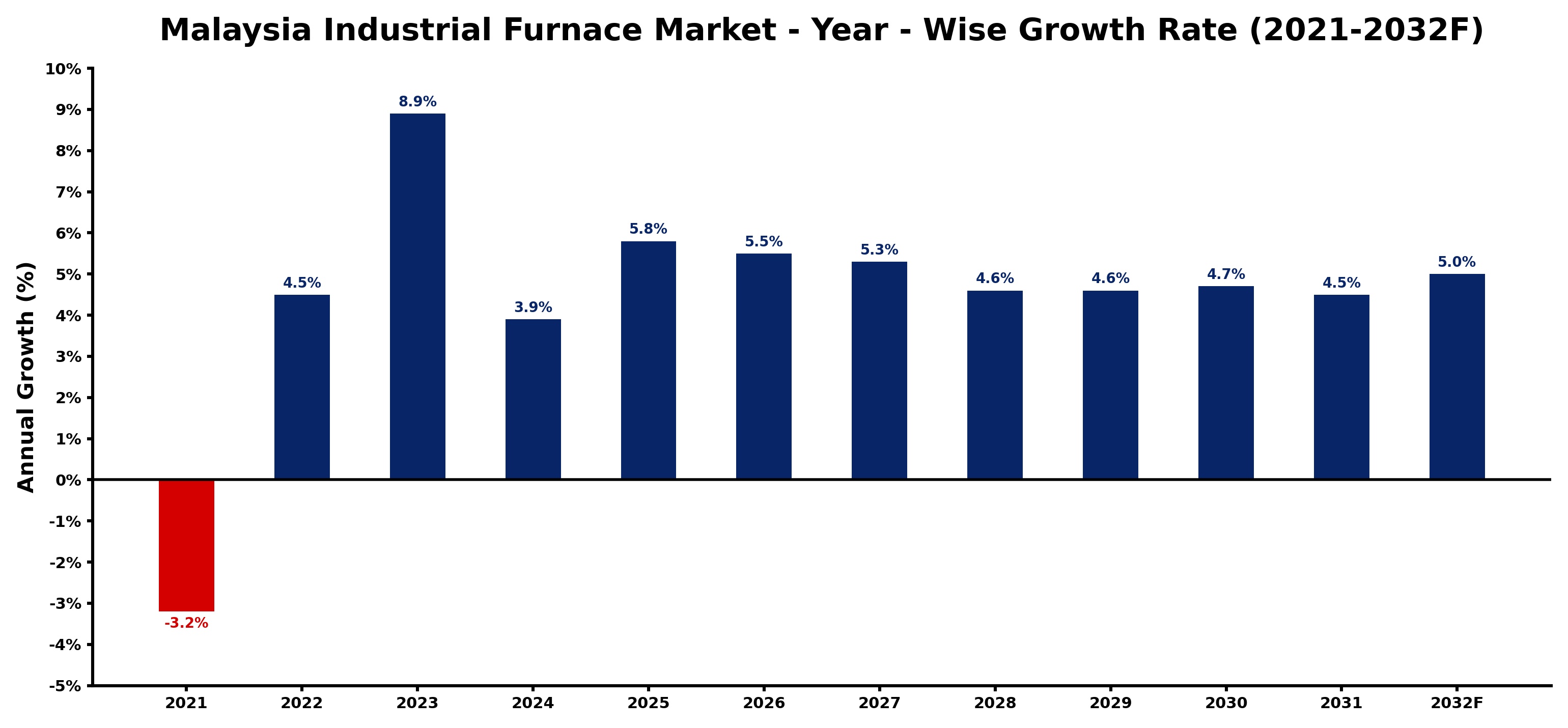
The table below presents the year‑wise growth rates along with the key drivers influencing the market
| Year | Growth Rate | Major Drivers |
| 2021 | -3.2% | Supply chain disruptions hinder industrial furnace component availability and delivery |
| 2022 | 4.5% | Precision engineering advancements boost furnace demand in export markets |
| 2023 | 8.9% | Precision engineering investments boost local industrial furnace production capacity |
| 2024 | 3.9% | OEM production capacity growth bolstered industrial furnace demand across sectors |
| 2025 | 5.8% | Manufacturing investments in automation boost furnace production capacities |
| 2026 | 5.5% | Regional automotive sector expansion drives industrial furnace capacity enhancements |
| 2027 | 5.3% | Technology integration in manufacturing enhanced furnace efficiency and output |
| 2028 | 4.6% | Export growth in automotive components drives furnace production demands |
| 2029 | 4.6% | Advanced materials adoption boosts furnace efficiency in automotive production |
| 2030 | 4.7% | Precision engineering investments drive furnace utilization across automotive supply chains |
| 2031 | 4.5% | Precision engineering upgrades boost furnace efficiency for export manufacturing |
| 2032 | 5.0% | New manufacturing facilities boost high temperature furnace production capacity |
Note - Market size estimations and growth projections presented in this report are based on 6Wresearch’s advanced forecasting approach, validated with industry datasets as of June 2026.
Malaysia Industrial Furnace Market Synopsis
The increasing complexity of manufacturing processes in Malaysia is fueling the demand for high-efficiency industrial furnaces that enable precision heat treatment. As manufacturers focus on enhancing product quality and optimizing production efficiency, the adoption of modern furnace systems has become paramount.
Additionally, the government's favorable policies promoting foreign direct investment (FDI) are catalyzing market expansion by attracting global players into the local furnace manufacturing sector. This influx of investment not only augments the technological capabilities available in the market but also strengthens the competitive landscape.
Malaysia Industrial Furnace Market Key Takeaways
- The market is experiencing significant demand growth from the automotive, aerospace, and semiconductor sectors.
- Investments in energy-efficient furnace technologies are becoming a priority for manufacturers.
- The government is implementing policies to foster foreign direct investment, enhancing market opportunities.
- Technological advancements are key to addressing energy efficiency and sustainability challenges.
- As manufacturing resumes post-pandemic, modernization efforts are expected to accelerate market recovery.
Evaluation of Restraints in Malaysia Industrial Furnace Market
While the Malaysia Industrial Furnace Market shows promising growth potential, it faces several significant restraints. A primary concern is the stringent energy efficiency and environmental regulations that necessitate advanced furnace designs capable of minimizing emissions and energy consumption. Manufacturers must invest in innovative technologies to comply with these standards, often increasing operational costs. Additionally, the market requires skilled labor adept at operating and maintaining sophisticated furnace systems, which can be a limitation in scaling operations rapidly.
Malaysia Industrial Furnace Market Trends
The industry is witnessing a shift towards automated and digitally integrated industrial furnaces, which enhance process control and efficiency. With the rise of Industry 4.0, more manufacturers are exploring smart furnace technologies that utilize IoT and AI for real-time monitoring and predictive maintenance. This trend not only boosts operational efficiency but also aligns with the growing emphasis on sustainable manufacturing practices.
Malaysia Industrial Furnace Market Opportunities
There are substantial growth opportunities within the Malaysia Industrial Furnace Market, particularly in sectors that demand high-quality material processing. As the government continues to promote advanced manufacturing capabilities, industries such as aerospace and electronics are poised for expansion, necessitating investments in sophisticated furnace technologies. Furthermore, the increasing focus on energy efficiency presents a significant opportunity for innovation, encouraging companies to develop eco-friendly heating solutions that comply with emerging regulations.
Government Initiatives in the Malaysia Industrial Furnace Market
The Malaysian government is actively pursuing initiatives to promote manufacturing growth, particularly through policies that enhance foreign direct investment (FDI) inflows. Programs aimed at fostering technology transfer and providing fiscal incentives to manufacturers support the development of the industrial furnace sector. Additionally, the government's commitment to sustainability is driving investments in green technologies, which align with global trends towards energy-efficient manufacturing.
Future Insights of the Malaysia Industrial Furnace Market
Looking ahead to 2026-2032, the Malaysia Industrial Furnace Market is anticipated to thrive as manufacturers adapt to increasing demands for advanced manufacturing capabilities. The integration of smart technologies and sustainable practices will become standard, making industrial furnaces not only more efficient but also environmentally compliant. As the local economy rebounds and manufacturing activities accelerate, the market is set to capture emerging opportunities, particularly in high-tech sectors.
Malaysia Industrial Furnace Market Latest Developments (May 2025 - June 2026)
Recent developments in the Malaysia Industrial Furnace Market indicate a growing trend towards the adoption of energy-efficient systems. Manufacturers are increasingly investing in research and development to incorporate advanced heating technologies and automation into their furnace designs. Additionally, collaborations between industry leaders and technology providers are on the rise, aimed at enhancing furnace capabilities and addressing energy efficiency challenges.
Malaysia Industrial Furnace Market - Key Attractiveness of the Report
- 10 Years of Market Numbers
- Historical Data Starting from 2022 to 2025
- Base Year: 2025
- Forecast Data until 2032
- Key Performance Indicators Impacting the Market
- Major Upcoming Developments and Projects
Key Highlights of the Report:
- Malaysia Industrial Furnace Market Outlook
- Market Size of Malaysia Industrial Furnace Market, 2025
- Forecast of Malaysia Industrial Furnace Market, 2032
- Historical Data and Forecast of Malaysia Industrial Furnace Revenues & Volume for the Period 2022-2032F
- Malaysia Industrial Furnace Market Trend Evolution
- Malaysia Industrial Furnace Market Drivers and Challenges
- Malaysia Industrial Furnace Price Trends
- Malaysia Industrial Furnace Porter's Five Forces
- Malaysia Industrial Furnace Industry Life Cycle
- Historical Data and Forecast of Malaysia Industrial Furnace Market Revenues & Volume By Furnace Type for the Period 2022-2032F
- Historical Data and Forecast of Malaysia Industrial Furnace Market Revenues & Volume By Gas/fuel Operated Industrial Furnace for the Period 2022-2032F
- Historical Data and Forecast of Malaysia Industrial Furnace Market Revenues & Volume By Electrically Operated Industrial Furnace for the Period 2022-2032F
- Historical Data and Forecast of Malaysia Industrial Furnace Market Revenues & Volume By Arrangement for the Period 2022-2032F
- Historical Data and Forecast of Malaysia Industrial Furnace Market Revenues & Volume By Tube or Clamshell Type for the Period 2022-2032F
- Historical Data and Forecast of Malaysia Industrial Furnace Market Revenues & Volume By Box Type for the Period 2022-2032F
- Historical Data and Forecast of Malaysia Industrial Furnace Market Revenues & Volume By Bottom Loading & Car Bottom Furnace for the Period 2022-2032F
- Historical Data and Forecast of Malaysia Industrial Furnace Market Revenues & Volume By Top Loading Furnace for the Period 2022-2032F
- Historical Data and Forecast of Malaysia Industrial Furnace Market Revenues & Volume By Others for the Period 2022-2032F
- Historical Data and Forecast of Malaysia Industrial Furnace Market Revenues & Volume By End-User for the Period 2022-2032F
- Historical Data and Forecast of Malaysia Industrial Furnace Market Revenues & Volume By Metals & Mining for the Period 2022-2032F
- Historical Data and Forecast of Malaysia Industrial Furnace Market Revenues & Volume By Transportation for the Period 2022-2032F
- Historical Data and Forecast of Malaysia Industrial Furnace Market Revenues & Volume By Oil & Gas for the Period 2022-2032F
- Historical Data and Forecast of Malaysia Industrial Furnace Market Revenues & Volume By Chemicals for the Period 2022-2032F
- Historical Data and Forecast of Malaysia Industrial Furnace Market Revenues & Volume By Others for the Period 2022-2032F
- Malaysia Industrial Furnace Import Export Trade Statistics
- Market Opportunity Assessment By Furnace Type
- Market Opportunity Assessment By Arrangement
- Market Opportunity Assessment By End-User
- Malaysia Industrial Furnace Top Companies Market Share
- Malaysia Industrial Furnace Competitive Benchmarking By Technical and Operational Parameters
- Malaysia Industrial Furnace Company Profiles
- Malaysia Industrial Furnace Key Strategic Recommendations






































