Malaysia Industrial Gases Market Summary
The malaysia industrial gases market was estimated at USD 287 Million in 2025 and is projected to reach USD 371 Million by 2032, growing at a CAGR of 5.3% from 2026 to 2032.
Malaysia Industrial Gases Market Year-wise Growth Rate and Key Drivers
This graph highlights how the Malaysia Industrial Gases Market has steadily grown over the past five years, supported by major growth factors.
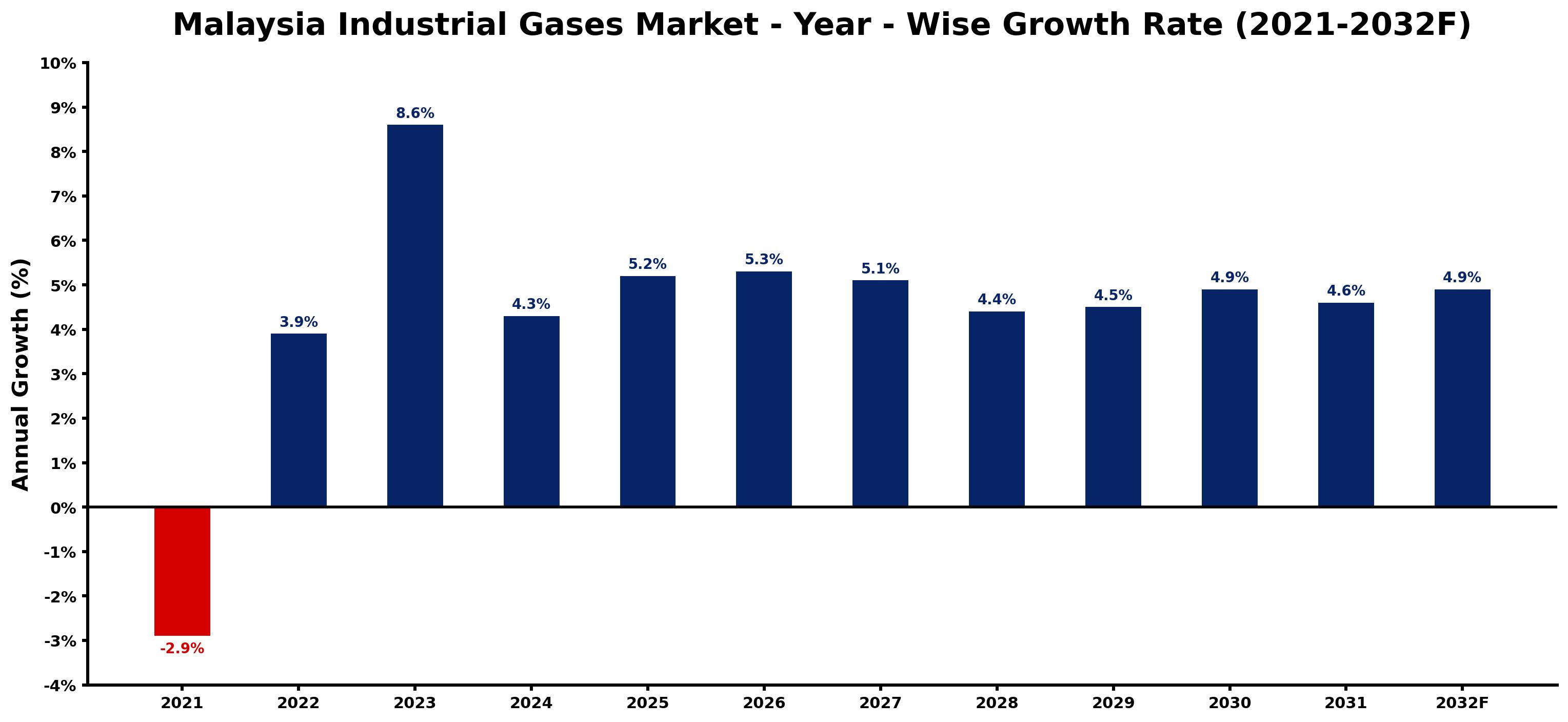
The table below presents the year wise growth rates along with the key drivers influencing the market
| Year | Growth Rate | Major Drivers |
| 2021 | -2.9% | Disruptions in supply chains led to production delays, undermining demand for industrial gases in various sectors. |
| 2022 | 3.9% | Rising energy costs compel factories to seek efficient gas solutions. |
| 2023 | 8.6% | Increased investment in manufacturing innovation drives gas consumption patterns. |
| 2024 | 4.3% | Local production facilities enhance supply chain resilience amidst global disruptions. |
| 2025 | 5.2% | Emerging technologies in welding and metal fabrication lift gas demand significantly. |
| 2026 | 5.3% | Strong growth in pharmaceuticals creates new industrial gas requirements. |
| 2027 | 5.1% | Focus on sustainability pushes industries towards cleaner gas alternatives. |
| 2028 | 4.4% | Economic diversification initiatives open new applications for industrial gases. |
| 2029 | 4.5% | Expansion of logistics infrastructure increases demand for gas-powered transportation. |
| 2030 | 4.9% | Greater emphasis on health and safety regulations boosts gas purification technologies. |
| 2031 | 4.6% | Digital transformation initiatives lead to automated gas distribution systems. |
| 2032 | 4.9% | Collaborations between industries foster innovation, expanding gas application horizons. |
Note - Market size estimations and growth projections presented in this report are based on 6Wresearch's advanced forecasting approach, validated with industry datasets as of June 2026.
Malaysia Industrial Gases Market Synopsis
The Malaysia Industrial Gases Market is projected to reach 5.3% and witness significant growth during the forecast period (2026-2032). The market is anticipated to register a compound annual growth rate (CAGR) of 4.7% as various end-user industries ramp up their consumption of industrial gases. Notably, sectors such as automotive, electronics, and food and beverages are at the forefront of this growth, driven by rapid expansions within their respective industries. This demand surge is complemented by governmental measures designed to promote foreign investment and support local businesses.
Malaysia Industrial Gases Market Growth Drivers
Several key factors are driving the growth of the Malaysia Industrial Gases Market:
- The automotive sector's continuous expansion necessitates various industrial gases for manufacturing processes, which in turn fuels market demand.
- Increased activity in the electronics industry, particularly in the production of semiconductors and related components, has led to a rise in specialty gas usage.
- The food and beverage industry is increasingly adopting nitrogen gas packaging solutions to extend product shelf life and ensure food safety.
- Government incentives aimed at attracting foreign investments are fostering a climate conducive to business growth, indirectly amplifying the demand for industrial gases.
- The rising population and disposable income levels in Malaysia are contributing to the demand for processed foods, thereby increasing the need for gas packaging solutions.
Malaysia Industrial Gases Market Challenges and Restraints
While the Malaysia Industrial Gases Market is positioned for growth, several challenges must be considered:
- Fluctuating raw material prices can significantly impact production costs for industrial gases and affect market stability.
- Stringent environmental regulations may pose operational challenges, as companies need to balance production efficiency with compliance.
- The global trend towards renewable energy sources could shift focus away from traditional industrial gases, influencing future demand.
- Competition from alternative packaging methods, particularly in the food sector, could temper growth in nitrogen gas applications.
- Supply chain disruptions, exacerbated by geopolitical tensions, can hinder the timely availability of gases for end-user industries.
Malaysia Industrial Gases Market Government Investment and Initiatives
The Malaysian government has implemented various initiatives aimed at driving growth within the industrial gases sector:
- The Malaysia Investment Development Authority (MIDA) has introduced financial incentives that encourage companies to invest in expanding their business operations within the country.
- Public spending on infrastructure projects is intended to support industrial growth, which positively correlates with increased consumption of industrial gases.
- Government policies focus on enhancing the local manufacturing sector, which is expected to stimulate demand for essential gases in manufacturing processes.
- Initiatives promoting technology transfer and innovation in the industrial sector are likely to lead to more efficient and sustainable practices in gas usage.
- Support for research and development in the industrial gases domain is expected to yield advanced gas solutions, catering to diverse market needs.
Malaysia Industrial Gases Market Latest Developments (May 2025 - June 2026)
Recent trends in the Malaysia Industrial Gases Market have showcased a notable shift towards sustainability and efficiency:
- Industry stakeholders are increasingly investing in the development of eco-friendly gas solutions to address environmental concerns and adhere to regulatory requirements.
- Collaborations between academic institutions and industrial entities have intensified, focusing on innovation in gas technologies and applications.
- There is a growing emphasis on automation and smart technologies within the industrial sector, which is expected to impact the demand for specific types of gases.
- The market has observed advancements in gas storage and distribution methods, enhancing overall operational efficiency for industrial gas providers.
- Strategic partnerships aimed at expanding the product portfolio of industrial gases are being formed, reflecting changing consumer preferences and market dynamics.
Malaysia Industrial Gases Market - Key Attractiveness of the Report
- 10 Years of Market Numbers
- Historical Data Starting from 2022 to 2025
- Base Year: 2025
- Forecast Data until 2032
- Key Performance Indicators Impacting the Market
- Major Upcoming Developments and Projects
Key Highlights of the Report:
- Malaysia Industrial Gases Market Outlook
- Market Size of Malaysia Industrial Gases Market, 2025
- Forecast of Malaysia Industrial Gases Market, 2032F
- Historical Data and Forecast of Malaysia Industrial Gases Revenues & Volume for the Period 2022-2032F
- Malaysia Industrial Gases Market Trend Evolution
- Malaysia Industrial Gases Market Drivers and Challenges
- Malaysia Industrial Gases Price Trends
- Malaysia Industrial Gases Porter's Five Forces
- Malaysia Industrial Gases Industry Life Cycle
- Historical Data and Forecast of Malaysia Industrial Gases Market Revenues & Volume By Product Type for the Period 2022-2032F
- Historical Data and Forecast of Malaysia Industrial Gases Market Revenues & Volume By Oxygen for the Period 2022-2032F
- Historical Data and Forecast of Malaysia Industrial Gases Market Revenues & Volume By Nitrogen for the Period 2022-2032F
- Historical Data and Forecast of Malaysia Industrial Gases Market Revenues & Volume By Hydrogen for the Period 2022-2032F
- Historical Data and Forecast of Malaysia Industrial Gases Market Revenues & Volume By Carbon Dioxide for the Period 2022-2032F
- Historical Data and Forecast of Malaysia Industrial Gases Market Revenues & Volume By Acetylene for the Period 2022-2032F
- Historical Data and Forecast of Malaysia Industrial Gases Market Revenues & Volume By Argon for the Period 2022-2032F
- Historical Data and Forecast of Malaysia Industrial Gases Market Revenues & Volume By Others for the Period 2022-2032F
- Historical Data and Forecast of Malaysia Industrial Gases Market Revenues & Volume By Application for the Period 2022-2032F
- Historical Data and Forecast of Malaysia Industrial Gases Market Revenues & Volume By Healthcare for the Period 2022-2032F
- Historical Data and Forecast of Malaysia Industrial Gases Market Revenues & Volume By Manufacturing for the Period 2022-2032F
- Historical Data and Forecast of Malaysia Industrial Gases Market Revenues & Volume By Metallurgy & Glasses for the Period 2022-2032F
- Historical Data and Forecast of Malaysia Industrial Gases Market Revenues & Volume By Food & Beverage for the Period 2022-2032F
- Historical Data and Forecast of Malaysia Industrial Gases Market Revenues & Volume By Retail for the Period 2022-2032F
- Historical Data and Forecast of Malaysia Industrial Gases Market Revenues & Volume By Chemicals & Energy for the Period 2022-2032F
- Historical Data and Forecast of Malaysia Industrial Gases Market Revenues & Volume By Others for the Period 2022-2032F
- Historical Data and Forecast of Malaysia Industrial Gases Market Revenues & Volume By Distribution for the Period 2022-2032F
- Historical Data and Forecast of Malaysia Industrial Gases Market Revenues & Volume By On-site for the Period 2022-2032F
- Historical Data and Forecast of Malaysia Industrial Gases Market Revenues & Volume By Bulk (Liquid Gas Transport) for the Period 2022-2032F
- Historical Data and Forecast of Malaysia Industrial Gases Market Revenues & Volume By Cylinder (Merchant) for the Period 2022-2032F
- Malaysia Industrial Gases Import Export Trade Statistics
- Market Opportunity Assessment By Product Type
- Market Opportunity Assessment By Application
- Market Opportunity Assessment By Distribution
- Malaysia Industrial Gases Top Companies Market Share
- Malaysia Industrial Gases Competitive Benchmarking By Technical and Operational Parameters
- Malaysia Industrial Gases Company Profiles
- Malaysia Industrial Gases Key Strategic Recommendations






































