Malaysia Infrared Imaging Market Size, Share & Growth Rate
The Malaysia Infrared Imaging Market was estimated at USD 204 Million in 2025 and is projected to reach USD 266 Million by 2032, growing at a CAGR of 3.9% from 2026 to 2032. This growth is significantly supported by the increasing deployment of infrared imaging solutions in healthcare for non-invasive diagnostic techniques and in automotive industries for advanced night vision systems. Additionally, the burgeoning demand for security and surveillance applications is catalyzing market expansion, as businesses and consumers alike prioritize safety measures.
Malaysia Infrared Imaging Market Year-wise Growth Rate and Key Drivers
This graph highlights how the Malaysia Infrared Imaging Market has steadily grown over the years, supported by major growth factors.
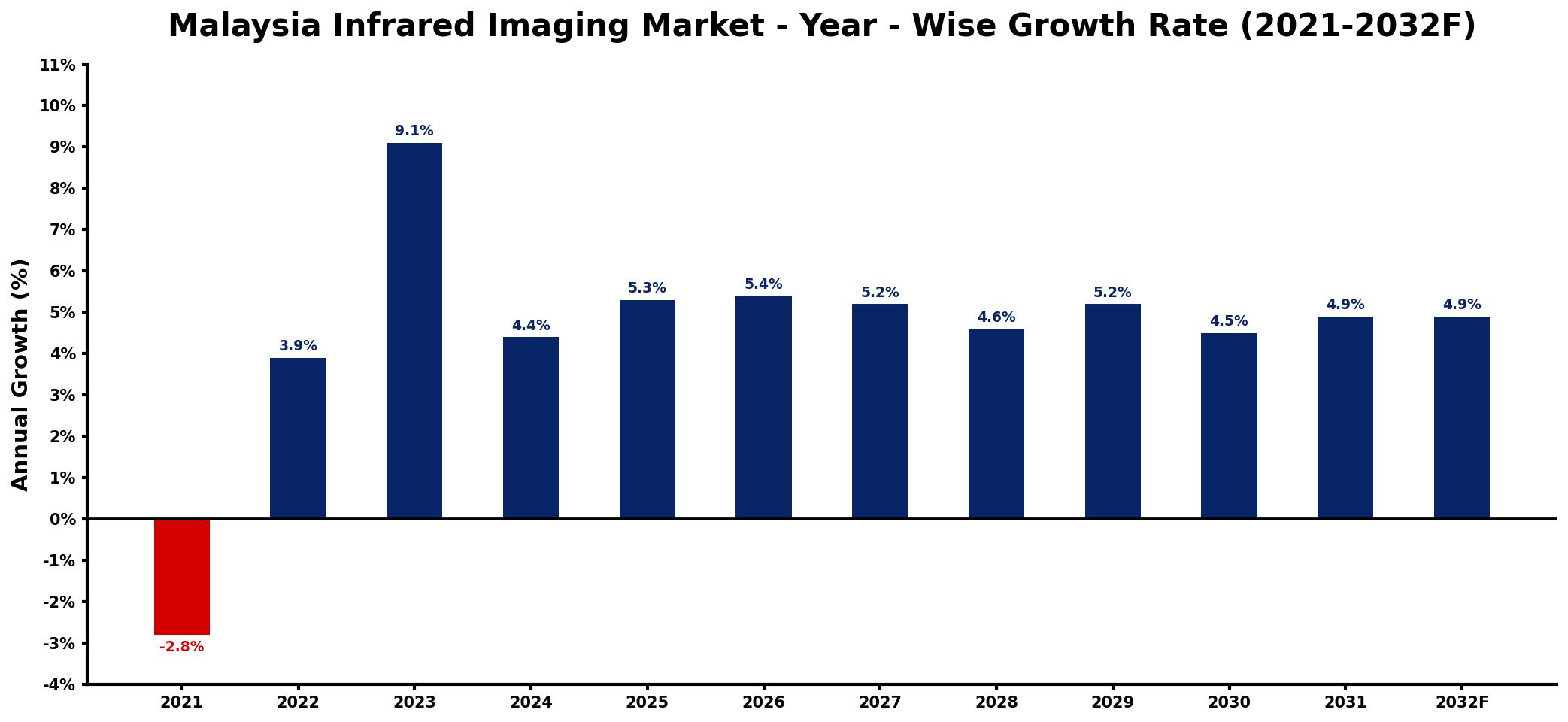
The table below presents the year‑wise growth rates along with the key drivers influencing the market
| Year | Growth Rate | Major Drivers |
| 2021 | -2.8% | decreased industrial equipment investments |
| 2022 | 3.9% | increased healthcare technology adoption |
| 2023 | 9.1% | growing demand for energy efficiency |
| 2024 | 4.4% | expansion in research applications |
| 2025 | 5.3% | rise in public safety initiatives |
| 2026 | 5.4% | enhanced construction monitoring requirements |
| 2027 | 5.2% | growth in environmental monitoring needs |
| 2028 | 4.6% | increased agricultural technology utilization |
| 2029 | 5.2% | evolution of smart city projects |
| 2030 | 4.5% | expanding telecommunications infrastructure projects |
| 2031 | 4.9% | growing interest in renewable energy |
| 2032 | 4.9% | advancements in industrial automation |
Note: Market size estimations and growth projections presented in this report are based on 6Wresearch's proprietary forecasting methodology, utilizing the latest available industry data, government publications, and primary research inputs.
Malaysia Infrared Imaging Market Synopsis
The rising adoption of infrared imaging technology for predictive maintenance in industrial applications is creating a robust demand landscape in Malaysia. Industries are leveraging thermal imaging for building inspections and equipment monitoring, contributing to operational efficiency and safety.
Furthermore, the healthcare sector's reliance on infrared imaging for early fever detection and diagnostic processes has significantly spurred market growth post-COVID-19. This technology is increasingly recognized for its non-invasive nature, making it an essential tool in various clinical settings.
Malaysia Infrared Imaging Market Key Takeaways
- The market is poised for growth driven by increasing applications across healthcare, security, and automotive sectors.
- Technological advancements are enhancing the functionality and accessibility of infrared imaging solutions.
- The COVID-19 pandemic has underscored the utility of infrared imaging for health monitoring.
- Local and international players are innovating to meet the diverse needs of industries.
- Increasing investments in industrial automation are driving demand for predictive maintenance tools.
Evaluation of Restraints in Malaysia Infrared Imaging Market
While the market for infrared imaging in Malaysia is growing, it faces certain restraints that could impact its expansion trajectory. The high initial costs associated with advanced thermal imaging systems can deter smaller enterprises from investing in these technologies. Additionally, competition from alternative imaging technologies may pose challenges in terms of market penetration and customer preference. These factors could slow adoption rates, particularly in sectors with tighter budgets or less awareness of infrared imaging benefits.
Malaysia Infrared Imaging Market Trends
Key trends in the Malaysian infrared imaging market include the increased integration of artificial intelligence and machine learning, enhancing the analysis capabilities of thermal imaging data. Furthermore, the growing trend towards automation in various industries is spurring demand for reliable predictive maintenance tools. Another emerging trend is the focus on miniaturization and portability of infrared cameras, making them more accessible for various applications, from home inspection to fieldwork in remote locations.
Malaysia Infrared Imaging Market Opportunities
Significant opportunities exist for growth in the Malaysia infrared imaging market, particularly in sectors such as agriculture, where thermal imaging can optimize irrigation and crop health assessments. Additionally, advancements in smart city initiatives are creating prospects for infrared imaging in urban planning and infrastructure management. The rise of telemedicine and remote healthcare services post-pandemic also presents a compelling avenue for infrared imaging technology to enhance patient monitoring and diagnostics.
Government Initiatives in the Malaysia Infrared Imaging Market
The Malaysian government has been actively promoting technological advancements across industries through various initiatives and policies. Investment in healthcare infrastructure, especially post-COVID-19, has increased funding and support for technologies that include infrared imaging for health monitoring and diagnostics. Additionally, the push towards smart manufacturing under the Industry 4.0 initiative encourages businesses to adopt advanced imaging solutions for better efficiency and productivity.
Future Insights of the Malaysia Infrared Imaging Market
Looking ahead to 2026-2032, the Malaysia Infrared Imaging Market is expected to continue its upward trajectory, driven by technological innovations and expanding applications. Increased awareness of the benefits of thermal imaging technology will likely lead to broader acceptance across industries. Moreover, as the emphasis on workplace safety and predictive maintenance grows, the market is poised for sustained demand, positioning infrared imaging as a critical tool for the future of multiple sectors.
Malaysia Infrared Imaging Market Latest Developments (2025 - 2026)
Recent industry developments indicate a strong shift toward advanced infrared imaging solutions tailored for specific applications such as thermal screening in public spaces and health facilities. Companies are increasingly focusing on developing multi-functional devices that integrate with other digital technologies, enhancing user experience and data analytics capabilities. Research and development efforts are also on the rise, aiming to further refine image resolution and extend operational ranges of infrared cameras.
Malaysia Infrared Imaging Market - Key Attractiveness of the Report
- 10 Years of Market Numbers
- Historical Data Starting from 2022 to 2025
- Base Year: 2025
- Forecast Data until 2032
- Key Performance Indicators Impacting the Market
- Major Upcoming Developments and Projects
Key Highlights of the Report:
- Malaysia Infrared Imaging Market Outlook
- Market Size of Malaysia Infrared Imaging Market, 2025
- Forecast of Malaysia Infrared Imaging Market, 2032
- Historical Data and Forecast of Malaysia Infrared Imaging Revenues & Volume for the Period 2022-2032F
- Malaysia Infrared Imaging Market Trend Evolution
- Malaysia Infrared Imaging Market Drivers and Challenges
- Malaysia Infrared Imaging Price Trends
- Malaysia Infrared Imaging Porter's Five Forces
- Malaysia Infrared Imaging Industry Life Cycle
- Historical Data and Forecast of Malaysia Infrared Imaging Market Revenues & Volume By Technology for the Period 2022-2032F
- Historical Data and Forecast of Malaysia Infrared Imaging Market Revenues & Volume By Cooled Infrared Imaging for the Period 2022-2032F
- Historical Data and Forecast of Malaysia Infrared Imaging Market Revenues & Volume By Uncooled Infrared Imaging for the Period 2022-2032F
- Historical Data and Forecast of Malaysia Infrared Imaging Market Revenues & Volume By Wavelength for the Period 2022-2032F
- Historical Data and Forecast of Malaysia Infrared Imaging Market Revenues & Volume By Near Infrared for the Period 2022-2032F
- Historical Data and Forecast of Malaysia Infrared Imaging Market Revenues & Volume By Shortwave Infrared for the Period 2022-2032F
- Historical Data and Forecast of Malaysia Infrared Imaging Market Revenues & Volume By Mid-wave Infrared for the Period 2022-2032F
- Historical Data and Forecast of Malaysia Infrared Imaging Market Revenues & Volume By Long-wave Infrared for the Period 2022-2032F
- Historical Data and Forecast of Malaysia Infrared Imaging Market Revenues & Volume By Application for the Period 2022-2032F
- Historical Data and Forecast of Malaysia Infrared Imaging Market Revenues & Volume By Security & Surveillance for the Period 2022-2032F
- Historical Data and Forecast of Malaysia Infrared Imaging Market Revenues & Volume By Monitoring & Inspection for the Period 2022-2032F
- Historical Data and Forecast of Malaysia Infrared Imaging Market Revenues & Volume By Detection for the Period 2022-2032F
- Historical Data and Forecast of Malaysia Infrared Imaging Market Revenues & Volume By Vertical for the Period 2022-2032F
- Historical Data and Forecast of Malaysia Infrared Imaging Market Revenues & Volume By Industrial for the Period 2022-2032F
- Historical Data and Forecast of Malaysia Infrared Imaging Market Revenues & Volume By Nonindustrial for the Period 2022-2032F
- Malaysia Infrared Imaging Import Export Trade Statistics
- Market Opportunity Assessment By Technology
- Market Opportunity Assessment By Wavelength
- Market Opportunity Assessment By Application
- Market Opportunity Assessment By Vertical
- Malaysia Infrared Imaging Top Companies Market Share
- Malaysia Infrared Imaging Competitive Benchmarking By Technical and Operational Parameters
- Malaysia Infrared Imaging Company Profiles
- Malaysia Infrared Imaging Key Strategic Recommendations






































