Malaysia Internet Protocol Television (IPTV) CDN Market Size & Growth Rate (2026-2032)
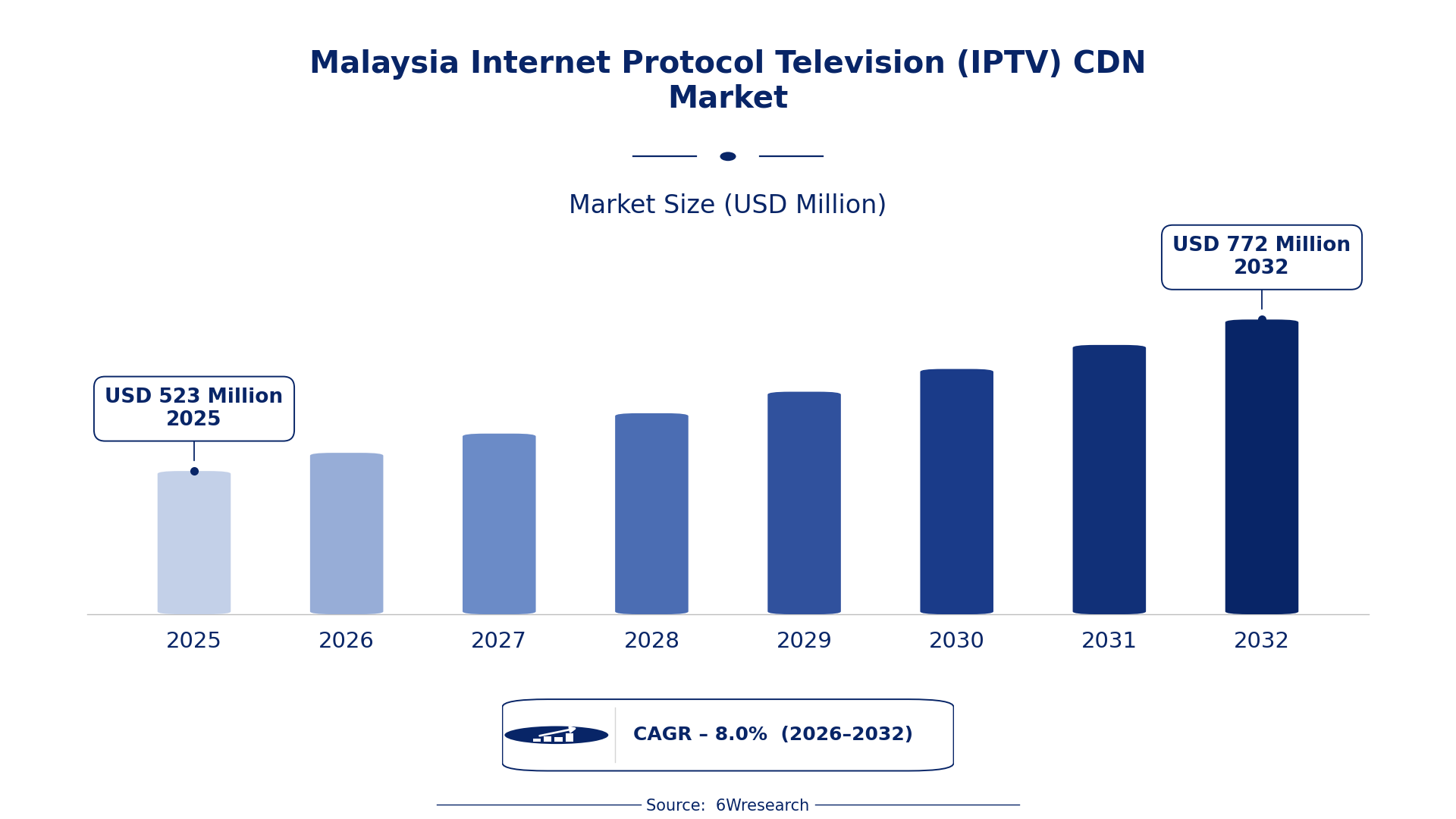
The Malaysia Internet Protocol Television (IPTV) CDN Market was estimated at USD 523 Million in 2025 and is projected to reach USD 772 Million by 2032, growing at a CAGR of 8.0% from 2026 to 2032.
Malaysia Internet Protocol Television (IPTV) CDN Market Synopsis
The primary force driving the Malaysia Internet Protocol Television (IPTV) CDN market is the accelerating consumer shift towards internet-based television services. This transition is reshaping the entertainment landscape as viewers increasingly demand high-quality content delivered instantaneously.
Alongside the growing appetite for on-demand and interactive viewing experiences, service providers are investing heavily in advanced CDN infrastructures. Such developments not only enhance the overall user experience but are also critical in managing the surging traffic associated with streaming services.
Malaysia Internet Protocol Television (IPTV) CDN Market Year-wise Growth Rate and Key Drivers
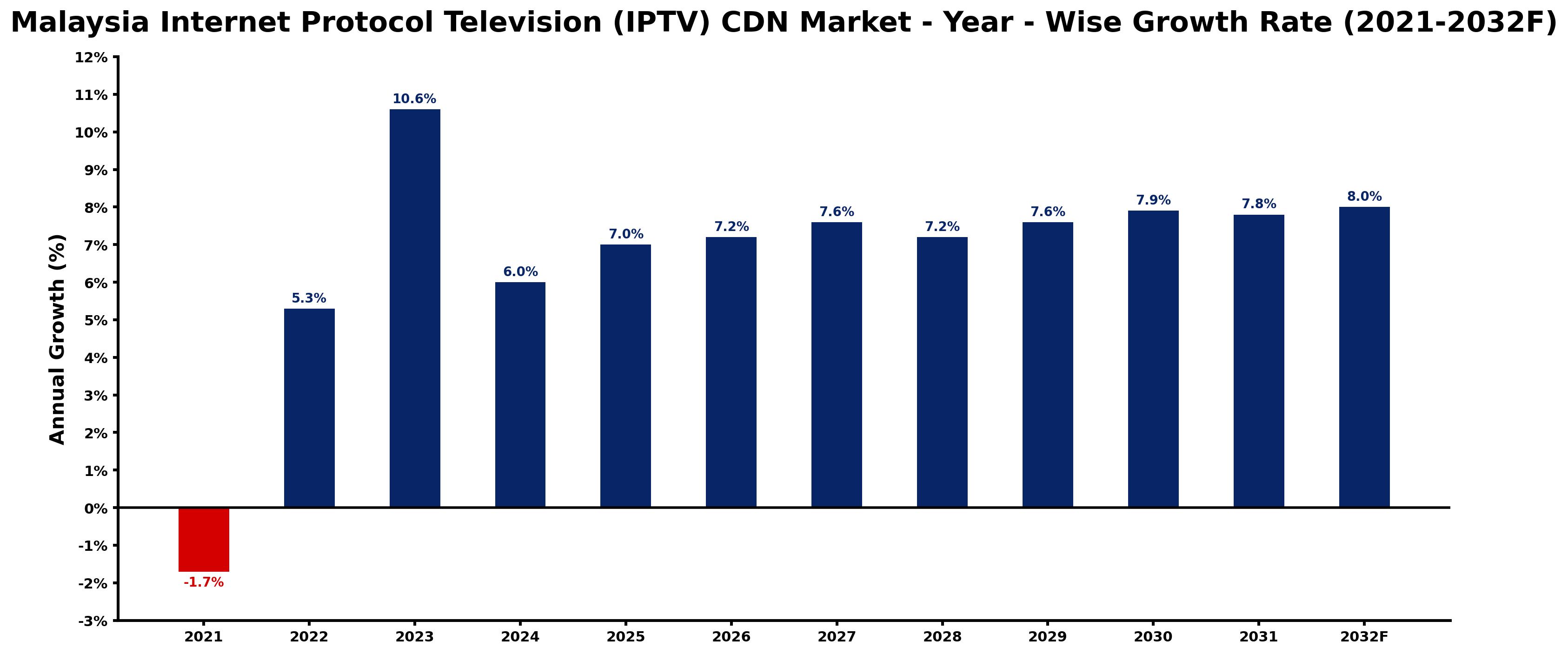
This graph illustrates the annual growth rates of the Malaysia Internet Protocol Television (IPTV) CDN Market from 2021 to 2032, highlighting a steady upward trajectory and projected expansion over the forecast period.
The table below presents the year‑wise growth rates along with the key drivers influencing the market
| Year | Growth Rate | Major Drivers |
| 2021 | -1.7% | Government restrictions limiting local content distribution deals |
| 2022 | 5.3% | Increased adoption of 5G technology enhancing streaming experiences |
| 2023 | 10.6% | Government's Digital Economy initiative supporting digital content expansion |
| 2024 | 6.0% | Rising smartphone penetration facilitating IPTV access |
| 2025 | 7.0% | Surge in local sports content driving subscription growth |
| 2026 | 7.2% | Partnerships with local producers improving IPTV content variety |
| 2027 | 7.6% | Consumer preference shift towards on-demand viewing platforms |
| 2028 | 7.2% | Regulatory support for content delivery network improvements |
| 2029 | 7.6% | Increased competition among IPTV providers spurring innovation |
| 2030 | 7.9% | Growing urban population as a driver for IPTV uptake |
| 2031 | 7.8% | Increased broadband access enabling faster IPTV services |
| 2032 | 8.0% | Local partnerships enhancing user engagement in IPTV offerings |
Note: Market size estimations and growth projections presented in this report are based on 6Wresearch's proprietary forecasting methodology, utilizing the latest available industry data, government publications, and primary research inputs.
Malaysia Internet Protocol Television (IPTV) CDN Market Key Takeaways
Below are some of the specific key takeaways from the market, including:
- The Malaysian IPTV CDN market is experiencing significant growth driven by increased consumer adoption of IPTV services.
- Advancements in video compression and content caching technologies are essential for optimizing content delivery.
- Investment in CDN infrastructure is critical to ensure smooth and high-quality user experiences as traditional cable TV usage declines.
- The recent pandemic has further accelerated the demand for streaming services and advanced CDN solutions.
- Strong competition among service providers is fostering innovation and enhanced service offerings in the market.
Evaluation of Restraints in Malaysia Internet Protocol Television (IPTV) CDN Market
A significant hurdle faced by the IPTV CDN market in Malaysia is the necessity for extensive investment in network infrastructure. High-quality video content delivery relies on sophisticated CDN solutions that demand capital and technological commitment. Additionally, navigating the complexities of regulatory requirements and content licensing agreements can hinder service providers’ expansion efforts, creating a challenging environment for growth.
Malaysia Internet Protocol Television (IPTV) CDN Market Trends
Emerging trends in the IPTV CDN market include a pronounced shift towards personalized content delivery, enabling users to curate their viewing experiences. As 5G technology rolls out across Malaysia, the potential for ultra-high-definition streaming becomes feasible, further influencing CDN investments. Another trend is the integration of artificial intelligence for optimizing content distribution and predictive analytics, ensuring that viewer demand is met with minimal latency.
Malaysia Internet Protocol Television (IPTV) CDN Market Opportunities
The real growth opportunities lie in expanding CDN capabilities to support immersive technologies such as virtual and augmented reality. As entertainment consumption trends evolve, providers who invest in these areas are likely to gain a competitive edge. Furthermore, partnerships between traditional media and tech companies can foster innovation and enhance service delivery, paving the way for new business models.
Government Initiatives in the Malaysia Internet Protocol Television (IPTV) CDN Market
Government policies are crucial in shaping the trajectory of the Malaysia Internet Protocol Television (IPTV) CDN market. Regulatory frameworks aimed at enhancing digital infrastructure have been established, reflecting public-sector priorities in boosting national broadband capabilities. Such initiatives are vital for supporting the growing demand for high-quality digital content and ensuring that the industry remains competitive on a global scale.
- A national digital infrastructure upgrade programme launched in early 2023 aims to enhance broadband speed and accessibility nationwide.
- Current efforts include a regulatory review process designed to streamline content licensing agreements, facilitating smoother operations for service providers.
- Planned initiatives include an upcoming public-private partnership aimed at expanding fiber-optic networks by 2026.
- Recent regulations introduced in 2022 focus on data protection, which will affect how content delivery networks manage user information.
- Ongoing discussions around tax incentives for companies investing in advanced CDN technologies are expected to be formalized by late 2025.
Future Insights of the Malaysia Internet Protocol Television (IPTV) CDN Market
Looking ahead to 2026-2032, the Malaysia Internet Protocol Television (IPTV) CDN market is set to grow substantially. The increasing demand for high-quality, on-demand content will continue to drive service providers to enhance their CDN infrastructures. With advancements in technology and consumer behavior shifting towards more interactive platforms, this market is likely to witness significant transformation and expansion. The advent of 5G networks will further catalyze this growth, ensuring a superior viewing experience.
Malaysia Internet Protocol Television (IPTV) CDN Market Latest Developments
In the past year, the Malaysia Internet Protocol Television (IPTV) CDN market has witnessed dynamic developments characterized by increased technological investments and strategic partnerships. Providers are actively seeking innovative solutions to enhance user experience and manage traffic efficiently amid rising demands for streaming services.
- A major technology vendor announced plans in Q1 2023 to enhance its CDN offerings, focusing on low-latency streaming capabilities.
- Currently ongoing is a partnership between regional service providers aimed at developing joint CDN infrastructures, expected to conclude by late 2025.
- An expansion initiative launched in early 2023 is set to roll out advanced caching solutions across urban areas.
- Upcoming service upgrades planned for mid-2024 will include enhanced user interfaces and personalized content recommendations.
- In early 2023, a leading regional operator completed a trial for a new video compression technology that significantly improves bandwidth efficiency.
Malaysia Internet Protocol Television (IPTV) CDN Market - Key Attractiveness of the Report
- 10 Years of Market Numbers
- Historical Data Starting from 2022 to 2025
- Base Year: 2025
- Forecast Data until 2032
- Key Performance Indicators Impacting the Market
- Major Upcoming Developments and Projects
Key Highlights of the Report:
- Malaysia Internet Protocol Television (IPTV) CDN Market Outlook
- Market Size of Malaysia Internet Protocol Television (IPTV) CDN Market, 2025
- Forecast of Malaysia Internet Protocol Television (IPTV) CDN Market, 2032
- Historical Data and Forecast of Malaysia Internet Protocol Television (IPTV) CDN Revenues & Volume for the Period 2022-2032F
- Malaysia Internet Protocol Television (IPTV) CDN Market Trend Evolution
- Malaysia Internet Protocol Television (IPTV) CDN Market Drivers and Challenges
- Malaysia Internet Protocol Television (IPTV) CDN Price Trends
- Malaysia Internet Protocol Television (IPTV) CDN Porter's Five Forces
- Malaysia Internet Protocol Television (IPTV) CDN Industry Life Cycle
- Historical Data and Forecast of Malaysia Internet Protocol Television (IPTV) CDN Market Revenues & Volume By Type for the Period 2022-2032F
- Historical Data and Forecast of Malaysia Internet Protocol Television (IPTV) CDN Market Revenues & Volume By Video for the Period 2022-2032F
- Historical Data and Forecast of Malaysia Internet Protocol Television (IPTV) CDN Market Revenues & Volume By Non-Video Content for the Period 2022-2032F
- Historical Data and Forecast of Malaysia Internet Protocol Television (IPTV) CDN Market Revenues & Volume By Service for the Period 2022-2032F
- Historical Data and Forecast of Malaysia Internet Protocol Television (IPTV) CDN Market Revenues & Volume By In-House for the Period 2022-2032F
- Historical Data and Forecast of Malaysia Internet Protocol Television (IPTV) CDN Market Revenues & Volume By Manage Service for the Period 2022-2032F
- Historical Data and Forecast of Malaysia Internet Protocol Television (IPTV) CDN Market Revenues & Volume By End-User for the Period 2022-2032F
- Historical Data and Forecast of Malaysia Internet Protocol Television (IPTV) CDN Market Revenues & Volume By SME for the Period 2022-2032F
- Historical Data and Forecast of Malaysia Internet Protocol Television (IPTV) CDN Market Revenues & Volume By Large Enterprise for the Period 2022-2032F
- Historical Data and Forecast of Malaysia Internet Protocol Television (IPTV) CDN Market Revenues & Volume By Residential Customers for the Period 2022-2032F
- Malaysia Internet Protocol Television (IPTV) CDN Import Export Trade Statistics
- Market Opportunity Assessment By Type
- Market Opportunity Assessment By Service
- Market Opportunity Assessment By End-User
- Malaysia Internet Protocol Television (IPTV) CDN Top Companies Market Share
- Malaysia Internet Protocol Television (IPTV) CDN Competitive Benchmarking By Technical and Operational Parameters
- Malaysia Internet Protocol Television (IPTV) CDN Company Profiles
- Malaysia Internet Protocol Television (IPTV) CDN Key Strategic Recommendations






































