Malaysia IoT Security Market Size & Growth Rate (2026-2032)
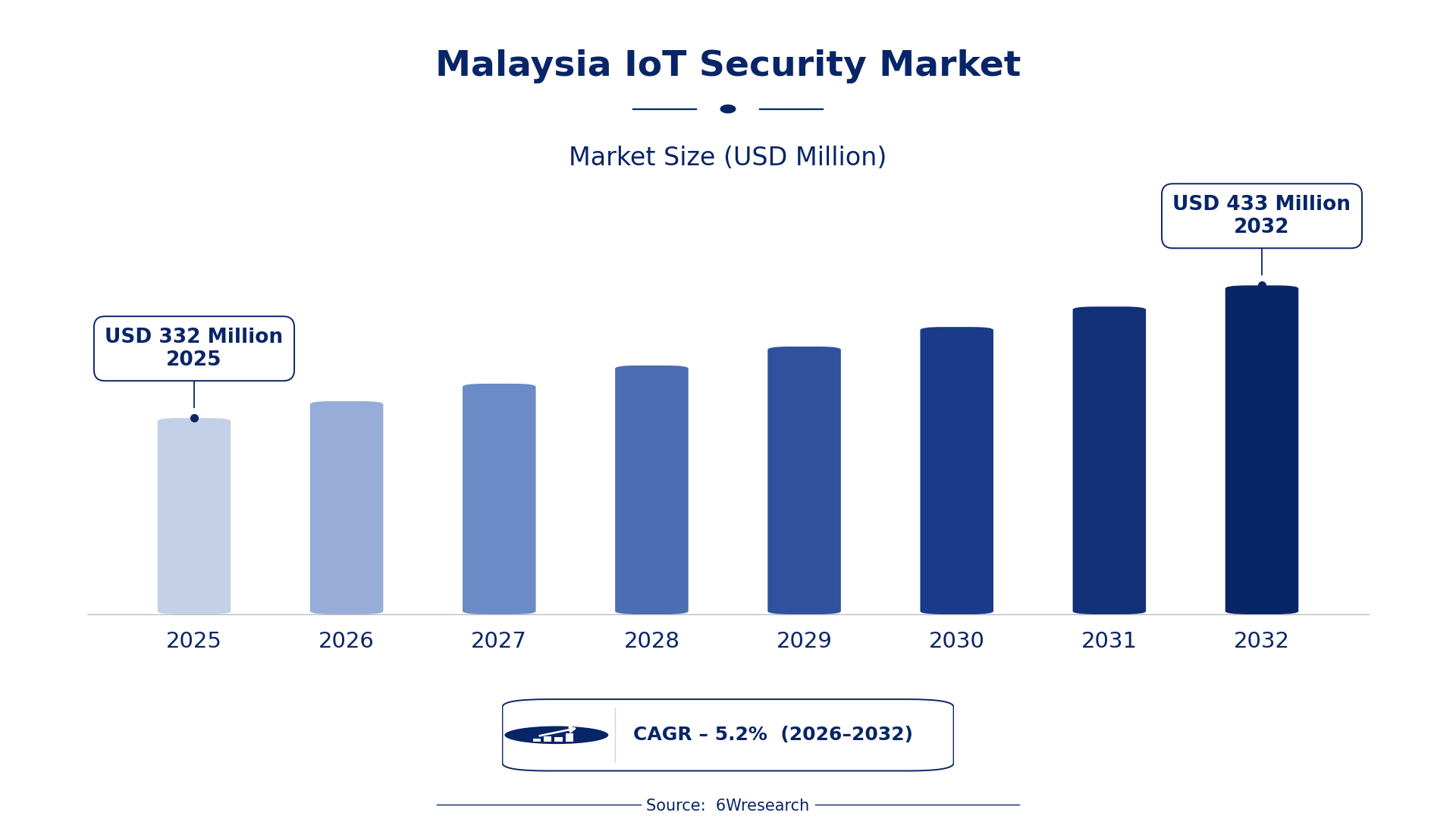
The Malaysia IoT Security Market was estimated at USD 332 Million in 2025 and is projected to reach USD 433 Million by 2032, growing at a CAGR of 5.2% from 2026 to 2032.
Malaysia IoT Security Market Synopsis
The Malaysia IoT security market has gained notable traction in recent years, driven by an increasing number of connected devices across sectors. Businesses are acutely aware of the vulnerabilities posed by these technologies, prompting heightened investments in security measures.
Looking forward, the market is expected to continue its upward trajectory as organizations prioritize securing their IoT ecosystems. The growing number of cyber threats, coupled with a greater emphasis on data protection, will further amplify the demand for robust IoT security solutions.
Malaysia IoT Security Market Year-wise Growth Rate and Key Drivers
This graph illustrates the annual growth rates of the Malaysia IoT Security Market from 2021 to 2032, highlighting a steady upward trajectory and projected expansion over the forecast period.
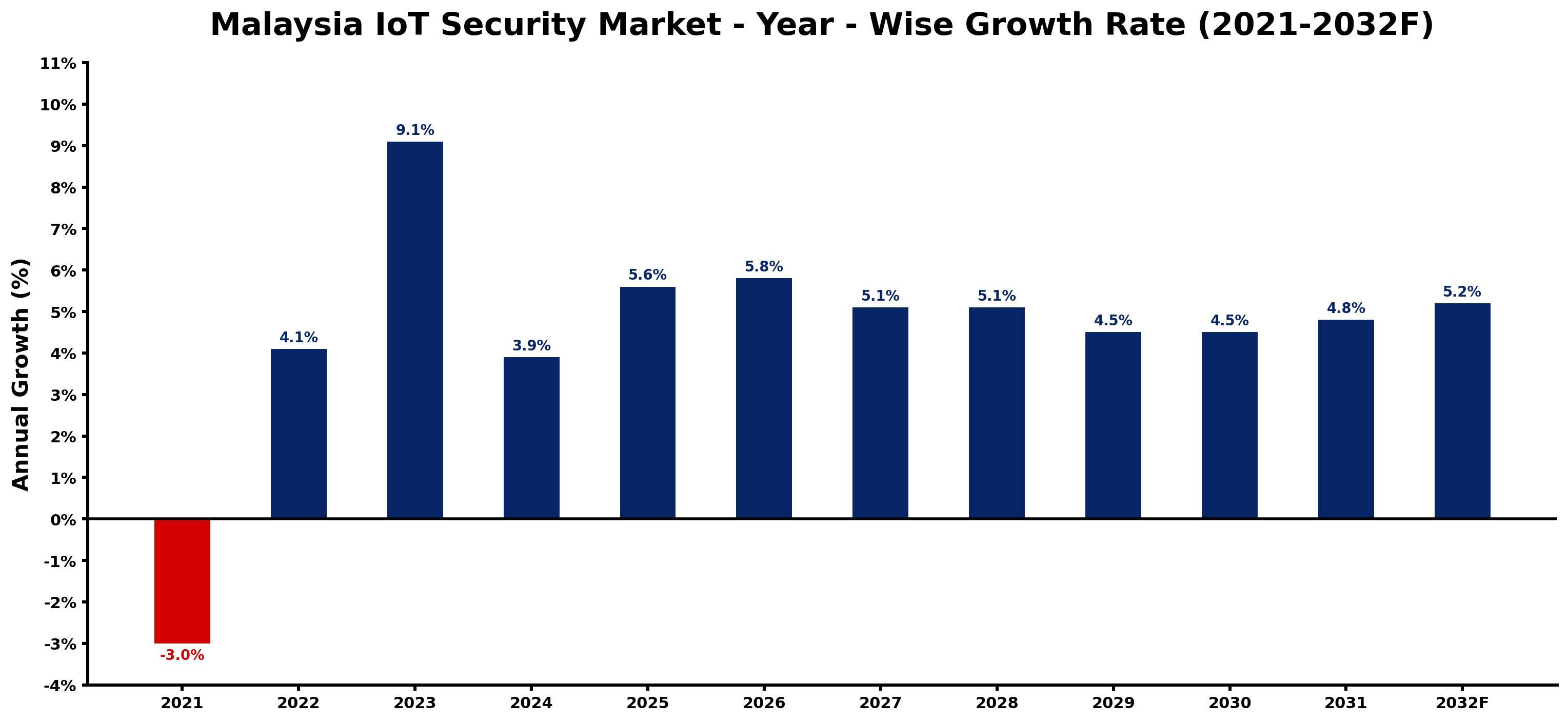
The table below presents the year‑wise growth rates along with the key drivers influencing the market
| Year | Growth Rate | Major Drivers |
| 2021 | -3.0% | MCMC regulations hindered IoT device deployments in Malaysia. |
| 2022 | 4.1% | Government Smart Nation initiative promoting secure IoT adoption |
| 2023 | 9.1% | Increased regulatory focus on data privacy protection |
| 2024 | 3.9% | Rising concerns over cybersecurity breaches in smart devices |
| 2025 | 5.6% | Growing adoption of IoT in Malaysian healthcare sector |
| 2026 | 5.8% | National Cyber Security Agency enhancing IoT security protocols |
| 2027 | 5.1% | Expanded IoT deployments in Malaysian manufacturing sites |
| 2028 | 5.1% | Local demand for smart home devices driving security need |
| 2029 | 4.5% | Implementation of IoT-driven smart agriculture solutions |
| 2030 | 4.5% | Educational campaigns raising awareness of IoT security |
| 2031 | 4.8% | Emergence of Malaysian startups focusing on IoT security |
| 2032 | 5.2% | Strong investment in IoT by Malaysian tech firms |
Note: Market size estimations and growth projections presented in this report are based on 6Wresearch's proprietary forecasting methodology, utilizing the latest available industry data, government publications, and primary research inputs.
Malaysia IoT Security Market Key Takeaways
Below are some of the specific key takeaways from the market, including:
- The market is experiencing growth as businesses recognize the importance of safeguarding their IoT assets.
- Rising instances of cyber threats are pushing organizations to adopt advanced security solutions.
- Government investments in cybersecurity infrastructure are bolstering the market's growth prospects.
- Public awareness regarding IoT security is gradually increasing, leading to better practices.
- Technological advancements will continue to shape the solutions available in the market.
Evaluation of Restraints in Malaysia IoT Security Market
Despite the growth potential, several challenges hinder the Malaysia IoT security market. A significant barrier is the persistent lack of awareness among both consumers and organizations regarding IoT security best practices. Many still underestimate the risks associated with connected devices, which can lead to inadequate protection measures. The rapidly evolving technology landscape further complicates matters, as businesses struggle to keep pace with emerging threats and vulnerabilities. on top of that, existing regulatory frameworks are still maturing and need enhancements to effectively address these issues.
Malaysia IoT Security Market Trends
Several trends are shaping the Malaysia IoT security market, with a clear shift towards integrated security solutions. Companies are increasingly seeking systems that not only address current vulnerabilities but also anticipate future threats. The rise of artificial intelligence and machine learning in security protocols is gaining traction, enabling more proactive threat detection and response capabilities. on top of that, as smart cities gain prominence, the demand for IoT security will extend beyond private enterprises to public infrastructure.
Malaysia IoT Security Market Opportunities
There are substantial opportunities for growth within the Malaysia IoT security market. Businesses that focus on developing solutions tailored to specific industry needs—such as healthcare, manufacturing, and transportation—will likely find favorable conditions. Additionally, the increasing demand for compliance with international data protection regulations opens avenues for security providers. The ongoing digitization of processes across various sectors presents a unique chance to integrate cutting-edge IoT security measures into existing frameworks.
Government Initiatives in the Malaysia IoT Security Market
The Malaysian government is actively shaping the IoT security market through various initiatives aimed at enhancing cybersecurity and infrastructure. A robust regulatory framework is essential, as it guides organizations in implementing effective security measures. With a focus on fostering a secure IoT ecosystem, government policies are increasingly prioritizing public-private partnerships to address emerging threats.
- A national cybersecurity strategy launched in 2023 aims to enhance the overall security posture of critical infrastructure.
- Current initiatives include the rollout of a cybersecurity awareness program targeting SMEs, which began in early 2024.
- The government is planning a comprehensive IoT security compliance framework expected to be introduced by 2026.
- Ongoing collaboration with international cybersecurity bodies focuses on sharing best practices and intelligence.
- A recent public-private partnership initiative was established in 2025 to foster innovation in IoT security technologies.
Future Insights of the Malaysia IoT Security Market
The future of the Malaysia IoT security market appears promising, with growth driven by increasing digitalization and an expanding IoT ecosystem. As organizations continue to embrace smart technologies, the emphasis on cybersecurity will intensify. By 2032, we can expect a market that not only adapts to current threats but also proactively addresses future vulnerabilities through advanced technologies and regulatory frameworks.
Malaysia IoT Security Market Latest Developments
In the past year, the Malaysia IoT security market has witnessed several significant developments. Industry players are ramping up efforts to enhance their offerings in response to the growing threat landscape. This has led to innovations in security solutions and increased collaboration between stakeholders.
- A major technology vendor launched a new IoT security platform in Q2 2024, aimed at enhancing device authentication and data encryption.
- In mid-2024, a partnership between leading telecommunications companies was formed to develop secure communication protocols for IoT devices.
- Ongoing research initiatives focused on integrating AI in IoT security solutions are expected to yield results by late 2025.
- A pilot program for a national IoT security certification scheme is underway, with completion anticipated in early 2025.
- Upcoming events, including a cybersecurity conference scheduled for late 2025, will focus on the latest IoT security trends and technologies.
Malaysia IoT Security Market - Key Attractiveness of the Report
- 10 Years of Market Numbers
- Historical Data Starting from 2022 to 2025
- Base Year: 2025
- Forecast Data until 2032
- Key Performance Indicators Impacting the Market
- Major Upcoming Developments and Projects
Key Highlights of the Report:
- Malaysia IoT Security Market Outlook
- Market Size of Malaysia IoT Security Market, 2025
- Forecast of Malaysia IoT Security Market, 2032
- Historical Data and Forecast of Malaysia IoT Security Revenues & Volume for the Period 2022-2032F
- Malaysia IoT Security Market Trend Evolution
- Malaysia IoT Security Market Drivers and Challenges
- Malaysia IoT Security Price Trends
- Malaysia IoT Security Porter's Five Forces
- Malaysia IoT Security Industry Life Cycle
- Historical Data and Forecast of Malaysia IoT Security Market Revenues & Volume By Type for the Period 2022-2032F
- Historical Data and Forecast of Malaysia IoT Security Market Revenues & Volume By Network Security for the Period 2022-2032F
- Historical Data and Forecast of Malaysia IoT Security Market Revenues & Volume By Endpoint Security for the Period 2022-2032F
- Historical Data and Forecast of Malaysia IoT Security Market Revenues & Volume By Application Security for the Period 2022-2032F
- Historical Data and Forecast of Malaysia IoT Security Market Revenues & Volume By Cloud Security for the Period 2022-2032F
- Historical Data and Forecast of Malaysia IoT Security Market Revenues & Volume By Other Security Types for the Period 2022-2032F
- Historical Data and Forecast of Malaysia IoT Security Market Revenues & Volume By Deployment Mode for the Period 2022-2032F
- Historical Data and Forecast of Malaysia IoT Security Market Revenues & Volume By Small and Medium Enterprises for the Period 2022-2032F
- Historical Data and Forecast of Malaysia IoT Security Market Revenues & Volume By Large Enterprises for the Period 2022-2032F
- Historical Data and Forecast of Malaysia IoT Security Market Revenues & Volume By Component for the Period 2022-2032F
- Historical Data and Forecast of Malaysia IoT Security Market Revenues & Volume By Solutions for the Period 2022-2032F
- Historical Data and Forecast of Malaysia IoT Security Market Revenues & Volume By Services for the Period 2022-2032F
- Historical Data and Forecast of Malaysia IoT Security Market Revenues & Volume By Solution for the Period 2022-2032F
- Historical Data and Forecast of Malaysia IoT Security Market Revenues & Volume By Identity and Access Management for the Period 2022-2032F
- Historical Data and Forecast of Malaysia IoT Security Market Revenues & Volume By Data Encryption and Tokenization for the Period 2022-2032F
- Historical Data and Forecast of Malaysia IoT Security Market Revenues & Volume By Intrusion Detection System/Intrusion Prevention System for the Period 2022-2032F
- Historical Data and Forecast of Malaysia IoT Security Market Revenues & Volume By Device Authentication and Management for the Period 2022-2032F
- Historical Data and Forecast of Malaysia IoT Security Market Revenues & Volume By Secure Communications for the Period 2022-2032F
- Historical Data and Forecast of Malaysia IoT Security Market Revenues & Volume By PKI Lifecycle Management for the Period 2022-2032F
- Historical Data and Forecast of Malaysia IoT Security Market Revenues & Volume By Distributed Denial of Service Protection for the Period 2022-2032F
- Historical Data and Forecast of Malaysia IoT Security Market Revenues & Volume By Security Analytics for the Period 2022-2032F
- Historical Data and Forecast of Malaysia IoT Security Market Revenues & Volume By Application Area for the Period 2022-2032F
- Historical Data and Forecast of Malaysia IoT Security Market Revenues & Volume By Smart Manufacturing for the Period 2022-2032F
- Historical Data and Forecast of Malaysia IoT Security Market Revenues & Volume By Smart Energy and Utilities for the Period 2022-2032F
- Historical Data and Forecast of Malaysia IoT Security Market Revenues & Volume By Connected Logistics for the Period 2022-2032F
- Historical Data and Forecast of Malaysia IoT Security Market Revenues & Volume By Smart Home and Consumer Electronics for the Period 2022-2032F
- Historical Data and Forecast of Malaysia IoT Security Market Revenues & Volume By Connected Healthcare for the Period 2022-2032F
- Historical Data and Forecast of Malaysia IoT Security Market Revenues & Volume By Smart Government and Defense for the Period 2022-2032F
- Historical Data and Forecast of Malaysia IoT Security Market Revenues & Volume By Smart Retail for the Period 2022-2032F
- Historical Data and Forecast of Malaysia IoT Security Market Revenues & Volume By Other Application Areas for the Period 2022-2032F
- Historical Data and Forecast of Malaysia IoT Security Market Revenues & Volume By Organization Size for the Period 2022-2032F
- Historical Data and Forecast of Malaysia IoT Security Market Revenues & Volume By Small and Medium-sized Enterprises for the Period 2022-2032F
- Historical Data and Forecast of Malaysia IoT Security Market Revenues & Volume By Large Enterprises for the Period 2022-2032F
- Historical Data and Forecast of Malaysia IoT Security Market Revenues & Volume By Service for the Period 2022-2032F
- Historical Data and Forecast of Malaysia IoT Security Market Revenues & Volume By Professional Services for the Period 2022-2032F
- Historical Data and Forecast of Malaysia IoT Security Market Revenues & Volume By Managed Services for the Period 2022-2032F
- Malaysia IoT Security Import Export Trade Statistics
- Market Opportunity Assessment By Type
- Market Opportunity Assessment By Deployment Mode
- Market Opportunity Assessment By Component
- Market Opportunity Assessment By Solution
- Market Opportunity Assessment By Application Area
- Market Opportunity Assessment By Organization Size
- Market Opportunity Assessment By Service
- Malaysia IoT Security Top Companies Market Share
- Malaysia IoT Security Competitive Benchmarking By Technical and Operational Parameters
- Malaysia IoT Security Company Profiles
- Malaysia IoT Security Key Strategic Recommendations






































