Malaysia Iron Castings Market Summary
The malaysia iron castings market was estimated at USD 341 Million in 2025 and is projected to reach USD 444 Million by 2032, growing at a CAGR of 5.6% from 2026 to 2032.
Malaysia Iron Castings Market Year-wise Growth Rate and Key Drivers
This graph highlights how the Malaysia Iron Castings Market has steadily grown over the past five years, supported by major growth factors.
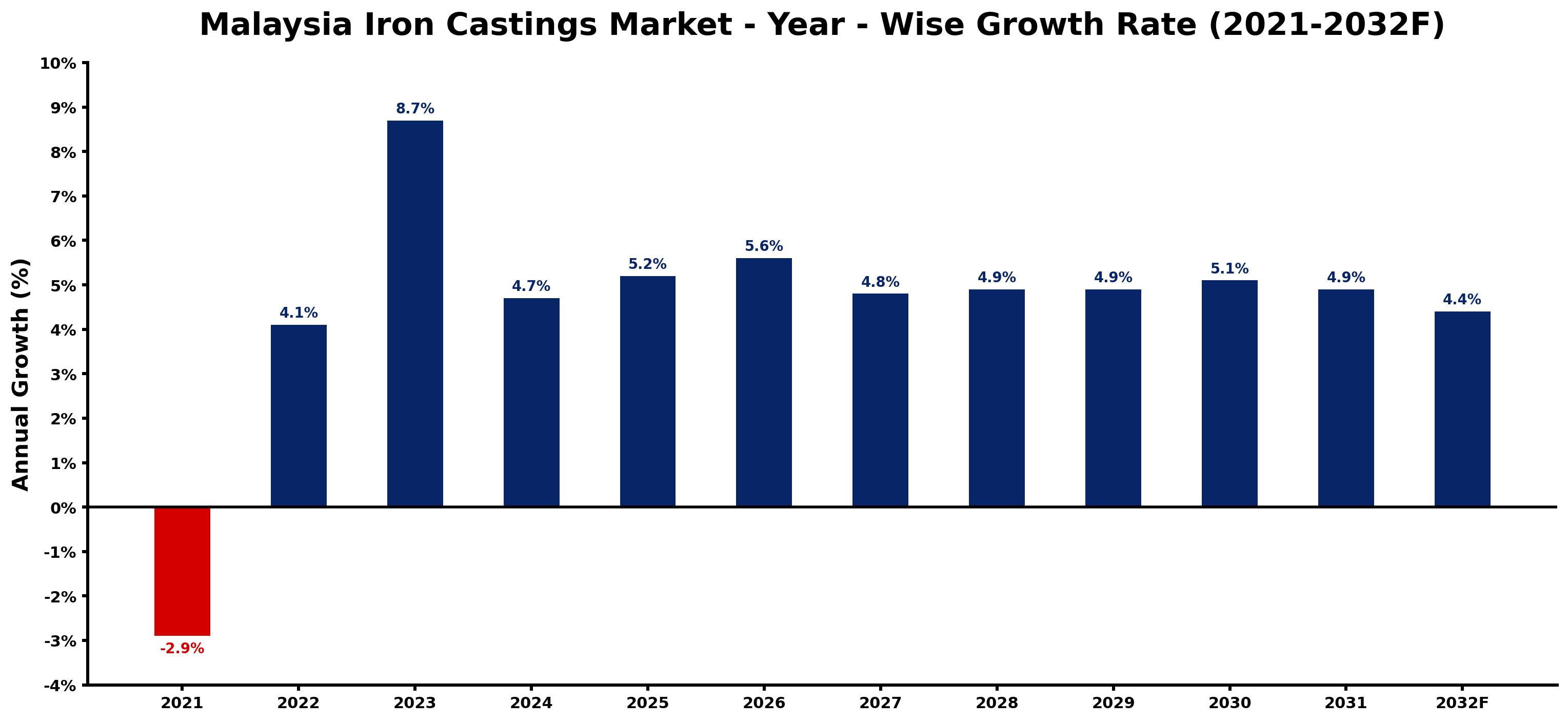
The table below presents the year wise growth rates along with the key drivers influencing the market
| Year | Growth Rate | Major Drivers |
| 2021 | -2.9% | Decreased infrastructure development projects led to diminished demand for iron castings in construction applications. |
| 2022 | 4.1% | Heavy machinery manufacturers expanded operations, reflecting optimism in local industries. |
| 2023 | 8.7% | Investment in automotive production facilities surged, leading to higher casting requirements. |
| 2024 | 4.7% | Infrastructure projects gained momentum, driving increased orders for durable iron cast components. |
| 2025 | 5.2% | Sustainability trends prompted innovation in recycling scrap metal for casting processes. |
| 2026 | 5.6% | Global supply chain reconfigurations encouraged local firms to enhance their capabilities. |
| 2027 | 4.8% | Technological upgrades in foundries improved product quality and production efficiency. |
| 2028 | 4.9% | Renewable energy projects emerged, requiring specialized castings for wind and solar applications. |
| 2029 | 4.9% | Market diversification strategies led companies to explore international export opportunities. |
| 2030 | 5.1% | Emerging smart city initiatives drove demand for high-performance cast iron fittings. |
| 2031 | 4.9% | Local players started forming alliances, enhancing competitiveness in global markets. |
| 2032 | 4.4% | Economic stability attracted foreign direct investment, further expanding the iron castings sector. |
Note - Market size estimations and growth projections presented in this report are based on 6Wresearch's advanced forecasting approach, validated with industry datasets as of June 2026.
Malaysia Iron Castings Market Synopsis
The Malaysia Iron Castings Market is projected to reach 5.6% and witness significant growth during the forecast period (2026-2032). This growth trajectory is primarily fueled by increasing demand across key sectors such as construction and automotive. As urbanization and industrialization continue to gain momentum in Malaysia, the reliance on iron castings is expected to escalate. Furthermore, substantial investments in infrastructure development, particularly in the oil gas sector, will likely enhance the market dynamics for iron castings in Malaysia. As technology progresses, new methodologies like 3D printing are emerging, creating opportunities for innovative product developments and heightened demand in the subsequent years.
Malaysia Iron Castings Market Growth Drivers
The growth of the Malaysia Iron Castings Market is underpinned by several critical factors that shape its landscape:
- The surge in construction activities across Malaysia directly correlates with the increasing need for durable and robust materials like iron castings, propelling the market forward.
- The automotive sector's expansion, driven by rising vehicle production and sales, serves as a significant demand driver for iron castings, essential for various vehicle components.
- Urbanization plays a pivotal role, as the continuous influx of populations to urban centers necessitates increased infrastructure and housing developments, thus boosting the iron castings market.
- Investment in infrastructure projects, particularly in the oil & gas sector, results in heightened demand for iron castings, underpinning future market growth.
- Advancements in casting technologies, such as 3D printing and automation, are expected to enhance production efficiency and product offerings, further stimulating market expansion.
Malaysia Iron Castings Market Challenges and Restraints
Despite its promising outlook, the Malaysia Iron Castings Market faces several challenges that could hinder its growth:
- The volatility of raw material prices poses a substantial risk, as fluctuations can impact production costs and profit margins for manufacturers within the market.
- Stringent environmental regulations are becoming increasingly prevalent, necessitating compliance from companies, which could increase operational costs and complexity.
- Competition from alternative materials, such as plastics and composites, may pose a threat by offering potentially lower-cost, lighter, and corrosion-resistant options.
- The economic uncertainties resulting from fluctuating global markets could deter investment in new projects, thus impacting overall demand for iron castings.
- Talent shortages in skilled labor for casting production and technology adoption could impede the efficiency of operations and innovation within the market.
Malaysia Iron Castings Market Trends and Opportunities
Emerging trends and opportunities within the Malaysia Iron Castings Market are shaping its trajectory in impactful ways:
- The adoption of advanced manufacturing techniques, including automation and smart technologies, is streamlining production processes and enhancing product quality.
- Growing sustainability concerns are prompting investments in eco-friendly manufacturing practices, offering companies the chance to differentiate themselves in the market.
- Increased focus on renewable energy projects offers new avenues for iron casting applications, particularly in wind and solar energy infrastructure.
- Collaboration between industry and research institutions is fostering innovation in casting techniques and materials, laying the groundwork for future advancements.
- Global partnerships and export opportunities are expanding, as Malaysian iron castings gain traction in international markets due to their quality and competitive pricing.
Malaysia Iron Castings Market Government Investment and Initiatives
The Malaysian government has embarked on several initiatives aimed at bolstering the iron castings market through strategic investments and supportive policies:
- Investment in infrastructure development is being prioritized, with significant public spending focusing on sectors such as transportation and utilities, which rely heavily on iron castings.
- The government is providing incentives for research and development in the manufacturing sector, encouraging innovation in iron casting techniques and technologies.
- Policies aimed at enhancing foreign direct investment are facilitating the entry of international players, which could boost competition and technological advancements within the local market.
- Government-funded training and skill development programs are being implemented to address the skilled labor shortage and improve workforce competency in casting manufacturing.
- Regulatory frameworks are being established to promote environmentally sustainable practices, ensuring that companies align with global standards while maintaining economic growth.
Malaysia Iron Castings Market Latest Developments (May 2025 - June 2026)
Recent developments in the Malaysia Iron Castings Market from May 2025 to June 2026 reflect a dynamic industry responding to both challenges and opportunities:
- Technological advancements in production processes have been a focal point, with manufacturers increasingly investing in automation and digitalization to enhance efficiency and reduce costs.
- There has been a noticeable uptick in collaborations between industry leaders and research institutions, aiming to innovate and improve casting methodologies.
- Market participants are placing greater emphasis on sustainability, with many companies adopting green manufacturing practices to meet evolving regulatory standards and consumer expectations.
- Infrastructure projects spearheaded by the government have begun to materialize, resulting in increased demand for iron castings, particularly in construction and energy sectors.
- The competitive landscape has seen new entrants exploring export markets, positioning Malaysian iron castings as viable options for global buyers due to their quality and cost-effectiveness.
Malaysia Iron Castings Market - Key Attractiveness of the Report
- 10 Years of Market Numbers
- Historical Data Starting from 2022 to 2025
- Base Year: 2025
- Forecast Data until 2032
- Key Performance Indicators Impacting the Market
- Major Upcoming Developments and Projects
Key Highlights of the Report:
- Malaysia Iron Castings Market Outlook
- Market Size of Malaysia Iron Castings Market, 2025
- Forecast of Malaysia Iron Castings Market, 2032F
- Historical Data and Forecast of Malaysia Iron Castings Revenues & Volume for the Period 2022-2032F
- Malaysia Iron Castings Market Trend Evolution
- Malaysia Iron Castings Market Drivers and Challenges
- Malaysia Iron Castings Price Trends
- Malaysia Iron Castings Porter's Five Forces
- Malaysia Iron Castings Industry Life Cycle
- Historical Data and Forecast of Malaysia Iron Castings Market Revenues & Volume By Product for the Period 2022-2032F
- Historical Data and Forecast of Malaysia Iron Castings Market Revenues & Volume By Gray Iron for the Period 2022-2032F
- Historical Data and Forecast of Malaysia Iron Castings Market Revenues & Volume By Ductile Iron for the Period 2022-2032F
- Historical Data and Forecast of Malaysia Iron Castings Market Revenues & Volume By Malleable Iron for the Period 2022-2032F
- Historical Data and Forecast of Malaysia Iron Castings Market Revenues & Volume By End-User for the Period 2022-2032F
- Historical Data and Forecast of Malaysia Iron Castings Market Revenues & Volume By Automobile for the Period 2022-2032F
- Historical Data and Forecast of Malaysia Iron Castings Market Revenues & Volume By Industrial Machinery for the Period 2022-2032F
- Historical Data and Forecast of Malaysia Iron Castings Market Revenues & Volume By Infrastructure and Construction Machines for the Period 2022-2032F
- Historical Data and Forecast of Malaysia Iron Castings Market Revenues & Volume By Power for the Period 2022-2032F
- Historical Data and Forecast of Malaysia Iron Castings Market Revenues & Volume By Others for the Period 2022-2032F
- Malaysia Iron Castings Import Export Trade Statistics
- Market Opportunity Assessment By Product
- Market Opportunity Assessment By End-User
- Malaysia Iron Castings Top Companies Market Share
- Malaysia Iron Castings Competitive Benchmarking By Technical and Operational Parameters
- Malaysia Iron Castings Company Profiles
- Malaysia Iron Castings Key Strategic Recommendations






































