Malaysia Lead Chemicals Market Size, Share & Growth Rate
The Malaysia Lead Chemicals Market was estimated at USD 317 Million in 2025 and is projected to reach USD 411 Million by 2032, growing at a CAGR of 3.8% from 2026 to 2032. This growth trajectory is primarily driven by the increasing demand for lead-acid batteries, spurred by the expanding automotive sector and a rising need for energy storage solutions. As these industries evolve, they create ample opportunities for lead chemical applications, contributing to the market's sustained expansion.
Malaysia Lead Chemicals Market Year-wise Growth Rate and Key Drivers
This graph highlights how the Malaysia Lead Chemicals Market has steadily grown over the years, supported by major growth factors.
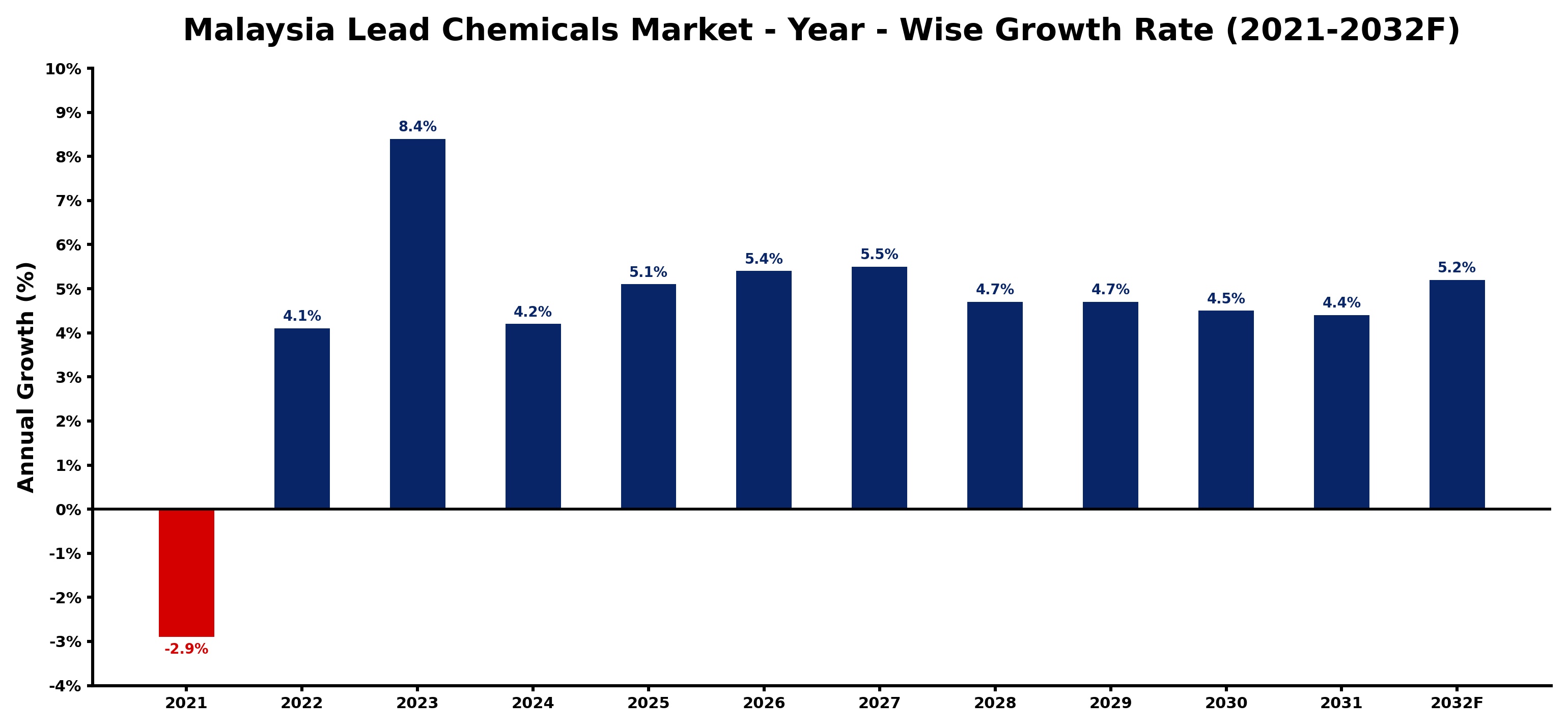
The table below presents the year‑wise growth rates along with the key drivers influencing the market
| Year | Growth Rate | Major Drivers |
| 2021 | -2.9% | Supply chain disruptions limited availability |
| 2022 | 4.1% | Manufacturing recovery stimulated demand |
| 2023 | 8.4% | Sustainability initiatives enhanced production |
| 2024 | 4.2% | Technological advancements improved efficiency |
| 2025 | 5.1% | Regulatory support fostered innovation |
| 2026 | 5.4% | Market diversification opened new opportunities |
| 2027 | 5.5% | Increased investment in R&D |
| 2028 | 4.7% | Consumer awareness of benefits expanded |
| 2029 | 4.7% | Export opportunities grew significantly |
| 2030 | 4.5% | Partnerships strengthened market presence |
| 2031 | 4.4% | Local sourcing initiatives gained traction |
| 2032 | 5.2% | Emerging markets increased consumption |
Note - Market size estimations and growth projections presented in this report are based on 6Wresearch's advanced forecasting approach, validated with industry datasets as of June 2026.
Malaysia Lead Chemicals Market Synopsis
The lead chemicals sector in Malaysia has established itself as a crucial component of various industrial applications, notably in batteries and electronics. With a market valuation of approximately USD 115 million in 2025, it reflects a robust demand anchored in the country's economic growth and industrial diversification efforts.
As companies adapt to stricter environmental regulations and heightened health concerns, the landscape of the lead chemicals market is gradually evolving. Innovations in recycling practices and the exploration of safer alternatives are paving the way for sustainable growth, even as traditional applications continue to dominate.
Malaysia Lead Chemicals Market Key Takeaways
- The market is projected to grow steadily, reflecting consistent demand from key sectors such as automotive and electronics.
- Innovations in lead recycling and safer alternatives are essential for compliance with increasingly stringent regulations.
- Key players in the market are focusing on sustainable practices to enhance their competitiveness.
- The growth of the automotive industry is a significant driver, particularly for lead-acid batteries.
- Market dynamics are being influenced by the ongoing technological shifts and advancements in chemical safety.
Evaluation of Restraints in Malaysia Lead Chemicals Market
While the Malaysia Lead Chemicals Market demonstrates promising growth potential, it is not without its challenges. One of the most pressing restraints involves the stringent environmental regulations governing the use of lead-based products. These regulations arise from growing health concerns, prompting a shift towards safer alternatives. Companies are thus compelled to invest heavily in research and innovation to meet compliance requirements while satisfying market demand. Moreover, the transition from conventional lead applications to environmentally friendly substitutes poses a significant challenge, necessitating a careful balance between profitability and safety.
Malaysia Lead Chemicals Market Trends
The Malaysian market is currently experiencing a trend toward increased investment in sustainability and environmental compliance. Companies are actively seeking innovative methods to recycle lead and minimize waste. Additionally, there is a noticeable shift in consumer preferences towards products that prioritize health and safety, further influencing production strategies. Moreover, advancements in battery technology are driving demand for more efficient lead-acid batteries, which in turn is fostering research into lead chemical applications in other sectors.
Malaysia Lead Chemicals Market Opportunities
Opportunities abound in the Malaysia Lead Chemicals Market, particularly in the realms of battery production and recycling technologies. As the automotive industry continues to grow, there is an increasing need for reliable lead-acid batteries. Additionally, investments in research and development for safer lead alternatives present avenues for companies willing to innovate. The expanding construction sector also offers significant potential, as demand for lead-based materials in paints and coatings remains strong, particularly in high-performance applications.
Government Initiatives in the Malaysia Lead Chemicals Market
The Malaysian government is actively promoting initiatives aimed at enhancing sustainability within the lead chemicals sector. Policies encouraging recycling and the development of safer alternatives are being prioritized. Public funding and grants aimed at supporting innovation in chemical safety and environmental compliance further underline the government's commitment to fostering a responsible and sustainable industrial landscape. These initiatives are essential in navigating the complexities of regulatory compliance and market demands.
Future Insights of the Malaysia Lead Chemicals Market
Looking ahead to 2026-2032, the Malaysia Lead Chemicals Market is set to navigate a landscape marked by both challenges and opportunities. Growth is expected to be driven by continuous innovations in battery technology and the increasing focus on sustainable practices. As industries adapt to evolving regulations and consumer preferences, there is a strong likelihood that lead recycling will become a cornerstone of market strategies. Furthermore, the intersection of safety standards and industrial applications will remain critical in shaping the future dynamics of the market.
Malaysia Lead Chemicals Market Latest Developments (May 2025 - June 2026)
Recent trends indicate a shift toward adopting cleaner technologies and more sustainable manufacturing practices. Companies are investing in research aimed at enhancing lead recycling methods and reducing waste associated with lead-based products. Moreover, collaborations among industry stakeholders are becoming more common, with a focus on sharing best practices and advancing chemical safety initiatives. This collective movement is pivotal in redefining the trajectory of the market amid an evolving regulatory landscape.
Malaysia Lead Chemicals Market - Key Attractiveness of the Report
- 10 Years of Market Numbers
- Historical Data Starting from 2022 to 2025
- Base Year: 2025
- Forecast Data until 2032
- Key Performance Indicators Impacting the Market
- Major Upcoming Developments and Projects
Key Highlights of the Report:
- Malaysia Lead Chemicals Market Outlook
- Market Size of Malaysia Lead Chemicals Market, 2025
- Forecast of Malaysia Lead Chemicals Market, 2032
- Historical Data and Forecast of Malaysia Lead Chemicals Revenues & Volume for the Period 2022-2032F
- Malaysia Lead Chemicals Market Trend Evolution
- Malaysia Lead Chemicals Market Drivers and Challenges
- Malaysia Lead Chemicals Price Trends
- Malaysia Lead Chemicals Porter's Five Forces
- Malaysia Lead Chemicals Industry Life Cycle
- Historical Data and Forecast of Malaysia Lead Chemicals Market Revenues & Volume By Types for the Period 2022-2032F
- Historical Data and Forecast of Malaysia Lead Chemicals Market Revenues & Volume By Lead Nitrate for the Period 2022-2032F
- Historical Data and Forecast of Malaysia Lead Chemicals Market Revenues & Volume By Lead Acetate for the Period 2022-2032F
- Historical Data and Forecast of Malaysia Lead Chemicals Market Revenues & Volume By Lead Stabilizers for the Period 2022-2032F
- Historical Data and Forecast of Malaysia Lead Chemicals Market Revenues & Volume By Lead Chloride for the Period 2022-2032F
- Historical Data and Forecast of Malaysia Lead Chemicals Market Revenues & Volume By Others for the Period 2022-2032F
- Historical Data and Forecast of Malaysia Lead Chemicals Market Revenues & Volume By Applications for the Period 2022-2032F
- Historical Data and Forecast of Malaysia Lead Chemicals Market Revenues & Volume By Mining for the Period 2022-2032F
- Historical Data and Forecast of Malaysia Lead Chemicals Market Revenues & Volume By PVC Stabilizers for the Period 2022-2032F
- Historical Data and Forecast of Malaysia Lead Chemicals Market Revenues & Volume By Dyes for the Period 2022-2032F
- Historical Data and Forecast of Malaysia Lead Chemicals Market Revenues & Volume By Pigment for the Period 2022-2032F
- Historical Data and Forecast of Malaysia Lead Chemicals Market Revenues & Volume By Others for the Period 2022-2032F
- Malaysia Lead Chemicals Import Export Trade Statistics
- Market Opportunity Assessment By Types
- Market Opportunity Assessment By Applications
- Malaysia Lead Chemicals Top Companies Market Share
- Malaysia Lead Chemicals Competitive Benchmarking By Technical and Operational Parameters
- Malaysia Lead Chemicals Company Profiles
- Malaysia Lead Chemicals Key Strategic Recommendations






































