Malaysia Lead Nitrate Market Size, Share & Growth Rate
The Malaysia Lead Nitrate Market was estimated at USD 311 Million in 2025 and is projected to reach USD 403 Million by 2032, growing at a CAGR of 3.8% from 2026 to 2032. This growth is spurred by increasing demand from key sectors such as mining, pharmaceuticals, and pyrotechnics. The ongoing industrial expansion in Malaysia, along with investments aimed at technological advancements and enhanced safety measures, presents a favorable landscape for market participants.
Malaysia Lead Nitrate Market Year-wise Growth Rate and Key Drivers
This graph highlights how the Malaysia Lead Nitrate Market has steadily grown over the years, supported by major growth factors.
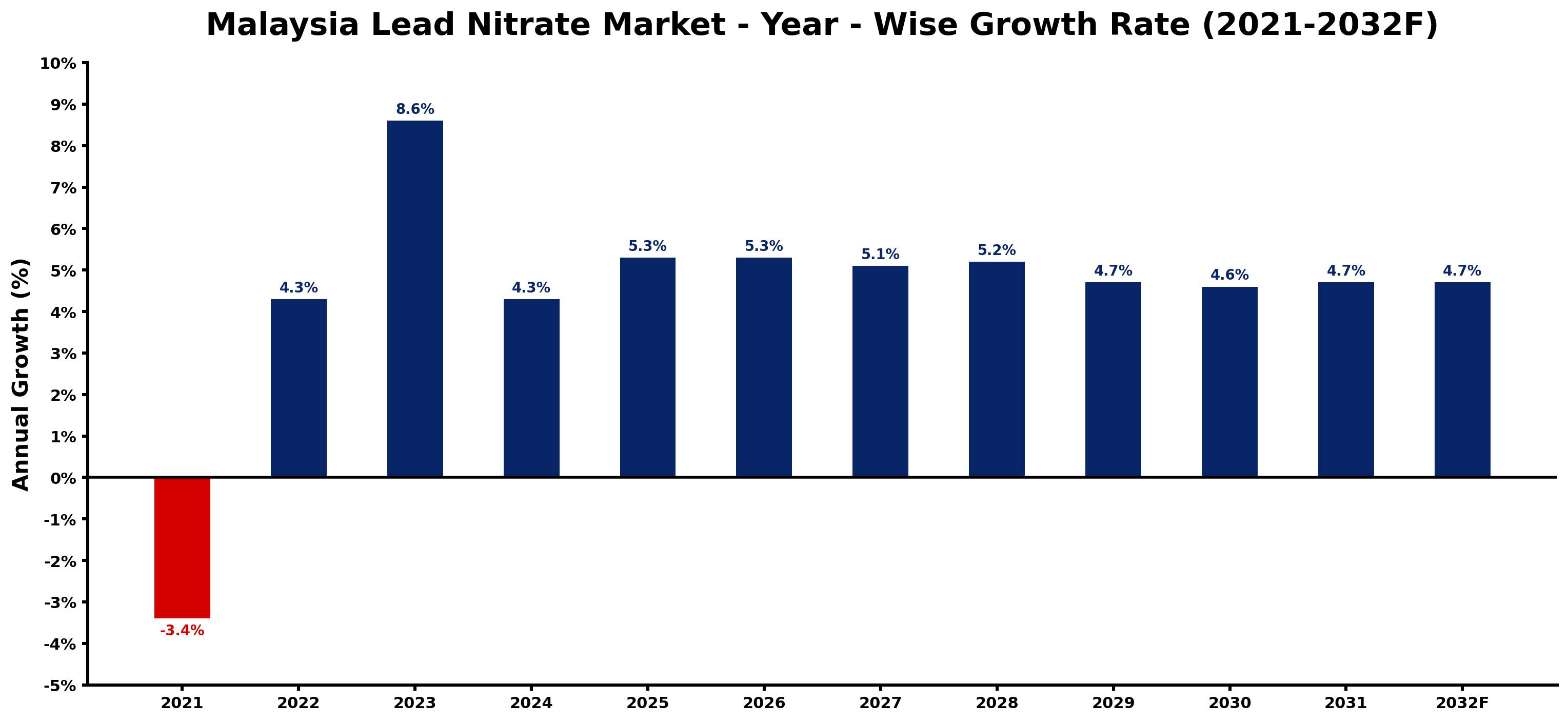
The table below presents the year‑wise growth rates along with the key drivers influencing the market
| Year | Growth Rate | Major Drivers |
| 2021 | -3.4% | decreased industrial production capacity |
| 2022 | 4.3% | increased agricultural investment activities |
| 2023 | 8.6% | growing demand from construction sector |
| 2024 | 4.3% | expansion of chemical manufacturing facilities |
| 2025 | 5.3% | rising consumer electronics production |
| 2026 | 5.3% | surge in automotive sector growth |
| 2027 | 5.1% | enhanced research and development funding |
| 2028 | 5.2% | increased environmental regulations compliance |
| 2029 | 4.7% | growing popularity of eco-friendly products |
| 2030 | 4.6% | enhanced product quality standards |
| 2031 | 4.7% | increased infrastructure development projects |
| 2032 | 4.7% | rising demand for specialty applications |
Note: Market size estimations and growth projections presented in this report are based on 6Wresearch's proprietary forecasting methodology, utilizing the latest available industry data, government publications, and primary research inputs.
Malaysia Lead Nitrate Market Synopsis
The Malaysian lead nitrate market has witnessed fluctuations, largely influenced by the demand dynamics from various industries. Recent years have shown a stabilized interest in lead nitrate due to its pivotal roles in mining and manufacturing sectors, setting a positive trajectory for the upcoming forecast period.
Looking ahead, the market is poised for growth as technological innovations enhance its applications and mitigate safety concerns associated with lead compounds. The interplay between regulatory measures and market demand will be crucial in shaping the future landscape of the Malaysian lead nitrate market.
Malaysia Lead Nitrate Market Key Takeaways
- The market is projected to grow at a CAGR of 3.8% from 2026 to 2032, reflecting resilience and adaptability.
- Applications in mining and explosives are key drivers, as they correlate with the expanding industrial activities.
- Private sector investments in technology and safety are fostering market growth.
- Government regulations promoting safe practices are creating a conducive environment for market expansion.
- The rising concerns over environmental impacts necessitate the exploration of alternative solutions.
Evaluation of Restraints in Malaysia Lead Nitrate Market
Despite its growth potential, the Malaysian lead nitrate market faces significant restraints stemming from health and environmental concerns linked to lead compounds. The tightening of regulations surrounding the use of lead in various applications could potentially hamper demand. Manufacturers must navigate this regulatory landscape while balancing the need for compliance with market expectations. Additionally, the exploration of lead-free alternatives represents a challenge that may redefine conventional market dynamics.
Malaysia Lead Nitrate Market Trends
Current trends indicate a shift towards greater regulatory compliance and safety in handling hazardous materials. The increasing focus on sustainability is driving interest in environmentally friendly practices within the lead nitrate space. Moreover, advancements in technology are enhancing the efficiency and safety of lead nitrate production processes, positioning the market to meet future demands while addressing existing challenges.
Malaysia Lead Nitrate Market Opportunities
There are promising opportunities within the Malaysian lead nitrate market, particularly in the sectors of mining and pyrotechnics. As global demand for precious metals continues to rise, the need for lead nitrate in extraction processes is expected to expand. Furthermore, increased research and development into alternative materials can lead to innovation and market diversification, paving the way for new product offerings that cater to evolving consumer needs.
Government Initiatives in the Malaysia Lead Nitrate Market
The Malaysian government has been proactive in instituting regulations that promote safety in handling and usage of hazardous materials, including lead nitrate. These initiatives are aimed at ensuring environmental sustainability while balancing industrial growth. Public spending in industrial safety programs and support for research into lead-free alternatives are also noteworthy government actions that signal a commitment to both economic and environmental goals.
Future Insights of the Malaysia Lead Nitrate Market
Looking ahead to the period between 2026 and 2032, the Malaysia lead nitrate market is expected to evolve significantly. As industries adapt to changing regulatory environments and environmental demands, market participants will need to embrace innovation. The integration of safer alternatives and technological advancements will not only enhance compliance but also support sustainability objectives, allowing the market to thrive amid challenges.
Malaysia Lead Nitrate Market Latest Developments (2025 - 2026)
Recent developments in the Malaysian lead nitrate market have centered around enhanced safety protocols and compliance with new environmental regulations. Companies are actively seeking partnerships to explore innovative production methods and sustainable practices. The ongoing dialogue between regulatory bodies and industry stakeholders continues to shape market dynamics as the landscape for lead nitrate evolves.
Malaysia Lead Nitrate Market - Key Attractiveness of the Report
- 10 Years of Market Numbers
- Historical Data Starting from 2022 to 2025
- Base Year: 2025
- Forecast Data until 2032
- Key Performance Indicators Impacting the Market
- Major Upcoming Developments and Projects
Key Highlights of the Report:
- Malaysia Lead Nitrate Market Outlook
- Market Size of Malaysia Lead Nitrate Market, 2025
- Forecast of Malaysia Lead Nitrate Market, 2032
- Historical Data and Forecast of Malaysia Lead Nitrate Revenues & Volume for the Period 2022-2032F
- Malaysia Lead Nitrate Market Trend Evolution
- Malaysia Lead Nitrate Market Drivers and Challenges
- Malaysia Lead Nitrate Price Trends
- Malaysia Lead Nitrate Porter's Five Forces
- Malaysia Lead Nitrate Industry Life Cycle
- Historical Data and Forecast of Malaysia Lead Nitrate Market Revenues & Volume By Types for the Period 2022-2032F
- Historical Data and Forecast of Malaysia Lead Nitrate Market Revenues & Volume By Pharmaceutical Grade Lead Nitrate for the Period 2022-2032F
- Historical Data and Forecast of Malaysia Lead Nitrate Market Revenues & Volume By Industrial Grade Lead Nitrate for the Period 2022-2032F
- Historical Data and Forecast of Malaysia Lead Nitrate Market Revenues & Volume By Applications for the Period 2022-2032F
- Historical Data and Forecast of Malaysia Lead Nitrate Market Revenues & Volume By Mining for the Period 2022-2032F
- Historical Data and Forecast of Malaysia Lead Nitrate Market Revenues & Volume By PVC Stabilizers for the Period 2022-2032F
- Historical Data and Forecast of Malaysia Lead Nitrate Market Revenues & Volume By Pigment for the Period 2022-2032F
- Historical Data and Forecast of Malaysia Lead Nitrate Market Revenues & Volume By Others for the Period 2022-2032F
- Malaysia Lead Nitrate Import Export Trade Statistics
- Market Opportunity Assessment By Types
- Market Opportunity Assessment By Applications
- Malaysia Lead Nitrate Top Companies Market Share
- Malaysia Lead Nitrate Competitive Benchmarking By Technical and Operational Parameters
- Malaysia Lead Nitrate Company Profiles
- Malaysia Lead Nitrate Key Strategic Recommendations






































