Malaysia Loudspeakers Market Summary
The malaysia loudspeakers market was estimated at USD 456 Million in 2025 and is projected to reach USD 596 Million by 2032, growing at a CAGR of 5.5% from 2026 to 2032.
Malaysia Loudspeakers Market Year-wise Growth Rate and Key Drivers
This graph highlights how the Malaysia Loudspeakers Market has steadily grown over the past five years, supported by major growth factors.
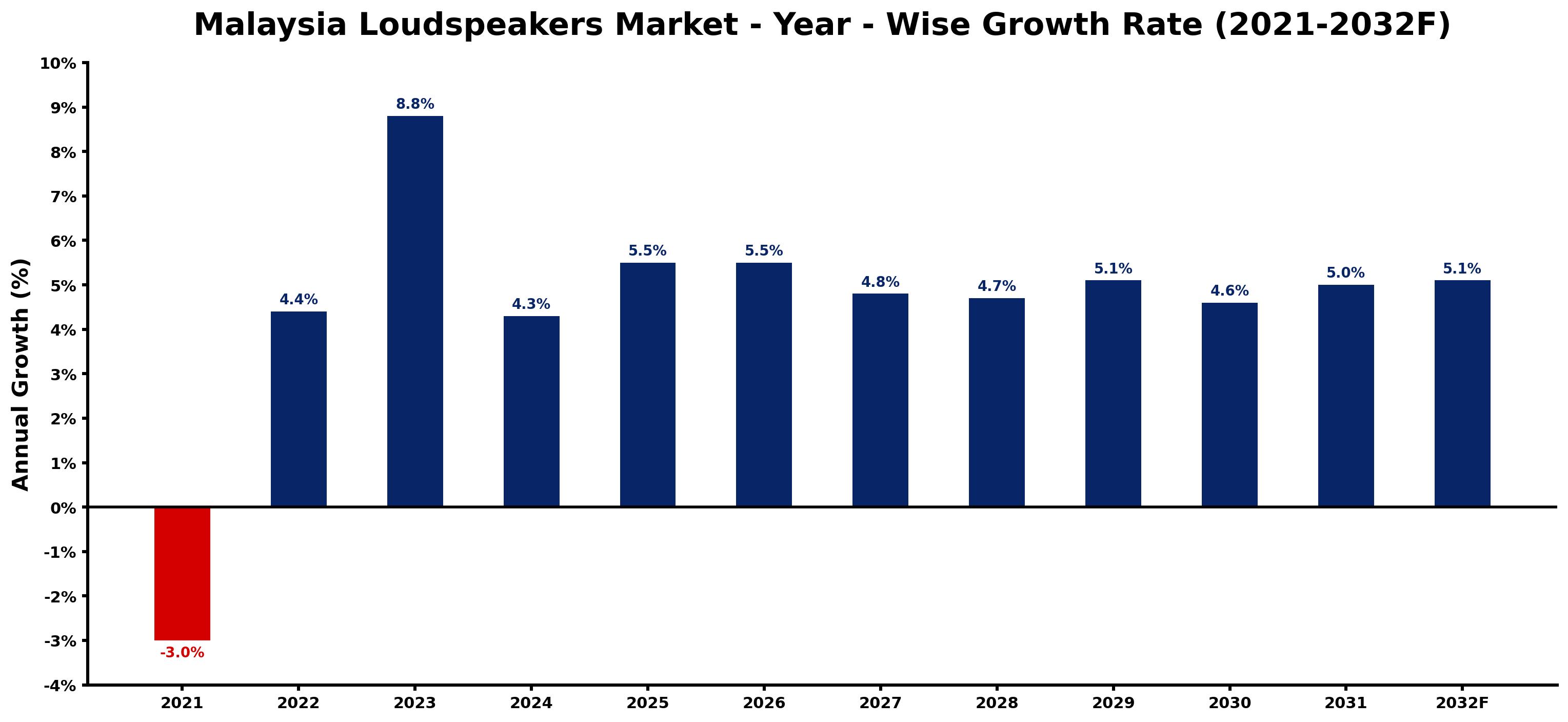
The table below presents the year wise growth rates along with the key drivers influencing the market
| Year | Growth Rate | Major Drivers |
| 2021 | -3.0% | Pandemicrelated disruptions severely limited live events, diminishing the demand for professional loudspeakers significantly. |
| 2022 | 4.4% | Local manufacturers began prioritizing cost-effective loudspeaker solutions for home entertainment setups. |
| 2023 | 8.8% | As e-commerce expanded, online sales channels for loudspeakers became increasingly competitive. |
| 2024 | 4.3% | Emerging tech brands launched innovative loudspeaker designs, appealing to younger consumers. |
| 2025 | 5.5% | Increased urbanization led to higher demand for sound systems in public spaces and venues. |
| 2026 | 5.5% | Consumer preference shifted towards sustainable materials in loudspeaker manufacturing processes. |
| 2027 | 4.8% | Integration of smart technology in loudspeakers captured interest from tech-savvy customers. |
| 2028 | 4.7% | Regional music festivals stimulated interest in portable loudspeakers for outdoor entertainment. |
| 2029 | 5.1% | Local content creators drove demand for high-quality sound equipment for video production. |
| 2030 | 4.6% | Corporate events focused on enhanced audio experiences, elevating demand for professional loudspeakers. |
| 2031 | 5.0% | Educational institutions incorporated advanced sound systems for better learning environments. |
| 2032 | 5.1% | Collaborations between tech companies and audio brands led to innovative product offerings. |
Note - Market size estimations and growth projections presented in this report are based on 6Wresearch's advanced forecasting approach, validated with industry datasets as of June 2026.
Malaysia Loudspeakers Market Synopsis
The Malaysia Loudspeakers Market is projected to reach 5.5% and witness significant growth during the forecast period (2026-2032). This growth is underpinned by several factors, which include rising disposable incomes among consumers, an increasing inclination towards home and car theater systems, and a substantial demand for wireless speakers. Notably, the expansion of smart homes is further driving the sales of soundbars, which are increasingly becoming integral for enhancing the audio experience in modern households. In addition, vendors are actively launching advanced products with contemporary designs that complement the aesthetic appeal of various living and entertainment spaces, thereby spurring the sales of Bluetooth speakers and portable audio devices throughout Malaysia. Furthermore, ongoing technological advancements are enabling manufacturers to offer superior sound quality at competitive prices, encouraging widespread adoption of loudspeakers within the Malaysian market over the coming years.
Malaysia Loudspeakers Market Growth Drivers
Several key drivers are propelling the Malaysia Loudspeakers Market towards robust growth from 2026 to 2032. Chief among these drivers is the escalating disposable income of Malaysian consumers, which has led to an increased willingness to invest in high-quality audio equipment. Additionally, the trend of home entertainment is gaining momentum as more households prioritize immersive audio experiences, resulting in heightened demand for home theater systems and soundbars.
- The rising popularity of smart home technology contributes significantly to the surge in demand for integrated audio solutions, including wireless speakers and soundbars.
- Increased urbanization is influencing lifestyle choices, encouraging consumers to invest in advanced audio systems that enhance their home entertainment setups.
- The ongoing shift towards portability and convenience is fostering the growth of Bluetooth speakers, making them a preferred choice for on-the-go audio experiences.
- Technological innovation, such as advancements in Bluetooth connectivity and acoustic engineering, is improving product performance and attracting consumers willing to pay a premium for superior sound quality.
- Seasonal promotions and marketing strategies from retailers are stimulating purchase behavior, making it easier for consumers to access a wide variety of options in the loudspeaker market.
Malaysia Loudspeakers Market Trends and Opportunities
The Malaysia Loudspeakers Market is currently witnessing several notable trends that present opportunities for growth. The increasing integration of artificial intelligence in audio devices is revolutionizing the way consumers interact with sound systems, providing a more personalized experience. Additionally, the growing trend of multi-room audio systems encourages consumers to invest in multiple speakers for comprehensive sound coverage throughout their homes.
- The trend towards sustainable and eco-friendly products is prompting manufacturers to consider environmentally friendly materials in speaker designs, catering to the conscious consumer.
- The rise in online shopping and e-commerce platforms is expanding market reach, allowing consumers to access a wider range of loudspeaker products with ease.
- Social media-driven marketing campaigns are effectively influencing consumer choices, making it essential for brands to engage with their audience online.
- Collaboration between technology and design is resulting in aesthetically pleasing products that not only perform well but also enhance the interior decor of homes and offices.
- Emerging trends in gaming are increasing demand for high-fidelity loudspeakers, as gamers seek immersive audio experiences that elevate their gaming sessions.
Malaysia Loudspeakers Market Challenges and Restraints
While the Malaysia Loudspeakers Market is poised for growth, several challenges and restraints need to be acknowledged. The high level of competition among manufacturers could lead to price wars, affecting profit margins. Additionally, the fluctuating costs of raw materials may impact production expenses, making it difficult for companies to maintain price stability.
- The potential for market saturation could limit growth opportunities, particularly in urban areas where consumers may already own multiple audio devices.
- Consumer preferences may shift rapidly due to advancements in technology, necessitating continuous innovation to meet changing demands.
- Economic fluctuations could influence disposable incomes and overall consumer spending on non-essential items such as loudspeakers.
- The prevalence of counterfeit products poses a significant risk to brand reputation and consumer trust within the market.
- Regulatory challenges related to product safety and environmental compliance can affect manufacturing processes and product launches.
Malaysia Loudspeakers Market Government Investment and Initiatives
The Malaysian government has recognized the potential of the loudspeakers market within the broader context of technological advancement and consumer electronics. Various initiatives are being undertaken to facilitate growth in this sector, including public spending on technology infrastructure and incentives for local manufacturers to innovate.
- Government policies aimed at promoting smart home technologies are expected to bolster demand for integrated audio solutions among consumers.
- Investments in research and development programs are encouraging local companies to enhance their product offerings and compete effectively on a global scale.
- Public initiatives to elevate the manufacturing sector's capabilities are providing firms with the necessary support to adopt cutting-edge manufacturing processes.
- The introduction of tax incentives for environmentally sustainable products is motivating manufacturers to explore eco-friendly materials and designs.
- Collaboration with educational institutions to foster talent in engineering and design fields is ensuring a skilled workforce that can drive innovation within the loudspeakers market.
Malaysia Loudspeakers Market Latest Developments (May 2025 - June 2026)
The recent developments in the Malaysia Loudspeakers Market from May 2025 to June 2026 indicate a dynamic landscape characterized by technological innovation and shifting consumer trends. There has been a marked increase in the availability of innovative wireless audio solutions, driven by the popularity of smart home integration.
- Manufacturers are increasingly focusing on enhancing Bluetooth technology to ensure seamless connectivity and improved audio performance for consumers.
- The launch of multifunctional soundbars that combine various features, including voice control and smart capabilities, has gained traction among consumers.
- New marketing strategies have emerged, leveraging social media and influencer partnerships to better engage younger audiences and drive online sales.
- Exhibitions and trade shows have showcased the latest advancements in loudspeaker technology, providing a platform for manufacturers to highlight innovative features and designs.
- Consumer feedback loops have become integral in product development cycles, allowing manufacturers to refine their offerings based on market needs and preferences.
Malaysia Loudspeakers Market - Key Attractiveness of the Report
- 10 Years of Market Numbers
- Historical Data Starting from 2022 to 2025
- Base Year: 2025
- Forecast Data until 2032
- Key Performance Indicators Impacting the Market
- Major Upcoming Developments and Projects
Key Highlights of the Report:
- Malaysia Loudspeakers Market Outlook
- Market Size of Malaysia Loudspeakers Market, 2025
- Forecast of Malaysia Loudspeakers Market, 2032F
- Historical Data and Forecast of Malaysia Loudspeakers Revenues & Volume for the Period 2022-2032F
- Malaysia Loudspeakers Market Trend Evolution
- Malaysia Loudspeakers Market Drivers and Challenges
- Malaysia Loudspeakers Price Trends
- Malaysia Loudspeakers Porter's Five Forces
- Malaysia Loudspeakers Industry Life Cycle
- Historical Data and Forecast of Malaysia Loudspeakers Market Revenues & Volume By Type for the Period 2022-2032F
- Historical Data and Forecast of Malaysia Loudspeakers Market Revenues & Volume By Electric Loudspeaker for the Period 2022-2032F
- Historical Data and Forecast of Malaysia Loudspeakers Market Revenues & Volume By Capacitive Loudspeaker for the Period 2022-2032F
- Historical Data and Forecast of Malaysia Loudspeakers Market Revenues & Volume By Electromagnetic Loudspeaker for the Period 2022-2032F
- Historical Data and Forecast of Malaysia Loudspeakers Market Revenues & Volume By Piezoelectric Loudspeaker for the Period 2022-2032F
- Historical Data and Forecast of Malaysia Loudspeakers Market Revenues & Volume By Mounting for the Period 2022-2032F
- Historical Data and Forecast of Malaysia Loudspeakers Market Revenues & Volume By Wall-mounted for the Period 2022-2032F
- Historical Data and Forecast of Malaysia Loudspeakers Market Revenues & Volume By Portable for the Period 2022-2032F
- Historical Data and Forecast of Malaysia Loudspeakers Market Revenues & Volume By Ceiling for the Period 2022-2032F
- Historical Data and Forecast of Malaysia Loudspeakers Market Revenues & Volume By Bracket-mounted for the Period 2022-2032F
- Historical Data and Forecast of Malaysia Loudspeakers Market Revenues & Volume By Flush-mounted for the Period 2022-2032F
- Historical Data and Forecast of Malaysia Loudspeakers Market Revenues & Volume By Sound Level for the Period 2022-2032F
- Historical Data and Forecast of Malaysia Loudspeakers Market Revenues & Volume By < 50dB for the Period 2022-2032F
- Historical Data and Forecast of Malaysia Loudspeakers Market Revenues & Volume By 51 ? 80dB for the Period 2022-2032F
- Historical Data and Forecast of Malaysia Loudspeakers Market Revenues & Volume By >81dB for the Period 2022-2032F
- Historical Data and Forecast of Malaysia Loudspeakers Market Revenues & Volume By Applications for the Period 2022-2032F
- Historical Data and Forecast of Malaysia Loudspeakers Market Revenues & Volume By Commercial for the Period 2022-2032F
- Historical Data and Forecast of Malaysia Loudspeakers Market Revenues & Volume By Agricultural for the Period 2022-2032F
- Historical Data and Forecast of Malaysia Loudspeakers Market Revenues & Volume By Educational Institutions for the Period 2022-2032F
- Malaysia Loudspeakers Import Export Trade Statistics
- Market Opportunity Assessment By Type
- Market Opportunity Assessment By Mounting
- Market Opportunity Assessment By Sound Level
- Market Opportunity Assessment By Applications
- Malaysia Loudspeakers Top Companies Market Share
- Malaysia Loudspeakers Competitive Benchmarking By Technical and Operational Parameters
- Malaysia Loudspeakers Company Profiles
- Malaysia Loudspeakers Key Strategic Recommendations






































