Malaysia Low Power Wide Area Network Market Size & Growth Rate (2026-2032)
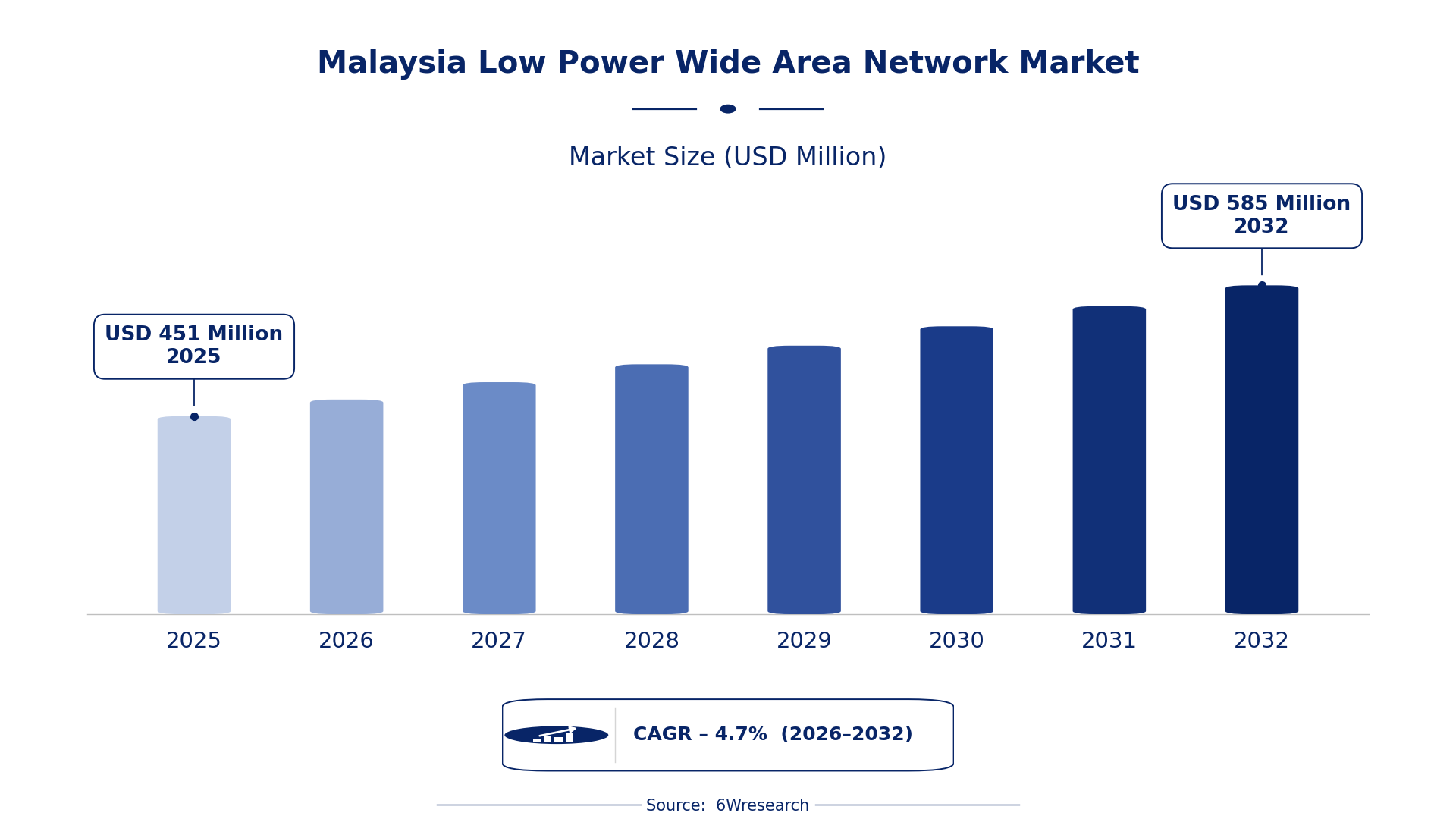
The Malaysia Low Power Wide Area Network Market was estimated at USD 451 Million in 2025 and is projected to reach USD 585 Million by 2032, growing at a CAGR of 4.7% from 2026 to 2032.
Malaysia Low Power Wide Area Network Market Synopsis
The Low Power Wide Area Network (LPWAN) market in Malaysia is gaining momentum as demand for IoT applications escalates. From smart agriculture to urban infrastructure, LPWAN technology is becoming indispensable for connecting a myriad of devices that require efficient long-range connectivity.
As organizations and government bodies embrace digital transformation, LPWAN emerges as a foundational technology. Its capacity to support diverse applications with minimal power consumption places it at the forefront of Malaysia's tech agenda, making the market a hotbed for innovative solutions.
Malaysia Low Power Wide Area Network Market Year-wise Growth Rate and Key Drivers
This graph illustrates the annual growth rates of the Malaysia Low Power Wide Area Network Market from 2021 to 2032, highlighting a steady upward trajectory and projected expansion over the forecast period.
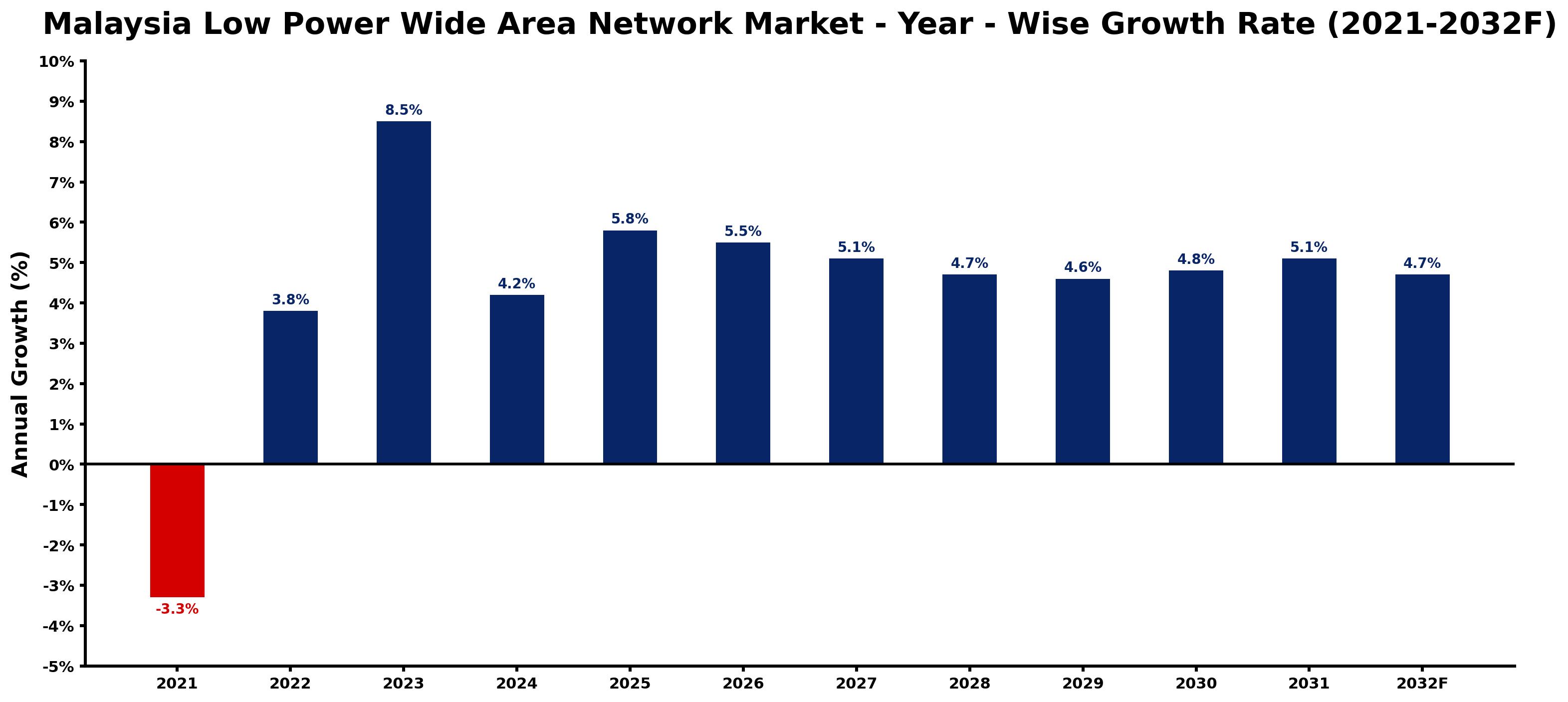
The table below presents the year‑wise growth rates along with the key drivers influencing the market
| Year | Growth Rate | Major Drivers |
| 2021 | -3.3% | Regulatory delays in IoT spectrum allocation by MCMC |
| 2022 | 3.8% | Government support for IoT and LPWAN technologies |
| 2023 | 8.5% | Launch of MyDigital blueprint enhancing digital connectivity |
| 2024 | 4.2% | Increased adoption of smart metering in utilities sector |
| 2025 | 5.8% | Growing urbanization driving demand for LPWAN applications |
| 2026 | 5.5% | Local startups innovating in LPWAN for logistics tracking |
| 2027 | 5.1% | Investment in smart building solutions boosting LPWAN usage |
| 2028 | 4.7% | Partnerships between telcos and industries for LPWAN trials |
| 2029 | 4.6% | Regulatory push for IoT in transportation infrastructure |
| 2030 | 4.8% | Emerging demand for environmental monitoring via LPWAN |
| 2031 | 5.1% | Rising smart city initiatives necessitating wider LPWAN reach |
| 2032 | 4.7% | Increased focus on disaster management IoT solutions |
Note: Market size estimations and growth projections presented in this report are based on 6Wresearch's proprietary forecasting methodology, utilizing the latest available industry data, government publications, and primary research inputs.
Malaysia Low Power Wide Area Network Market Key Takeaways
Below are some of the specific key takeaways from the market, including:
- LPWAN is essential for powering a wide range of IoT applications across various sectors.
- There is growing competition among solution providers, which enhances technology adoption.
- The need for long-range, low-power connectivity is driving investments in LPWAN technologies.
- Market growth is influenced by government initiatives that prioritize smart city development.
- Challenges related to standardization and regulatory issues continue to affect market expansion.
Evaluation of Restraints in Malaysia Low Power Wide Area Network Market
Despite the optimism surrounding LPWAN in Malaysia, significant challenges remain. One major restraint is the complexity of ensuring reliable connectivity over vast distances while maintaining minimal power usage. Providers often grapple with the balance between extensive coverage and energy efficiency, which can deter deployment in less accessible regions. Furthermore, the lack of uniform regulatory standards can complicate interoperability, thereby hindering broader market adoption. Addressing these concerns is vital for sustained growth.
Malaysia Low Power Wide Area Network Market Trends
Current trends reveal a notable shift towards integrating LPWAN technology in smart city frameworks. With governments prioritizing urban modernization, there is an increasing emphasis on deploying solutions that optimize resource management and enhance quality of life for citizens.
Additionally, the agricultural sector is witnessing a surge in LPWAN adoption for precision farming applications. These initiatives focus on monitoring soil health, crop conditions, and irrigation needs, enabling farmers to maximize yield while conserving resources.
Malaysia Low Power Wide Area Network Market Opportunities
The LPWAN market in Malaysia presents ample opportunities for growth, particularly in sectors like healthcare and logistics. For instance, the need for remote patient monitoring systems is on the rise, which can significantly benefit from LPWAN's capabilities. Similarly, logistics firms are looking to enhance asset tracking to improve supply chain efficiencies. Such initiatives promise lucrative avenues for investment and technological advancement.
Government Initiatives in the Malaysia Low Power Wide Area Network Market
The Malaysian government has recognized the transformative potential of LPWAN technologies and is implementing policies to foster this growth. Regulatory frameworks and public-private partnerships are designed to enhance connectivity infrastructure across urban and rural areas, making LPWAN a focal point in national development strategies. These initiatives are critical for supporting various sectors reliant on IoT technology.
- A national digital infrastructure upgrade programme launched in early 2024 aims to boost connectivity in underserved regions.
- Current initiatives include the rollout of LPWAN solutions across smart city pilot projects, focusing on traffic management and environmental monitoring.
- Planned public-private partnerships expected to commence in 2026 will enhance IoT adoption in agricultural applications.
- The establishment of a regulatory task force in mid-2025 is set to streamline standards for LPWAN technologies.
Future Insights of the Malaysia Low Power Wide Area Network Market
Looking ahead to 2026-2032, the Malaysia Low Power Wide Area Network Market is expected to evolve significantly. As urban environments become increasingly connected, LPWAN will play a crucial role in ensuring that smart solutions are efficiently integrated. The convergence of various technologies, such as AI and machine learning with LPWAN, will further drive innovation and application potential, enabling more data-driven decision-making across multiple sectors.
Malaysia Low Power Wide Area Network Market Latest Developments
In the past year, Malaysia's LPWAN market has seen a flurry of activity, reflecting the urgent demand for efficient connectivity solutions. The focus has been on both expanding existing networks and developing new applications that leverage LPWAN technology.
- A major technology vendor launched a new LPWAN platform in early 2025, enhancing support for IoT applications in smart cities.
- Initiatives underway as of late 2024 include a collaboration between municipal governments and tech firms to deploy LPWAN for city-wide environmental monitoring.
- A new asset tracking solution based on LPWAN technology is planned for rollout in Q3 2026, targeting logistics companies.
- Recent partnerships in late 2023 between regional operators are aimed at consolidating LPWAN infrastructure to improve service quality.
Malaysia Low Power Wide Area Network Market - Key Attractiveness of the Report
- 10 Years of Market Numbers
- Historical Data Starting from 2022 to 2025
- Base Year: 2025
- Forecast Data until 2032
- Key Performance Indicators Impacting the Market
- Major Upcoming Developments and Projects
Key Highlights of the Report:
- Malaysia Low Power Wide Area Network Market Outlook
- Market Size of Malaysia Low Power Wide Area Network Market, 2025
- Forecast of Malaysia Low Power Wide Area Network Market, 2032
- Historical Data and Forecast of Malaysia Low Power Wide Area Network Revenues & Volume for the Period 2022-2032F
- Malaysia Low Power Wide Area Network Market Trend Evolution
- Malaysia Low Power Wide Area Network Market Drivers and Challenges
- Malaysia Low Power Wide Area Network Price Trends
- Malaysia Low Power Wide Area Network Porter's Five Forces
- Malaysia Low Power Wide Area Network Industry Life Cycle
- Historical Data and Forecast of Malaysia Low Power Wide Area Network Market Revenues & Volume By Connectivity Technology for the Period 2022-2032F
- Historical Data and Forecast of Malaysia Low Power Wide Area Network Market Revenues & Volume By SIGFOX for the Period 2022-2032F
- Historical Data and Forecast of Malaysia Low Power Wide Area Network Market Revenues & Volume By LoRaWAN for the Period 2022-2032F
- Historical Data and Forecast of Malaysia Low Power Wide Area Network Market Revenues & Volume By Weigthless for the Period 2022-2032F
- Historical Data and Forecast of Malaysia Low Power Wide Area Network Market Revenues & Volume By Others for the Period 2022-2032F
- Historical Data and Forecast of Malaysia Low Power Wide Area Network Market Revenues & Volume By Verticals for the Period 2022-2032F
- Historical Data and Forecast of Malaysia Low Power Wide Area Network Market Revenues & Volume By Agriculture for the Period 2022-2032F
- Historical Data and Forecast of Malaysia Low Power Wide Area Network Market Revenues & Volume By Smart Logistic and Transportation for the Period 2022-2032F
- Historical Data and Forecast of Malaysia Low Power Wide Area Network Market Revenues & Volume By Healthcare for the Period 2022-2032F
- Historical Data and Forecast of Malaysia Low Power Wide Area Network Market Revenues & Volume By Industrial Manufacturing for the Period 2022-2032F
- Historical Data and Forecast of Malaysia Low Power Wide Area Network Market Revenues & Volume By Oil and Gas for the Period 2022-2032F
- Historical Data and Forecast of Malaysia Low Power Wide Area Network Market Revenues & Volume By Consumer Electronics for the Period 2022-2032F
- Historical Data and Forecast of Malaysia Low Power Wide Area Network Market Revenues & Volume By Others for the Period 2022-2032F
- Historical Data and Forecast of Malaysia Low Power Wide Area Network Market Revenues & Volume By Application for the Period 2022-2032F
- Historical Data and Forecast of Malaysia Low Power Wide Area Network Market Revenues & Volume By Smart Waste Management for the Period 2022-2032F
- Historical Data and Forecast of Malaysia Low Power Wide Area Network Market Revenues & Volume By Smart Buildings for the Period 2022-2032F
- Historical Data and Forecast of Malaysia Low Power Wide Area Network Market Revenues & Volume By Smart Gas and Water Metering for the Period 2022-2032F
- Historical Data and Forecast of Malaysia Low Power Wide Area Network Market Revenues & Volume By Smart Streetlights for the Period 2022-2032F
- Historical Data and Forecast of Malaysia Low Power Wide Area Network Market Revenues & Volume By Smart Parking for the Period 2022-2032F
- Historical Data and Forecast of Malaysia Low Power Wide Area Network Market Revenues & Volume By Livestock Monitoring for the Period 2022-2032F
- Historical Data and Forecast of Malaysia Low Power Wide Area Network Market Revenues & Volume By Others for the Period 2022-2032F
- Historical Data and Forecast of Malaysia Low Power Wide Area Network Market Revenues & Volume By Network Deployment for the Period 2022-2032F
- Historical Data and Forecast of Malaysia Low Power Wide Area Network Market Revenues & Volume By Public Sector for the Period 2022-2032F
- Historical Data and Forecast of Malaysia Low Power Wide Area Network Market Revenues & Volume By Private Sector for the Period 2022-2032F
- Historical Data and Forecast of Malaysia Low Power Wide Area Network Market Revenues & Volume By Technology Service for the Period 2022-2032F
- Historical Data and Forecast of Malaysia Low Power Wide Area Network Market Revenues & Volume By Managed Services for the Period 2022-2032F
- Historical Data and Forecast of Malaysia Low Power Wide Area Network Market Revenues & Volume By Professional Services for the Period 2022-2032F
- Malaysia Low Power Wide Area Network Import Export Trade Statistics
- Market Opportunity Assessment By Connectivity Technology
- Market Opportunity Assessment By Verticals
- Market Opportunity Assessment By Application
- Market Opportunity Assessment By Network Deployment
- Market Opportunity Assessment By Technology Service
- Malaysia Low Power Wide Area Network Top Companies Market Share
- Malaysia Low Power Wide Area Network Competitive Benchmarking By Technical and Operational Parameters
- Malaysia Low Power Wide Area Network Company Profiles
- Malaysia Low Power Wide Area Network Key Strategic Recommendations






































