Malaysia Lubrication System Market Summary
The malaysia lubrication system market was estimated at USD 321 Million in 2025 and is projected to reach USD 418 Million by 2032, growing at a CAGR of 5.1% from 2026 to 2032.
Malaysia Lubrication System Market Year-wise Growth Rate and Key Drivers
This graph highlights how the Malaysia Lubrication System Market has steadily grown over the past five years, supported by major growth factors.
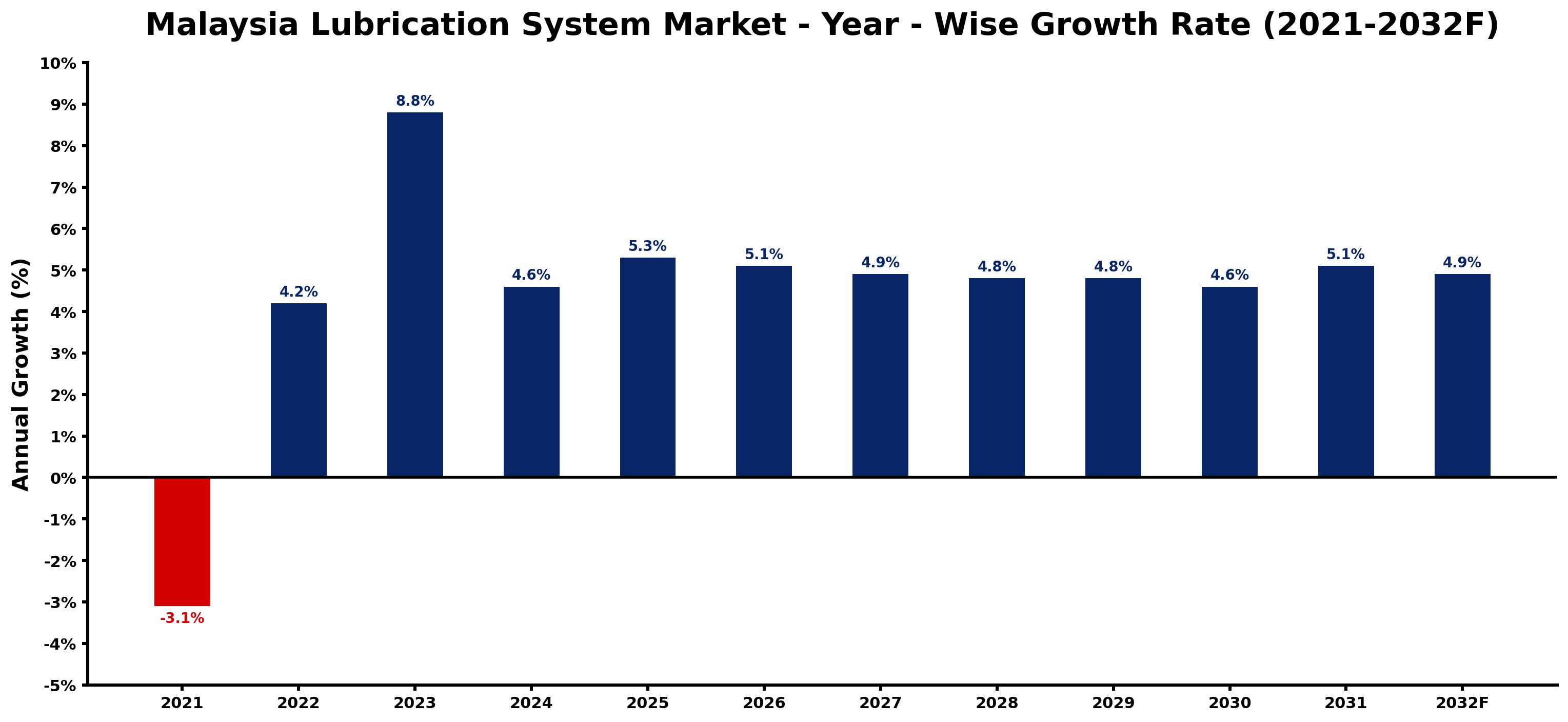
The table below presents the year wise growth rates along with the key drivers influencing the market
| Year | Growth Rate | Major Drivers |
| 2021 | -3.1% | Increased adoption of electric vehicles diminished demand for traditional lubrication systems in the automotive sector. |
| 2022 | 4.2% | Petrochemical industry expansions provided increased opportunities for lubrication applications. |
| 2023 | 8.8% | Emerging electric vehicle market created demand for advanced lubrication systems. |
| 2024 | 4.6% | Research investments aimed at enhancing lubrication performance and efficiency surged significantly. |
| 2025 | 5.3% | Industrial automation trends stimulated interest in high-performance lubrication technologies. |
| 2026 | 5.1% | Regional infrastructure projects highlighted the necessity for robust lubrication systems. |
| 2027 | 4.9% | Technological innovations in synthetic lubricants garnered attention from various sectors. |
| 2028 | 4.8% | Growing commercial vehicle segment increased the need for specialized lubrication products. |
| 2029 | 4.8% | Partnerships between manufacturers and suppliers focused on enhancing service delivery. |
| 2030 | 4.6% | Sustainability practices in manufacturing influenced lubricant formulations and applications. |
| 2031 | 5.1% | Digital transformation prompted the integration of IoT in lubrication systems management. |
| 2032 | 4.9% | Global supply chain dynamics reshaped sourcing strategies for lubrication materials. |
Note - Market size estimations and growth projections presented in this report are based on 6Wresearch's advanced forecasting approach, validated with industry datasets as of June 2026.
Malaysia Lubrication System Market Synopsis
The Malaysia Lubrication System Market is projected to reach 5.1% and witness significant growth during the forecast period (2026-2032). The market is anticipated to experience a compound annual growth rate (CAGR) of 4.8%, driven by multiple factors including the increasing demand for advanced automotive lubricants, the growth in production of automobiles, and stringent government regulations aimed at promoting efficiency. The industrial sector's burgeoning requirement for lubricants, particularly in oil gas, mining, and manufacturing, complements this growth trajectory.
Malaysia Lubrication System Market Growth Drivers
The dynamics of the Malaysia Lubrication System Market are shaped by several key drivers that influence both demand and adoption rates. The following factors are particularly noteworthy:
- The automotive industry's expansion is a major catalyst for growth; with rising automobile production, the demand for high-quality lubricants is increasing to enhance vehicle performance and longevity.
- Industrial sectors have increased their focus on operational efficiency, prompting investments in advanced lubrication systems that can minimize downtime and improve equipment lifespan.
- Government regulations promoting environmental sustainability and efficiency are pushing industries to adopt modern lubrication technologies, creating a supportive environment for market growth.
- The transition towards renewable energy sources is prompting the development of new lubricants that meet emerging industry standards, therefore opening new avenues for market expansion.
- Foreign investments in the Malaysian market are on the rise, further stimulating demand for sophisticated lubrication systems that meet global benchmarks in quality and performance.
Malaysia Lubrication System Market Challenges and Restraints
Despite the positive growth outlook, the Malaysia Lubrication System Market faces certain challenges that could impact its trajectory:
- The high initial costs associated with the installation of automated greasing systems may deter organizations from making necessary investments, slowing down overall market adoption.
- A lack of skilled labor to operate and maintain advanced lubrication systems could limit the effective use of these technologies, affecting overall operational efficiency.
- Fluctuations in raw material prices due to geopolitical factors may also impact manufacturing costs, leading to increased pricing pressures on end-users.
- There is a need for continuous innovation in product offerings to meet the evolving demands of various industries, which can be resource-intensive.
- Stringent environmental regulations may pose additional compliance costs for manufacturers, potentially impacting their profitability.
Malaysia Lubrication System Market Investment Opportunities
The investment landscape within the Malaysia Lubrication System Market appears robust, supported by various emerging opportunities:
- As the automotive sector grows, there will be increasing opportunities for investment in research and development of high-performance lubricants tailored to modern vehicles.
- Investment in oil & gas exploration and production will necessitate enhanced lubrication systems, providing a lucrative avenue for companies specializing in this space.
- The rising emphasis on renewable energy presents opportunities for developing innovative lubrication solutions that cater to clean energy technologies.
- Expansion of manufacturing capabilities in Malaysia provides potential for local and foreign investment in production facilities that can meet the growing lubricant demand.
- Public-private partnerships can further enhance infrastructure development, leading to new opportunities for market players looking to innovate and expand their offerings.
Malaysia Lubrication System Market Government Investment and Initiatives
The Malaysian government is playing a vital role in supporting the lubrication system market through various initiatives aimed at fostering economic growth:
- Government programs focusing on industrial growth encourage local manufacturing and technological advancements within the lubrication sector.
- Strategic initiatives promoting investment in sustainable energy solutions indirectly bolster demand for advanced lubrication systems by encouraging cleaner technologies.
- Public spending on infrastructure development, particularly in transportation and logistics, boosts the automotive sector, which subsequently increases the demand for lubricants.
- Incentives for research and development activities encourage innovation in lubrication technologies, helping fulfill both regulatory requirements and market demands.
- Government support for skill development and training programs in related sectors ensures a competent workforce capable of managing advanced lubrication systems.
Malaysia Lubrication System Market Latest Developments (May 2025 - June 2026)
Recent developments in the Malaysia Lubrication System Market indicate a trend toward enhanced innovation and efficiency. Key industry players are focusing on product development that aligns with sustainability initiatives, responding to heightened regulatory pressures. Technological advancements in automated lubrication systems have gained traction, with companies investing heavily in R&D to produce more efficient solutions. Furthermore, collaborations between government entities and private sectors are looking to bolster investments in lubrication infrastructure, supporting the burgeoning market. A noticeable shift towards eco-friendly lubricants aligned with sustainability goals is also evident, as consumers increasingly prefer solutions that minimize environmental impact.
Malaysia Lubrication System Market - Key Attractiveness of the Report
- 10 Years of Market Numbers
- Historical Data Starting from 2022 to 2025
- Base Year: 2025
- Forecast Data until 2032
- Key Performance Indicators Impacting the Market
- Major Upcoming Developments and Projects
Key drivers include increased production of automobiles, rising industrial lubricant demand, stringent regulations, and investment in sectors like oil & gas and power generation.
Key Highlights of the Report:
- Malaysia Lubrication System Market Outlook
- Market Size of Malaysia Lubrication System Market, 2025
- Forecast of Malaysia Lubrication System Market, 2032F
- Historical Data and Forecast of Malaysia Lubrication System Revenues & Volume for the Period 2022-2032F
- Malaysia Lubrication System Market Trend Evolution
- Malaysia Lubrication System Market Drivers and Challenges
- Malaysia Lubrication System Price Trends
- Malaysia Lubrication System Porter's Five Forces
- Malaysia Lubrication System Industry Life Cycle
- Historical Data and Forecast of Malaysia Lubrication System Market Revenues & Volume By Line Type for the Period 2022-2032F
- Historical Data and Forecast of Malaysia Lubrication System Market Revenues & Volume By Manual Lubrication Systems for the Period 2022-2032F
- Historical Data and Forecast of Malaysia Lubrication System Market Revenues & Volume By Automatic Lubrication Systems for the Period 2022-2032F
- Historical Data and Forecast of Malaysia Lubrication System Market Revenues & Volume By Product Type for the Period 2022-2032F
- Historical Data and Forecast of Malaysia Lubrication System Market Revenues & Volume By Single-Product Lubrication Systems for the Period 2022-2032F
- Historical Data and Forecast of Malaysia Lubrication System Market Revenues & Volume By Dual-Product Lubrication Systems for the Period 2022-2032F
- Historical Data and Forecast of Malaysia Lubrication System Market Revenues & Volume By Multi-Product Lubrication Systems for the Period 2022-2032F
- Historical Data and Forecast of Malaysia Lubrication System Market Revenues & Volume By Series Progressive for the Period 2022-2032F
- Historical Data and Forecast of Malaysia Lubrication System Market Revenues & Volume By Circulating Oil for the Period 2022-2032F
- Historical Data and Forecast of Malaysia Lubrication System Market Revenues & Volume By Oil & Air for the Period 2022-2032F
- Historical Data and Forecast of Malaysia Lubrication System Market Revenues & Volume By Application for the Period 2022-2032F
- Historical Data and Forecast of Malaysia Lubrication System Market Revenues & Volume By Cement Plants for the Period 2022-2032F
- Historical Data and Forecast of Malaysia Lubrication System Market Revenues & Volume By Steel Industry for the Period 2022-2032F
- Historical Data and Forecast of Malaysia Lubrication System Market Revenues & Volume By Mining & Mineral Processing for the Period 2022-2032F
- Historical Data and Forecast of Malaysia Lubrication System Market Revenues & Volume By Paper & Printing for the Period 2022-2032F
- Historical Data and Forecast of Malaysia Lubrication System Market Revenues & Volume By Automotive for the Period 2022-2032F
- Historical Data and Forecast of Malaysia Lubrication System Market Revenues & Volume By Industrial Machine & Machine Tools for the Period 2022-2032F
- Historical Data and Forecast of Malaysia Lubrication System Market Revenues & Volume By Construction Machines Machines for the Period 2022-2032F
- Malaysia Lubrication System Import Export Trade Statistics
- Market Opportunity Assessment By Line Type
- Market Opportunity Assessment By Product Type
- Market Opportunity Assessment By Application
- Malaysia Lubrication System Top Companies Market Share
- Malaysia Lubrication System Competitive Benchmarking By Technical and Operational Parameters
- Malaysia Lubrication System Company Profiles
- Malaysia Lubrication System Key Strategic Recommendations






































