Malaysia Luggage Market Size Growth Rate
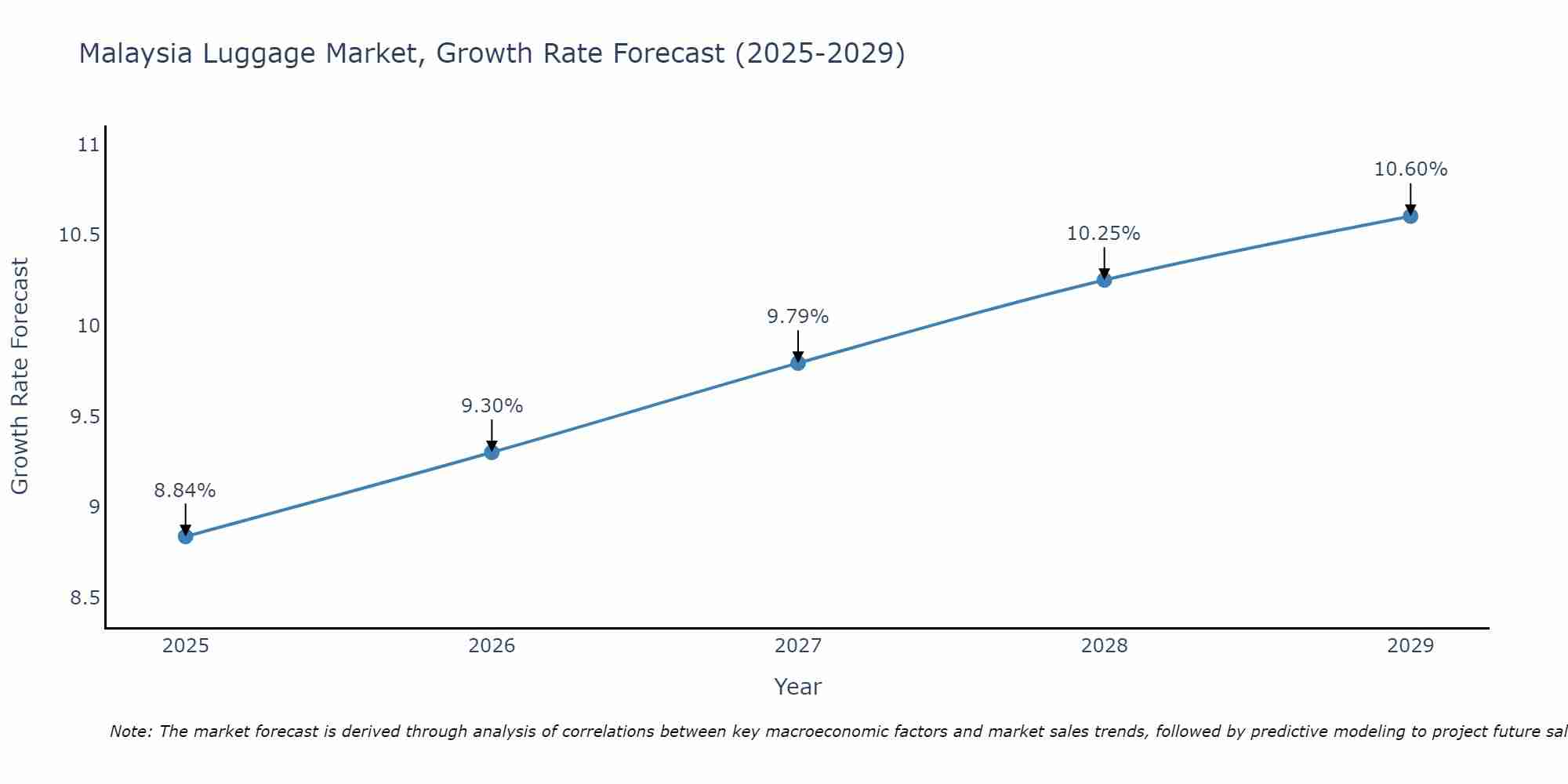
The Malaysia Luggage Market is poised for steady growth rate improvements from 2025 to 2029. From 8.84% in 2025, the growth rate steadily ascends to 10.60% in 2029.
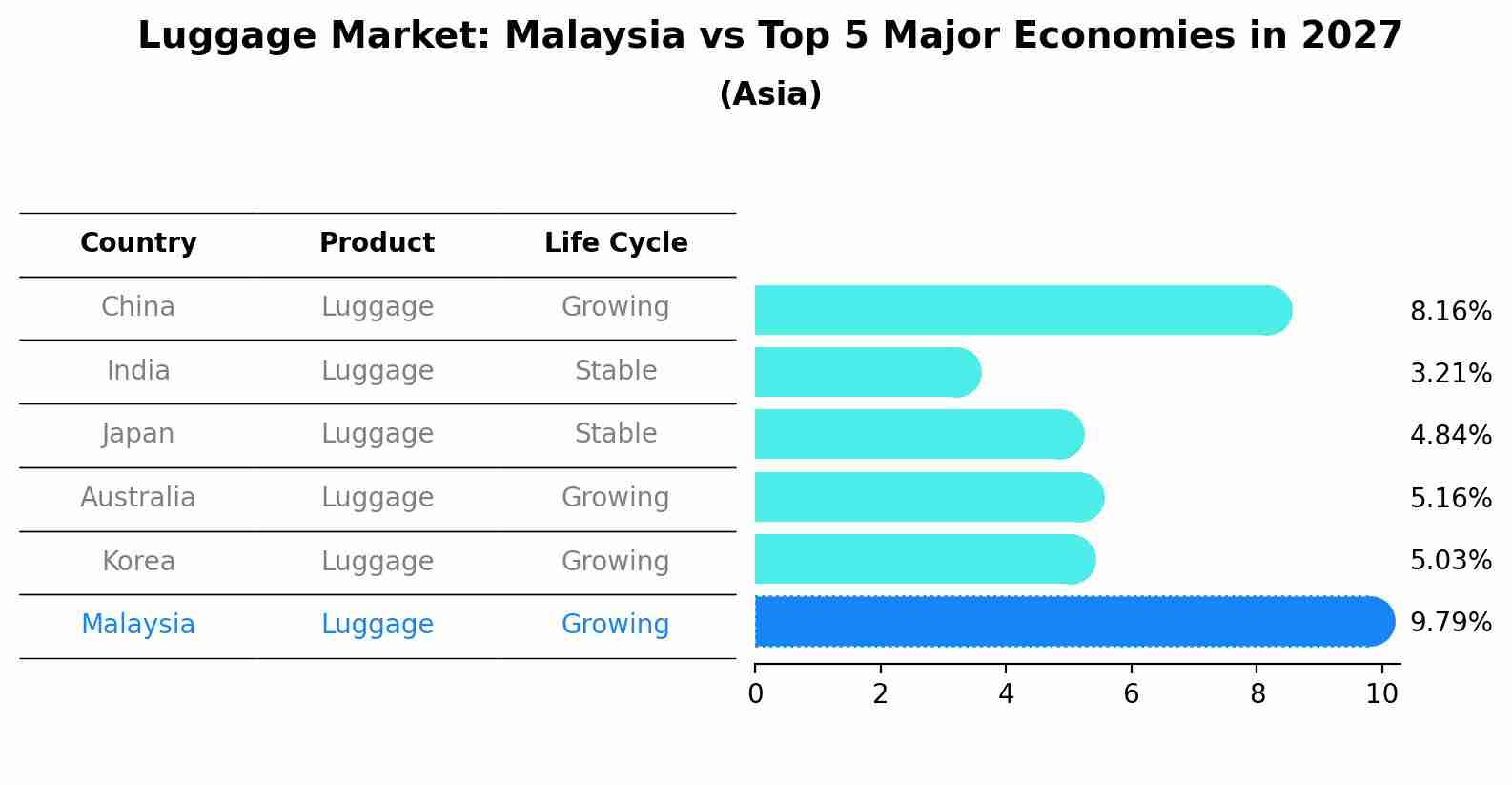
Luggage Market: Malaysia vs Top 5 Major Economies in 2027 (Asia)
The Luggage market in Malaysia is projected to grow at a growing growth rate of 9.79% by 2027, within the Asia region led by China, along with other countries like India, Japan, Australia and South Korea, collectively shaping a dynamic and evolving market environment driven by innovation and increasing adoption of emerging technologies.
Malaysia Luggage Market Synopsis
The Malaysia luggage market is expected to reach USD 570.4 million by 2026, growing at a CAGR of 5.3% during the forecast period 2020-2026. The growth in this luggage market can be attributed to increasing demand for fashionable and stylish products among travelers, surge in e-commerce industry, rising disposable incomes of people across Malaysia and other developing countries, and availability of innovative designs with improved quality materials.
However, fluctuating cost of raw materials such as polyester and PVC used in manufacturing various types of bags may hamper the market growth over the forecast period from 2020 to 2026. Additionally, increasing environmental awareness about plastic utilization will likely challenge manufacturers ability to produce durable yet lightweight products which might restrain the overall industry expansion during the projected timeframe.
Key Highlights of the Report:
- Malaysia Luggage Market Outlook
- Market Size of Malaysia Luggage Market, 2019
- Forecast of Malaysia Luggage Market, 2026
- Historical Data and Forecast of Malaysia Luggage Revenues & Volume for the Period 2016 - 2026
- Malaysia Luggage Market Trend Evolution
- Malaysia Luggage Market Drivers and Challenges
- Malaysia Luggage Price Trends
- Malaysia Luggage Porter's Five Forces
- Malaysia Luggage Industry Life Cycle
- Historical Data and Forecast of Malaysia Luggage Market Revenues & Volume By Product Type for the Period 2016 - 2026
- Historical Data and Forecast of Malaysia Luggage Market Revenues & Volume By Travel Luggage for the Period 2016 - 2026
- Historical Data and Forecast of Malaysia Luggage Market Revenues & Volume By Casual Luggage for the Period 2016 - 2026
- Historical Data and Forecast of Malaysia Luggage Market Revenues & Volume By Business Luggage for the Period 2016 - 2026
- Historical Data and Forecast of Malaysia Luggage Market Revenues & Volume By Sports Luggage for the Period 2016 - 2026
- Historical Data and Forecast of Malaysia Luggage Market Revenues & Volume By Other Product Types for the Period 2016 - 2026
- Historical Data and Forecast of Malaysia Luggage Market Revenues & Volume By Distribution Channel for the Period 2016 - 2026
- Historical Data and Forecast of Malaysia Luggage Market Revenues & Volume By Online for the Period 2016 - 2026
- Historical Data and Forecast of Malaysia Luggage Market Revenues & Volume By Offline for the Period 2016 - 2026
- Malaysia Luggage Import Export Trade Statistics
- Market Opportunity Assessment By Product Type
- Market Opportunity Assessment By Distribution Channel
- Malaysia Luggage Top Companies Market Share
- Malaysia Luggage Competitive Benchmarking By Technical and Operational Parameters
- Malaysia Luggage Company Profiles
- Malaysia Luggage Key Strategic Recommendations






































