Malaysia Magnesium Metal Market Size, Share & Growth Rate
The Malaysia Magnesium Metal Market was estimated at USD 281 Million in 2025 and is projected to reach USD 367 Million by 2032, growing at a CAGR of 3.9% from 2026 to 2032. This anticipated growth is primarily driven by the increasing application of magnesium metal in the automotive sector, where its lightweight and strength properties facilitate fuel efficiency. Additionally, the rising demand for eco-friendly products made from magnesium alloys in home appliances is further enhancing the market's prospects.
Malaysia Magnesium Metal Market Year-wise Growth Rate and Key Drivers
This graph highlights how the Malaysia Magnesium Metal Market has steadily grown over the years, supported by major growth factors.
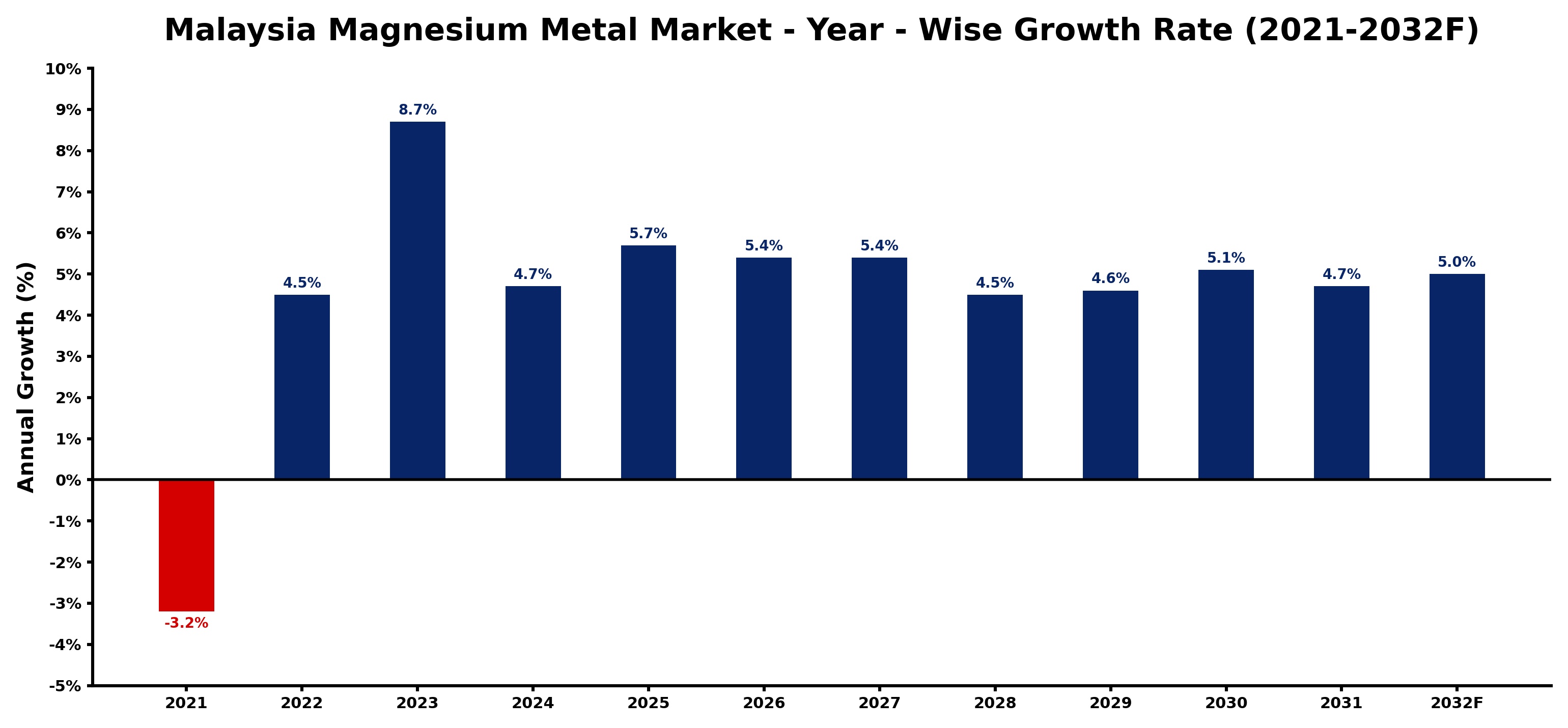
The table below presents the year‑wise growth rates along with the key drivers influencing the market
| Year | Growth Rate | Major Drivers |
| 2021 | -3.2% | Raw material prices limited production |
| 2022 | 4.5% | Automotive sector recovery stimulated demand |
| 2023 | 8.7% | Construction projects increased consumption |
| 2024 | 4.7% | Electronics manufacturing expanded usage |
| 2025 | 5.7% | Aerospace industry growth drove demand |
| 2026 | 5.4% | Renewable energy applications gained traction |
| 2027 | 5.4% | Medical technology advancements increased needs |
| 2028 | 4.5% | Consumer electronics market expanded rapidly |
| 2029 | 4.6% | Lightweight materials trend boosted usage |
| 2030 | 5.1% | Sustainable practices enhanced market appeal |
| 2031 | 4.7% | Innovative applications drove industry growth |
| 2032 | 5.0% | Global trade agreements facilitated exports |
Note - Market size estimations and growth projections presented in this report are based on 6Wresearch’s advanced forecasting approach, validated with industry datasets as of June 2026.
Malaysia Magnesium Metal Market Synopsis
The Malaysian magnesium metal market is experiencing a dynamic shift, particularly due to the rapid expansion of its automotive components sector. Stricter environmental regulations from the Ministry of Energy Science Technology Environment And Climate Change (MESTECC) are nudging manufacturers towards sustainable practices, leading to a surge in magnesium metal usage.
In addition, the growing consumer awareness regarding the benefits of lightweight materials is prompting industries like aerospace and electronics to adopt magnesium. This trend is helping to enhance the overall demand for magnesium metal in Malaysia, aligning with global sustainability goals.
Malaysia Magnesium Metal Market Key Takeaways
- Significant growth driven by automotive, aerospace, and electronics industries.
- Eco-friendly initiatives are pushing demand for lightweight materials.
- Innovations in production technology are required to mitigate environmental impacts.
- Government policies favoring sustainable manufacturing will shape market dynamics.
- Prominent local companies are focusing on quality and metallurgical advancements.
Evaluation of Restraints in Malaysia Magnesium Metal Market
Despite the promising growth trajectory, the Malaysia magnesium metal market contends with several significant restraints. The production of magnesium metal is notably energy-intensive, leading to environmental concerns and higher operational costs. Furthermore, the need to balance the demand for lightweight materials with responsible sourcing and sustainable production methods remains a daunting challenge. These factors necessitate a transition towards more innovative and eco-efficient technologies, compelling industry stakeholders to focus on recycling methods and alternative production practices that can help mitigate these issues.
Malaysia Magnesium Metal Market Trends
Current trends in the Malaysia magnesium metal market indicate a robust shift towards using magnesium alloys in various sectors. The automotive industry is increasingly embracing lightweight materials for vehicle manufacturing, aiming for higher fuel efficiency and lower emissions. Concurrently, advances in technology are enabling improved metallurgical processes that enhance the strength and durability of magnesium products. Additionally, the growing popularity of eco-conscious consumerism is propelling the demand for magnesium in home appliances, further solidifying its role as a versatile material in manufacturing.
Malaysia Magnesium Metal Market Opportunities
Opportunities for growth in the Malaysia magnesium metal market are plentiful, particularly within the automotive and aerospace sectors. The ongoing push for lightweight vehicles presents a fertile ground for innovation, as manufacturers look to incorporate magnesium components to meet stringent performance and regulatory standards. Additionally, investments in research and development can lead to breakthroughs in recycling technologies and production efficiencies. This evolving landscape is ripe for strategic partnerships and collaborations aimed at harnessing the full potential of magnesium metal applications.
Government Initiatives in the Malaysia Magnesium Metal Market
The Malaysian government is actively promoting policies that favor sustainable manufacturing practices, which significantly impacts the magnesium metal market. Initiatives by the Ministry of Energy Science Technology Environment And Climate Change (MESTECC) emphasize reducing carbon emissions and enhancing energy efficiency across industries. Incentives aimed at encouraging the use of eco-friendly materials and technologies support manufacturers in adopting magnesium as a viable alternative, facilitating a favorable environment for market growth.
Future Insights of the Malaysia Magnesium Metal Market
Looking ahead to 2026-2032, the Malaysia magnesium metal market is poised for sustained growth. As industries increasingly prioritize lightweight materials to enhance energy efficiency and performance, magnesium's role will become ever more central. Governmental support for green initiatives, combined with advances in technology and production methodologies, will likely bolster market expansion. Consequently, stakeholders must remain vigilant in adapting to emerging trends and consumer demands, positioning themselves strategically for future success.
Malaysia Magnesium Metal Market Latest Developments (May 2025 - June 2026)
Recent industry developments indicate a heightened focus on sustainability within the Malaysian magnesium metal market. Companies are exploring advanced production techniques to minimize energy consumption and reduce environmental footprints. Collaborative efforts with governmental bodies aim to streamline regulations around magnesium production, encouraging more manufacturers to pivot towards eco-friendly practices. Additionally, strategic partnerships are being formed to invest in innovative technologies that enhance the performance and applications of magnesium in various sectors.
Malaysia Magnesium Metal Market - Key Attractiveness of the Report
- 10 Years of Market Numbers
- Historical Data Starting from 2022 to 2025
- Base Year: 2025
- Forecast Data until 2032
- Key Performance Indicators Impacting the Market
- Major Upcoming Developments and Projects
Key Highlights of the Report:
- Malaysia Magnesium Metal Market Outlook
- Market Size of Malaysia Magnesium Metal Market, 2025
- Forecast of Malaysia Magnesium Metal Market, 2032
- Historical Data and Forecast of Malaysia Magnesium Metal Revenues & Volume for the Period 2022-2032F
- Malaysia Magnesium Metal Market Trend Evolution
- Malaysia Magnesium Metal Market Drivers and Challenges
- Malaysia Magnesium Metal Price Trends
- Malaysia Magnesium Metal Porter's Five Forces
- Malaysia Magnesium Metal Industry Life Cycle
- Historical Data and Forecast of Malaysia Magnesium Metal Market Revenues & Volume By Application for the Period 2022-2032F
- Historical Data and Forecast of Malaysia Magnesium Metal Market Revenues & Volume By Die Casting for the Period 2022-2032F
- Historical Data and Forecast of Malaysia Magnesium Metal Market Revenues & Volume By Aluminum Alloys for the Period 2022-2032F
- Historical Data and Forecast of Malaysia Magnesium Metal Market Revenues & Volume By Titanium Reduction for the Period 2022-2032F
- Historical Data and Forecast of Malaysia Magnesium Metal Market Revenues & Volume By Iron & Steel Making for the Period 2022-2032F
- Historical Data and Forecast of Malaysia Magnesium Metal Market Revenues & Volume By Others for the Period 2022-2032F
- Historical Data and Forecast of Malaysia Magnesium Metal Market Revenues & Volume By End-user Industry for the Period 2022-2032F
- Historical Data and Forecast of Malaysia Magnesium Metal Market Revenues & Volume By Automotive for the Period 2022-2032F
- Historical Data and Forecast of Malaysia Magnesium Metal Market Revenues & Volume By Aerospace for the Period 2022-2032F
- Historical Data and Forecast of Malaysia Magnesium Metal Market Revenues & Volume By Electronics for the Period 2022-2032F
- Historical Data and Forecast of Malaysia Magnesium Metal Market Revenues & Volume By Sports for the Period 2022-2032F
- Historical Data and Forecast of Malaysia Magnesium Metal Market Revenues & Volume By Medical for the Period 2022-2032F
- Historical Data and Forecast of Malaysia Magnesium Metal Market Revenues & Volume By Others for the Period 2022-2032F
- Malaysia Magnesium Metal Import Export Trade Statistics
- Market Opportunity Assessment By Application
- Market Opportunity Assessment By End-user Industry
- Malaysia Magnesium Metal Top Companies Market Share
- Malaysia Magnesium Metal Competitive Benchmarking By Technical and Operational Parameters
- Malaysia Magnesium Metal Company Profiles
- Malaysia Magnesium Metal Key Strategic Recommendations






































