Malaysia Makeup Remover Market Size, Share & Growth Rate
The Malaysia Makeup Remover Market was estimated at USD 461 Million in 2025 and is projected to reach USD 600 Million by 2032, growing at a CAGR of 3.8% from 2026 to 2032. This growth trajectory is fueled by the increasing awareness of skin health among Malaysian consumers, alongside a rising demand for high-quality cleansing solutions. The diversification of product offerings, particularly in micellar water and cream-based formulations, also contributes to this burgeoning market.
Malaysia Makeup Remover Market Year-wise Growth Rate and Key Drivers
This graph highlights how the Malaysia Makeup Remover Market has steadily grown over the years, supported by major growth factors.
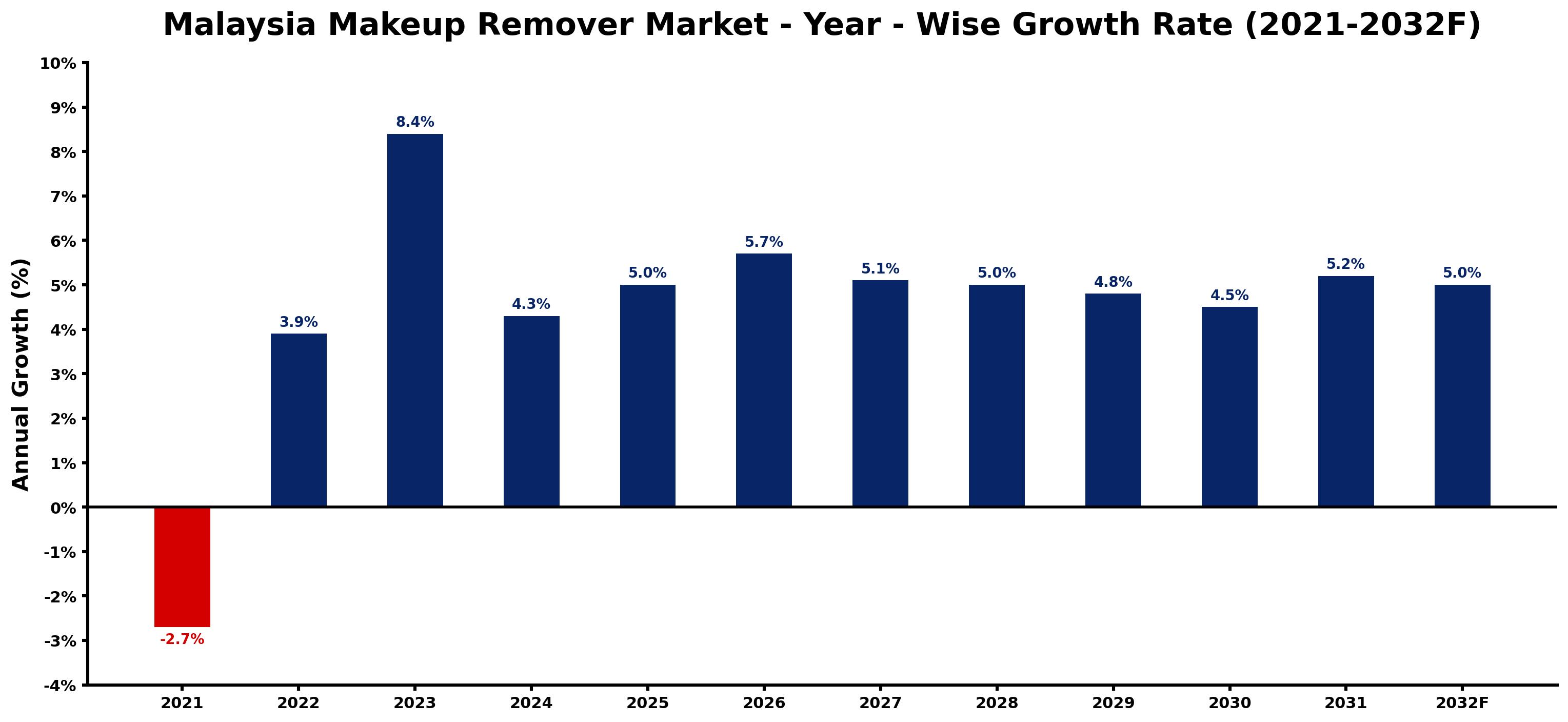
The table below presents the year‑wise growth rates along with the key drivers influencing the market
| Year | Growth Rate | Major Drivers |
| 2021 | -2.7% | Rising electricity demand across industries |
| 2022 | 3.9% | Growing renewable energy integration projects |
| 2023 | 8.4% | Expansion of commercial construction activities |
| 2024 | 4.3% | Expansion of manufacturing activities |
| 2025 | 5.0% | Growing urbanization and commercial development |
| 2026 | 5.7% | Growing urbanization and commercial development |
| 2027 | 5.1% | Rising electricity demand across industries |
| 2028 | 5.0% | Expansion of commercial construction activities |
| 2029 | 4.8% | Government infrastructure modernization initiatives |
| 2030 | 4.5% | Rapid growth in telecom and data center sectors |
| 2031 | 5.2% | Expansion of manufacturing activities |
| 2032 | 5.0% | Expansion of manufacturing activities |
Note - Market size estimations and growth projections presented in this report are based on 6Wresearch’s advanced forecasting approach, validated with industry datasets as of June 2026.
Malaysia Makeup Remover Market Synopsis
Recent momentum in the Malaysia Makeup Remover Market illustrates a shift towards more sophisticated and varied product types, with brands innovating to meet consumer needs. While traditional cleansers still hold a significant share, newer options such as micellar water are rapidly gaining traction, indicating a clear evolution in consumer preferences.
As consumers continue to prioritize skincare, the market is expected to see a substantial shift toward products that not only cleanse but also nourish the skin. This ongoing evolution highlights the competitive landscape, where brands must continually adapt and innovate to capture the attention of an increasingly discerning consumer base.
Malaysia Makeup Remover Market Key Takeaways
- The market is currently driven by an increasing awareness of skin health and beauty among Malaysian consumers.
- Micellar water and cream-based cleansers represent the fastest-growing segments within the market.
- Established brands are expanding their product ranges to include organic and cruelty-free options.
- Online retail channels are gaining prominence, reshaping how consumers purchase makeup removers.
- Innovative marketing strategies are emerging, focusing on the educational aspect of skin care.
Evaluation of Restraints in Malaysia Makeup Remover Market
Despite robust growth, the Malaysia Makeup Remover Market faces several restraints. Consumer hesitation regarding ingredient safety remains a significant barrier, as individuals become more conscious of the potential harmful effects of certain chemicals. Additionally, the prevalence of counterfeit products in the market can undermine brand trust and consumer confidence. Economic fluctuations could also lead to shifts in discretionary spending, affecting premium product sales and limiting market expansion.
Malaysia Makeup Remover Market Trends
Several current and emerging trends are shaping the Malaysia Makeup Remover Market. The rise in demand for eco-friendly and sustainable products is prompting brands to innovate with biodegradable packaging and natural formulations. Additionally, an increase in online beauty consultations is allowing consumers to access personalized recommendations, further influencing purchasing decisions. Social media continues to play a crucial role in shaping beauty standards and influencing trends, as beauty influencers promote various products to their followers.
Malaysia Makeup Remover Market Opportunities
Genuine growth opportunities in the Malaysia Makeup Remover Market lie in the expansion of organic and natural product lines, appealing to the health-conscious consumer. Moreover, targeting niche segments, such as sensitive skin or specialized formulations for specific demographics, presents a lucrative opportunity. The increase in e-commerce and direct-to-consumer models provides additional avenues for market penetration and brand establishment, especially in underrepresented regions.
Government Initiatives in the Malaysia Makeup Remover Market
The Malaysian government has been increasingly supportive of the beauty and personal care industry, implementing policies to promote local manufacturing and innovation. Public spending on health and wellness initiatives indirectly supports the makeup remover market as consumers increasingly seek products that align with these values. Programs encouraging sustainable practices in manufacturing are also emerging, fostering an environment for brands to enhance their commitment to environmental responsibility.
Future Insights of the Malaysia Makeup Remover Market
Looking ahead to 2026-2032, the Malaysia Makeup Remover Market is poised for continued growth. Increasing urbanization and changing lifestyles are likely to drive further adoption of makeup and, subsequently, the demand for effective removers. With consumer preferences leaning towards multifunctional products that cleanse and treat the skin, brands will need to align their offerings accordingly. The anticipated rise in e-commerce penetration will also facilitate market access and amplify competition, ultimately benefitting consumers.
Malaysia Makeup Remover Market Latest Developments (May 2025 - June 2026)
Recent developments in the Malaysia Makeup Remover Market have seen brands rapidly expanding their portfolios to include innovative formulations aimed at diverse consumer needs. The adoption of digital marketing strategies has intensified, with companies utilizing social media platforms for targeted campaigns. Trends indicate a move towards personalized beauty solutions, with some brands introducing customizable makeup removal kits. Regulatory changes are encouraging a focus on cleaner ingredients, positioning brands to compete in an increasingly informed marketplace.
Malaysia Makeup Remover Market - Key Attractiveness of the Report
- 10 Years of Market Numbers
- Historical Data Starting from 2022 to 2025
- Base Year: 2025
- Forecast Data until 2032
- Key Performance Indicators Impacting the Market
- Major Upcoming Developments and Projects
Key Highlights of the Report:
- Malaysia Makeup Remover Market Outlook
- Market Size of Malaysia Makeup Remover Market, 2025
- Forecast of Malaysia Makeup Remover Market, 2032F
- Historical Data and Forecast of Malaysia Makeup Remover Revenues & Volume for the Period 2022-2032F
- Malaysia Makeup Remover Market Trend Evolution
- Malaysia Makeup Remover Market Drivers and Challenges
- Malaysia Makeup Remover Price Trends
- Malaysia Makeup Remover Porter's Five Forces
- Malaysia Makeup Remover Industry Life Cycle
- Historical Data and Forecast of Malaysia Makeup Remover Market Revenues & Volume By Product Type for the Period 2022-2032F
- Historical Data and Forecast of Malaysia Makeup Remover Market Revenues & Volume By Liquid for the Period 2022-2032F
- Historical Data and Forecast of Malaysia Makeup Remover Market Revenues & Volume By Lotion / Cream for the Period 2022-2032F
- Historical Data and Forecast of Malaysia Makeup Remover Market Revenues & Volume By Wipes for the Period 2022-2032F
- Historical Data and Forecast of Malaysia Makeup Remover Market Revenues & Volume By Distribution Channel for the Period 2022-2032F
- Historical Data and Forecast of Malaysia Makeup Remover Market Revenues & Volume By Online for the Period 2022-2032F
- Historical Data and Forecast of Malaysia Makeup Remover Market Revenues & Volume By Offline for the Period 2022-2032F
- Malaysia Makeup Remover Import Export Trade Statistics
- Market Opportunity Assessment By Product Type
- Market Opportunity Assessment By Distribution Channel
- Malaysia Makeup Remover Top Companies Market Share
- Malaysia Makeup Remover Competitive Benchmarking By Technical and Operational Parameters
- Malaysia Makeup Remover Company Profiles
- Malaysia Makeup Remover Key Strategic Recommendations






































