Malaysia Malt Extract Market Size, Share & Growth Rate
The Malaysia Malt Extract Market was estimated at USD 450 Million in 2025 and is projected to reach USD 589 Million by 2032, growing at a CAGR of 3.9% from 2026 to 2032. This growth trajectory is largely fueled by the increasing consumer preference for natural ingredients, especially within the food and beverage sector. As manufacturers explore new avenues for product innovation, the demand for malt extract as a natural sweetener and flavor enhancer continues to gain momentum, further solidifying its position in Malaysias evolving culinary landscape.
Malaysia Malt Extract Market Year-wise Growth Rate and Key Drivers
This graph highlights how the Malaysia Malt Extract Market has steadily grown over the years, supported by major growth factors.
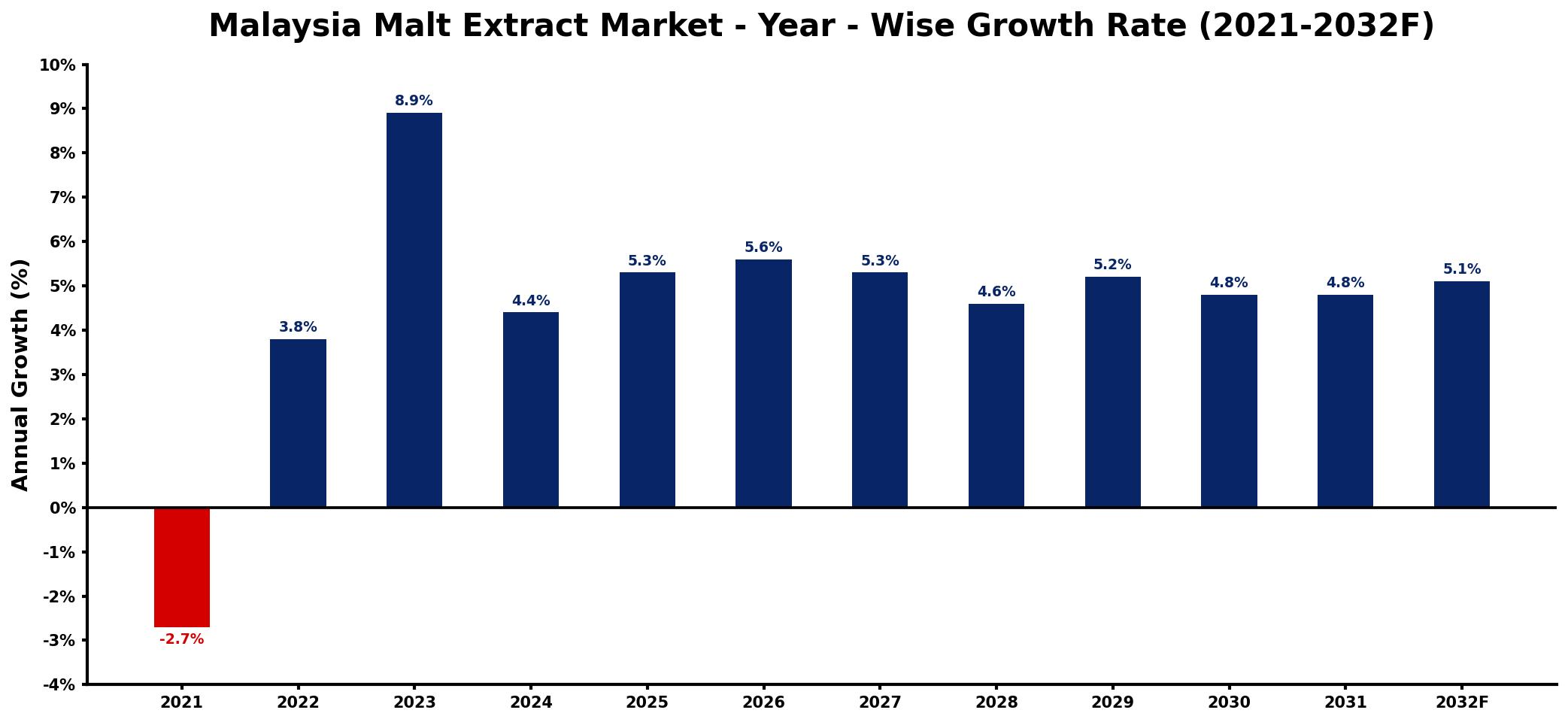
The table below presents the year‑wise growth rates along with the key drivers influencing the market
| Year | Growth Rate | Major Drivers |
| 2021 | -2.7% | decreased consumer interest in beverages |
| 2022 | 3.8% | rising demand for healthy alternatives |
| 2023 | 8.9% | expansion of craft beverage sector |
| 2024 | 4.4% | increased investment in production facilities |
| 2025 | 5.3% | growing popularity of organic products |
| 2026 | 5.6% | enhanced distribution network efficiency |
| 2027 | 5.3% | surge in food industry applications |
| 2028 | 4.6% | increased awareness of nutritional benefits |
| 2029 | 5.2% | growth in e-commerce sales channels |
| 2030 | 4.8% | development of innovative product lines |
| 2031 | 4.8% | rising consumer preference for sustainability |
| 2032 | 5.1% | expansion into international markets |
Note: Market size estimations and growth projections presented in this report are based on 6Wresearch's proprietary forecasting methodology, utilizing the latest available industry data, government publications, and primary research inputs.
Malaysia Malt Extract Market Synopsis
The primary force shaping the Malaysia Malt Extract Market is the rising trend of health-conscious consumption. Consumers are gravitating towards products that boast natural and clean-label attributes, elevating malt extract's status as a preferred ingredient in various applications, including beverages and bakery items. This shift is aligning well with the burgeoning craft brewing scene, which is amplifying the demand for malt extract among small-scale breweries and homebrewers alike.
In addition to its applications in food and beverages, the versatility of malt extract is driving innovation in new product formulations. As Malaysian consumers continue to seek diverse flavor profiles and enhanced nutritional content, malt extract's adaptability is key to meeting their evolving tastes. This landscape presents significant opportunities for market players to introduce inventive offerings that resonate with both traditional and contemporary culinary preferences.
Malaysia Malt Extract Market Key Takeaways
- The market is witnessing a shift towards health-oriented products, driving demand for natural ingredients.
- Craft beer trends are influencing the growth of malt extract among homebrewers and small breweries.
- Innovation in product formulations is creating new applications for malt extract in various sectors.
- Consistent quality and reliable sourcing are pivotal for success in the competitive market landscape.
- COVID-19 brought challenges but also opened avenues for growth in homebrewing and DIY culinary experiences.
Evaluation of Restraints in Malaysia Malt Extract Market
The Malaysia Malt Extract Market does face certain limitations that could inhibit its growth. One significant challenge is the intense competition from alternative sweeteners and flavor enhancers, which may deter manufacturers from fully utilizing malt extract's unique advantages. Additionally, the market relies heavily on the quality of raw materials; thus, maintaining strong supplier relationships is critical. Manufacturers must navigate sourcing challenges to ensure consistency and reliability, which can be complex and resource-intensive.
Malaysia Malt Extract Market Trends
Several trends are shaping the Malaysia Malt Extract Market landscape. There is a growing inclination towards artisanal and craft products, where malt extract plays a pivotal role. Moreover, as consumers become more educated about ingredient labels, the demand for clean-label products featuring malt extract is expected to rise. Additionally, sustainability is becoming a focal point for consumers, prompting manufacturers to adopt eco-friendly practices, further boosting the appeal of natural ingredients like malt extract.
Malaysia Malt Extract Market Opportunities
The Malaysia Malt Extract Market presents several avenues for growth and investment. With the rising popularity of health-conscious diets, brands can capitalize on the trend by developing products that highlight malt extract's nutritional benefits. Additionally, the burgeoning homebrewing sector provides fertile ground for suppliers to introduce specialized malt extracts tailored for DIY brewers. As Malaysian consumers continue to embrace diverse culinary experiences, opportunities to innovate with malt extract are expanding across various food categories.
Government Initiatives in the Malaysia Malt Extract Market
The Malaysian government has been proactive in promoting the local food and beverage industry, including initiatives aimed at supporting natural ingredient sourcing and clean-label product development. Public spending is being directed towards research and development in the agricultural sector, fostering advancements in malt production. Moreover, various programs aim to assist small and medium enterprises in adopting sustainable practices, aligning with the increasing consumer demand for eco-friendly products.
Future Insights of the Malaysia Malt Extract Market
As we look towards the future, the Malaysia Malt Extract Market is poised for significant transformation from 2026 to 2032. The increasing inclination towards artisanal and health-oriented products will likely drive further innovation, compelling manufacturers to experiment with malt extract in novel applications. Additionally, as awareness about the benefits of malt extract continues to grow among consumers, the market is expected to expand, meeting the demands of a more discerning customer base eager for natural and flavorful choices.
Malaysia Malt Extract Market Latest Developments (2025 - 2026)
Recent developments in the Malaysia Malt Extract Market include a noticeable uptick in craft beer production, fostering a greater demand for malt extract as breweries look to differentiate their offerings. Innovative product launches featuring malt extract have been gaining traction across various food segments, reflecting changing consumer preferences. Additionally, a surge in homebrewing has led suppliers to adapt their offerings, catering to DIY enthusiasts eager for quality ingredients.
Malaysia Malt Extract Market - Key Attractiveness of the Report
- 10 Years of Market Numbers
- Historical Data Starting from 2022 to 2025
- Base Year: 2025
- Forecast Data until 2032
- Key Performance Indicators Impacting the Market
- Major Upcoming Developments and Projects
Key Highlights of the Report:
- Malaysia Malt Extract Market Outlook
- Market Size of Malaysia Malt Extract Market, 2025
- Forecast of Malaysia Malt Extract Market, 2032
- Historical Data and Forecast of Malaysia Malt Extract Revenues & Volume for the Period 2022-2032F
- Malaysia Malt Extract Market Trend Evolution
- Malaysia Malt Extract Market Drivers and Challenges
- Malaysia Malt Extract Price Trends
- Malaysia Malt Extract Porter's Five Forces
- Malaysia Malt Extract Industry Life Cycle
- Historical Data and Forecast of Malaysia Malt Extract Market Revenues & Volume By Application for the Period 2022-2032F
- Historical Data and Forecast of Malaysia Malt Extract Market Revenues & Volume By Bakery for the Period 2022-2032F
- Historical Data and Forecast of Malaysia Malt Extract Market Revenues & Volume By Confectionary for the Period 2022-2032F
- Historical Data and Forecast of Malaysia Malt Extract Market Revenues & Volume By Beverages for the Period 2022-2032F
- Historical Data and Forecast of Malaysia Malt Extract Market Revenues & Volume By Animal Feed for the Period 2022-2032F
- Historical Data and Forecast of Malaysia Malt Extract Market Revenues & Volume By Pharmaceuticals for the Period 2022-2032F
- Historical Data and Forecast of Malaysia Malt Extract Market Revenues & Volume By Source for the Period 2022-2032F
- Historical Data and Forecast of Malaysia Malt Extract Market Revenues & Volume By Barley for the Period 2022-2032F
- Historical Data and Forecast of Malaysia Malt Extract Market Revenues & Volume By Wheat for the Period 2022-2032F
- Historical Data and Forecast of Malaysia Malt Extract Market Revenues & Volume By Rice for the Period 2022-2032F
- Historical Data and Forecast of Malaysia Malt Extract Market Revenues & Volume By Rye for the Period 2022-2032F
- Historical Data and Forecast of Malaysia Malt Extract Market Revenues & Volume By Product Form for the Period 2022-2032F
- Historical Data and Forecast of Malaysia Malt Extract Market Revenues & Volume By Dry for the Period 2022-2032F
- Historical Data and Forecast of Malaysia Malt Extract Market Revenues & Volume By Liquid for the Period 2022-2032F
- Historical Data and Forecast of Malaysia Malt Extract Market Revenues & Volume By Product Type for the Period 2022-2032F
- Historical Data and Forecast of Malaysia Malt Extract Market Revenues & Volume By Standard for the Period 2022-2032F
- Historical Data and Forecast of Malaysia Malt Extract Market Revenues & Volume By Speciality for the Period 2022-2032F
- Malaysia Malt Extract Import Export Trade Statistics
- Market Opportunity Assessment By Application
- Market Opportunity Assessment By Source
- Market Opportunity Assessment By Product Form
- Market Opportunity Assessment By Product Type
- Malaysia Malt Extract Top Companies Market Share
- Malaysia Malt Extract Competitive Benchmarking By Technical and Operational Parameters
- Malaysia Malt Extract Company Profiles
- Malaysia Malt Extract Key Strategic Recommendations






































