Malaysia Manufacturing Analytics Market Size & Growth Rate (2026-2032)
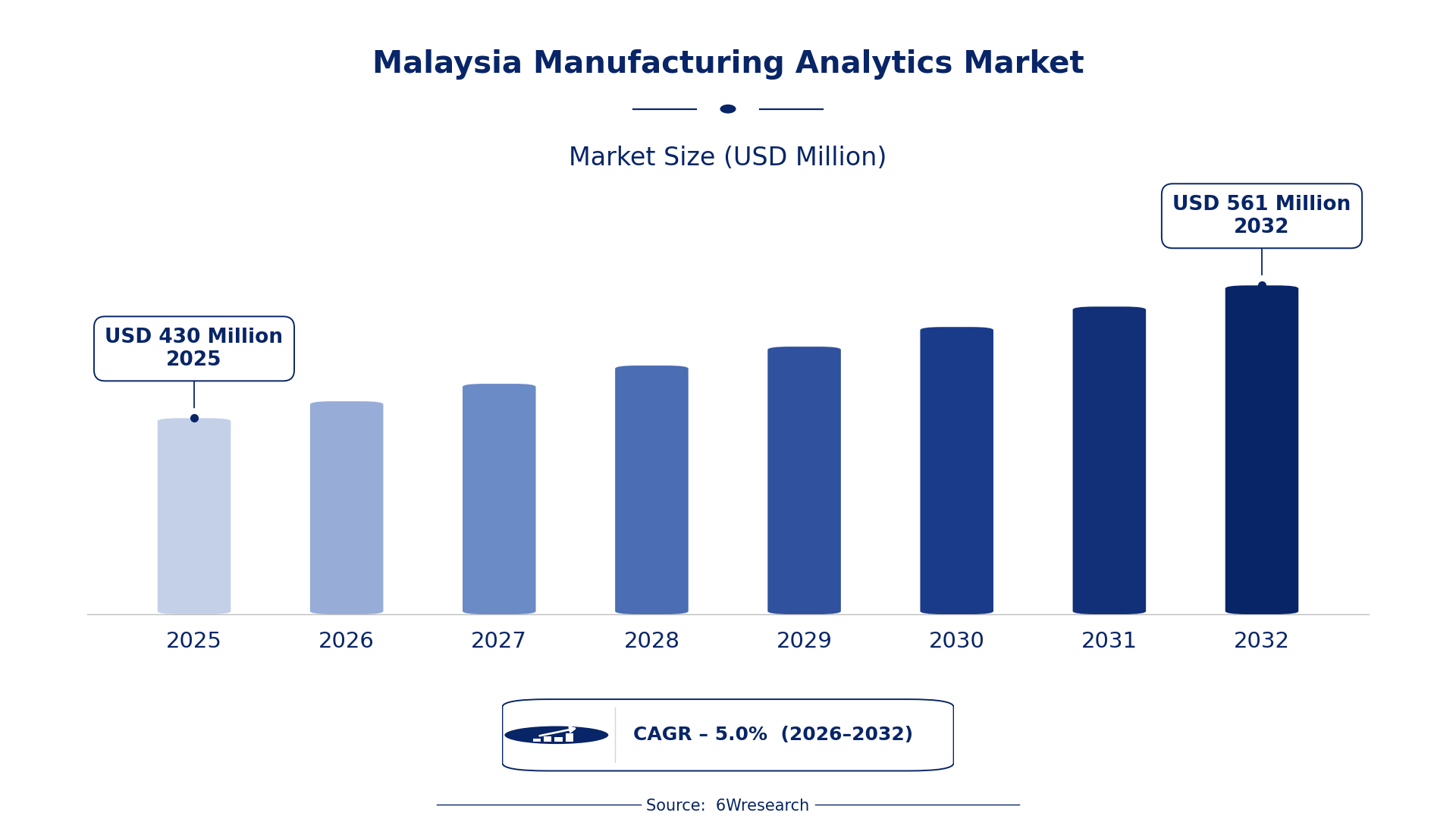
The Malaysia Manufacturing Analytics Market was estimated at USD 430 Million in 2025 and is projected to reach USD 561 Million by 2032, growing at a CAGR of 5.0% from 2026 to 2032.
Malaysia Manufacturing Analytics Market Synopsis
The Malaysia Manufacturing Analytics Market is on a clear upward trajectory, driven by the growing necessity for data-driven decision-making among manufacturers. As Industry 4.0 initiatives gain traction, analytics solutions are becoming essential for optimizing processes, enhancing quality, and improving productivity.
Manufacturers are increasingly recognizing the value of real-time insights and predictive maintenance capabilities that analytics platforms provide. This shift is not just about keeping pace with technology; it's about transforming operations to remain competitive in a rapidly changing market.
Malaysia Manufacturing Analytics Market Year-wise Growth Rate and Key Drivers
This graph illustrates the annual growth rates of the Malaysia Manufacturing Analytics Market from 2021 to 2032, highlighting a steady upward trajectory and projected expansion over the forecast period.
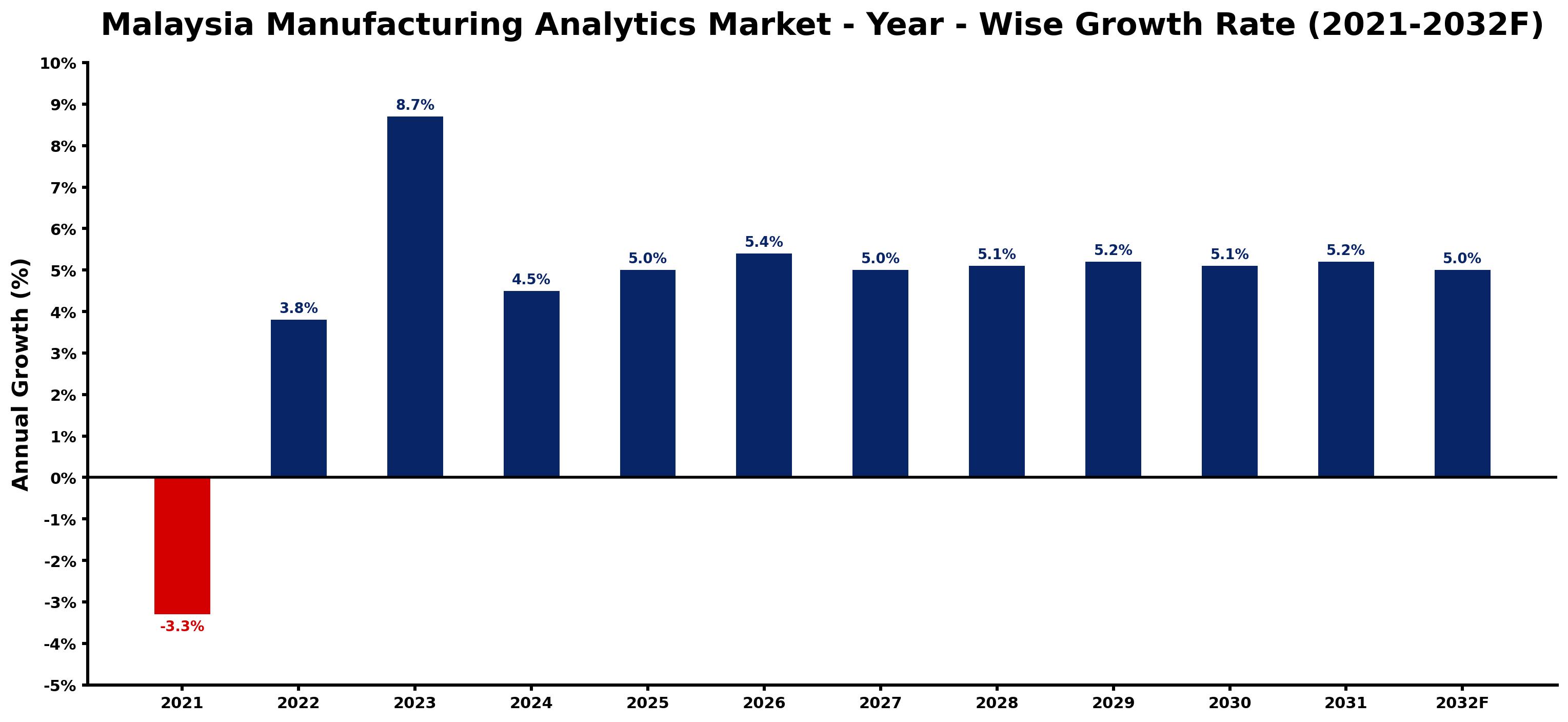
The table below presents the year‑wise growth rates along with the key drivers influencing the market
| Year | Growth Rate | Major Drivers |
| 2021 | -3.3% | Government's MCO restrictions hindered manufacturing analytics adoption. |
| 2022 | 3.8% | MDEC's push for Industry 4.0 adoption accelerates analytics. |
| 2023 | 8.7% | Increase in semiconductor manufacturing drives analytics investment. |
| 2024 | 4.5% | Boost in local production capabilities enhances data utilization. |
| 2025 | 5.0% | Sustainable manufacturing initiatives drive demand for analytics. |
| 2026 | 5.4% | Evolving labor market demands smarter manufacturing solutions. |
| 2027 | 5.0% | Government policies favoring local SMEs improve manufacturing analytics. |
| 2028 | 5.1% | Rise in automation investments necessitates advanced analytics solutions. |
| 2029 | 5.2% | Increased focus on supply chain resilience fuels analytics growth. |
| 2030 | 5.1% | Collaboration with global tech firms enhances local analytics expertise. |
| 2031 | 5.2% | Growing interest in predictive maintenance increases analytics adoption. |
| 2032 | 5.0% | Government-led digital skills training boosts analytics capabilities. |
Note: Market size estimations and growth projections presented in this report are based on 6Wresearch's proprietary forecasting methodology, utilizing the latest available industry data, government publications, and primary research inputs.
Malaysia Manufacturing Analytics Market Key Takeaways
Below are some of the specific key takeaways from the market, including:
- Strong demand for analytics tools is reshaping manufacturing operations across sectors.
- Integration of IoT devices is accelerating the transition to data-centric manufacturing.
- Challenges in legacy system integration remain a hurdle for many manufacturers.
- COVID-19 acted as a catalyst for the adoption of analytics solutions in the sector.
- Ongoing government initiatives are supporting the growth of the analytics market.
Evaluation of Restraints in Malaysia Manufacturing Analytics Market
Several key restraints are holding back the Malaysia Manufacturing Analytics Market from reaching its full potential. A major concern is the integration of advanced analytics tools with existing legacy systems. Many manufacturers find it difficult to incorporate new technologies, which can stall progress and lead to inefficiencies.
Data security issues also pose a significant challenge. As manufacturers increasingly rely on data for operational decisions, protecting sensitive information becomes paramount. on top of that, data quality and accessibility issues further complicate the situation, as reliable data is essential for successful analytics deployment.
Malaysia Manufacturing Analytics Market Trends
The market is witnessing several trends that are shaping its evolution. One notable trend is the growing emphasis on predictive analytics, which allows manufacturers to foresee potential issues before they arise. This proactive approach is becoming a key differentiator in operational efficiency.
Another trend is the increasing adoption of cloud-based analytics solutions. These platforms offer scalability and flexibility that traditional systems cannot match, allowing manufacturers to adapt quickly to changing market demands.
Malaysia Manufacturing Analytics Market Opportunities
Opportunities abound in the Malaysia Manufacturing Analytics Market, particularly in advanced analytics technologies. Manufacturers looking to invest in machine learning and artificial intelligence can harness these technologies to unlock deeper insights from their data.
Additionally, companies that focus on enhancing data security measures will find a growing market for their solutions, as data protection continues to be a priority for manufacturers. Collaborations between tech providers and manufacturers can also lead to innovative solutions tailored for the specific challenges faced by the industry.
Government Initiatives in the Malaysia Manufacturing Analytics Market
The Malaysian government is actively fostering an environment conducive to the growth of the manufacturing analytics market. With a focus on digital transformation, public policy is aligning with the needs of the manufacturing sector to boost competitiveness and innovation.
- A national digital infrastructure upgrade programme was launched to enhance connectivity and data accessibility for manufacturers, completed in early 2025.
- Currently, the government is rolling out a digital skills development initiative aimed at equipping the workforce with the necessary skills to utilize analytics tools effectively.
- A planned public-private partnership is expected to be initiated by 2026, designed to facilitate investment in advanced analytics technologies.
- The introduction of a regulatory framework in 2025 mandates enhanced data privacy measures within the manufacturing sector.
- Ongoing support for R&D initiatives is aimed at encouraging innovations in manufacturing analytics solutions.
Future Insights of the Malaysia Manufacturing Analytics Market
Looking ahead to 2026-2032, the Malaysia Manufacturing Analytics Market is set for steady growth driven by technological advancements and increasing demand for operational efficiencies. Manufacturers will likely continue to invest in analytics solutions that offer predictive capabilities and data-driven insights.
As integration challenges are addressed through better training and updated technologies, the market will see a broader adoption of analytics tools. This growth will be further supported by government initiatives aimed at fostering innovation and improving data infrastructure.
Malaysia Manufacturing Analytics Market Latest Developments
Over the past 12-14 months, the Malaysia Manufacturing Analytics Market has witnessed several notable developments that reflect its dynamic nature. The push towards Industry 4.0 has intensified, as manufacturers increasingly adopt advanced analytics solutions to streamline operations and enhance decision-making capabilities.
- A major technology vendor launched a new analytics platform specifically tailored for the manufacturing sector in Q3 2025, offering enhanced predictive maintenance features.
- An initiative that began in mid-2025 and remains underway is focused on integrating IoT devices with existing manufacturing processes to improve data collection and analysis.
- By early 2026, a leading regional operator is expected to roll out a comprehensive training program aimed at upskilling employees in analytics tools and methodologies.
- A collaborative project between several manufacturers and tech providers was completed in late 2025, resulting in a pilot program that showcased the benefits of real-time analytics in production environments.
Malaysia Manufacturing Analytics Market - Key Attractiveness of the Report
- 10 Years of Market Numbers
- Historical Data Starting from 2022 to 2025
- Base Year: 2025
- Forecast Data until 2032
- Key Performance Indicators Impacting the Market
- Major Upcoming Developments and Projects
Key Highlights of the Report:
- Malaysia Manufacturing Analytics Market Outlook
- Market Size of Malaysia Manufacturing Analytics Market, 2025
- Forecast of Malaysia Manufacturing Analytics Market, 2032
- Historical Data and Forecast of Malaysia Manufacturing Analytics Revenues & Volume for the Period 2022-2032F
- Malaysia Manufacturing Analytics Market Trend Evolution
- Malaysia Manufacturing Analytics Market Drivers and Challenges
- Malaysia Manufacturing Analytics Price Trends
- Malaysia Manufacturing Analytics Porter's Five Forces
- Malaysia Manufacturing Analytics Industry Life Cycle
- Historical Data and Forecast of Malaysia Manufacturing Analytics Market Revenues & Volume By Type for the Period 2022-2032F
- Historical Data and Forecast of Malaysia Manufacturing Analytics Market Revenues & Volume By Software for the Period 2022-2032F
- Historical Data and Forecast of Malaysia Manufacturing Analytics Market Revenues & Volume By Service for the Period 2022-2032F
- Historical Data and Forecast of Malaysia Manufacturing Analytics Market Revenues & Volume By Deployment Models for the Period 2022-2032F
- Historical Data and Forecast of Malaysia Manufacturing Analytics Market Revenues & Volume By On-premises for the Period 2022-2032F
- Historical Data and Forecast of Malaysia Manufacturing Analytics Market Revenues & Volume By On-demand for the Period 2022-2032F
- Historical Data and Forecast of Malaysia Manufacturing Analytics Market Revenues & Volume By Applications for the Period 2022-2032F
- Historical Data and Forecast of Malaysia Manufacturing Analytics Market Revenues & Volume By Predictive maintenance & asset management for the Period 2022-2032F
- Historical Data and Forecast of Malaysia Manufacturing Analytics Market Revenues & Volume By Inventory management for the Period 2022-2032F
- Historical Data and Forecast of Malaysia Manufacturing Analytics Market Revenues & Volume By Supply chain planning & procurement for the Period 2022-2032F
- Historical Data and Forecast of Malaysia Manufacturing Analytics Market Revenues & Volume By Energy management for the Period 2022-2032F
- Historical Data and Forecast of Malaysia Manufacturing Analytics Market Revenues & Volume By Emergency management for the Period 2022-2032F
- Historical Data and Forecast of Malaysia Manufacturing Analytics Market Revenues & Volume By Sales & customer management for the Period 2022-2032F
- Historical Data and Forecast of Malaysia Manufacturing Analytics Market Revenues & Volume By Other applications for the Period 2022-2032F
- Historical Data and Forecast of Malaysia Manufacturing Analytics Market Revenues & Volume By Industry Vertical for the Period 2022-2032F
- Historical Data and Forecast of Malaysia Manufacturing Analytics Market Revenues & Volume By Automotive & aerospace manufacturing for the Period 2022-2032F
- Historical Data and Forecast of Malaysia Manufacturing Analytics Market Revenues & Volume By Electronics equipment manufacturing for the Period 2022-2032F
- Historical Data and Forecast of Malaysia Manufacturing Analytics Market Revenues & Volume By Food & beverages manufacturing for the Period 2022-2032F
- Historical Data and Forecast of Malaysia Manufacturing Analytics Market Revenues & Volume By Chemicals & materials manufacturing for the Period 2022-2032F
- Historical Data and Forecast of Malaysia Manufacturing Analytics Market Revenues & Volume By Machinery & industrial equipment manufacturing for the Period 2022-2032F
- Historical Data and Forecast of Malaysia Manufacturing Analytics Market Revenues & Volume By Pharma and life sciences for the Period 2022-2032F
- Historical Data and Forecast of Malaysia Manufacturing Analytics Market Revenues & Volume By Paper, pulp, plastic and rubber manufacturing for the Period 2022-2032F
- Historical Data and Forecast of Malaysia Manufacturing Analytics Market Revenues & Volume By Others for the Period 2022-2032F
- Malaysia Manufacturing Analytics Import Export Trade Statistics
- Market Opportunity Assessment By Type
- Market Opportunity Assessment By Deployment Models
- Market Opportunity Assessment By Applications
- Market Opportunity Assessment By Industry Vertical
- Malaysia Manufacturing Analytics Top Companies Market Share
- Malaysia Manufacturing Analytics Competitive Benchmarking By Technical and Operational Parameters
- Malaysia Manufacturing Analytics Company Profiles
- Malaysia Manufacturing Analytics Key Strategic Recommendations






































