Malaysia Mass Spectrometry Market Size, Share & Growth Rate
The Malaysia Mass Spectrometry Market was estimated at USD 267 Million in 2025 and is projected to reach USD 347 Million by 2032, growing at a CAGR of 3.8% from 2026 to 2032. This growth trajectory is primarily driven by the increasing demand for precise analytical tools across the healthcare, pharmaceutical, and environmental sectors. The enhanced capabilities of modern mass spectrometry technologies, particularly in sensitivity and analysis speed, are significantly contributing to the rising adoption rates within research institutions and industries alike.
Malaysia Mass Spectrometry Market Year-wise Growth Rate and Key Drivers
This graph highlights how the Malaysia Mass Spectrometry Market has steadily grown over the years, supported by major growth factors.
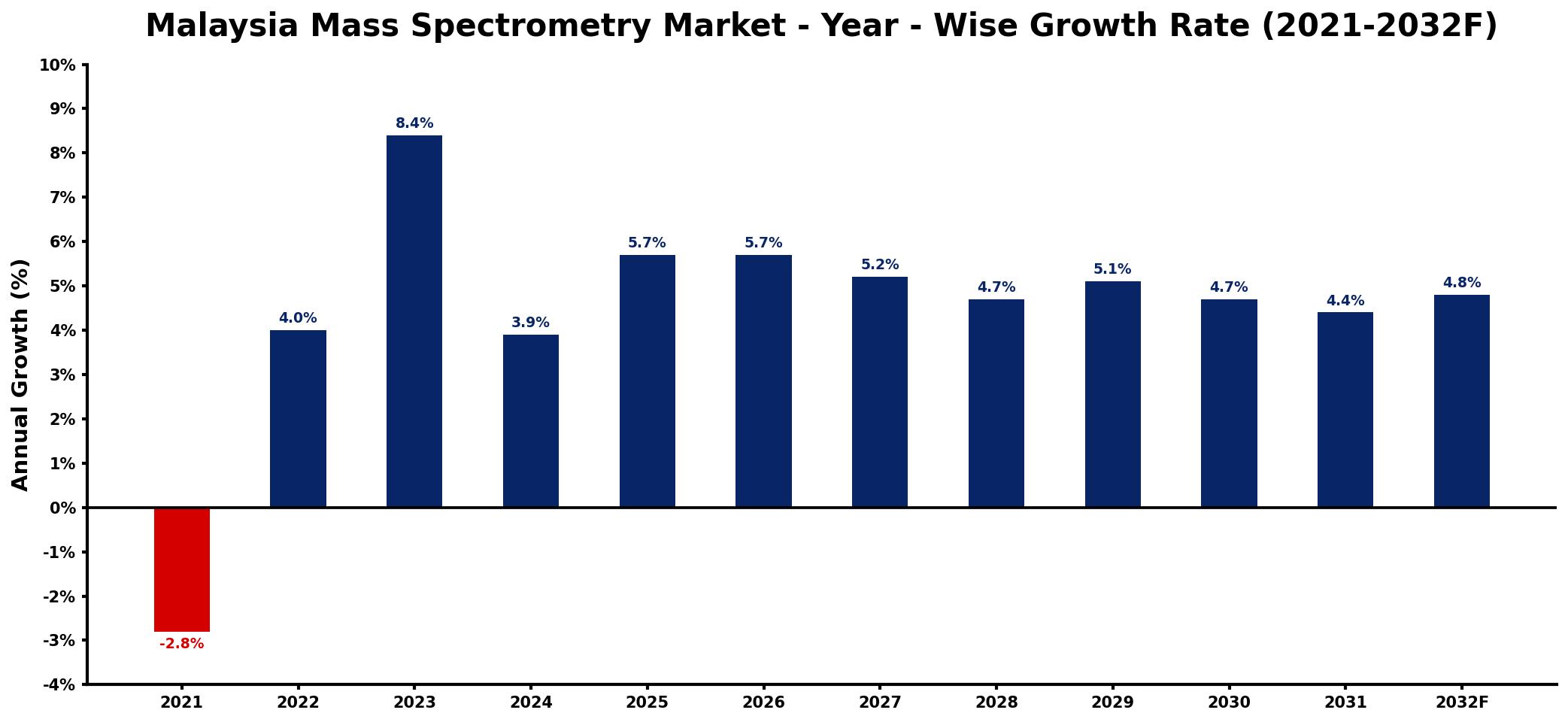
The table below presents the year‑wise growth rates along with the key drivers influencing the market
| Year | Growth Rate | Major Drivers |
| 2021 | -2.8% | reduced funding for research projects |
| 2022 | 4.0% | increased investments in healthcare technology |
| 2023 | 8.4% | growing demand for environmental testing |
| 2024 | 3.9% | expansion of pharmaceutical R&D activities |
| 2025 | 5.7% | rising adoption in academic institutions |
| 2026 | 5.7% | improved raw material availability |
| 2027 | 5.2% | surge in biotechnology applications |
| 2028 | 4.7% | growth in clinical diagnostics market |
| 2029 | 5.1% | increased utilization in forensic analysis |
| 2030 | 4.7% | development of new analytical techniques |
| 2031 | 4.4% | increased capital investment inflows |
| 2032 | 4.8% | increased collaboration among industries |
Note: Market size estimations and growth projections presented in this report are based on 6Wresearch's proprietary forecasting methodology, utilizing the latest available industry data, government publications, and primary research inputs.
Malaysia Mass Spectrometry Market Synopsis
In Malaysia, the mass spectrometry market is gaining momentum as it becomes integral to various fields, including drug development, quality control, and environmental assessment. The increasing recognition of the importance of analytical chemistry is paving the way for advancements that promise to enhance both accuracy and efficiency.
Recent technological innovations have expanded the capabilities of mass spectrometry, allowing researchers to tackle complex analytical challenges more effectively. As Malaysia continues to invest in healthcare and scientific research, the mass spectrometry market is set for a promising trajectory.
Malaysia Mass Spectrometry Market Key Takeaways
- The market is projected to experience a steady growth rate of 3.8% from 2026 to 2032.
- Applications in pharmaceuticals and environmental analysis are the primary growth drivers.
- Technological advancements in mass spectrometry will facilitate faster and more sensitive analytical procedures.
- Challenges regarding operator expertise and equipment costs need to be addressed for sustained growth.
- The demand for mass spectrometry solutions has shown resilience, recovering strongly post-COVID-19.
Evaluation of Restraints in Malaysia Mass Spectrometry Market
Despite the promising growth prospects, the Malaysia mass spectrometry market faces certain restraints that could inhibit its expansion. One significant challenge is the high cost associated with acquiring advanced mass spectrometry equipment, which may limit accessibility for smaller laboratories and research institutions. Additionally, the requirement for skilled operators to manage these sophisticated systems creates a gap in availability, potentially slowing the adoption rate. Addressing these issues through targeted education and training initiatives, along with strategies aimed at reducing equipment costs, will be crucial for market players looking to capitalize on the burgeoning demand.
Malaysia Mass Spectrometry Market Trends
The market is witnessing several trends that are shaping its future. Firstly, the integration of artificial intelligence and machine learning into mass spectrometry data analysis is transforming the efficiency of results interpretation. This trend is leading to a more streamlined workflow in laboratories, making it easier to handle large volumes of data. Secondly, there is a growing emphasis on environmentally friendly practices, pushing for mass spectrometry applications in environmental monitoring to ensure compliance with regulatory standards.
Moreover, the increasing complexity of biological samples necessitates the development of more advanced and sensitive mass spectrometry techniques. This demand is driving innovation and encouraging collaborations between academic institutions and industry players to enhance research capabilities.
Malaysia Mass Spectrometry Market Opportunities
There are several avenues for growth and investment within the Malaysian mass spectrometry landscape. The burgeoning pharmaceutical sector, characterized by a focus on drug discovery and development, presents a significant opportunity for mass spectrometry applications. Additionally, as environmental concerns rise, the demand for analytical solutions in environmental monitoring is also on the rise, creating a niche for mass spectrometry technologies. Furthermore, partnerships between research institutions and commercial entities could unlock potential innovations, driving the development of novel mass spectrometry applications.
Government Initiatives in the Malaysia Mass Spectrometry Market
The Malaysian government has been proactive in promoting research and innovation, particularly within the scientific community. Various public spending initiatives are directed towards enhancing laboratory capabilities and fostering technological advancements in analytical tools. Programs aimed at supporting healthcare improvements and environmental sustainability are also in place, encouraging the adoption of mass spectrometry solutions to meet these objectives. Through grants and funding for research projects, the government is creating a conducive environment for mass spectrometry technologies to flourish.
Future Insights of the Malaysia Mass Spectrometry Market
Looking ahead, the Malaysia mass spectrometry market is poised to evolve significantly from 2026 to 2032. As research in analytical chemistry continues to expand and technological innovations are developed, demand for mass spectrometry will likely surge. The increasing emphasis on personalized medicine and regulatory compliance in the pharmaceutical sector will further propel market growth. Additionally, ongoing advancements in sensitivity and efficiency of mass spectrometry technologies will enable broader applications, positioning the market for robust growth in the coming years.
Malaysia Mass Spectrometry Market Latest Developments (2025 - 2026)
Recent developments in the Malaysia mass spectrometry market indicate a strong focus on enhancing analytical capabilities. Industry players are investing heavily in R&D to create next-generation mass spectrometry systems that offer improved precision and faster analysis times. Collaboration between academic institutions and technology providers is becoming more common, resulting in innovative solutions tailored to local needs. Moreover, there is a marked increase in training programs aimed at developing skilled operators to meet the demand for expertise in this evolving field.
Malaysia Mass Spectrometry Market - Key Attractiveness of the Report
- 10 Years of Market Numbers
- Historical Data Starting from 2022 to 2025
- Base Year: 2025
- Forecast Data until 2032
- Key Performance Indicators Impacting the Market
- Major Upcoming Developments and Projects
Key Highlights of the Report:
- Malaysia Mass Spectrometry Market Outlook
- Market Size of Malaysia Mass Spectrometry Market, 2025
- Forecast of Malaysia Mass Spectrometry Market, 2032
- Historical Data and Forecast of Malaysia Mass Spectrometry Revenues & Volume for the Period 2022-2032F
- Malaysia Mass Spectrometry Market Trend Evolution
- Malaysia Mass Spectrometry Market Drivers and Challenges
- Malaysia Mass Spectrometry Price Trends
- Malaysia Mass Spectrometry Porter's Five Forces
- Malaysia Mass Spectrometry Industry Life Cycle
- Historical Data and Forecast of Malaysia Mass Spectrometry Market Revenues & Volume By Technology for the Period 2022-2032F
- Historical Data and Forecast of Malaysia Mass Spectrometry Market Revenues & Volume By Hybrid Mass Spectrometry for the Period 2022-2032F
- Historical Data and Forecast of Malaysia Mass Spectrometry Market Revenues & Volume By Single Mass Spectrometry for the Period 2022-2032F
- Historical Data and Forecast of Malaysia Mass Spectrometry Market Revenues & Volume By Application for the Period 2022-2032F
- Historical Data and Forecast of Malaysia Mass Spectrometry Market Revenues & Volume By Pharmaceutical for the Period 2022-2032F
- Historical Data and Forecast of Malaysia Mass Spectrometry Market Revenues & Volume By Biotechnology for the Period 2022-2032F
- Historical Data and Forecast of Malaysia Mass Spectrometry Market Revenues & Volume By Security for the Period 2022-2032F
- Historical Data and Forecast of Malaysia Mass Spectrometry Market Revenues & Volume By Industrial chemistry for the Period 2022-2032F
- Historical Data and Forecast of Malaysia Mass Spectrometry Market Revenues & Volume By Environmental testing for the Period 2022-2032F
- Historical Data and Forecast of Malaysia Mass Spectrometry Market Revenues & Volume By Food & beverage testing for the Period 2022-2032F
- Historical Data and Forecast of Malaysia Mass Spectrometry Market Revenues & Volume By Forensic for the Period 2022-2032F
- Historical Data and Forecast of Malaysia Mass Spectrometry Market Revenues & Volume By Clinical for the Period 2022-2032F
- Malaysia Mass Spectrometry Import Export Trade Statistics
- Market Opportunity Assessment By Technology
- Market Opportunity Assessment By Application
- Malaysia Mass Spectrometry Top Companies Market Share
- Malaysia Mass Spectrometry Competitive Benchmarking By Technical and Operational Parameters
- Malaysia Mass Spectrometry Company Profiles
- Malaysia Mass Spectrometry Key Strategic Recommendations






































