Malaysia Medical Tubing Market Size, Share & Growth Rate
The Malaysia Medical Tubing Market was estimated at USD 302 Million in 2025 and is projected to reach USD 395 Million by 2032, growing at a CAGR of 3.9% from 2026 to 2032. This growth trajectory is driven primarily by the ongoing expansion of healthcare infrastructure and an increased emphasis on patient care and safety. As healthcare facilities continue to modernize, the demand for advanced medical tubing solutions that meet stringent standards will only intensify.
Malaysia Medical Tubing Market Year-wise Growth Rate and Key Drivers
This graph highlights how the Malaysia Medical Tubing Market has steadily grown over the years, supported by major growth factors.
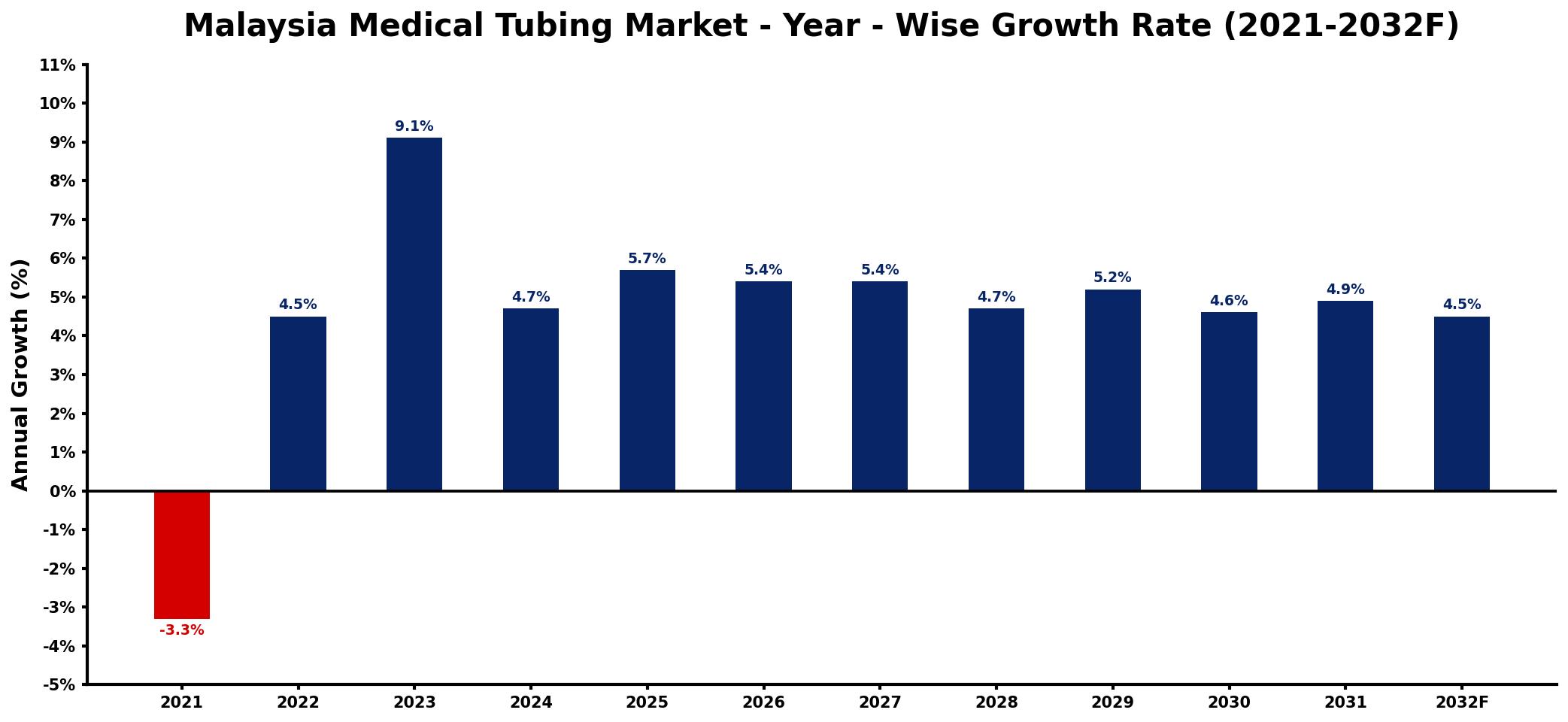
The table below presents the year‑wise growth rates along with the key drivers influencing the market
| Year | Growth Rate | Major Drivers |
| 2021 | -3.3% | decreased healthcare investments nationwide |
| 2022 | 4.5% | rising demand in healthcare sector |
| 2023 | 9.1% | expansion of healthcare infrastructure projects |
| 2024 | 4.7% | increased regulatory support initiatives |
| 2025 | 5.7% | growth in biotech innovation funding |
| 2026 | 5.4% | surge in population health awareness |
| 2027 | 5.4% | advancements in manufacturing technologies |
| 2028 | 4.7% | growing adoption of telemedicine solutions |
| 2029 | 5.2% | enhanced supply chain efficiencies |
| 2030 | 4.6% | rising number of healthcare facilities |
| 2031 | 4.9% | increased focus on preventive care |
| 2032 | 4.5% | increased domestic production output |
Note: Market size estimations and growth projections presented in this report are based on 6Wresearch's proprietary forecasting methodology, utilizing the latest available industry data, government publications, and primary research inputs.
Malaysia Medical Tubing Market Synopsis
The Malaysian medical tubing market has recently gained momentum, influenced by a surge in demand for high-quality medical equipment and disposable solutions. As healthcare providers look to enhance service delivery, the need for reliable, sterilizable tubing materials is increasingly coming to the forefront.
Looking ahead, the market is poised for steady growth, supported by technological advancements in materials and manufacturing processes. Innovations are key to enhancing product performance and ensuring compliance with rigorous international standards, thus enabling Malaysia to maintain a competitive edge in the medical tubing sector.
Malaysia Medical Tubing Market Key Takeaways
- Steady growth in the healthcare sector is significantly impacting the demand for medical tubing.
- Investment in modern healthcare infrastructure is a driving force behind market expansion.
- Compliance with international quality standards remains a critical concern for manufacturers.
- Competition from global players presents both a challenge and an opportunity for local businesses.
- The COVID-19 pandemic has reshaped market dynamics, emphasizing the need for scalable production capabilities.
Evaluation of Restraints in Malaysia Medical Tubing Market
Despite favorable growth prospects, the Malaysia Medical Tubing Market faces several restraints that could limit its potential. Compliance with international standards is a primary concern, as manufacturers must ensure their products meet stringent quality and safety regulations. This often requires significant investment in quality control processes and certifications. Additionally, competition from established global manufacturers can pressure local companies to innovate and improve their product offerings continuously, which may strain resources and limit growth opportunities.
Malaysia Medical Tubing Market Trends
Current trends in the Malaysia Medical Tubing Market include a shift towards the use of advanced materials that offer better performance and safety profiles. Additionally, manufacturers are increasingly adopting automation and smart manufacturing technologies to enhance production efficiency. There is also a growing focus on environmentally friendly materials, as sustainability becomes a priority in healthcare. These trends not only cater to current market demands but also position companies to address future challenges more effectively.
Malaysia Medical Tubing Market Opportunities
The Malaysian Medical Tubing Market presents numerous opportunities for growth and investment. As healthcare infrastructure continues to expand, there is potential for partnerships and collaborations to develop innovative tubing solutions tailored to local needs. Furthermore, the increasing trend towards home healthcare and telemedicine offers new avenues for medical tubing applications, particularly in diagnostics and therapeutic devices. By capitalizing on these emerging trends, businesses can position themselves strategically within the evolving healthcare landscape.
Government Initiatives in the Malaysia Medical Tubing Market
The Malaysian government is actively promoting the growth of the healthcare sector through various initiatives aimed at enhancing medical technology and services. Public spending on healthcare infrastructure has been increasing, with the government encouraging private investment in the sector. Programs aimed at improving local manufacturing capabilities in medical devices, including medical tubing, are also in place, providing incentives for innovation and compliance with international standards.
Future Insights of the Malaysia Medical Tubing Market
Looking forward to the period from 2026 to 2032, the Malaysia Medical Tubing Market is expected to experience significant changes driven by advancements in technology and evolving healthcare needs. The demand for high-quality, reliable medical tubing solutions will continue to rise as Malaysia's healthcare sector expands. Companies that prioritize innovation, compliance, and sustainability are likely to thrive, making it essential for stakeholders to adapt to the market's dynamic nature to leverage emerging opportunities effectively.
Malaysia Medical Tubing Market Latest Developments (2025 - 2026)
Recent developments in the Malaysia Medical Tubing Market indicate a strong industry focus on enhancing production capabilities and product innovation. Manufacturers are increasingly investing in research and development to create advanced tubing solutions that meet the growing demands of healthcare providers. The market is also witnessing collaborations between local firms and international players, which are aimed at improving the quality and availability of medical tubing products.
Malaysia Medical Tubing Market - Key Attractiveness of the Report
- 10 Years of Market Numbers
- Historical Data Starting from 2022 to 2025
- Base Year: 2025
- Forecast Data until 2032
- Key Performance Indicators Impacting the Market
- Major Upcoming Developments and Projects
Key Highlights of the Report:
- Malaysia Medical Tubing Market Outlook
- Market Size of Malaysia Medical Tubing Market, 2025
- Forecast of Malaysia Medical Tubing Market, 2032
- Historical Data and Forecast of Malaysia Medical Tubing Revenues & Volume for the Period 2022-2032F
- Malaysia Medical Tubing Market Trend Evolution
- Malaysia Medical Tubing Market Drivers and Challenges
- Malaysia Medical Tubing Price Trends
- Malaysia Medical Tubing Porter's Five Forces
- Malaysia Medical Tubing Industry Life Cycle
- Historical Data and Forecast of Malaysia Medical Tubing Market Revenues & Volume By Material for the Period 2022-2032F
- Historical Data and Forecast of Malaysia Medical Tubing Market Revenues & Volume By Plastics for the Period 2022-2032F
- Historical Data and Forecast of Malaysia Medical Tubing Market Revenues & Volume By Rubbers for the Period 2022-2032F
- Historical Data and Forecast of Malaysia Medical Tubing Market Revenues & Volume By Specialty Polymers for the Period 2022-2032F
- Historical Data and Forecast of Malaysia Medical Tubing Market Revenues & Volume By Structure for the Period 2022-2032F
- Historical Data and Forecast of Malaysia Medical Tubing Market Revenues & Volume By Single-lumen for the Period 2022-2032F
- Historical Data and Forecast of Malaysia Medical Tubing Market Revenues & Volume By Co-extruded for the Period 2022-2032F
- Historical Data and Forecast of Malaysia Medical Tubing Market Revenues & Volume By Multi-lumen for the Period 2022-2032F
- Historical Data and Forecast of Malaysia Medical Tubing Market Revenues & Volume By Tapered Or Bump Tubing for the Period 2022-2032F
- Historical Data and Forecast of Malaysia Medical Tubing Market Revenues & Volume By Braided Tubing for the Period 2022-2032F
- Historical Data and Forecast of Malaysia Medical Tubing Market Revenues & Volume By Application for the Period 2022-2032F
- Historical Data and Forecast of Malaysia Medical Tubing Market Revenues & Volume By Bulk Disposable Tubing for the Period 2022-2032F
- Historical Data and Forecast of Malaysia Medical Tubing Market Revenues & Volume By Catheters & Cannulas for the Period 2022-2032F
- Historical Data and Forecast of Malaysia Medical Tubing Market Revenues & Volume By Drug Delivery System for the Period 2022-2032F
- Historical Data and Forecast of Malaysia Medical Tubing Market Revenues & Volume By Special Applications for the Period 2022-2032F
- Malaysia Medical Tubing Import Export Trade Statistics
- Market Opportunity Assessment By Material
- Market Opportunity Assessment By Structure
- Market Opportunity Assessment By Application
- Malaysia Medical Tubing Top Companies Market Share
- Malaysia Medical Tubing Competitive Benchmarking By Technical and Operational Parameters
- Malaysia Medical Tubing Company Profiles
- Malaysia Medical Tubing Key Strategic Recommendations






































