Malaysia Medicinal Herbs Market Size, Share & Growth Rate
The Malaysia Medicinal Herbs Market was estimated at USD 424 Million in 2025 and is projected to reach USD 553 Million by 2032, growing at a CAGR of 3.9% from 2026 to 2032. This growth trajectory is largely fueled by the resurgence of interest in traditional remedies as consumers increasingly turn towards natural alternatives for health and wellness. The rising demand for herbal supplements and skincare products further amplifies this trend, marking a significant shift in consumer preferences towards more holistic healthcare solutions.
Malaysia Medicinal Herbs Market Year-wise Growth Rate and Key Drivers
This graph highlights how the Malaysia Medicinal Herbs Market has steadily grown over the years, supported by major growth factors.
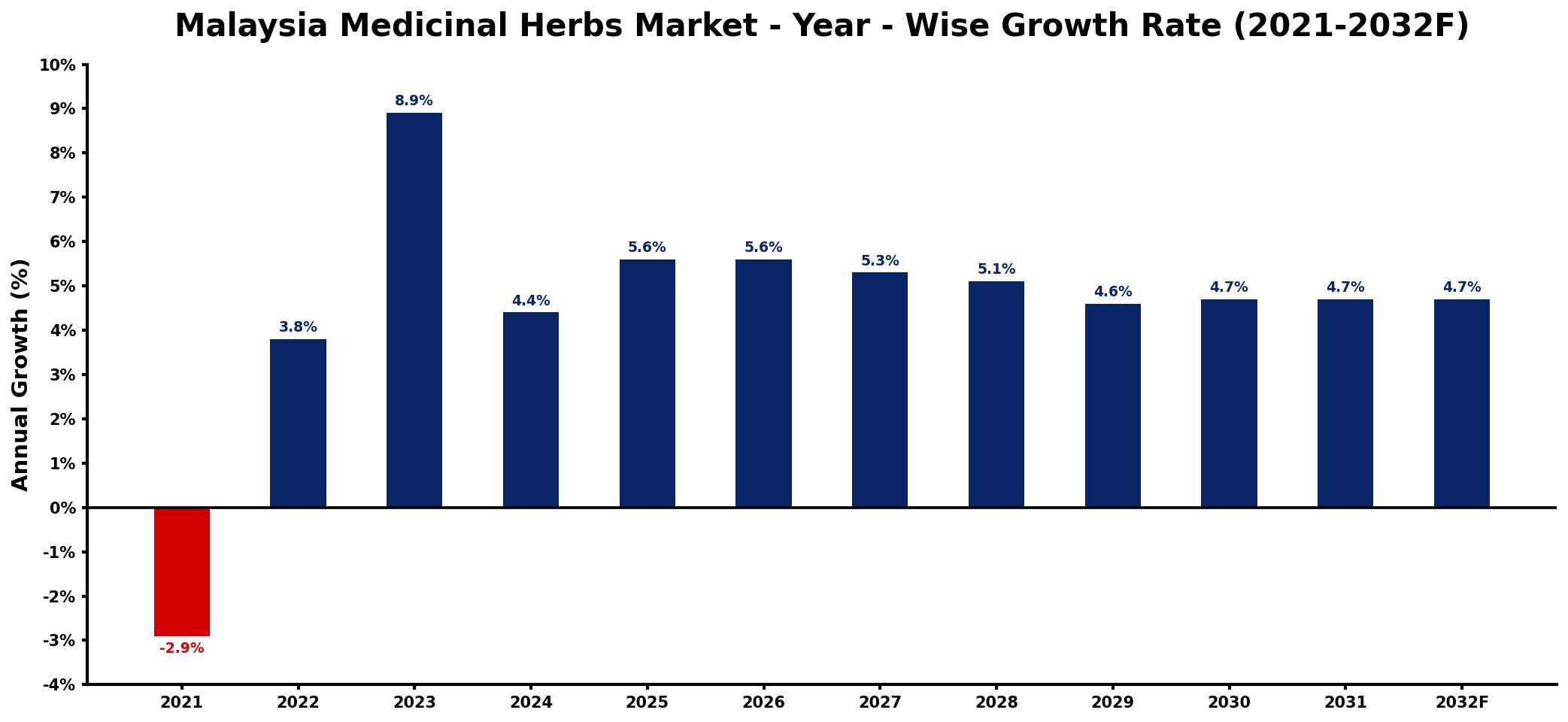
The table below presents the year‑wise growth rates along with the key drivers influencing the market
| Year | Growth Rate | Major Drivers |
| 2021 | -2.9% | Lower consumer spending on wellness |
| 2022 | 3.8% | Rising interest in natural remedies |
| 2023 | 8.9% | Increased investments in biotechnology |
| 2024 | 4.4% | Growing popularity of holistic health |
| 2025 | 5.6% | Expansion of online retail platforms |
| 2026 | 5.6% | Emerging trends in preventive care |
| 2027 | 5.3% | Strengthening health awareness campaigns |
| 2028 | 5.1% | Collaboration with wellness influencers |
| 2029 | 4.6% | Diversification of product offerings |
| 2030 | 4.7% | Enhancements in supply chain efficiency |
| 2031 | 4.7% | Development of new market segments |
| 2032 | 4.7% | Integration of sustainable practices |
Note: Market size estimations and growth projections presented in this report are based on 6Wresearch's proprietary forecasting methodology, utilizing the latest available industry data, government publications, and primary research inputs.
Malaysia Medicinal Herbs Market Synopsis
In Malaysia, the rich biodiversity and indigenous knowledge surrounding medicinal herbs play a pivotal role in shaping the market landscape. Traditional healing practices have long incorporated these herbs, making them an integral part of local culture and health paradigms. The current market is witnessing a revival, with growing consumer interest and a willingness to explore the therapeutic potential of these natural remedies.
As consumers increasingly gravitate towards herbal alternatives, the market is also responding with a heightened focus on sustainable cultivation practices. This emphasis on ethical sourcing not only helps preserve biodiversity but also supports local farmers, creating a symbiotic relationship between tradition and modern market demands.
Malaysia Medicinal Herbs Market Key Takeaways
- The market is characterized by a strong shift towards natural and holistic health solutions.
- Demand for herbal supplements, teas, and skincare products is significantly increasing.
- Export opportunities are expanding for local growers and suppliers in international markets.
- Government support for sustainable practices boosts confidence in the sector.
- Consumer education on product safety and efficacy remains a crucial market focus.
Evaluation of Restraints in Malaysia Medicinal Herbs Market
The growth of the Malaysia medicinal herbs market is tempered by significant challenges, particularly in quality control and safety standards. Instances of adulteration and mislabeling have historically undermined consumer confidence, posing a formidable barrier to broader acceptance. Furthermore, the market requires stringent regulations to ensure that products are not only safe but also effective. The need for consumer education regarding both the benefits and potential risks associated with herbal remedies is equally important to build a more trustful relationship between providers and users.
Malaysia Medicinal Herbs Market Trends
Current trends indicate a surge in the popularity of herbal supplements, as consumers actively seek out natural products that align with a wellness-oriented lifestyle. The integration of technology into the market, particularly through e-commerce platforms, has also opened new avenues for reaching consumers. Moreover, there is a discernible shift towards organic and sustainably sourced products, reflecting broader environmental concerns and the desire for transparency in the supply chain.
Malaysia Medicinal Herbs Market Opportunities
The outlook for the medicinal herbs market in Malaysia is brimming with opportunities. As the global demand for natural health products continues to rise, local growers are poised to capitalize on export potential. Additionally, innovative product development in areas such as herbal teas and cosmetics offers avenues for growth. Collaborations between traditional practitioners and modern health professionals could further enhance the market's credibility and appeal.
Government Initiatives in the Malaysia Medicinal Herbs Market
The Malaysian government has implemented various initiatives aimed at promoting sustainable agricultural practices in the medicinal herbs sector. Public spending on research and development, along with programs designed to support local farmers, are indicative of a proactive approach to enhance both cultivation and market outreach. Policies encouraging ethical sourcing and biodiversity preservation reflect a commitment to balancing economic growth with environmental stewardship.
Future Insights of the Malaysia Medicinal Herbs Market
Looking towards 2026-2032, the Malaysia medicinal herbs market is expected to evolve with increasing consumer demand for natural health solutions. The anticipated growth in awareness regarding the benefits of herbal remedies will drive further market expansion. Additionally, advancements in cultivation techniques and supply chain transparency will play critical roles in establishing a more robust and resilient industry.
Malaysia Medicinal Herbs Market Latest Developments (2025 - 2026)
Recent developments in the Malaysia medicinal herbs market highlight a concerted effort to enhance product quality and consumer trust. Various stakeholders are focusing on improving transparency in sourcing and production processes. Furthermore, collaborations between local growers and academic institutions aim to innovate in product development, ensuring that offerings meet evolving consumer preferences and safety standards.
Malaysia Medicinal Herbs Market - Key Attractiveness of the Report
- 10 Years of Market Numbers
- Historical Data Starting from 2022 to 2025
- Base Year: 2025
- Forecast Data until 2032
- Key Performance Indicators Impacting the Market
- Major Upcoming Developments and Projects
Key Highlights of the Report:
- Malaysia Medicinal Herbs Market Outlook
- Market Size of Malaysia Medicinal Herbs Market, 2025
- Forecast of Malaysia Medicinal Herbs Market, 2032
- Historical Data and Forecast of Malaysia Medicinal Herbs Revenues & Volume for the Period 2022-2032F
- Malaysia Medicinal Herbs Market Trend Evolution
- Malaysia Medicinal Herbs Market Drivers and Challenges
- Malaysia Medicinal Herbs Price Trends
- Malaysia Medicinal Herbs Porter's Five Forces
- Malaysia Medicinal Herbs Industry Life Cycle
- Historical Data and Forecast of Malaysia Medicinal Herbs Market Revenues & Volume By Type for the Period 2022-2032F
- Historical Data and Forecast of Malaysia Medicinal Herbs Market Revenues & Volume By Horsetail for the Period 2022-2032F
- Historical Data and Forecast of Malaysia Medicinal Herbs Market Revenues & Volume By Dandelion for the Period 2022-2032F
- Historical Data and Forecast of Malaysia Medicinal Herbs Market Revenues & Volume By Echinacea for the Period 2022-2032F
- Historical Data and Forecast of Malaysia Medicinal Herbs Market Revenues & Volume By Valerian for the Period 2022-2032F
- Historical Data and Forecast of Malaysia Medicinal Herbs Market Revenues & Volume By St. John??s Wort for the Period 2022-2032F
- Historical Data and Forecast of Malaysia Medicinal Herbs Market Revenues & Volume By Lemon Balm for the Period 2022-2032F
- Historical Data and Forecast of Malaysia Medicinal Herbs Market Revenues & Volume By Yarrow for the Period 2022-2032F
- Historical Data and Forecast of Malaysia Horsetail Medicinal Herbs Market Revenues & Volume By Calendula for the Period 2022-2032F
- Historical Data and Forecast of Malaysia Medicinal Herbs Market Revenues & Volume By Nature for the Period 2022-2032F
- Historical Data and Forecast of Malaysia Medicinal Herbs Market Revenues & Volume By Organic for the Period 2022-2032F
- Historical Data and Forecast of Malaysia Medicinal Herbs Market Revenues & Volume By Conventional for the Period 2022-2032F
- Historical Data and Forecast of Malaysia Medicinal Herbs Market Revenues & Volume By Form for the Period 2022-2032F
- Historical Data and Forecast of Malaysia Medicinal Herbs Market Revenues & Volume By Whole for the Period 2022-2032F
- Historical Data and Forecast of Malaysia Medicinal Herbs Market Revenues & Volume By Powder for the Period 2022-2032F
- Historical Data and Forecast of Malaysia Medicinal Herbs Market Revenues & Volume By Liquid for the Period 2022-2032F
- Historical Data and Forecast of Malaysia Medicinal Herbs Market Revenues & Volume By End-Use for the Period 2022-2032F
- Historical Data and Forecast of Malaysia Medicinal Herbs Market Revenues & Volume By Medicinal Tea for the Period 2022-2032F
- Historical Data and Forecast of Malaysia Medicinal Herbs Market Revenues & Volume By Health Supplement for the Period 2022-2032F
- Historical Data and Forecast of Malaysia Medicinal Herbs Market Revenues & Volume By Nutritive Jams for the Period 2022-2032F
- Historical Data and Forecast of Malaysia Medicinal Herbs Market Revenues & Volume By Herbal Medicines for the Period 2022-2032F
- Historical Data and Forecast of Malaysia Medicinal Herbs Market Revenues & Volume By Cosmeceuticals for the Period 2022-2032F
- Historical Data and Forecast of Malaysia Medicinal Herbs Market Revenues & Volume By Other Uses for the Period 2022-2032F
- Malaysia Medicinal Herbs Import Export Trade Statistics
- Market Opportunity Assessment By Type
- Market Opportunity Assessment By Nature
- Market Opportunity Assessment By Form
- Market Opportunity Assessment By End-Use
- Malaysia Medicinal Herbs Top Companies Market Share
- Malaysia Medicinal Herbs Competitive Benchmarking By Technical and Operational Parameters
- Malaysia Medicinal Herbs Company Profiles
- Malaysia Medicinal Herbs Key Strategic Recommendations






































