Malaysia Metalworking Machinery Market Size, Share & Growth Rate
The Malaysia Metalworking Machinery Market was estimated at USD 177 Million in 2025 and is projected to reach USD 230 Million by 2032, growing at a CAGR of 3.8% from 2026 to 2032. This growth trajectory is propelled primarily by the burgeoning automotive sector, a vital pillar of Malaysia's economy, alongside ongoing industrialization and the adoption of advanced manufacturing technologies. As the demand for precision and efficiency in manufacturing processes rises, the metalworking machinery market is poised to expand significantly.
Malaysia Metalworking Machinery Market Year-wise Growth Rate and Key Drivers
This graph highlights how the Malaysia Metalworking Machinery Market has steadily grown over the years, supported by major growth factors.
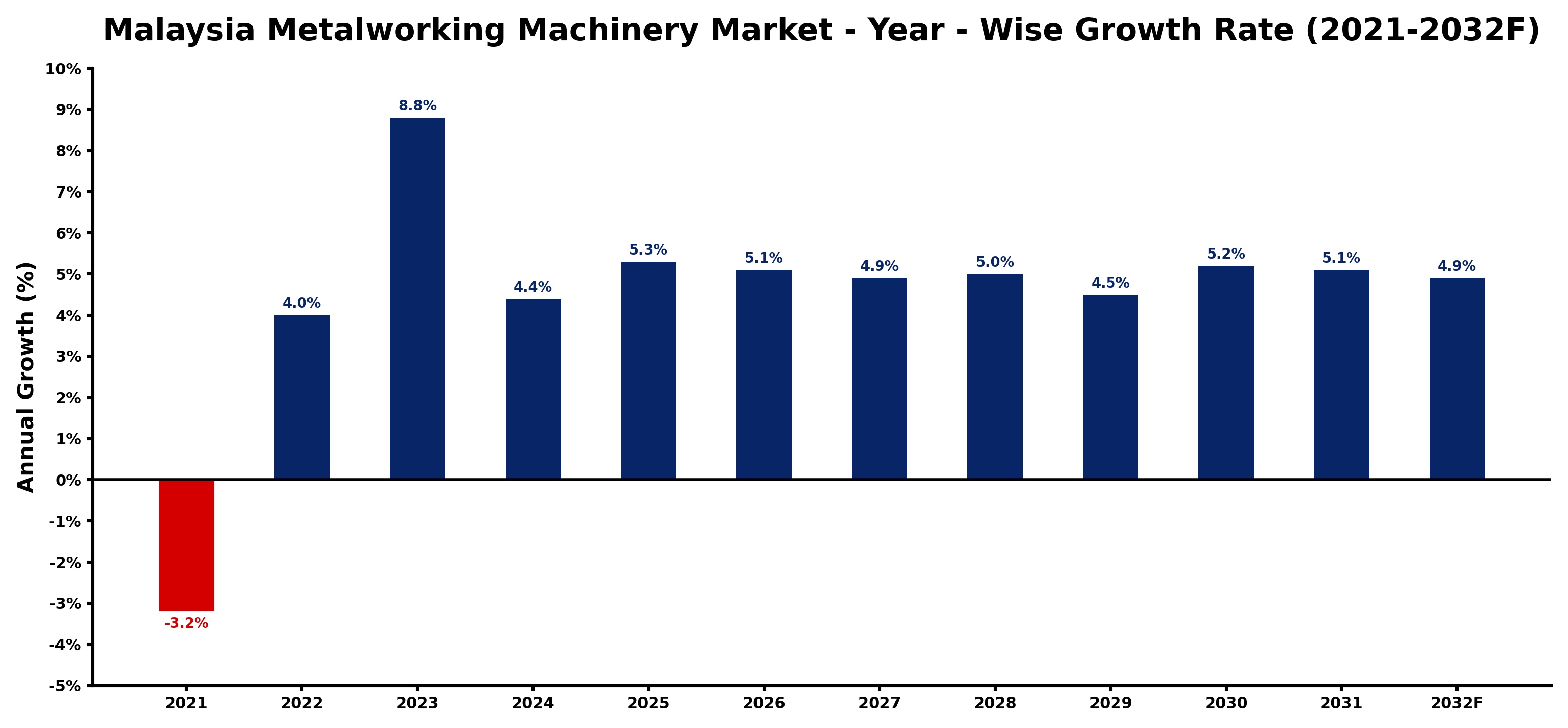
The table below presents the year‑wise growth rates along with the key drivers influencing the market
| Year | Growth Rate | Major Drivers |
| 2021 | -3.2% | Increasing industrial automation investments |
| 2022 | 4.0% | Increasing industrial infrastructure investments |
| 2023 | 8.8% | Increasing smart city development projects |
| 2024 | 4.4% | Government infrastructure modernization initiatives |
| 2025 | 5.3% | Expansion of manufacturing activities |
| 2026 | 5.1% | Increasing industrial automation investments |
| 2027 | 4.9% | Increasing industrial automation investments |
| 2028 | 5.0% | Growing renewable energy integration projects |
| 2029 | 4.5% | Growing renewable energy integration projects |
| 2030 | 5.2% | Rising electricity demand across industries |
| 2031 | 5.1% | Increasing smart city development projects |
| 2032 | 4.9% | Increasing smart city development projects |
Note - Market size estimations and growth projections presented in this report are based on 6Wresearch's advanced forecasting approach, validated with industry datasets as of June 2026.
Malaysia Metalworking Machinery Market Synopsis
The strongest force shaping the Malaysia Metalworking Machinery Market currently is the rapid growth of the automotive industry. This sector not only consumes a substantial amount of metalworking machinery but also influences innovation and technological advancements within the market. As automotive manufacturers seek to enhance production capabilities, the demand for sophisticated metalworking solutions becomes increasingly critical.
Alongside the automotive sector, industrialization continues to play a pivotal role in boosting the market. Malaysia's manufacturing landscape is evolving, driven by investments and a skilled workforce. This dynamic environment encourages the integration of cutting-edge metalworking technologies, enabling manufacturers to meet the diverse demands of various industries.
Malaysia Metalworking Machinery Market Key Takeaways
- The market is fueled by strong automotive sector growth and increasing industrial activities.
- Technological advancements in machinery are essential for maintaining competitive edge and productivity.
- Recent disruptions, including those caused by the pandemic, have highlighted the need for resilient supply chains.
- Strategic investments in manufacturing processes are anticipated to drive machinery demand.
- Local players are focusing on innovation and technical support to cater to market needs.
Evaluation of Restraints in Malaysia Metalworking Machinery Market
Despite the promising growth, the Malaysia Metalworking Machinery Market faces several restraints. A significant challenge is the rapid pace of technological change; manufacturers must continuously invest in upgrading equipment to remain competitive. Furthermore, fluctuating raw material costs and supply chain disruptions can hinder production capabilities and affect pricing strategies. Companies must balance the demands for innovation with operational efficiency to navigate these hurdles effectively.
Malaysia Metalworking Machinery Market Trends
Key trends shaping the Malaysia Metalworking Machinery Market include the shift toward automation and smart manufacturing solutions. Industries are increasingly adopting Industry 4.0 technologies, incorporating IoT and AI into their metalworking processes. This trend enhances efficiency and precision while also reducing operational costs. Additionally, sustainable manufacturing practices are gaining traction, prompting manufacturers to invest in eco-friendly machinery and processes.
Malaysia Metalworking Machinery Market Opportunities
Genuine growth opportunities lie in the expansion of the automotive and aerospace sectors, where demand for precision components is surging. Furthermore, as Malaysia positions itself as a manufacturing hub in Southeast Asia, there is potential for foreign investments in the metalworking machinery sector. Companies that align with these trends by offering innovative, high-quality machinery and support services are likely to thrive in this evolving landscape.
Government Initiatives in the Malaysia Metalworking Machinery Market
The Malaysian government has been actively promoting the development of the manufacturing sector through various initiatives and policies. Incentives for investment in advanced manufacturing technologies and support for research and development are key components of the government's strategy to boost industrial growth. Such measures not only enhance the competitive landscape but also encourage the adoption of best practices in metalworking processes.
Future Insights of the Malaysia Metalworking Machinery Market
Looking ahead to 2026-2032, the Malaysia Metalworking Machinery Market is expected to witness significant transformations. The continued integration of smart technologies will likely dominate the market, driving efficiency and productivity. As industries evolve and adapt to new manufacturing demands, the ability to offer customized solutions will be paramount. Furthermore, as sustainability becomes a core focus, environmentally friendly practices will reshape manufacturing strategies, creating new pathways for growth.
Malaysia Metalworking Machinery Market Latest Developments (May 2025 - June 2026)
In recent months, the metalworking machinery sector has witnessed notable advancements in automation technologies and robotics. Companies are increasingly investing in digital solutions to enhance manufacturing efficiency. Additionally, partnerships between local firms and international players have been forming, focusing on technology transfer and capacity building. These collaborations aim to strengthen the metalworking ecosystem in Malaysia, positioning it favorably on the global stage.
Malaysia Metalworking Machinery Market - Key Attractiveness of the Report
- 10 Years of Market Numbers
- Historical Data Starting from 2022 to 2025
- Base Year: 2025
- Forecast Data until 2032
- Key Performance Indicators Impacting the Market
- Major Upcoming Developments and Projects
Key Highlights of the Report:
- Malaysia Metalworking Machinery Market Outlook
- Market Size of Malaysia Metalworking Machinery Market, 2025
- Forecast of Malaysia Metalworking Machinery Market, 2032
- Historical Data and Forecast of Malaysia Metalworking Machinery Revenues & Volume for the Period 2022-2032F
- Malaysia Metalworking Machinery Market Trend Evolution
- Malaysia Metalworking Machinery Market Drivers and Challenges
- Malaysia Metalworking Machinery Price Trends
- Malaysia Metalworking Machinery Porter's Five Forces
- Malaysia Metalworking Machinery Industry Life Cycle
- Historical Data and Forecast of Malaysia Metalworking Machinery Market Revenues & Volume By Type for the Period 2022-2032F
- Historical Data and Forecast of Malaysia Metalworking Machinery Market Revenues & Volume By Special Die And Tool Die Set, Jig, And Fixture for the Period 2022-2032F
- Historical Data and Forecast of Malaysia Metalworking Machinery Market Revenues & Volume By Machine Tool for the Period 2022-2032F
- Historical Data and Forecast of Malaysia Metalworking Machinery Market Revenues & Volume By Industrial Mold for the Period 2022-2032F
- Historical Data and Forecast of Malaysia Metalworking Machinery Market Revenues & Volume By Rolling Mill And Other Metalworking Machinery for the Period 2022-2032F
- Historical Data and Forecast of Malaysia Metalworking Machinery Market Revenues & Volume By Cutting Tool And Machine Tool Accessory for the Period 2022-2032F
- Historical Data and Forecast of Malaysia Metalworking Machinery Market Revenues & Volume By Applications for the Period 2022-2032F
- Historical Data and Forecast of Malaysia Metalworking Machinery Market Revenues & Volume By Automotive for the Period 2022-2032F
- Historical Data and Forecast of Malaysia Metalworking Machinery Market Revenues & Volume By Manufacturing for the Period 2022-2032F
- Historical Data and Forecast of Malaysia Metalworking Machinery Market Revenues & Volume By Others for the Period 2022-2032F
- Historical Data and Forecast of Malaysia Metalworking Machinery Market Revenues & Volume By Capacity for the Period 2022-2032F
- Historical Data and Forecast of Malaysia Metalworking Machinery Market Revenues & Volume By Small for the Period 2022-2032F
- Historical Data and Forecast of Malaysia Metalworking Machinery Market Revenues & Volume By Medium for the Period 2022-2032F
- Historical Data and Forecast of Malaysia Metalworking Machinery Market Revenues & Volume By Large for the Period 2022-2032F
- Malaysia Metalworking Machinery Import Export Trade Statistics
- Market Opportunity Assessment By Type
- Market Opportunity Assessment By Applications
- Market Opportunity Assessment By Capacity
- Malaysia Metalworking Machinery Top Companies Market Share
- Malaysia Metalworking Machinery Competitive Benchmarking By Technical and Operational Parameters
- Malaysia Metalworking Machinery Company Profiles
- Malaysia Metalworking Machinery Key Strategic Recommendations






































