Malaysia Microbial Products Market Size, Share & Growth Rate
The Malaysia Microbial Products Market was estimated at USD 496 Million in 2025 and is projected to reach USD 649 Million by 2032, growing at a CAGR of 3.9% from 2026 to 2032. This growth trajectory is driven by a rising awareness of the efficacy of microbial products in enhancing agricultural yield, improving soil health, and advancing environmental management practices. Moreover, an increasing emphasis on sustainable agricultural practices and stringent environmental regulations is further propelling market expansion.
Malaysia Microbial Products Market Year-wise Growth Rate and Key Drivers
This graph highlights how the Malaysia Microbial Products Market has steadily grown over the years, supported by major growth factors.
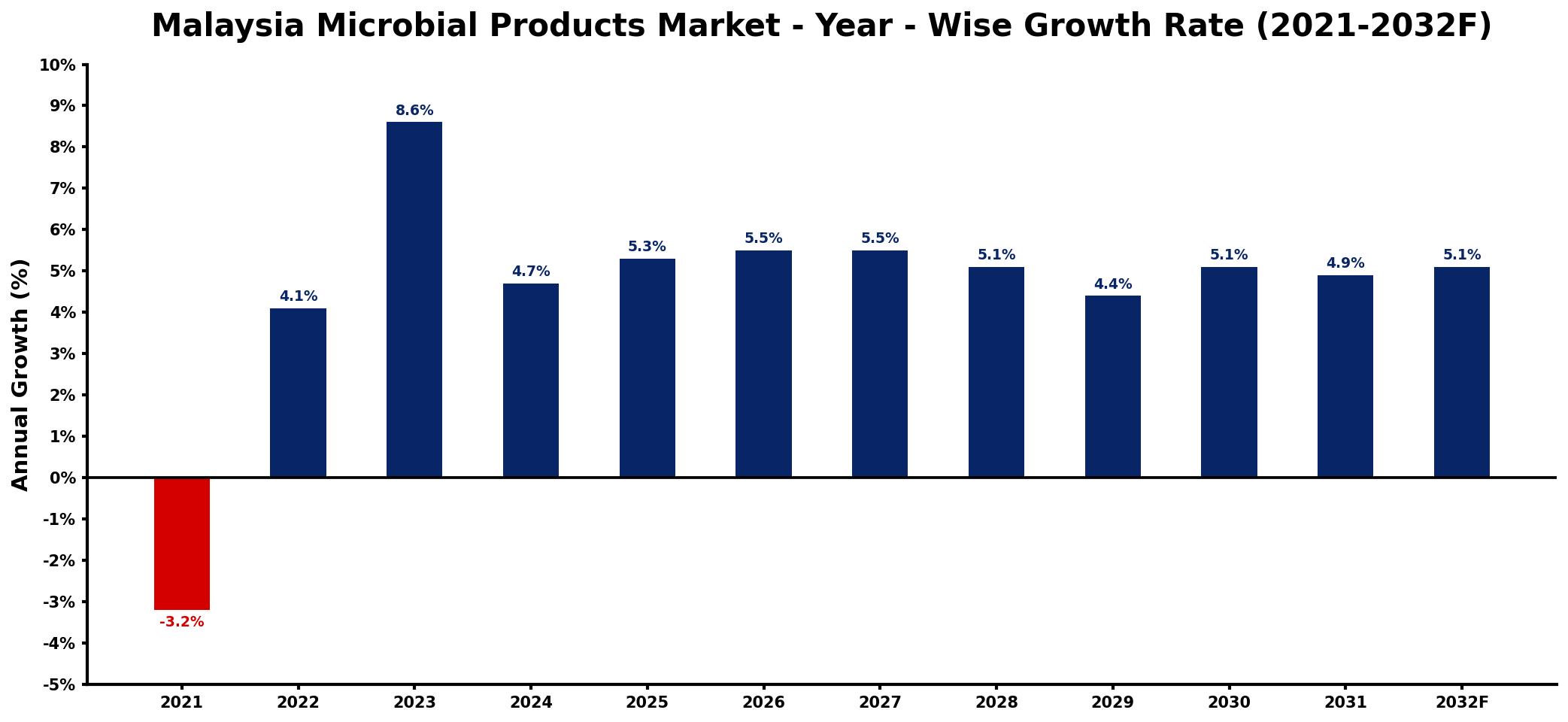
The table below presents the year‑wise growth rates along with the key drivers influencing the market
| Year | Growth Rate | Major Drivers |
| 2021 | -3.2% | decreased investments in biotechnology sector |
| 2022 | 4.1% | rising demand in agriculture sector |
| 2023 | 8.6% | growing interest in sustainable practices |
| 2024 | 4.7% | expansion of healthcare applications market |
| 2025 | 5.3% | increased funding for research initiatives |
| 2026 | 5.5% | enhanced regulatory support for innovations |
| 2027 | 5.5% | growing adoption in food industry |
| 2028 | 5.1% | emerging markets creating new opportunities |
| 2029 | 4.4% | increased focus on environmental sustainability |
| 2030 | 5.1% | expanding use in pharmaceuticals sector |
| 2031 | 4.9% | rising consumer awareness on health |
| 2032 | 5.1% | growing trends in bioengineering solutions |
Note: Market size estimations and growth projections presented in this report are based on 6Wresearch's proprietary forecasting methodology, utilizing the latest available industry data, government publications, and primary research inputs.
Malaysia Microbial Products Market Synopsis
The current strongest force shaping the Malaysia Microbial Products Market is the growing concern for environmental sustainability. As industries and consumers alike become increasingly aware of the negative impacts of chemical alternatives, the demand for eco-friendly microbial solutions is on the rise. These products are perceived not only as effective but also as essential for sustainable development.
Another significant factor driving the market is the expanding applications of microbial products across multiple sectors, particularly in agriculture and wastewater treatment. The integration of microbial solutions into farming practices is enhancing crop productivity while minimizing environmental footprints, thus opening new avenues for growth within the market.
Malaysia Microbial Products Market Key Takeaways
- The market is witnessing robust growth fueled by increased adoption in agriculture and environmental management.
- Sustainable practices and eco-conscious consumer behavior are critical drivers for microbial product demand.
- The market is characterized by a diverse range of applications, enhancing its overall growth potential.
- Education and marketing efforts are essential for overcoming acceptance barriers among potential users.
- The impact of COVID-19 has resulted in both challenges and opportunities across various sectors.
Evaluation of Restraints in Malaysia Microbial Products Market
Despite the positive growth outlook, the Malaysia Microbial Products Market faces significant restraints. One of the primary challenges is the limited market acceptance of microbial products compared to traditional chemical alternatives. Many industries remain hesitant to switch due to a lack of understanding regarding the effectiveness and long-term benefits of microbial solutions. Additionally, the prevailing competition from chemical products can create barriers to entry for microbial innovations, making it essential for manufacturers to invest in comprehensive educational initiatives that highlight the advantages of their offerings.
Malaysia Microbial Products Market Trends
Several notable trends are currently shaping the Malaysia Microbial Products Market. First, the rise in organic farming practices is significantly boosting the demand for natural microbial solutions, as growers seek sustainable alternatives to synthetic fertilizers and pesticides. Additionally, advancements in biotechnology are paving the way for more effective and targeted microbial products, which further enhance their attractiveness. Furthermore, increased investment in research and development is leading to innovative applications in various sectors, including healthcare and environmental remediation.
Malaysia Microbial Products Market Opportunities
The Malaysia Microbial Products Market presents genuine growth and investment opportunities, particularly in agricultural bioproducts and wastewater management solutions. As local farmers and industries increasingly adopt sustainable practices, the need for effective microbial solutions will expand. Moreover, there is a significant opportunity for manufacturers to collaborate with governmental bodies and environmental organizations to promote the adoption of microbial products as part of broader sustainability initiatives.
Government Initiatives in the Malaysia Microbial Products Market
The Malaysian government is actively promoting policies that encourage sustainable agricultural practices, which indirectly benefits the microbial products market. Public spending on environmental conservation projects, along with initiatives aimed at enhancing agricultural productivity, play a crucial role in fostering an ecosystem that supports microbial innovations. Various programs designed to educate farmers about the benefits of microbial solutions and incentives for sustainable farming practices are also being implemented to further propel market growth.
Future Insights of the Malaysia Microbial Products Market
Looking ahead to 2026-2032, the Malaysia Microbial Products Market is poised for substantial advancement. The increasing integration of microbial products into various industries will likely evolve as more organizations recognize their potential in addressing sustainability challenges. Anticipated advancements in product formulation and application methods may also enhance the efficiency and effectiveness of microbial solutions. As environmental regulations tighten and consumer preferences shift towards sustainable options, the market is expected to experience a sustained upward trajectory.
Malaysia Microbial Products Market Latest Developments (2025 - 2026)
Recent developments within the Malaysia microbial products market indicate a trend toward increased collaboration between industry players and research institutions to enhance product efficacy. Innovations in microbial technology are gaining traction, with a focus on developing specialized products tailored to specific agricultural needs and environmental challenges. Additionally, there has been a noticeable uptick in public awareness campaigns aimed at educating consumers and businesses about the benefits of switching to microbial solutions.
Malaysia Microbial Products Market - Key Attractiveness of the Report
- 10 Years of Market Numbers
- Historical Data Starting from 2022 to 2025
- Base Year: 2025
- Forecast Data until 2032
- Key Performance Indicators Impacting the Market
- Major Upcoming Developments and Projects
Key Highlights of the Report:
- Malaysia Microbial Products Market Outlook
- Market Size of Malaysia Microbial Products Market, 2025
- Forecast of Malaysia Microbial Products Market, 2032
- Historical Data and Forecast of Malaysia Microbial Products Revenues & Volume for the Period 2022-2032F
- Malaysia Microbial Products Market Trend Evolution
- Malaysia Microbial Products Market Drivers and Challenges
- Malaysia Microbial Products Price Trends
- Malaysia Microbial Products Porter's Five Forces
- Malaysia Microbial Products Industry Life Cycle
- Historical Data and Forecast of Malaysia Microbial Products Market Revenues & Volume By Types for the Period 2022-2032F
- Historical Data and Forecast of Malaysia Microbial Products Market Revenues & Volume By Enzymes for the Period 2022-2032F
- Historical Data and Forecast of Malaysia Microbial Products Market Revenues & Volume By Polysaccharides for the Period 2022-2032F
- Historical Data and Forecast of Malaysia Microbial Products Market Revenues & Volume By Nutrients for the Period 2022-2032F
- Historical Data and Forecast of Malaysia Microbial Products Market Revenues & Volume By Chemotherapeutic Agents for the Period 2022-2032F
- Historical Data and Forecast of Malaysia Microbial Products Market Revenues & Volume By Antibiotics for the Period 2022-2032F
- Historical Data and Forecast of Malaysia Microbial Products Market Revenues & Volume By Vaccines for the Period 2022-2032F
- Historical Data and Forecast of Malaysia Microbial Products Market Revenues & Volume By Source for the Period 2022-2032F
- Historical Data and Forecast of Malaysia Microbial Products Market Revenues & Volume By Bacterial for the Period 2022-2032F
- Historical Data and Forecast of Malaysia Microbial Products Market Revenues & Volume By Viral for the Period 2022-2032F
- Historical Data and Forecast of Malaysia Microbial Products Market Revenues & Volume By Fungi for the Period 2022-2032F
- Historical Data and Forecast of Malaysia Microbial Products Market Revenues & Volume By Applications for the Period 2022-2032F
- Historical Data and Forecast of Malaysia Microbial Products Market Revenues & Volume By Pharmaceutical for the Period 2022-2032F
- Historical Data and Forecast of Malaysia Microbial Products Market Revenues & Volume By Diagnostic for the Period 2022-2032F
- Historical Data and Forecast of Malaysia Microbial Products Market Revenues & Volume By Biotechnology for the Period 2022-2032F
- Historical Data and Forecast of Malaysia Microbial Products Market Revenues & Volume By End Users for the Period 2022-2032F
- Historical Data and Forecast of Malaysia Microbial Products Market Revenues & Volume By Pharmaceutical And Biotechnological Industries for the Period 2022-2032F
- Historical Data and Forecast of Malaysia Microbial Products Market Revenues & Volume By Hospitals And Clinics for the Period 2022-2032F
- Historical Data and Forecast of Malaysia Microbial Products Market Revenues & Volume By Diagnostic Labs for the Period 2022-2032F
- Historical Data and Forecast of Malaysia Microbial Products Market Revenues & Volume By Research And Academics for the Period 2022-2032F
- Malaysia Microbial Products Import Export Trade Statistics
- Market Opportunity Assessment By Types
- Market Opportunity Assessment By Source
- Market Opportunity Assessment By Applications
- Market Opportunity Assessment By End Users
- Malaysia Microbial Products Top Companies Market Share
- Malaysia Microbial Products Competitive Benchmarking By Technical and Operational Parameters
- Malaysia Microbial Products Company Profiles
- Malaysia Microbial Products Key Strategic Recommendations






































