Malaysia Microfiber Cleaning Cloths Market Size, Share & Growth Rate
The Malaysia Microfiber Cleaning Cloths Market was estimated at USD 471 Million in 2025 and is projected to reach USD 616 Million by 2032, growing at a CAGR of 3.9% from 2026 to 2032. This upward trajectory is largely driven by the rising consciousness around hygiene and cleanliness, significantly heightened by the recent pandemic. Additionally, the versatility of microfiber products for diverse applications—from household chores to industrial cleaning—continues to fuel demand across various sectors.
Malaysia Microfiber Cleaning Cloths Market Year-wise Growth Rate and Key Drivers
This graph highlights how the Malaysia Microfiber Cleaning Cloths Market has steadily grown over the years, supported by major growth factors.
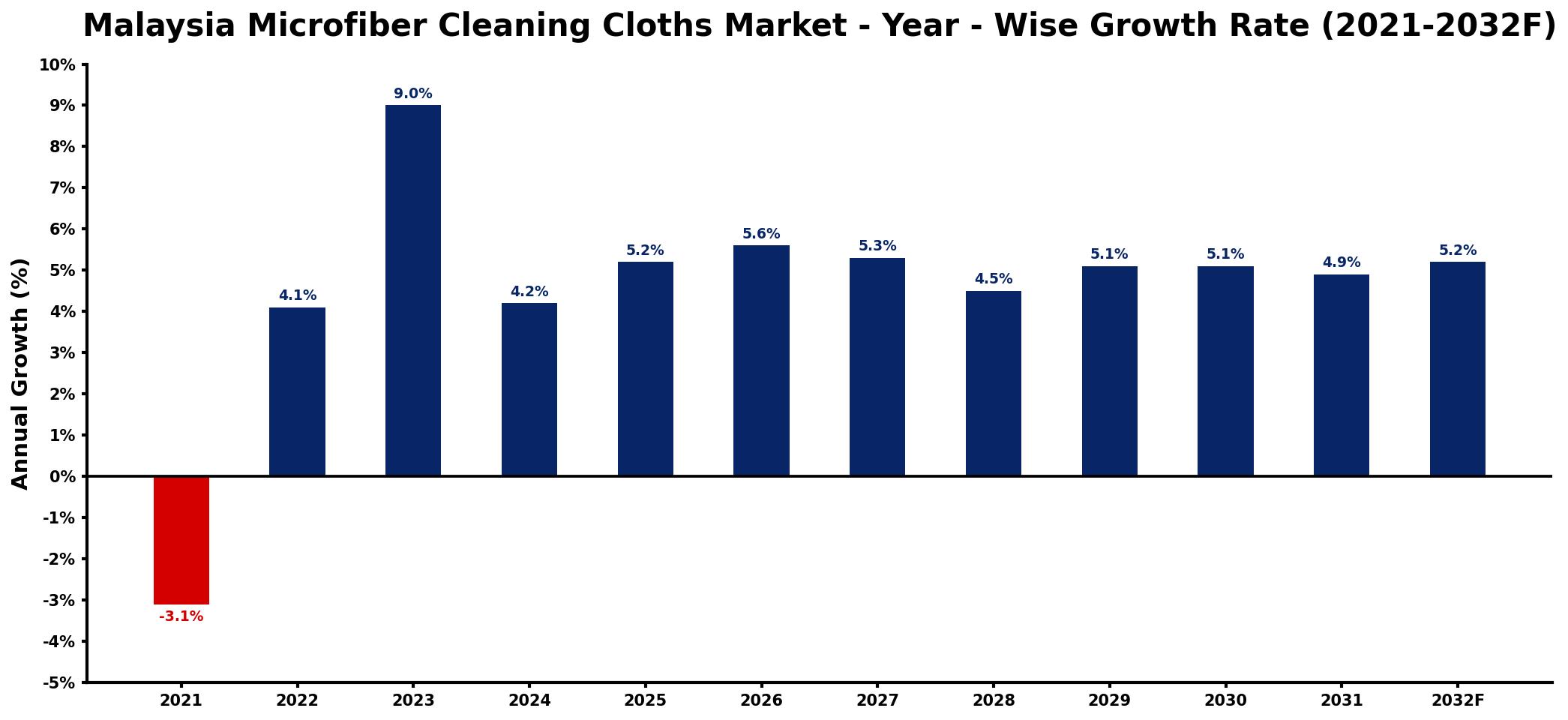
The table below presents the year‑wise growth rates along with the key drivers influencing the market
| Year | Growth Rate | Major Drivers |
| 2021 | -3.1% | decrease in consumer spending habits |
| 2022 | 4.1% | rise in eco-friendly product awareness |
| 2023 | 9.0% | increased demand for sustainable alternatives |
| 2024 | 4.2% | expansion of online retail channels |
| 2025 | 5.2% | growth in hospitality industry investments |
| 2026 | 5.6% | growing automotive sector requirements |
| 2027 | 5.3% | increased overall sector activity |
| 2028 | 4.5% | development of innovative product features |
| 2029 | 5.1% | rising infrastructure development spending |
| 2030 | 5.1% | stronger distribution network expansion |
| 2031 | 4.9% | growing emerging market penetration |
| 2032 | 5.2% | increase in corporate sustainability initiatives |
Note: Market size estimations and growth projections presented in this report are based on 6Wresearch's proprietary forecasting methodology, utilizing the latest available industry data, government publications, and primary research inputs.
Malaysia Microfiber Cleaning Cloths Market Synopsis
In Malaysia, the microfiber cleaning cloths market is experiencing a notable transformation, characterized by an increasing reliance on advanced cleaning solutions. Awareness of microfiber's superior cleaning capabilities, including its efficiency in capturing dust and dirt, positions it as a preferable option for consumers and businesses alike.
Moreover, the growing demand for eco-friendly and reusable cleaning products aligns with current global sustainability trends. This has prompted manufacturers to innovate and develop specialized cleaning cloths tailored for various settings, including healthcare, automotive, and hospitality, further propelling market expansion.
Malaysia Microfiber Cleaning Cloths Market Key Takeaways
- Growing consumer awareness of hygiene is significantly driving market demand.
- Microfiber cleaning cloths are favored for their eco-friendly and reusable properties.
- There is an increasing focus on product innovation to meet diverse cleaning needs.
- The impact of the COVID-19 pandemic has accelerated the shift towards microfiber cleaning solutions.
- The market is expected to see sustained growth across both residential and commercial sectors.
Evaluation of Restraints in Malaysia Microfiber Cleaning Cloths Market
Despite its growth potential, the Malaysia microfiber cleaning cloths market faces certain restraints. Quality control remains a critical issue, as varying product standards can lead to consumer distrust. Additionally, competition from traditional cleaning materials, such as cotton cloths and paper towels, poses a challenge, particularly among cost-sensitive consumers. As the market matures, addressing these restraints will be essential for sustained growth and brand loyalty.
Malaysia Microfiber Cleaning Cloths Market Trends
The microfiber cleaning cloths market is witnessing several noteworthy trends. One key trend is the increasing incorporation of technology in product development, such as antimicrobial properties in cleaning cloths, enhancing their effectiveness against bacteria and viruses. Additionally, there is a growing trend toward consumer education on the benefits of microfiber, with brands engaging in outreach efforts to promote better understanding of their products. Finally, the rising popularity of minimalism in households is leading to a preference for multifunctional cleaning solutions, further boosting microfiber's appeal.
Malaysia Microfiber Cleaning Cloths Market Opportunities
The Malaysian market presents numerous growth opportunities for stakeholders in the microfiber cleaning cloths sector. Expanding into niche markets, such as specialized automotive cleaning solutions, or targeting commercial sectors like healthcare and hospitality, could yield significant returns. Furthermore, partnerships with eco-conscious brands or initiatives aimed at promoting sustainable cleaning practices offer additional avenues for expansion, particularly as consumers gravitate toward environmentally friendly choices.
Government Initiatives in the Malaysia Microfiber Cleaning Cloths Market
The Malaysian government is increasingly recognizing the importance of promoting hygiene and sanitation standards, particularly in the wake of the pandemic. Public initiatives aimed at enhancing cleanliness in urban areas and public facilities have created a favorable environment for the microfiber cleaning cloths market. Furthermore, government support for sustainable practices and eco-friendly products is likely to encourage manufacturers to innovate and align their offerings with national objectives regarding environmental conservation and public health.
Future Insights of the Malaysia Microfiber Cleaning Cloths Market
Looking ahead to 2026-2032, the Malaysia microfiber cleaning cloths market is positioned for robust growth. The ongoing emphasis on hygiene will continue to drive demand, particularly in sectors that require stringent cleanliness standards, such as healthcare and food services. As consumer preferences evolve towards sustainable and effective cleaning solutions, manufacturers who prioritize product innovation and quality will likely emerge as leaders. This trajectory suggests a healthy competitive landscape ripe for new entrants and innovative solutions.
Malaysia Microfiber Cleaning Cloths Market Latest Developments (2025 - 2026)
Recent developments in the Malaysia microfiber cleaning cloths market indicate a strong focus on sustainability and product efficacy. Innovations in fabric technology are becoming more prominent, with companies experimenting with sustainable materials that enhance cleaning efficiency while reducing environmental impact. Furthermore, collaborations with local distributors have increased, aiming to improve market penetration and consumer access to high-quality microfiber products.
Malaysia Microfiber Cleaning Cloths Market - Key Attractiveness of the Report
- 10 Years of Market Numbers
- Historical Data Starting from 2022 to 2025
- Base Year: 2025
- Forecast Data until 2032
- Key Performance Indicators Impacting the Market
- Major Upcoming Developments and Projects
Key Highlights of the Report:
- Malaysia Microfiber Cleaning Cloths Market Outlook
- Market Size of Malaysia Microfiber Cleaning Cloths Market, 2025
- Forecast of Malaysia Microfiber Cleaning Cloths Market, 2032
- Historical Data and Forecast of Malaysia Microfiber Cleaning Cloths Revenues & Volume for the Period 2022-2032F
- Malaysia Microfiber Cleaning Cloths Market Trend Evolution
- Malaysia Microfiber Cleaning Cloths Market Drivers and Challenges
- Malaysia Microfiber Cleaning Cloths Price Trends
- Malaysia Microfiber Cleaning Cloths Porter's Five Forces
- Malaysia Microfiber Cleaning Cloths Industry Life Cycle
- Historical Data and Forecast of Malaysia Microfiber Cleaning Cloths Market Revenues & Volume By Type for the Period 2022-2032F
- Historical Data and Forecast of Malaysia Microfiber Cleaning Cloths Market Revenues & Volume By Multi-component Microfiber Cleaning Cloths for the Period 2022-2032F
- Historical Data and Forecast of Malaysia Microfiber Cleaning Cloths Market Revenues & Volume By Mono-component Microfiber Cleaning Cloths for the Period 2022-2032F
- Historical Data and Forecast of Malaysia Microfiber Cleaning Cloths Market Revenues & Volume By Application for the Period 2022-2032F
- Historical Data and Forecast of Malaysia Microfiber Cleaning Cloths Market Revenues & Volume By Household Used for the Period 2022-2032F
- Historical Data and Forecast of Malaysia Microfiber Cleaning Cloths Market Revenues & Volume By Commercial Used for the Period 2022-2032F
- Historical Data and Forecast of Malaysia Microfiber Cleaning Cloths Market Revenues & Volume By Industrial Used for the Period 2022-2032F
- Historical Data and Forecast of Malaysia Microfiber Cleaning Cloths Market Revenues & Volume By Car Care Used for the Period 2022-2032F
- Malaysia Microfiber Cleaning Cloths Import Export Trade Statistics
- Market Opportunity Assessment By Type
- Market Opportunity Assessment By Application
- Malaysia Microfiber Cleaning Cloths Top Companies Market Share
- Malaysia Microfiber Cleaning Cloths Competitive Benchmarking By Technical and Operational Parameters
- Malaysia Microfiber Cleaning Cloths Company Profiles
- Malaysia Microfiber Cleaning Cloths Key Strategic Recommendations






































