Malaysia Microprocessor Market Size, Share & Growth Rate
The Malaysia Microprocessor Market was estimated at USD 457 Million in 2025 and is projected to reach USD 589 Million by 2032, growing at a CAGR of 3.7% from 2026 to 2032. This growth trajectory is propelled by the increasing integration of microprocessors across various sectors, particularly in consumer electronics and automotive applications. As companies strive for innovation, the demand for efficient and powerful processing capabilities is anticipated to boost market dynamics substantially.
Malaysia Microprocessor Market Year-wise Growth Rate and Key Drivers
This graph highlights how the Malaysia Microprocessor Market has steadily grown over the years, supported by major growth factors.
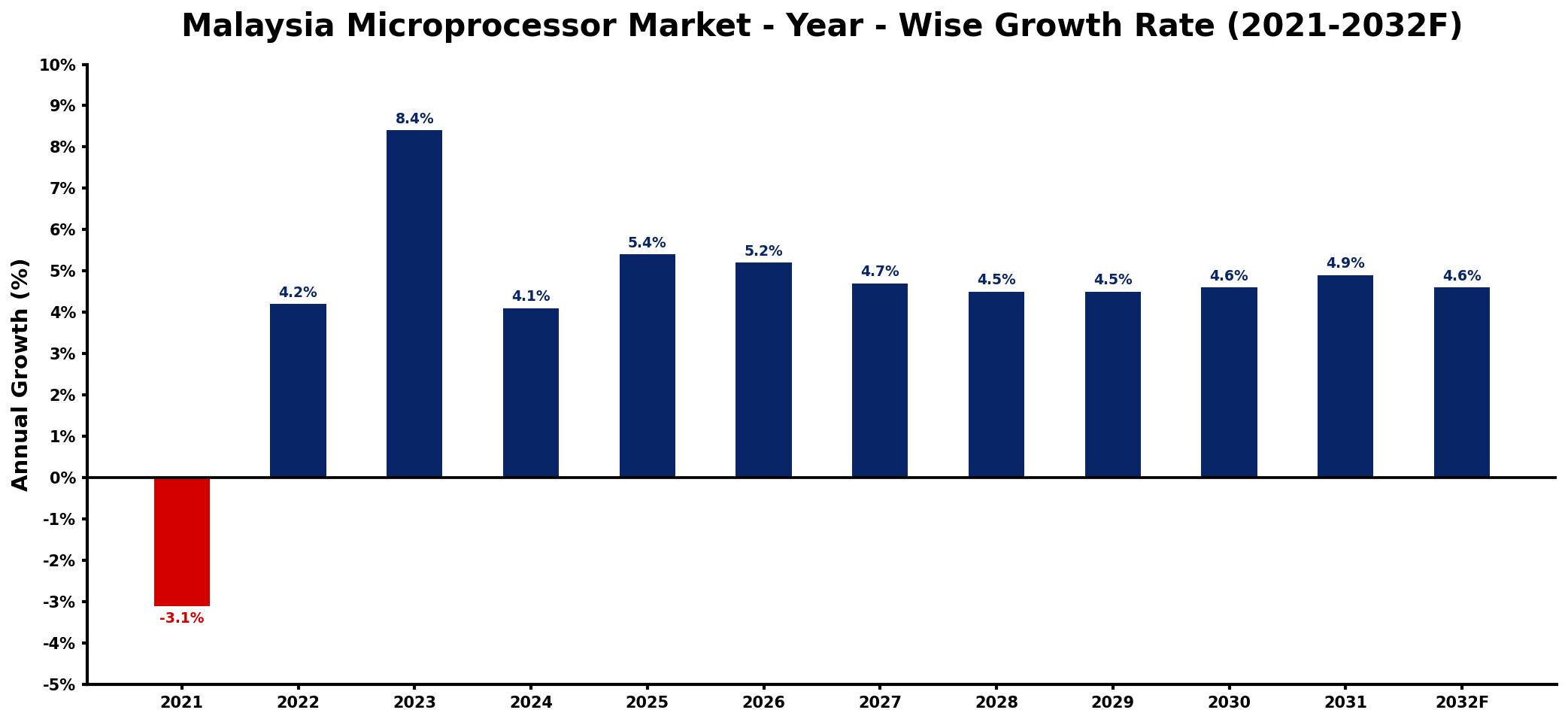
The table below presents the year‑wise growth rates along with the key drivers influencing the market
| Year | Growth Rate | Major Drivers |
| 2021 | -3.1% | decrease in consumer electronics demand |
| 2022 | 4.2% | increased automotive technology adoption |
| 2023 | 8.4% | expansion in cloud computing services |
| 2024 | 4.1% | growth of IoT applications market |
| 2025 | 5.4% | rising demand for smart devices |
| 2026 | 5.2% | surge in data center investments |
| 2027 | 4.7% | advancements in AI technologies |
| 2028 | 4.5% | growth in renewable energy systems |
| 2029 | 4.5% | increase in 5G infrastructure projects |
| 2030 | 4.6% | expansion of edge computing solutions |
| 2031 | 4.9% | increased production capacity utilization |
| 2032 | 4.6% | improved processing technologies adoption |
Note: Market size estimations and growth projections presented in this report are based on 6Wresearch's proprietary forecasting methodology, utilizing the latest available industry data, government publications, and primary research inputs.
Malaysia Microprocessor Market Synopsis
The microprocessor market in Malaysia is predominantly shaped by the escalating demand for advanced computing technologies. The country's strategic position within the global electronics supply chain facilitates its competitive edge, attracting significant investment in semiconductor manufacturing. As technology continues to evolve, the need for more compact, energy-efficient processors is influencing production and design trends.
Moreover, the rise of Internet of Things (IoT) applications is creating additional avenues for growth. With the increasing interconnectedness of devices, industries are experiencing a surge in demand for microprocessors that support complex functionalities and enhanced performance. This combination of local capabilities and market needs is setting the stage for a robust growth environment.
Malaysia Microprocessor Market Key Takeaways
- The market is positioned for steady growth, benefiting from increased microprocessor integration in various industries.
- Technological advancements are driving the development of smaller and more efficient processors tailored to meet evolving consumer needs.
- Investment in R&D remains crucial for maintaining competitive advantages amid global competition.
- The COVID-19 pandemic has accelerated demand in electronics, further propelling market growth.
- IoT applications are emerging as a key growth driver, expanding the scope and potential of microprocessor usage.
Evaluation of Restraints in Malaysia Microprocessor Market
While the microprocessor market in Malaysia shows promise, it is not without its constraints. A significant challenge stems from the intense global competition in the semiconductor industry, which complicates the ability of local manufacturers to secure substantial market shares. Additionally, the reliance on advanced manufacturing technologies necessitates heavy investments in research and development, which can be daunting for smaller firms. Compounding these issues, the industry's need for a highly skilled workforce often creates gaps that hinder growth. Moreover, external factors such as supply chain disruptions, notably highlighted during the COVID-19 pandemic, pose a threat to the stability and consistency of microprocessor production.
Malaysia Microprocessor Market Trends
The microprocessor market is currently witnessing several trends that are reshaping its landscape. Notably, there is a growing emphasis on the miniaturization of processors, driven by consumer demand for compact devices without compromising performance. Furthermore, advancements in AI and machine learning are encouraging the development of specialized microprocessors designed to handle complex algorithms efficiently. Another prominent trend is the increasing focus on sustainability, with manufacturers exploring eco-friendly materials and energy-efficient designs, reflecting broader societal shifts toward environmental responsibility.
Malaysia Microprocessor Market Opportunities
Genuine growth opportunities within the Malaysian microprocessor market are abundant. As industries continue to digitize and adopt automation, the demand for high-performance microprocessors will escalate, especially in sectors like healthcare and automotive. Additionally, the surge in IoT applications presents a unique opportunity for companies to innovate in the design and functionality of microprocessors. Collaborations with educational institutions to foster a skilled workforce can further enhance this growth potential, enabling local firms to thrive in an increasingly competitive global landscape.
Government Initiatives in the Malaysia Microprocessor Market
The Malaysian government plays a pivotal role in supporting the microprocessor market through various initiatives aimed at fostering innovation and competitiveness. Policies that promote public spending in technology and research are geared towards strengthening the semiconductor industry. Additionally, programs that incentivize investment in advanced manufacturing and skill development are crucial for enhancing the capabilities of the local workforce. By prioritizing these areas, the government seeks to position Malaysia as a key player in the global microprocessor supply chain.
Future Insights of the Malaysia Microprocessor Market
Looking ahead to the period from 2026 to 2032, the Malaysian microprocessor market is expected to flourish driven by continuous technological advancements and the increasing demand for smart devices. As industries embrace digital transformation, the integration of artificial intelligence and IoT will create new demands for sophisticated microprocessors. The ongoing commitment to R&D and innovation will be vital in ensuring that Malaysia maintains its competitive edge and capitalizes on emerging trends within the global semiconductor ecosystem.
Malaysia Microprocessor Market Latest Developments (2025 - 2026)
Recent developments in the Malaysia microprocessor market indicate a robust movement towards enhancing production capabilities and fostering partnerships aimed at innovation. Many industry players are focusing on expanding their research and development efforts, aligning with global trends that prioritize efficiency and advanced technology. Furthermore, there is a noticeable increase in collaboration among businesses and academic institutions to drive the workforce's skill development, ensuring that Malaysia remains competitive in the semiconductor landscape.
Malaysia Microprocessor Market - Key Attractiveness of the Report
- 10 Years of Market Numbers
- Historical Data Starting from 2022 to 2025
- Base Year: 2025
- Forecast Data until 2032
- Key Performance Indicators Impacting the Market
- Major Upcoming Developments and Projects
Key Highlights of the Report:
- Malaysia Microprocessor Market Outlook
- Market Size of Malaysia Microprocessor Market, 2025
- Forecast of Malaysia Microprocessor Market, 2032
- Historical Data and Forecast of Malaysia Microprocessor Revenues & Volume for the Period 2022-2032F
- Malaysia Microprocessor Market Trend Evolution
- Malaysia Microprocessor Market Drivers and Challenges
- Malaysia Microprocessor Price Trends
- Malaysia Microprocessor Porter's Five Forces
- Malaysia Microprocessor Industry Life Cycle
- Historical Data and Forecast of Malaysia Microprocessor Market Revenues & Volume By Technology for the Period 2022-2032F
- Historical Data and Forecast of Malaysia Microprocessor Market Revenues & Volume By CISC for the Period 2022-2032F
- Historical Data and Forecast of Malaysia Microprocessor Market Revenues & Volume By RISC for the Period 2022-2032F
- Historical Data and Forecast of Malaysia Microprocessor Market Revenues & Volume By ASIC for the Period 2022-2032F
- Historical Data and Forecast of Malaysia Microprocessor Market Revenues & Volume By Superscalar for the Period 2022-2032F
- Historical Data and Forecast of Malaysia Microprocessor Market Revenues & Volume By DSP for the Period 2022-2032F
- Historical Data and Forecast of Malaysia Microprocessor Market Revenues & Volume By Application for the Period 2022-2032F
- Historical Data and Forecast of Malaysia Microprocessor Market Revenues & Volume By Smartphones for the Period 2022-2032F
- Historical Data and Forecast of Malaysia Microprocessor Market Revenues & Volume By Personal Computers for the Period 2022-2032F
- Historical Data and Forecast of Malaysia Microprocessor Market Revenues & Volume By Servers for the Period 2022-2032F
- Historical Data and Forecast of Malaysia Microprocessor Market Revenues & Volume By Tablets for the Period 2022-2032F
- Historical Data and Forecast of Malaysia Microprocessor Market Revenues & Volume By Embedded Devices for the Period 2022-2032F
- Historical Data and Forecast of Malaysia Microprocessor Market Revenues & Volume By Others for the Period 2022-2032F
- Malaysia Microprocessor Import Export Trade Statistics
- Market Opportunity Assessment By Technology
- Market Opportunity Assessment By Application
- Malaysia Microprocessor Top Companies Market Share
- Malaysia Microprocessor Competitive Benchmarking By Technical and Operational Parameters
- Malaysia Microprocessor Company Profiles
- Malaysia Microprocessor Key Strategic Recommendations






































