Malaysia Microscopy Market Size, Share & Growth Rate
The Malaysia Microscopy Market was estimated at USD 378 Million in 2025 and is projected to reach USD 496 Million by 2032, growing at a CAGR of 4.0% from 2026 to 2032. This growth trajectory is primarily driven by the increasing investments in life sciences research and advancements in nanotechnology, which require high-resolution imaging techniques. Additionally, the expanding applications of microscopy in various industrial sectors, including materials science and pharmaceuticals, further solidify this upward trend.
Malaysia Microscopy Market Year-wise Growth Rate and Key Drivers
This graph highlights how the Malaysia Microscopy Market has steadily grown over the years, supported by major growth factors.
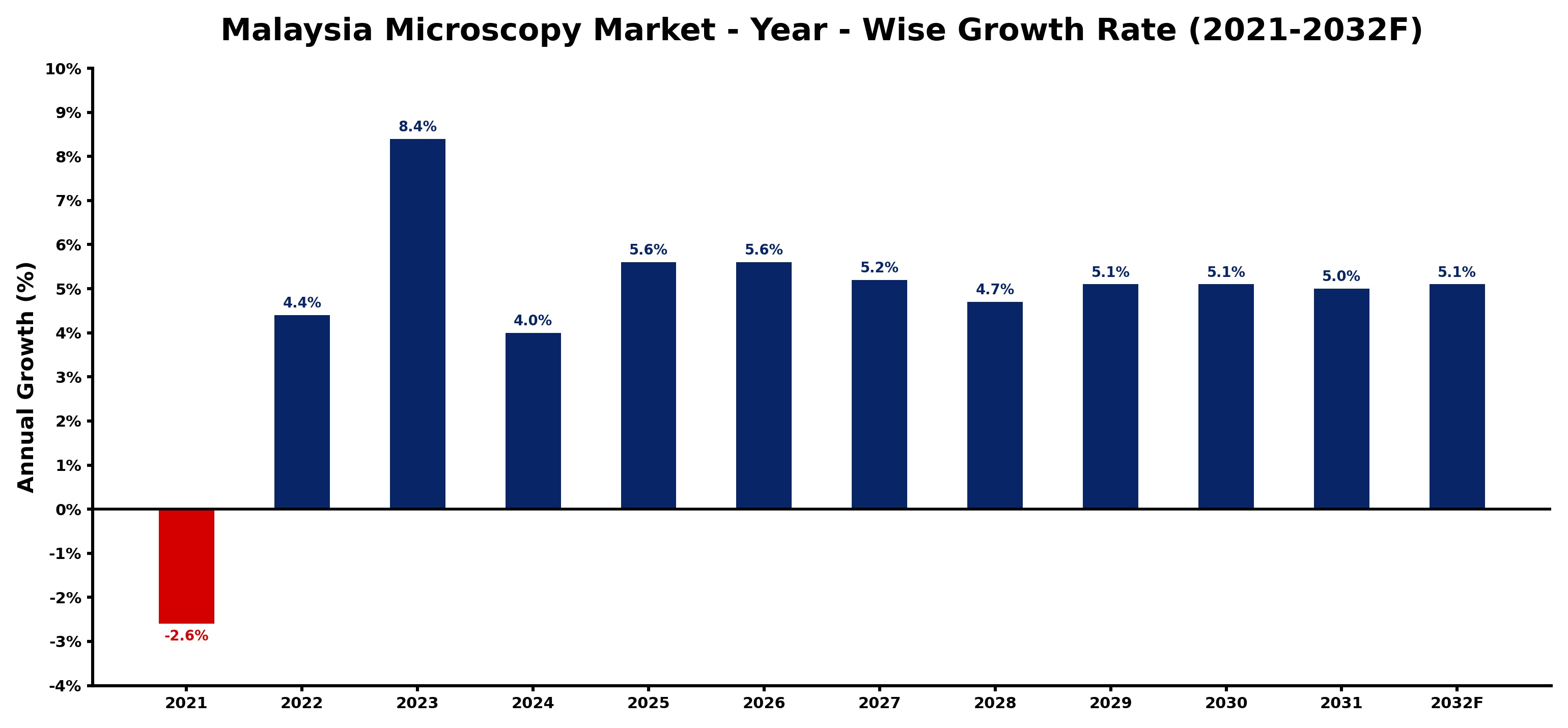
The table below presents the year‑wise growth rates along with the key drivers influencing the market
| Year | Growth Rate | Major Drivers |
| 2021 | -2.6% | Weak export demand diminished precision engineering machinery investments |
| 2022 | 4.4% | Technology adoption in precision engineering drives microscopy equipment investments |
| 2023 | 8.4% | Precision engineering investments boost advanced microscopy production capabilities |
| 2024 | 4.0% | Manufacturing investments boost precision engineering and automation capabilities |
| 2025 | 5.6% | Accelerated semiconductor fabrication boosts microscopy equipment demand in Malaysia |
| 2026 | 5.6% | Domestic precision engineering firms invest in advanced microscopy systems |
| 2027 | 5.2% | Improved manufacturing investments boosted microscopy equipment demand in automotive |
| 2028 | 4.7% | Precision engineering advancements boost microscopy equipment manufacturing capabilities |
| 2029 | 5.1% | Precision engineering investments boost microscopy equipment for automotive manufacturing |
| 2030 | 5.1% | Automotive supply chain revitalization boosts microscopy equipment procurement |
| 2031 | 5.0% | Precision engineering advancements optimize microscopy tool utilization rates |
| 2032 | 5.1% | Technology adoption in automotive supply chains boosts microscopy demand |
Note - Market size estimations and growth projections presented in this report are based on 6Wresearch's advanced forecasting approach, validated with industry datasets as of June 2026.
Malaysia Microscopy Market Synopsis
In Malaysia, the microscopy market has demonstrated significant growth due to a heightened demand for advanced imaging technologies. Researchers across diverse fields are increasingly relying on cutting-edge microscopy to explore complex biological structures and material properties. This trend reflects a broader global shift towards precision in scientific research.
As of recent years, the Malaysian market has witnessed substantial investments aimed at bolstering its research and development capabilities. This surge is indicative of the country's commitment to enhancing its scientific infrastructure and fostering an innovative ecosystem that supports advanced research methodologies.
Malaysia Microscopy Market Key Takeaways
- Robust growth is anticipated in the Malaysian microscopy market, driven by advancements in life sciences and nanotechnology.
- The increasing focus on high-resolution imaging techniques is propelling demand across various research fields.
- Government support and investments in R&D are crucial for the continued expansion of this market.
- Proficiency in microscopy techniques remains essential, with a growing need for skilled professionals in the field.
- COVID-19 has redirected some research priorities, but the demand for advanced microscopy remains strong.
Evaluation of Restraints in Malaysia Microscopy Market
While the Malaysian microscopy market is poised for growth, several constraints exist that may hinder its full potential. The high costs associated with acquiring advanced microscopy systems and equipment represent a significant barrier for many research institutions. Furthermore, inconsistent funding for research and development can limit the adoption of innovative microscopy technologies. Another pressing concern is the availability of skilled professionals trained in advanced microscopy techniques; the success of this market heavily relies on a workforce that can effectively utilize these sophisticated tools.
Malaysia Microscopy Market Trends
Emerging trends within the Malaysia microscopy market indicate a shift towards automation and integrated imaging systems. These advancements not only enhance efficiency but also allow for more comprehensive data analysis. Additionally, there is a growing interest in multimodal microscopy techniques that combine different imaging modalities for richer insights into materials and biological samples. Sustainability is becoming a focal point, with increasing demands for environmentally friendly microscopy practices and equipment.
Malaysia Microscopy Market Opportunities
There are substantial opportunities for growth in the Malaysian microscopy market, particularly in niche areas such as cryo-electron microscopy and super-resolution microscopy. Investment in these advanced techniques can provide researchers with unprecedented insights, thus attracting both academic and industrial partnerships. Additionally, strengthening collaboration between universities and research institutions presents a pathway for innovation and the development of new microscopy applications tailored to local needs.
Government Initiatives in the Malaysia Microscopy Market
The Malaysian government has recognized the importance of scientific research and development in driving economic growth. Initiatives aimed at enhancing research capabilities, including funding programs and infrastructure development, are being implemented to bolster the microscopy market. Public investments in educational programs are also geared toward nurturing talent in the field of microscopy, ensuring a steady pipeline of skilled professionals ready to meet the industry's demands.
Future Insights of the Malaysia Microscopy Market
Looking ahead to the 2026-2032 period, the Malaysia microscopy market is set to evolve rapidly, propelled by continuous technological advancements and increased investment in research. The integration of artificial intelligence in microscopy is expected to revolutionize data interpretation, making processes more efficient and accurate. As the demand for high-resolution imaging grows across sectors, Malaysia's position in the global microscopy landscape will likely strengthen, driven by its commitment to innovation and research excellence.
Malaysia Microscopy Market Latest Developments (May 2025 - June 2026)
Recent developments in the Malaysia microscopy market showcase a heightened focus on collaborative research projects, particularly in universities and research institutes. There has been an uptick in partnerships aimed at developing advanced imaging techniques that cater to local scientific challenges. Additionally, the emergence of new educational initiatives is fostering a greater understanding of advanced microscopy among the next generation of scientists.
Malaysia Microscopy Market - Key Attractiveness of the Report
- 10 Years of Market Numbers
- Historical Data Starting from 2022 to 2025
- Base Year: 2025
- Forecast Data until 2032
- Key Performance Indicators Impacting the Market
- Major Upcoming Developments and Projects
Key Highlights of the Report:
- Malaysia Microscopy Market Outlook
- Market Size of Malaysia Microscopy Market, 2025
- Forecast of Malaysia Microscopy Market, 2032
- Historical Data and Forecast of Malaysia Microscopy Revenues & Volume for the Period 2022-2032F
- Malaysia Microscopy Market Trend Evolution
- Malaysia Microscopy Market Drivers and Challenges
- Malaysia Microscopy Price Trends
- Malaysia Microscopy Porter's Five Forces
- Malaysia Microscopy Industry Life Cycle
- Historical Data and Forecast of Malaysia Microscopy Market Revenues & Volume By Product for the Period 2022-2032F
- Historical Data and Forecast of Malaysia Microscopy Market Revenues & Volume By Microscopes for the Period 2022-2032F
- Historical Data and Forecast of Malaysia Microscopy Market Revenues & Volume By Software for the Period 2022-2032F
- Historical Data and Forecast of Malaysia Microscopy Market Revenues & Volume By Accessories for the Period 2022-2032F
- Historical Data and Forecast of Malaysia Microscopy Market Revenues & Volume By Type for the Period 2022-2032F
- Historical Data and Forecast of Malaysia Microscopy Market Revenues & Volume By Optical Microscopes for the Period 2022-2032F
- Historical Data and Forecast of Malaysia Microscopy Market Revenues & Volume By Electron Microscopes for the Period 2022-2032F
- Historical Data and Forecast of Malaysia Microscopy Market Revenues & Volume By Scanning Probe Microscopes for the Period 2022-2032F
- Historical Data and Forecast of Malaysia Microscopy Market Revenues & Volume By Other Microscopes for the Period 2022-2032F
- Historical Data and Forecast of Malaysia Microscopy Market Revenues & Volume By Applications for the Period 2022-2032F
- Historical Data and Forecast of Malaysia Microscopy Market Revenues & Volume By Semiconductors for the Period 2022-2032F
- Historical Data and Forecast of Malaysia Microscopy Market Revenues & Volume By Life Sciences for the Period 2022-2032F
- Historical Data and Forecast of Malaysia Microscopy Market Revenues & Volume By Material Sciences for the Period 2022-2032F
- Historical Data and Forecast of Malaysia Microscopy Market Revenues & Volume By Nanotechnology for the Period 2022-2032F
- Historical Data and Forecast of Malaysia Microscopy Market Revenues & Volume By Other Applications for the Period 2022-2032F
- Historical Data and Forecast of Malaysia Microscopy Market Revenues & Volume By End-users for the Period 2022-2032F
- Historical Data and Forecast of Malaysia Microscopy Market Revenues & Volume By Industries for the Period 2022-2032F
- Historical Data and Forecast of Malaysia Microscopy Market Revenues & Volume By Research Institutes for the Period 2022-2032F
- Historical Data and Forecast of Malaysia Microscopy Market Revenues & Volume By Other end-users for the Period 2022-2032F
- Malaysia Microscopy Import Export Trade Statistics
- Market Opportunity Assessment By Product
- Market Opportunity Assessment By Type
- Market Opportunity Assessment By Applications
- Market Opportunity Assessment By End-users
- Malaysia Microscopy Top Companies Market Share
- Malaysia Microscopy Competitive Benchmarking By Technical and Operational Parameters
- Malaysia Microscopy Company Profiles
- Malaysia Microscopy Key Strategic Recommendations






































