Malaysia Military Radar Market Size, Share & Growth Rate
The Malaysia Military Radar Market was estimated at USD 150 Million in 2025 and is projected to reach USD 195 Million by 2032, growing at a CAGR of 3.8% from 2026 to 2032. This growth trajectory is primarily driven by Malaysia's ongoing commitment to modernizing its defense infrastructure and bolstering national security. Increasing investments in advanced radar technologies are crucial for enhancing surveillance capabilities, particularly along its extensive coastline and borders.
Malaysia Military Radar Market Year-wise Growth Rate and Key Drivers
This graph highlights how the Malaysia Military Radar Market has steadily grown over the years, supported by major growth factors.
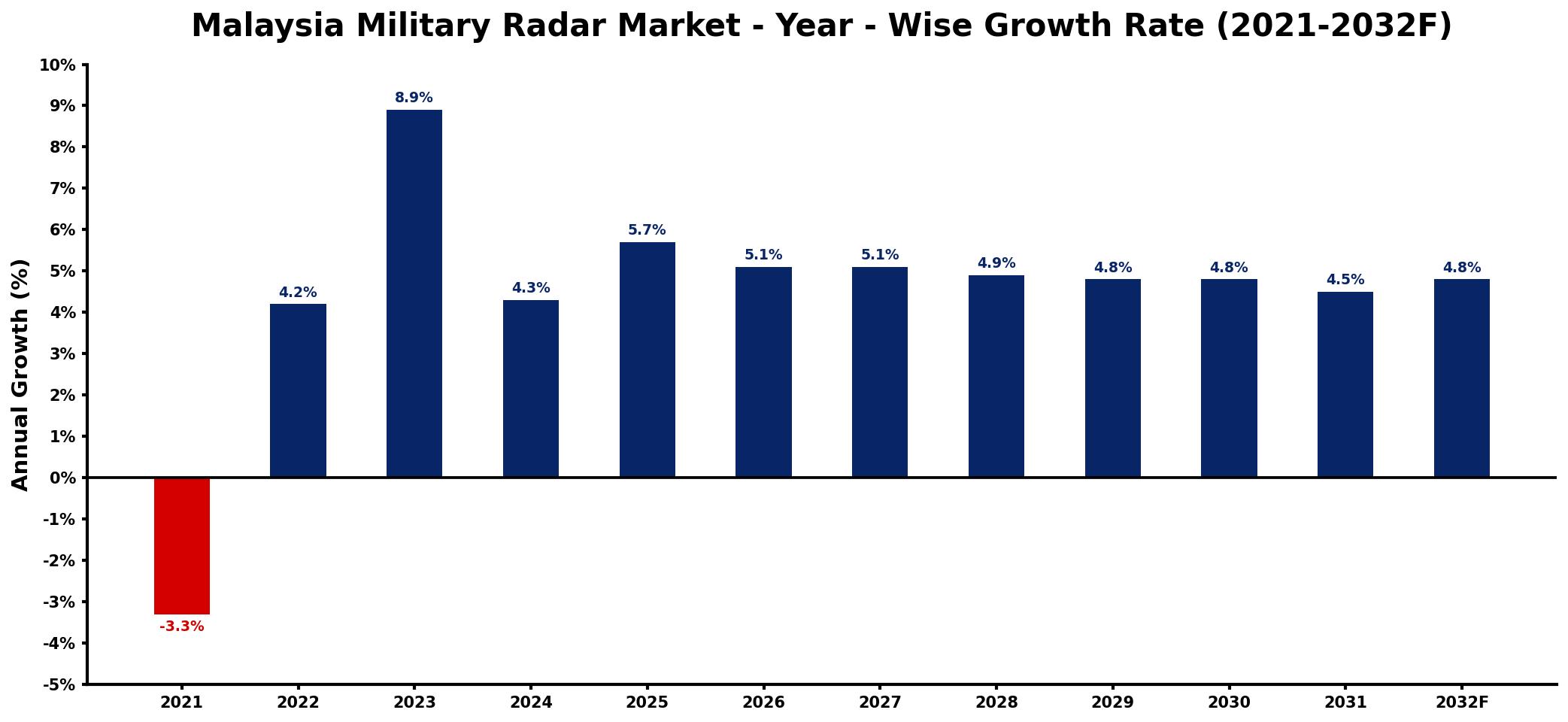
The table below presents the year‑wise growth rates along with the key drivers influencing the market
| Year | Growth Rate | Major Drivers |
| 2021 | -3.3% | decrease in defense spending initiatives |
| 2022 | 4.2% | strengthening underlying market demand |
| 2023 | 8.9% | strengthening international trade flows |
| 2024 | 4.3% | expansion of technological partnerships emerging |
| 2025 | 5.7% | rise in defense modernization projects |
| 2026 | 5.1% | enhanced focus on cybersecurity measures |
| 2027 | 5.1% | integration of advanced technologies proliferation |
| 2028 | 4.9% | stronger international defense collaborations |
| 2029 | 4.8% | increased demand for surveillance capabilities |
| 2030 | 4.8% | growing focus on indigenous manufacturing |
| 2031 | 4.5% | rising interest in dual-use technologies |
| 2032 | 4.8% | increased overall sector activity |
Note: Market size estimations and growth projections presented in this report are based on 6Wresearch's proprietary forecasting methodology, utilizing the latest available industry data, government publications, and primary research inputs.
Malaysia Military Radar Market Synopsis
In recent years, Malaysia has recognized the strategic importance of military radar systems in safeguarding its territorial integrity. With a geographical landscape that includes vast coastlines and busy shipping lanes, the country is actively pursuing advanced radar technologies for effective monitoring and threat detection.
The military radar market in Malaysia is characterized by a blend of indigenous development and international partnerships, as the nation seeks to upgrade its military capabilities in alignment with regional security dynamics. Increasing geopolitical tensions in Southeast Asia further underscore the necessity for sophisticated radar systems to enhance national defense.
Malaysia Military Radar Market Key Takeaways
- The market is set to grow due to substantial government investments in defense capabilities.
- Advanced radar technologies, such as phased-array and AESA systems, are gaining traction.
- International collaborations are facilitating technology transfer and system upgrades.
- Ongoing modernization of the armed forces is a priority for national security.
- Malaysian strategic location necessitates enhanced maritime surveillance capabilities.
Evaluation of Restraints in Malaysia Military Radar Market
Despite the promising outlook for the Malaysia military radar market, several restraints could hinder growth. Chief among these are the ever-evolving nature of technological advancements, necessitating constant upgrades to detect emerging threats effectively. Moreover, budgetary constraints present a challenge, as the government must balance defense expenditures with various national priorities. Additionally, concerns about cybersecurity threats targeting military systems can deter investments in newer technologies. These factors collectively indicate that while the market is poised for growth, it must navigate through complex challenges to realize its full potential.
Malaysia Military Radar Market Trends
Current trends indicate a significant shift towards the integration of cutting-edge technologies, such as artificial intelligence and machine learning, within radar systems to enhance performance. Moreover, the adoption of unmanned aerial systems (UAS) for surveillance in tandem with advanced radar technologies is becoming increasingly prevalent. The drive for interoperability among various defense systems further emphasizes the need for radar solutions that can seamlessly integrate with existing military frameworks. These trends signal a forward-thinking approach to military radar capabilities in Malaysia.
Malaysia Military Radar Market Opportunities
The growing need for robust surveillance and threat detection systems presents substantial opportunities for investments in the Malaysian military radar market. Companies focusing on innovative technologies, particularly in sensor development and radar signal processing, are likely to find promising avenues for growth. Additionally, the potential for regional partnerships and joint ventures with foreign defense companies can accelerate technological advancements and enhance local capabilities. Overall, the market landscape is ripe for those looking to capitalize on Malaysia's defense modernization efforts.
Government Initiatives in the Malaysia Military Radar Market
The Malaysian government has prioritized defense spending in recent years, recognizing the importance of advanced radar technologies to ensure national security. Various public programs aim to upgrade military capabilities, including the modernization of existing radar systems. Strategic partnerships with international defense firms are encouraged to foster local technological development and enhance the national defense industrial base. Furthermore, the government is exploring incentives to facilitate research and development in military radar solutions, positioning Malaysia as a competitive player in the Southeast Asian defense market.
Future Insights of the Malaysia Military Radar Market
Looking ahead to the period from 2026 to 2032, the Malaysia military radar market is expected to experience continuous growth, driven by sustained governmental focus on defense capabilities. As regional security dynamics evolve, the demand for advanced radar systems will only intensify. Innovations in technology, including enhanced detection capabilities and integration with other defense assets, will shape the future of this sector. With a commitment to modernizing its military, Malaysia is likely to emerge as a significant player in the global military radar landscape.
Malaysia Military Radar Market Latest Developments (2025 - 2026)
Recent developments in the Malaysia military radar market indicate a proactive approach towards integrating next-generation radar systems. Efforts to establish partnerships for technology transfer are underway, with local companies aiming to strengthen their capabilities. Additionally, recent defense procurements signal a strategic focus on enhancing border and maritime security through advanced surveillance systems. Overall, the landscape is evolving, with increasing collaboration between domestic firms and international defense players.
Malaysia Military Radar Market - Key Attractiveness of the Report
- 10 Years of Market Numbers
- Historical Data Starting from 2022 to 2025
- Base Year: 2025
- Forecast Data until 2032
- Key Performance Indicators Impacting the Market
- Major Upcoming Developments and Projects
Key Highlights of the Report:
- Malaysia Military Radar Market Outlook
- Market Size of Malaysia Military Radar Market, 2025
- Forecast of Malaysia Military Radar Market, 2032
- Historical Data and Forecast of Malaysia Military Radar Revenues & Volume for the Period 2022-2032F
- Malaysia Military Radar Market Trend Evolution
- Malaysia Military Radar Market Drivers and Challenges
- Malaysia Military Radar Price Trends
- Malaysia Military Radar Porter's Five Forces
- Malaysia Military Radar Industry Life Cycle
- Historical Data and Forecast of Malaysia Military Radar Market Revenues & Volume By Platform for the Period 2022-2032F
- Historical Data and Forecast of Malaysia Military Radar Market Revenues & Volume By Airborne Radar for the Period 2022-2032F
- Historical Data and Forecast of Malaysia Military Radar Market Revenues & Volume By Land Radar for the Period 2022-2032F
- Historical Data and Forecast of Malaysia Military Radar Market Revenues & Volume By Naval Radar for the Period 2022-2032F
- Historical Data and Forecast of Malaysia Military Radar Market Revenues & Volume By Range for the Period 2022-2032F
- Historical Data and Forecast of Malaysia Military Radar Market Revenues & Volume By Long for the Period 2022-2032F
- Historical Data and Forecast of Malaysia Military Radar Market Revenues & Volume By Medium for the Period 2022-2032F
- Historical Data and Forecast of Malaysia Military Radar Market Revenues & Volume By Short for the Period 2022-2032F
- Historical Data and Forecast of Malaysia Military Radar Market Revenues & Volume By Very Short for the Period 2022-2032F
- Historical Data and Forecast of Malaysia Military Radar Market Revenues & Volume By Application for the Period 2022-2032F
- Historical Data and Forecast of Malaysia Military Radar Market Revenues & Volume By Weapon Guidance for the Period 2022-2032F
- Historical Data and Forecast of Malaysia Military Radar Market Revenues & Volume By Airspace Monitoring & Traffic Management for the Period 2022-2032F
- Historical Data and Forecast of Malaysia Military Radar Market Revenues & Volume By Airborne Mapping for the Period 2022-2032F
- Historical Data and Forecast of Malaysia Military Radar Market Revenues & Volume By Ground Surveillance & Intruder Detection for the Period 2022-2032F
- Historical Data and Forecast of Malaysia Military Radar Market Revenues & Volume By Navigation for the Period 2022-2032F
- Historical Data and Forecast of Malaysia Military Radar Market Revenues & Volume By Others for the Period 2022-2032F
- Historical Data and Forecast of Malaysia Military Radar Market Revenues & Volume By Frequency for the Period 2022-2032F
- Historical Data and Forecast of Malaysia Military Radar Market Revenues & Volume By C-Band for the Period 2022-2032F
- Historical Data and Forecast of Malaysia Military Radar Market Revenues & Volume By S-Band for the Period 2022-2032F
- Historical Data and Forecast of Malaysia Military Radar Market Revenues & Volume By X-Band for the Period 2022-2032F
- Historical Data and Forecast of Malaysia Military Radar Market Revenues & Volume By L-Band for the Period 2022-2032F
- Historical Data and Forecast of Malaysia Military Radar Market Revenues & Volume By UHF/VHF for the Period 2022-2032F
- Historical Data and Forecast of Malaysia Military Radar Market Revenues & Volume By Ku/K/Ka-Band for the Period 2022-2032F
- Historical Data and Forecast of Malaysia Military Radar Market Revenues & Volume By Component for the Period 2022-2032F
- Historical Data and Forecast of Malaysia Military Radar Market Revenues & Volume By Transmitter for the Period 2022-2032F
- Historical Data and Forecast of Malaysia Military Radar Market Revenues & Volume By Antenna for the Period 2022-2032F
- Historical Data and Forecast of Malaysia Military Radar Market Revenues & Volume By Receiver for the Period 2022-2032F
- Historical Data and Forecast of Malaysia Military Radar Market Revenues & Volume By Duplexer for the Period 2022-2032F
- Historical Data and Forecast of Malaysia Military Radar Market Revenues & Volume By Others for the Period 2022-2032F
- Malaysia Military Radar Import Export Trade Statistics
- Market Opportunity Assessment By Platform
- Market Opportunity Assessment By Range
- Market Opportunity Assessment By Application
- Market Opportunity Assessment By Frequency
- Market Opportunity Assessment By Component
- Malaysia Military Radar Top Companies Market Share
- Malaysia Military Radar Competitive Benchmarking By Technical and Operational Parameters
- Malaysia Military Radar Company Profiles
- Malaysia Military Radar Key Strategic Recommendations






































