Malaysia Millets Market Size, Share & Growth Rate
The Malaysia Millets Market was estimated at USD 433 Million in 2025 and is projected to reach USD 563 Million by 2032, growing at a CAGR of 3.8% from 2026 to 2032. This trajectory is driven by a renewed consumer focus on health, sustainability, and the versatility of millet as a food source. Increasing recognition of millets as an environmentally friendly alternative to traditional grains is further amplifying market interest.
Malaysia Millets Market Growth Rate Analysis (2021-2032)
The Malaysia millets market has shown a remarkable recovery from a decline of 2.7% in 2021, pivoting to a robust growth phase with an impressive 8.6% increase in 2023. This surge can be attributed to rising consumer demand for health-conscious food choices and a growing awareness of millets as a sustainable agricultural option. As the country moves towards energy transition and embraces digitalization in agricultural practices, investments in millet cultivation are likely to strengthen further, leading to steady growth rates of around 4.8% to 5.5% projected through 2032. The ongoing infrastructure improvements and supportive policies for local farmers are also key factors bolstering this upward trend.
Malaysia Millets Market Year-wise Growth Rate and Key Drivers
This graph highlights how the Malaysia Millets Market has steadily grown over the past five years, supported by major growth factors.
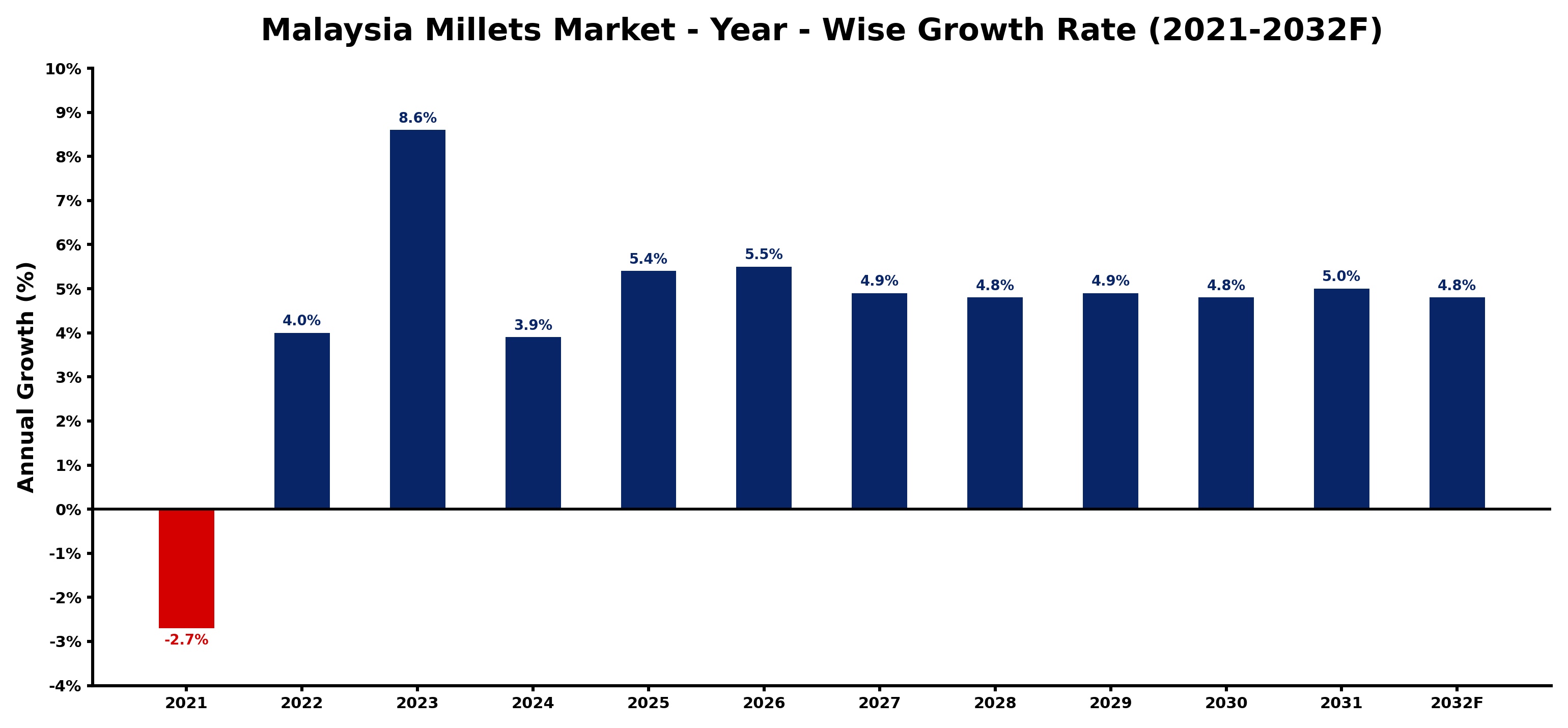
The table below presents the year‑wise growth rates along with the key drivers influencing the market
| Year | Growth Rate | Major Drivers |
| 2021 | -2.7% | Consumer interest in alternatives declined |
| 2022 | 4.0% | Health awareness drove product interest |
| 2023 | 8.6% | Local sourcing increased market presence |
| 2024 | 3.9% | Export opportunities expanded significantly |
| 2025 | 5.4% | New product launches attracted attention |
| 2026 | 5.5% | Sustainability trends influenced purchasing behavior |
| 2027 | 4.9% | Culinary innovation enhanced product appeal |
| 2028 | 4.8% | Nutritional benefits gained consumer recognition |
| 2029 | 4.9% | E-commerce growth improved accessibility |
| 2030 | 4.8% | Cross-industry collaborations boosted visibility |
| 2031 | 5.0% | Cultural integration expanded market reach |
| 2032 | 4.8% | Consumer loyalty programs increased retention |
Note - Market size estimations and growth projections presented in this report are based on 6Wresearch’s advanced forecasting approach, validated with industry datasets as of June 2026.
Malaysia Millets Market Synopsis
Millets have been integral to traditional diets in Malaysia for centuries, offering a rich nutritional profile that aligns well with contemporary dietary preferences. This ancient grain is now gaining momentum again, with local farmers embracing its cultivation due to its resilience and health benefits.
As health-conscious consumers seek nutritious alternatives to conventional grains, millets are emerging as a popular choice. Their high protein content, coupled with a low glycemic index, makes them particularly appealing to those focused on wellness and sustainable eating habits.
Malaysia Millets Market Key Takeaways
- The Malaysia Millets Market is on a growth trajectory driven by increasing consumer awareness of health and sustainability.
- Millets are positioned as drought-resistant crops, requiring fewer resources for cultivation compared to traditional grains.
- Diversification of millet products, including snacks and cereals, is enhancing market penetration.
- Barriers like consumer awareness and supply chain consistency need to be addressed for sustained growth.
- Key players are focusing on product innovation to expand their millet offerings, thereby catering to a broader consumer base.
Evaluation of Restraints in Malaysia Millets Market
While the market presents significant growth potential, several restraints hinder its full realization. A predominant challenge is the limited consumer awareness regarding the culinary versatility of millets. Many consumers remain unfamiliar with how to incorporate millets into their diets, thereby restricting market demand. Additionally, the supply chain for millets is still underdeveloped, which complicates consistent availability and price stability. Overcoming these barriers will be crucial for unlocking the market's full potential.
Malaysia Millets Market Trends
Current trends indicate a rising interest in plant-based diets, and millets are uniquely positioned to benefit from this shift. Health-conscious consumers are leaning towards high-fiber and gluten-free options, which enhances millet's appeal. Additionally, there is a noticeable uptick in millet-based product innovation, with manufacturers exploring various applications such as baked goods, energy bars, and breakfast items. This innovation will continue to shape demand and drive market dynamics.
Malaysia Millets Market Opportunities
Investment opportunities in the Malaysia Millets Market are expanding as more consumers seek sustainable food choices. The growing trend towards organic products presents a significant avenue for growth, particularly for organically grown millets. Furthermore, collaborations with food technology startups to create convenient, ready-to-eat millet products could open new market segments and attract a younger demographic seeking nutritious fast food alternatives.
Government Initiatives in the Malaysia Millets Market
The Malaysian government has initiated various programs aimed at promoting sustainable agricultural practices, which includes the cultivation of millets. Policies focused on supporting local farmers with subsidies for drought-resistant crops and incentives for organic farming practices are being implemented. These initiatives are crucial in fostering a conducive environment for the growth of the millet market, aligning with national goals for food security and sustainability.
Future Insights of the Malaysia Millets Market
Looking ahead, the Malaysia Millets Market is poised for significant evolution between 2026 and 2032. As consumer trends increasingly favor health-oriented and environmentally sustainable foods, millets are set to gain a stronger foothold in both domestic and international markets. Enhanced product innovation, combined with a sustained focus on educating consumers about the benefits and uses of millets, will be pivotal in driving market growth during this period.
Malaysia Millets Market Latest Developments (May 2025 - June 2026)
Recent developments in the Malaysia Millets Market indicate a strategic shift toward expanding product offerings. New product launches and collaborations between agricultural organizations and health-focused brands are becoming more common. These partnerships aim to enhance consumer education while promoting the nutritional benefits of millets. Additionally, ongoing research into the health benefits of millets is expected to contribute to increased consumer awareness and market demand.
Malaysia Millets Market - Key Attractiveness of the Report
- 10 Years of Market Numbers
- Historical Data Starting from 2022 to 2025
- Base Year: 2025
- Forecast Data until 2032
- Key Performance Indicators Impacting the Market
- Major Upcoming Developments and Projects
Key Highlights of the Report:
- Malaysia Millets Market Outlook
- Market Size of Malaysia Millets Market, 2025
- Forecast of Malaysia Millets Market, 2032F
- Historical Data and Forecast of Malaysia Millets Revenues & Volume for the Period 2022-2032F
- Malaysia Millets Market Trend Evolution
- Malaysia Millets Market Drivers and Challenges
- Malaysia Millets Price Trends
- Malaysia Millets Porter's Five Forces
- Malaysia Millets Industry Life Cycle
- Historical Data and Forecast of Malaysia Millets Market Revenues & Volume By Type for the Period 2022-2032F
- Historical Data and Forecast of Malaysia Millets Market Revenues & Volume By Pearl Millet for the Period 2022-2032F
- Historical Data and Forecast of Malaysia Millets Market Revenues & Volume By Finger Millet for the Period 2022-2032F
- Historical Data and Forecast of Malaysia Millets Market Revenues & Volume By ProsoMillet for the Period 2022-2032F
- Historical Data and Forecast of Malaysia Millets Market Revenues & Volume By Others for the Period 2022-2032F
- Historical Data and Forecast of Malaysia Millets Market Revenues & Volume By Distribution Channel for the Period 2022-2032F
- Historical Data and Forecast of Malaysia Millets Market Revenues & Volume By Trade Association& Organization for the Period 2022-2032F
- Historical Data and Forecast of Malaysia Millets Market Revenues & Volume By Traditional Grocery Stores for the Period 2022-2032F
- Historical Data and Forecast of Malaysia Millets Market Revenues & Volume By Supermarket for the Period 2022-2032F
- Historical Data and Forecast of Malaysia Millets Market Revenues & Volume By Online Stores for the Period 2022-2032F
- Historical Data and Forecast of Malaysia Millets Market Revenues & Volume By Others for the Period 2022-2032F
- Historical Data and Forecast of Malaysia Millets Market Revenues & Volume By Application for the Period 2022-2032F
- Historical Data and Forecast of Malaysia Millets Market Revenues & Volume By Infant Food for the Period 2022-2032F
- Historical Data and Forecast of Malaysia Millets Market Revenues & Volume By Bakery Products for the Period 2022-2032F
- Historical Data and Forecast of Malaysia Millets Market Revenues & Volume By Beverages for the Period 2022-2032F
- Malaysia Millets Import Export Trade Statistics
- Market Opportunity Assessment By Type
- Market Opportunity Assessment By Distribution Channel
- Market Opportunity Assessment By Application
- Malaysia Millets Top Companies Market Share
- Malaysia Millets Competitive Benchmarking By Technical and Operational Parameters
- Malaysia Millets Company Profiles
- Malaysia Millets Key Strategic Recommendations






































