Malaysia Mobile Accelerator Market Size & Growth Rate (2026-2032)
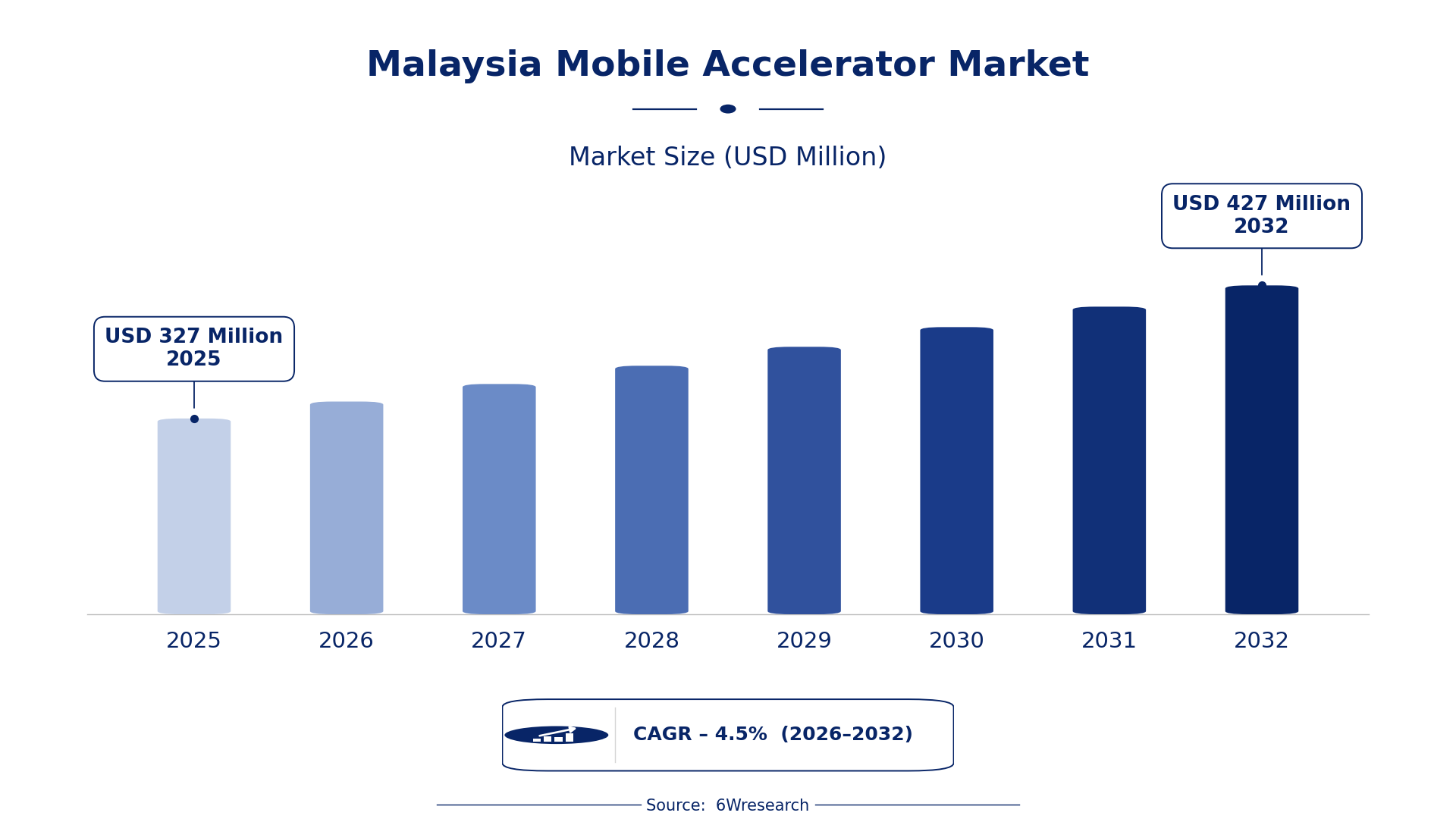
The Malaysia Mobile Accelerator Market was estimated at USD 327 Million in 2025 and is projected to reach USD 427 Million by 2032, growing at a CAGR of 4.5% from 2026 to 2032.
Malaysia Mobile Accelerator Market Synopsis
As mobile applications proliferate in Malaysia, businesses are increasingly focused on enhancing app performance to meet user expectations. Mobile accelerators have emerged as essential tools, providing the necessary technology to optimize speed and responsiveness, thereby driving user satisfaction and loyalty.
The demand for mobile accelerators is not just about speed; it's about reliability. With the rise of remote work and online services, applications must perform optimally under various conditions. Mobile accelerators facilitate this by ensuring that apps remain functional and fast, even during peak usage times.
Malaysia Mobile Accelerator Market Year-wise Growth Rate and Key Drivers
This graph illustrates the annual growth rates of the Malaysia Mobile Accelerator Market from 2021 to 2032, highlighting a steady upward trajectory and projected expansion over the forecast period.
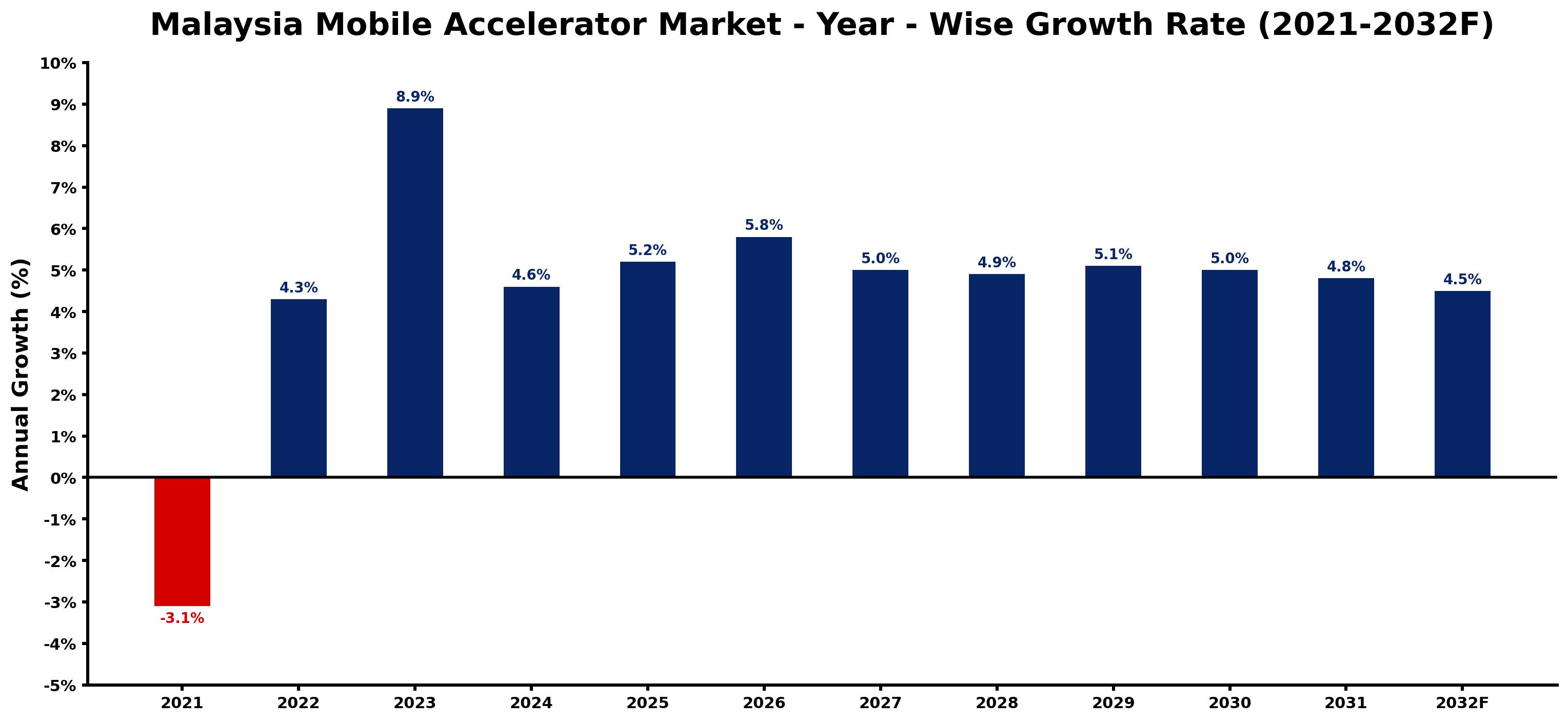
The table below presents the year‑wise growth rates along with the key drivers influencing the market
| Year | Growth Rate | Major Drivers |
| 2021 | -3.1% | MCMC's stricter regulations hindered app developer innovation. |
| 2022 | 4.3% | Increased government support for digital startups through initiatives. |
| 2023 | 8.9% | Strong uptick in mobile e-commerce adoption among consumers. |
| 2024 | 4.6% | Launch of 5G services enhancing mobile application performance. |
| 2025 | 5.2% | Enhanced focus on mobile cybersecurity regulations by MCMC. |
| 2026 | 5.8% | Growth in mobile workforce solutions amid urban job shifts. |
| 2027 | 5.0% | Investments in mobile infrastructure under National Digital Economy Policy. |
| 2028 | 4.9% | Rise in mobile gaming popularity among Malaysian youth demographics. |
| 2029 | 5.1% | Increased broadband penetration fueling mobile internet access. |
| 2030 | 5.0% | Government initiatives promoting digital literacy across rural areas. |
| 2031 | 4.8% | Partnerships between fintech and mobile platforms driving innovation. |
| 2032 | 4.5% | Emergence of local incubators supporting mobile app entrepreneurs. |
Note: Market size estimations and growth projections presented in this report are based on 6Wresearch's proprietary forecasting methodology, utilizing the latest available industry data, government publications, and primary research inputs.
Malaysia Mobile Accelerator Market Key Takeaways
Below are some of the specific key takeaways from the market, including:
- The market is witnessing a steady growth trajectory, fueled by increasing mobile application usage.
- Businesses are prioritizing user experience, driving the demand for performance optimization solutions.
- Network infrastructure challenges remain a significant barrier to achieving optimal app performance.
- Amid economic uncertainties, there's a shift towards cost-effective accelerator solutions.
- Government initiatives aimed at digital infrastructure improvement are expected to boost market growth.
Evaluation of Restraints in Malaysia Mobile Accelerator Market
The Malaysia Mobile Accelerator Market faces notable challenges that hinder its growth. A primary constraint is the uneven network infrastructure across the country. Many regions still experience inconsistent data speeds and limited coverage, which directly affects the effectiveness of mobile accelerators. This results in a fragmented user experience that can deter businesses from fully investing in these solutions. The competitive landscape adds another layer of difficulty, as companies strive to differentiate themselves in a crowded market. Without clear value propositions, gaining traction becomes increasingly complex.
Malaysia Mobile Accelerator Market Trends
Several trends are shaping the Malaysia Mobile Accelerator Market. Firstly, there is a noticeable shift towards cloud-based solutions, allowing for greater scalability and flexibility in performance optimization. Businesses are also integrating artificial intelligence to enhance predictive capabilities, thereby improving user experiences. on top of that, the rise of 5G technology is set to revolutionize mobile applications, creating even greater demand for accelerators that can maximize the potential of these high-speed networks.
Malaysia Mobile Accelerator Market Opportunities
The market is ripe with opportunities for growth and investment. With increasing smartphone penetration and a surge in mobile app development, there is a pressing need for effective performance optimization solutions. Companies that can innovate and provide unique value propositions will find a receptive market. The ongoing digital transformation across various sectors further emphasizes the importance of high-performing mobile applications, presenting a clear pathway for mobile accelerators to thrive.
Government Initiatives in the Malaysia Mobile Accelerator Market
Government policies play a crucial role in shaping the Malaysia Mobile Accelerator Market. The Malaysian government has recognized the need for improved digital infrastructure and is actively investing in initiatives that support technological advancement. These policies not only enhance the overall digital ecosystem but also create an environment conducive to the growth of mobile accelerators.
- A national digital infrastructure upgrade programme is currently underway, aimed at improving broadband access across urban and rural areas.
- In 2023, a regulatory framework was introduced to promote transparency in mobile application performance metrics.
- A planned public-private partnership initiative is expected to expand mobile network coverage by 2027.
- The government is currently developing a digital economy roadmap to drive innovation in mobile technologies.
- As part of its 2025 digital transformation agenda, policies focusing on enhancing cybersecurity for mobile applications are being implemented.
Future Insights of the Malaysia Mobile Accelerator Market
Looking ahead to 2026-2032, the Malaysia Mobile Accelerator Market is set to experience substantial growth. The convergence of mobile technology and increased internet accessibility will foster demand for advanced solutions. As businesses continue to prioritize user engagement and performance, mobile accelerators will become indispensable tools. on top of that, the anticipated advancements in network technologies like 5G will create new avenues for performance optimization, propelling market growth even further.
Malaysia Mobile Accelerator Market Latest Developments
In recent months, the Malaysia Mobile Accelerator Market has seen a flurry of activity as companies adapt to evolving consumer demands. The focus has shifted towards enhancing app performance through innovative technologies and strategic partnerships. This vibrant environment is indicative of a market on the move, seeking to capture emerging opportunities.
- A major technology vendor launched a new cloud-based mobile acceleration solution in early 2023, aimed at small to medium enterprises.
- An initiative began in Q1 2023 to integrate AI capabilities into existing mobile accelerators, enhancing predictive performance analytics.
- A strategic partnership was announced in mid-2023 between two leading service providers to co-develop mobile optimization tools.
- An upcoming project is set to launch in late 2024, focusing on enhancing mobile app performance for the e-commerce sector.
- A service upgrade was completed in early 2023, improving load times and user experience for several popular mobile applications.
Malaysia Mobile Accelerator Market - Key Attractiveness of the Report
- 10 Years of Market Numbers
- Historical Data Starting from 2022 to 2025
- Base Year: 2025
- Forecast Data until 2032
- Key Performance Indicators Impacting the Market
- Major Upcoming Developments and Projects
Key Highlights of the Report:
- Malaysia Mobile Accelerator Market Outlook
- Market Size of Malaysia Mobile Accelerator Market, 2025
- Forecast of Malaysia Mobile Accelerator Market, 2032
- Historical Data and Forecast of Malaysia Mobile Accelerator Revenues & Volume for the Period 2022-2032F
- Malaysia Mobile Accelerator Market Trend Evolution
- Malaysia Mobile Accelerator Market Drivers and Challenges
- Malaysia Mobile Accelerator Price Trends
- Malaysia Mobile Accelerator Porter's Five Forces
- Malaysia Mobile Accelerator Industry Life Cycle
- Historical Data and Forecast of Malaysia Mobile Accelerator Market Revenues & Volume By Device for the Period 2022-2032F
- Historical Data and Forecast of Malaysia Mobile Accelerator Market Revenues & Volume By Smartphones for the Period 2022-2032F
- Historical Data and Forecast of Malaysia Mobile Accelerator Market Revenues & Volume By Tablets for the Period 2022-2032F
- Historical Data and Forecast of Malaysia Mobile Accelerator Market Revenues & Volume By Other Devices for the Period 2022-2032F
- Historical Data and Forecast of Malaysia Mobile Accelerator Market Revenues & Volume By Type for the Period 2022-2032F
- Historical Data and Forecast of Malaysia Mobile Accelerator Market Revenues & Volume By Content/Web Applications for the Period 2022-2032F
- Historical Data and Forecast of Malaysia Mobile Accelerator Market Revenues & Volume By Content Delivery Network Acceleration for the Period 2022-2032F
- Historical Data and Forecast of Malaysia Mobile Accelerator Market Revenues & Volume By WAN Optimization for the Period 2022-2032F
- Historical Data and Forecast of Malaysia Mobile Accelerator Market Revenues & Volume By Mobile Application Accelerator for the Period 2022-2032F
- Historical Data and Forecast of Malaysia Mobile Accelerator Market Revenues & Volume By Device/User End Acceleration for the Period 2022-2032F
- Historical Data and Forecast of Malaysia Mobile Accelerator Market Revenues & Volume By Other Types for the Period 2022-2032F
- Historical Data and Forecast of Malaysia Mobile Accelerator Market Revenues & Volume By Application for the Period 2022-2032F
- Historical Data and Forecast of Malaysia Mobile Accelerator Market Revenues & Volume By Gaming Applications for the Period 2022-2032F
- Historical Data and Forecast of Malaysia Mobile Accelerator Market Revenues & Volume By M-Commerce Applications for the Period 2022-2032F
- Historical Data and Forecast of Malaysia Mobile Accelerator Market Revenues & Volume By Location-based Service Applications for the Period 2022-2032F
- Historical Data and Forecast of Malaysia Mobile Accelerator Market Revenues & Volume By Social Networking Applications for the Period 2022-2032F
- Historical Data and Forecast of Malaysia Mobile Accelerator Market Revenues & Volume By Music and Messaging Applications for the Period 2022-2032F
- Historical Data and Forecast of Malaysia Mobile Accelerator Market Revenues & Volume By Other Applications for the Period 2022-2032F
- Malaysia Mobile Accelerator Import Export Trade Statistics
- Market Opportunity Assessment By Device
- Market Opportunity Assessment By Type
- Market Opportunity Assessment By Application
- Malaysia Mobile Accelerator Top Companies Market Share
- Malaysia Mobile Accelerator Competitive Benchmarking By Technical and Operational Parameters
- Malaysia Mobile Accelerator Company Profiles
- Malaysia Mobile Accelerator Key Strategic Recommendations






































