Malaysia Mobile Application Security Market Size & Growth Rate (2026-2032)
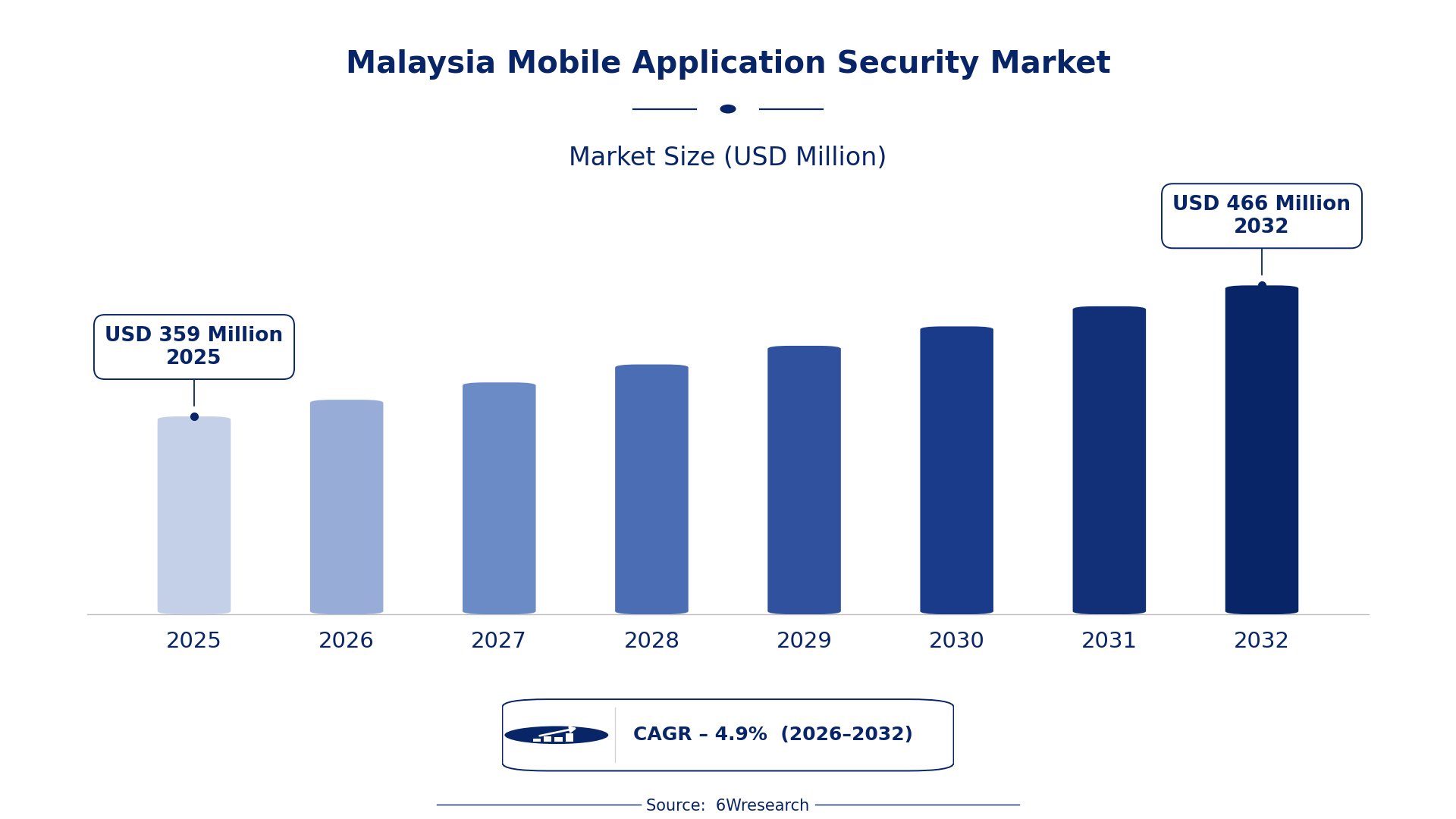
The Malaysia Mobile Application Security Market was estimated at USD 359 Million in 2025 and is projected to reach USD 466 Million by 2032, growing at a CAGR of 4.9% from 2026 to 2032.
Malaysia Mobile Application Security Market Synopsis
The rapid growth of mobile device adoption in Malaysia has heightened the demand for mobile application security solutions. As businesses and consumers increasingly rely on mobile apps for a range of functions, the potential for security vulnerabilities has surged, making it critical for organizations to safeguard their digital assets.
With cyber threats on the rise, businesses are investing in a variety of security measures such as app shielding, code obfuscation, and vulnerability assessments. This trend is further fueled by regulatory requirements and the boom in mobile banking and e-commerce applications, which have made security a top priority.
Malaysia Mobile Application Security Market Year-wise Growth Rate and Key Drivers
This graph illustrates the annual growth rates of the Malaysia Mobile Application Security Market from 2021 to 2032, highlighting a steady upward trajectory and projected expansion over the forecast period.
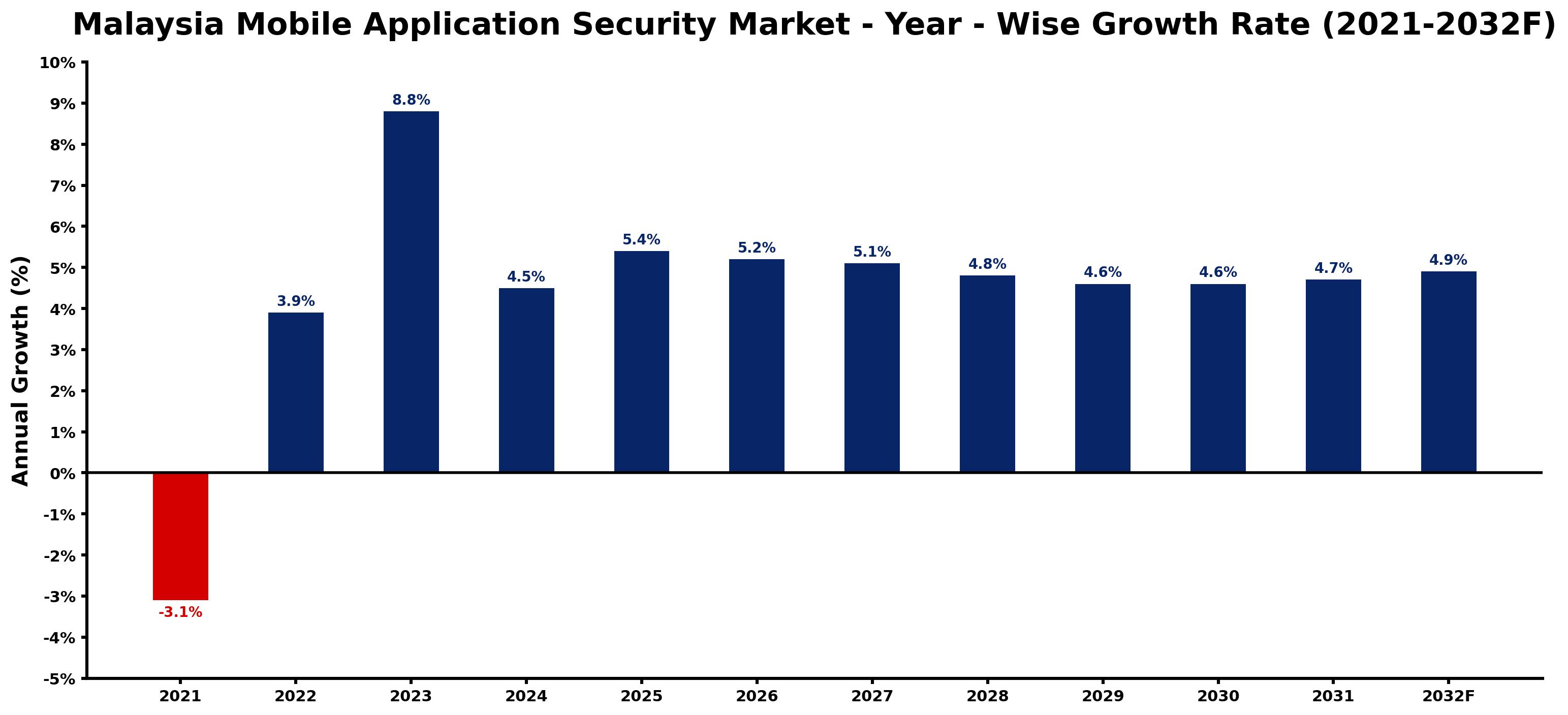
The table below presents the year‑wise growth rates along with the key drivers influencing the market
| Year | Growth Rate | Major Drivers |
| 2021 | -3.1% | MCMC tightened regulation on mobile application standards. |
| 2022 | 3.9% | Increased mobile banking usage demand secure app features. |
| 2023 | 8.8% | Cybersecurity regulations from Malaysian Communications and Multimedia Commission. |
| 2024 | 4.5% | Growing digital payment adoption necessitates enhanced app security. |
| 2025 | 5.4% | Rising smartphone penetration boosts mobile app security focus. |
| 2026 | 5.2% | Remote work increase drives demand for secure mobile solutions. |
| 2027 | 5.1% | Government initiatives promote digital transformation and app security. |
| 2028 | 4.8% | Surge in mobile gaming escalates need for security measures. |
| 2029 | 4.6% | Factors like e-commerce growth increase mobile app vulnerabilities. |
| 2030 | 4.6% | New data protection laws necessitate compliance in app security. |
| 2031 | 4.7% | Strategic alliances between tech firms enhance app security standards. |
| 2032 | 4.9% | Growing awareness of cybersecurity threats drives market interest. |
Note: Market size estimations and growth projections presented in this report are based on 6Wresearch's proprietary forecasting methodology, utilizing the latest available industry data, government publications, and primary research inputs.
Malaysia Mobile Application Security Market Key Takeaways
Below are some of the specific key takeaways from the market, including:
- Cyber threats are evolving, pushing businesses to rethink their security strategies for mobile applications.
- The increasing adoption of mobile banking is amplifying the need for stringent security measures.
- Regulatory compliance is driving investment in security solutions, especially among financial services.
- Local companies are stepping up to provide specialized security solutions tailored to the Malaysian market.
- Innovation is essential as companies seek to balance user experience with robust security features.
Evaluation of Restraints in Malaysia Mobile Application Security Market
Despite growth opportunities, the Malaysia Mobile Application Security Market faces notable restraints. The diversity and rapid expansion of the mobile app ecosystem complicate efforts to maintain security across all platforms. Organizations struggle to keep pace with the constant evolution of cyber threats while also ensuring that security measures do not detract from user experience. This necessitates ongoing investment in both technology and talent, which can be a barrier for smaller companies.
Malaysia Mobile Application Security Market Trends
A surge in remote work has significantly increased mobile app usage, further heightening the focus on mobile security. Companies are increasingly adopting advanced security solutions, such as AI-driven threat detection and risk assessment tools, to proactively address vulnerabilities. Collaboration between tech firms and financial institutions is on the rise, aiming to create secure platforms that enhance consumer confidence in digital transactions.
Malaysia Mobile Application Security Market Opportunities
The market presents several promising growth avenues. Companies that can develop innovative security solutions tailored to the unique needs of Malaysian businesses will find ample opportunities. The demand for security in sectors such as fintech and healthcare is particularly high due to the sensitive nature of data involved. Additionally, partnerships between startups and established firms can lead to the development of cutting-edge technologies that meet evolving security challenges.
Government Initiatives in the Malaysia Mobile Application Security Market
The Malaysian government recognizes the critical importance of mobile application security in protecting citizens and fostering trust in digital transactions. To bolster this, various initiatives have been introduced aimed at enhancing regulatory frameworks and promoting secure practices in the digital economy. A proactive public policy approach is essential for creating an environment conducive to innovation in mobile security solutions.
- A national cybersecurity strategy launched in late 2023 focuses on safeguarding digital infrastructures, including mobile applications.
- Ongoing development of a regulatory framework mandating secure coding practices for mobile app developers is expected to be finalized by mid-2024.
- A public-private partnership initiative initiated in early 2024 aims to increase collaboration between the government and tech firms for cybersecurity training programs.
- Plans are underway for a 2025 national campaign aimed at raising public awareness of mobile security best practices.
- A review of current regulations regarding data protection in mobile apps is ongoing and is projected to yield updates by 2026.
Future Insights of the Malaysia Mobile Application Security Market
Looking ahead to 2026-2032, the Malaysia Mobile Application Security Market is set to evolve significantly. The emphasis on compliance with international data protection regulations will drive further investment in security solutions. As more businesses embrace digital transformation, the integration of security at every stage of app development will become a best practice. The increasing sophistication of cyber threats will also necessitate ongoing innovation, making adaptable security solutions a critical component of business strategies.
Malaysia Mobile Application Security Market Latest Developments
In the past year, activity in the Malaysia Mobile Application Security Market has intensified, driven by a combination of regulatory pressures and the growing threat landscape. Companies are increasingly focused on enhancing their security offerings to meet both consumer and regulatory demands, resulting in a flurry of developments aimed at strengthening mobile security.
- A major technology vendor launched an enhanced mobile application security solution in Q2 2023, focusing on AI-driven threat detection.
- In early 2023, a leading regional operator initiated a pilot program that integrates biometric security features into mobile applications.
- A collaboration between multiple fintech startups and cybersecurity firms commenced in mid-2023, focusing on secure payment technologies.
- A comprehensive service upgrade was completed in late 2023, offering improved code obfuscation technologies for existing applications.
- A rollout of a new mobile app security compliance framework is expected to begin by Q1 2025, aiming to streamline security protocols for app developers.
Malaysia Mobile Application Security Market - Key Attractiveness of the Report
- 10 Years of Market Numbers
- Historical Data Starting from 2022 to 2025
- Base Year: 2025
- Forecast Data until 2032
- Key Performance Indicators Impacting the Market
- Major Upcoming Developments and Projects
Key Highlights of the Report:
- Malaysia Mobile Application Security Market Outlook
- Market Size of Malaysia Mobile Application Security Market, 2025
- Forecast of Malaysia Mobile Application Security Market, 2032
- Historical Data and Forecast of Malaysia Mobile Application Security Revenues & Volume for the Period 2022-2032F
- Malaysia Mobile Application Security Market Trend Evolution
- Malaysia Mobile Application Security Market Drivers and Challenges
- Malaysia Mobile Application Security Price Trends
- Malaysia Mobile Application Security Porter's Five Forces
- Malaysia Mobile Application Security Industry Life Cycle
- Historical Data and Forecast of Malaysia Mobile Application Security Market Revenues & Volume By Solution for the Period 2022-2032F
- Historical Data and Forecast of Malaysia Mobile Application Security Market Revenues & Volume By Antivirus & Antitheft for the Period 2022-2032F
- Historical Data and Forecast of Malaysia Mobile Application Security Market Revenues & Volume By Data Recovery for the Period 2022-2032F
- Historical Data and Forecast of Malaysia Mobile Application Security Market Revenues & Volume By Others for the Period 2022-2032F
- Historical Data and Forecast of Malaysia Mobile Application Security Market Revenues & Volume By Deployment Type for the Period 2022-2032F
- Historical Data and Forecast of Malaysia Mobile Application Security Market Revenues & Volume By Cloud for the Period 2022-2032F
- Historical Data and Forecast of Malaysia Mobile Application Security Market Revenues & Volume By On Premise for the Period 2022-2032F
- Historical Data and Forecast of Malaysia Mobile Application Security Market Revenues & Volume By Industry Vertical for the Period 2022-2032F
- Historical Data and Forecast of Malaysia Mobile Application Security Market Revenues & Volume By BFSI for the Period 2022-2032F
- Historical Data and Forecast of Malaysia Mobile Application Security Market Revenues & Volume By Healthcare for the Period 2022-2032F
- Historical Data and Forecast of Malaysia Mobile Application Security Market Revenues & Volume By IT & Telecom for the Period 2022-2032F
- Historical Data and Forecast of Malaysia Mobile Application Security Market Revenues & Volume By Manufacturing for the Period 2022-2032F
- Historical Data and Forecast of Malaysia Mobile Application Security Market Revenues & Volume By Government and Public Sector for the Period 2022-2032F
- Historical Data and Forecast of Malaysia Mobile Application Security Market Revenues & Volume By Retail & E-commerce for the Period 2022-2032F
- Historical Data and Forecast of Malaysia Mobile Application Security Market Revenues & Volume By Others for the Period 2022-2032F
- Malaysia Mobile Application Security Import Export Trade Statistics
- Market Opportunity Assessment By Solution
- Market Opportunity Assessment By Deployment Type
- Market Opportunity Assessment By Industry Vertical
- Malaysia Mobile Application Security Top Companies Market Share
- Malaysia Mobile Application Security Competitive Benchmarking By Technical and Operational Parameters
- Malaysia Mobile Application Security Company Profiles
- Malaysia Mobile Application Security Key Strategic Recommendations






































