Malaysia Mobile BI Market Size & Growth Rate (2026-2032)
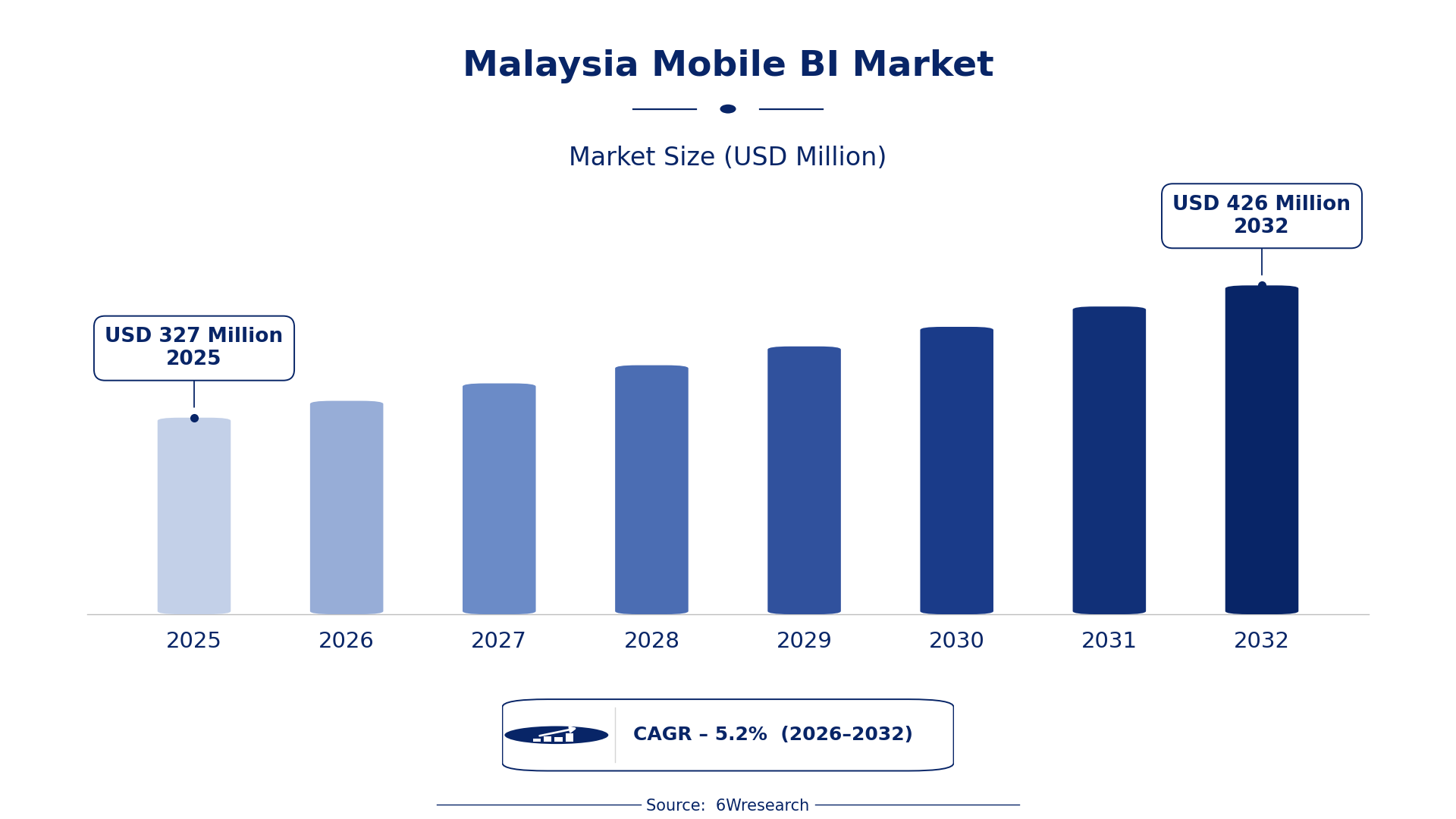
The Malaysia Mobile BI Market was estimated at USD 327 Million in 2025 and is projected to reach USD 426 Million by 2032, growing at a CAGR of 5.2% from 2026 to 2032.
Malaysia Mobile BI Market Synopsis
Demand for mobile business intelligence solutions in Malaysia is surging, primarily driven by the increasing prevalence of smartphones and tablets in the workplace. Organizations are keenly aware of the necessity for data accessibility, especially for decision-makers who need to make informed choices on the go.
The adoption of mobile BI tools has become critical across various sectors, notably sales and marketing. Companies are leveraging these solutions to enhance productivity and streamline operations, making real-time data insights readily available for employees, regardless of location.
Malaysia Mobile BI Market Year-wise Growth Rate and Key Drivers
This graph illustrates the annual growth rates of the Malaysia Mobile BI Market from 2021 to 2032, highlighting a steady upward trajectory and projected expansion over the forecast period.
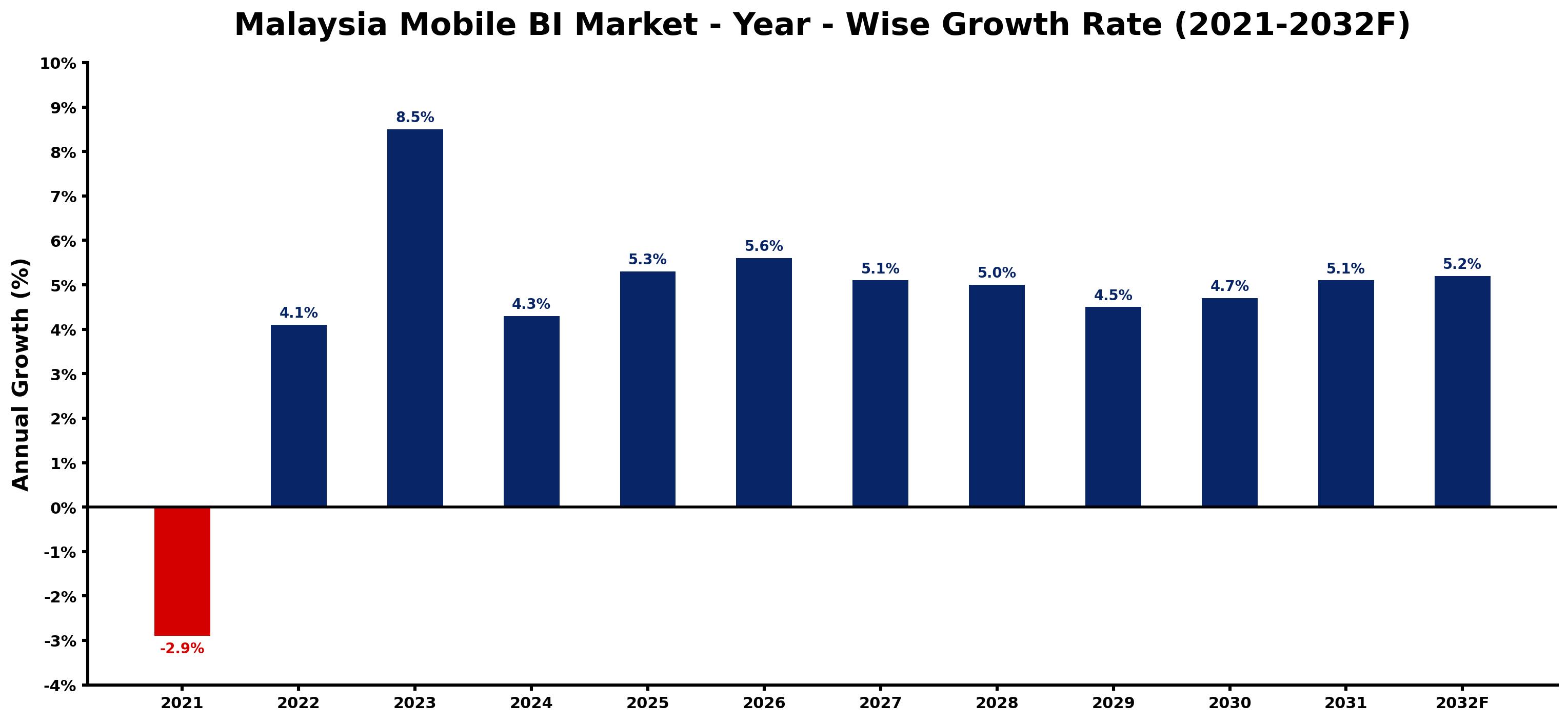
The table below presents the year‑wise growth rates along with the key drivers influencing the market
| Year | Growth Rate | Major Drivers |
| 2021 | -2.9% | Increased data privacy regulations by Malaysian Communications and Multimedia Commission. |
| 2022 | 4.1% | Enhancements in 5G infrastructure accelerating mobile analytics usage |
| 2023 | 8.5% | Rapid urbanization driving demand for real-time data insights |
| 2024 | 4.3% | High smartphone penetration rates boosting mobile BI adoption |
| 2025 | 5.3% | Government incentives for digital economy projects enhancing analytics |
| 2026 | 5.6% | Growing interest in data privacy influencing BI solutions |
| 2027 | 5.1% | Corporate training programs on data analytics expanding market reach |
| 2028 | 5.0% | Increased investment in fintech fostering mobile BI growth |
| 2029 | 4.5% | Local enterprises focusing on operational efficiency through analytics |
| 2030 | 4.7% | Emerging AI technologies enhancing mobile BI capabilities |
| 2031 | 5.1% | Sustainable development goals driving insights for corporate strategies |
| 2032 | 5.2% | Competitive retail landscape necessitating advanced data-driven decisions |
Note: Market size estimations and growth projections presented in this report are based on 6Wresearch's proprietary forecasting methodology, utilizing the latest available industry data, government publications, and primary research inputs.
Malaysia Mobile BI Market Key Takeaways
Below are some of the specific key takeaways from the market, including:
- The mobile BI market in Malaysia is primarily fueled by the demand for real-time data access and analytics.
- Mobile devices’ ubiquity in business settings significantly boosts the adoption of mobile BI solutions.
- Security and compatibility challenges persist, necessitating focused development efforts from providers.
- The COVID-19 pandemic accelerated the shift towards mobile BI as remote work became the norm.
- Local vendors are increasingly tailoring solutions to meet the unique needs of Malaysian businesses.
Evaluation of Restraints in Malaysia Mobile BI Market
The Malaysia Mobile BI market, while promising, faces notable constraints. A primary concern is the wide array of mobile devices and operating systems available, which complicates the development of uniform solutions. Companies must invest significant resources to ensure compatibility and a consistent user experience across these diverse platforms.
Security is another pressing issue. As organizations increasingly rely on mobile BI for critical data access, the risk of data breaches rises. Providers must prioritize advanced security measures to protect sensitive information and build user trust.
Malaysia Mobile BI Market Trends
Several trends are currently shaping the Malaysia Mobile BI market. The integration of artificial intelligence and machine learning into mobile BI tools is gaining traction, enabling businesses to derive deeper insights from data analytics. This shift not only enhances decision-making but also automates routine data processing tasks.
on top of that, there is a growing emphasis on user-friendly interfaces and visualization capabilities. As organizations prioritize data storytelling, the demand for intuitive mobile BI solutions that simplify complex data into actionable insights is on the rise.
Malaysia Mobile BI Market Opportunities
The market presents substantial opportunities for growth and investment. As companies continue to embrace digital transformation, there’s a heightened need for advanced mobile BI solutions that can adapt to varying business requirements. Industries such as retail, healthcare, and logistics are particularly ripe for mobile BI adoption, given their reliance on real-time data for operational efficiency.
Additionally, partnerships between technology providers and local businesses can foster innovation and lead to the development of customized solutions tailored to the Malaysian market, further driving growth.
Government Initiatives in the Malaysia Mobile BI Market
The Malaysian government is actively fostering a conducive environment for the growth of the mobile BI market through various initiatives aimed at enhancing digital infrastructure and promoting data accessibility. Public policies emphasize the integration of technology across sectors, which is vital for the growth of mobile BI solutions.
- A national digital infrastructure upgrade programme is currently underway, aimed at enhancing connectivity and supporting mobile BI applications.
- A recently completed regulatory framework was introduced to ensure data privacy and security in mobile applications, directly impacting mobile BI solutions.
- Ongoing public-private partnerships are being established to drive innovation in mobile analytics, enhancing the capabilities of local businesses.
- A planned initiative set for 2026 aims to provide training programs for businesses to better utilize mobile BI tools effectively.
Future Insights of the Malaysia Mobile BI Market
Looking ahead to 2026-2032, the Malaysia Mobile BI market is expected to experience steady growth. The continuous expansion of mobile device usage in business environments will drive demand for sophisticated BI tools. As organizations increasingly prioritize data-driven decision-making, the need for real-time analytics will become indispensable.
The integration of emerging technologies, such as AI and predictive analytics, will further enhance the capabilities of mobile BI solutions. This evolution will create new opportunities for both established players and startups in the market.
Malaysia Mobile BI Market Latest Developments
In the past year, the Malaysia Mobile BI market has witnessed several noteworthy developments, reflecting an industry increasingly focused on innovation and user-centric solutions. Companies are adapting to the rapid shifts in how data is accessed and utilized in business operations.
- A major technology vendor launched a new mobile BI solution in early 2025, integrating enhanced visualization capabilities to aid decision-makers.
- An ongoing initiative began in mid-2025, focusing on developing security protocols specifically for mobile BI applications to mitigate data breach risks.
- A rollout expected to commence in Q3 2026 aims to introduce a suite of mobile BI tools designed for small and medium enterprises.
- In late 2025, a partnership was established between local firms to create a customizable mobile BI platform tailored to the Malaysian market.
Malaysia Mobile BI Market - Key Attractiveness of the Report
- 10 Years of Market Numbers
- Historical Data Starting from 2022 to 2025
- Base Year: 2025
- Forecast Data until 2032
- Key Performance Indicators Impacting the Market
- Major Upcoming Developments and Projects
Key Highlights of the Report:
- Malaysia Mobile BI Market Outlook
- Market Size of Malaysia Mobile BI Market, 2025
- Forecast of Malaysia Mobile BI Market, 2032
- Historical Data and Forecast of Malaysia Mobile BI Revenues & Volume for the Period 2022-2032F
- Malaysia Mobile BI Market Trend Evolution
- Malaysia Mobile BI Market Drivers and Challenges
- Malaysia Mobile BI Price Trends
- Malaysia Mobile BI Porter's Five Forces
- Malaysia Mobile BI Industry Life Cycle
- Historical Data and Forecast of Malaysia Mobile BI Market Revenues & Volume By Type for the Period 2022-2032F
- Historical Data and Forecast of Malaysia Mobile BI Market Revenues & Volume By Software for the Period 2022-2032F
- Historical Data and Forecast of Malaysia Mobile BI Market Revenues & Volume By Services for the Period 2022-2032F
- Historical Data and Forecast of Malaysia Mobile BI Market Revenues & Volume By Organization Size for the Period 2022-2032F
- Historical Data and Forecast of Malaysia Mobile BI Market Revenues & Volume By SMES for the Period 2022-2032F
- Historical Data and Forecast of Malaysia Mobile BI Market Revenues & Volume By Large Enterprises for the Period 2022-2032F
- Historical Data and Forecast of Malaysia Mobile BI Market Revenues & Volume By Business Function for the Period 2022-2032F
- Historical Data and Forecast of Malaysia Mobile BI Market Revenues & Volume By IT for the Period 2022-2032F
- Historical Data and Forecast of Malaysia Mobile BI Market Revenues & Volume By Marketing for the Period 2022-2032F
- Historical Data and Forecast of Malaysia Mobile BI Market Revenues & Volume By Sales for the Period 2022-2032F
- Historical Data and Forecast of Malaysia Mobile BI Market Revenues & Volume By Operations for the Period 2022-2032F
- Historical Data and Forecast of Malaysia Mobile BI Market Revenues & Volume By Finance for the Period 2022-2032F
- Historical Data and Forecast of Malaysia Mobile BI Market Revenues & Volume By Human resources (HR) for the Period 2022-2032F
- Historical Data and Forecast of Malaysia Mobile BI Market Revenues & Volume By Business Application for the Period 2022-2032F
- Historical Data and Forecast of Malaysia Mobile BI Market Revenues & Volume By Fraud and security management for the Period 2022-2032F
- Historical Data and Forecast of Malaysia Mobile BI Market Revenues & Volume By Sales and marketing management for the Period 2022-2032F
- Historical Data and Forecast of Malaysia Mobile BI Market Revenues & Volume By Predictive asset maintenance for the Period 2022-2032F
- Historical Data and Forecast of Malaysia Mobile BI Market Revenues & Volume By Risk and compliance management for the Period 2022-2032F
- Historical Data and Forecast of Malaysia Mobile BI Market Revenues & Volume By Customer engagement and analysis for the Period 2022-2032F
- Historical Data and Forecast of Malaysia Mobile BI Market Revenues & Volume By Supply chain management and procurement for the Period 2022-2032F
- Historical Data and Forecast of Malaysia Mobile BI Market Revenues & Volume By Operations management for the Period 2022-2032F
- Historical Data and Forecast of Malaysia Mobile BI Market Revenues & Volume By Others for the Period 2022-2032F
- Historical Data and Forecast of Malaysia Mobile BI Market Revenues & Volume By Industry Vertical for the Period 2022-2032F
- Historical Data and Forecast of Malaysia Mobile BI Market Revenues & Volume By Banking, Financial Services, and Insurance (BFSI) for the Period 2022-2032F
- Historical Data and Forecast of Malaysia Mobile BI Market Revenues & Volume By Telecommunications and IT for the Period 2022-2032F
- Historical Data and Forecast of Malaysia Mobile BI Market Revenues & Volume By Retail and eCommerce for the Period 2022-2032F
- Historical Data and Forecast of Malaysia Mobile BI Market Revenues & Volume By Healthcare and life sciences for the Period 2022-2032F
- Historical Data and Forecast of Malaysia Mobile BI Market Revenues & Volume By Manufacturing for the Period 2022-2032F
- Historical Data and Forecast of Malaysia Mobile BI Market Revenues & Volume By Government for the Period 2022-2032F
- Historical Data and Forecast of Malaysia Mobile BI Market Revenues & Volume By Energy and utilities for the Period 2022-2032F
- Historical Data and Forecast of Malaysia Mobile BI Market Revenues & Volume By Media and entertainment for the Period 2022-2032F
- Historical Data and Forecast of Malaysia Mobile BI Market Revenues & Volume By Deployment Model for the Period 2022-2032F
- Historical Data and Forecast of Malaysia Mobile BI Market Revenues & Volume By On-Premise for the Period 2022-2032F
- Historical Data and Forecast of Malaysia Mobile BI Market Revenues & Volume By Hosted/ On-Cloud for the Period 2022-2032F
- Malaysia Mobile BI Import Export Trade Statistics
- Market Opportunity Assessment By Type
- Market Opportunity Assessment By Organization Size
- Market Opportunity Assessment By Business Function
- Market Opportunity Assessment By Business Application
- Market Opportunity Assessment By Industry Vertical
- Market Opportunity Assessment By Deployment Model
- Malaysia Mobile BI Top Companies Market Share
- Malaysia Mobile BI Competitive Benchmarking By Technical and Operational Parameters
- Malaysia Mobile BI Company Profiles
- Malaysia Mobile BI Key Strategic Recommendations






































