Malaysia Mobile Security Market Size & Growth Rate (2026-2032)
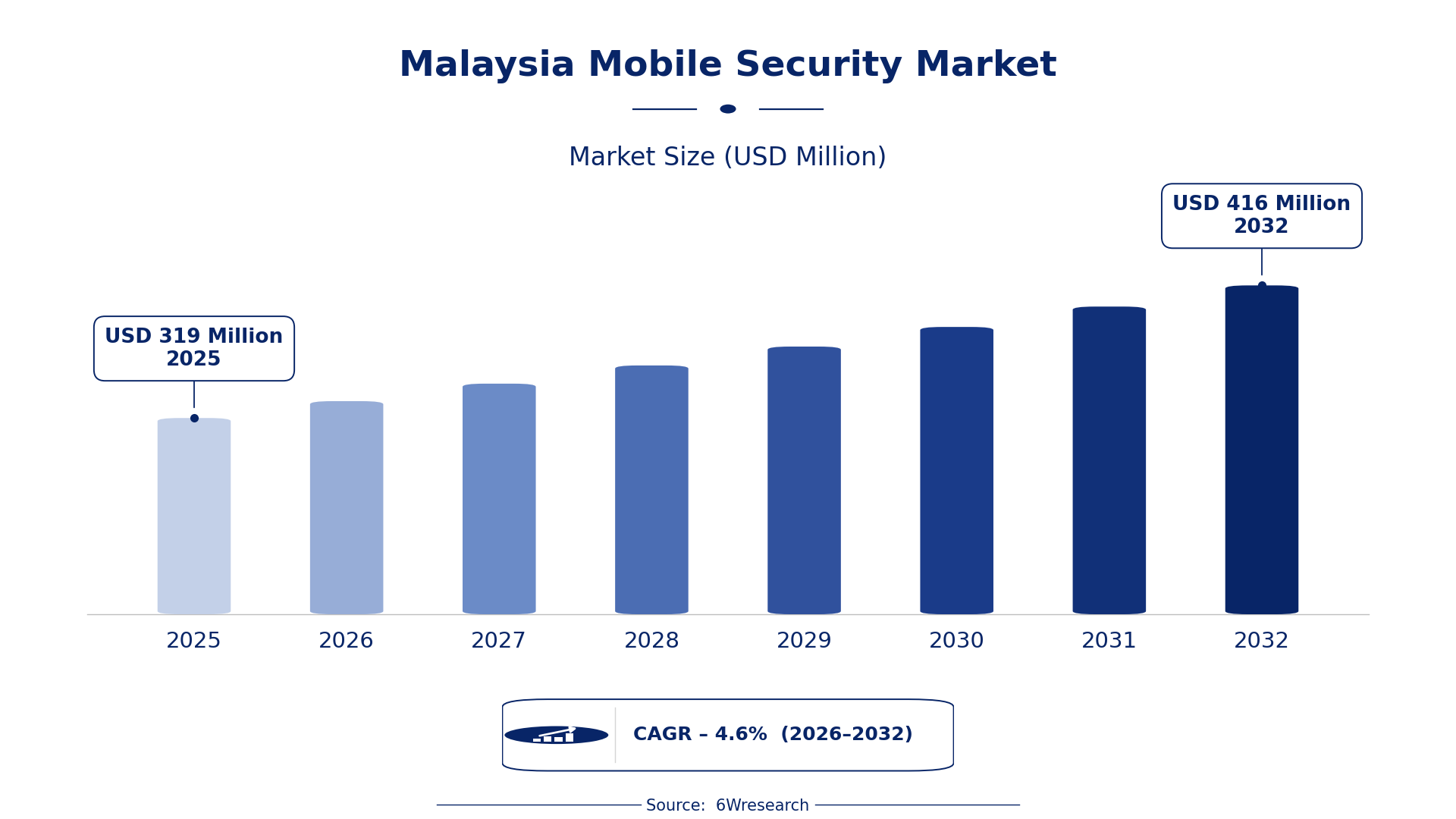
The Malaysia Mobile Security Market was estimated at USD 319 Million in 2025 and is projected to reach USD 416 Million by 2032, growing at a CAGR of 4.6% from 2026 to 2032.
Malaysia Mobile Security Market Synopsis
The rapid adoption of mobile devices across Malaysia is pushing organizations and individuals to prioritize mobile security. As smartphone penetration rises, coupled with the widespread use of tablets for work and personal tasks, the need for security solutions to fend off threats like malware and data breaches has become urgent.
With mobile malware becoming more sophisticated, the demand for comprehensive security measures is escalating. Businesses, in particular, are focusing on safeguarding sensitive information while ensuring that user experiences are not compromised, especially within the context of Bring Your Own Device (BYOD) policies.
Malaysia Mobile Security Market Year-wise Growth Rate and Key Drivers
This graph illustrates the annual growth rates of the Malaysia Mobile Security Market from 2021 to 2032, highlighting a steady upward trajectory and projected expansion over the forecast period.
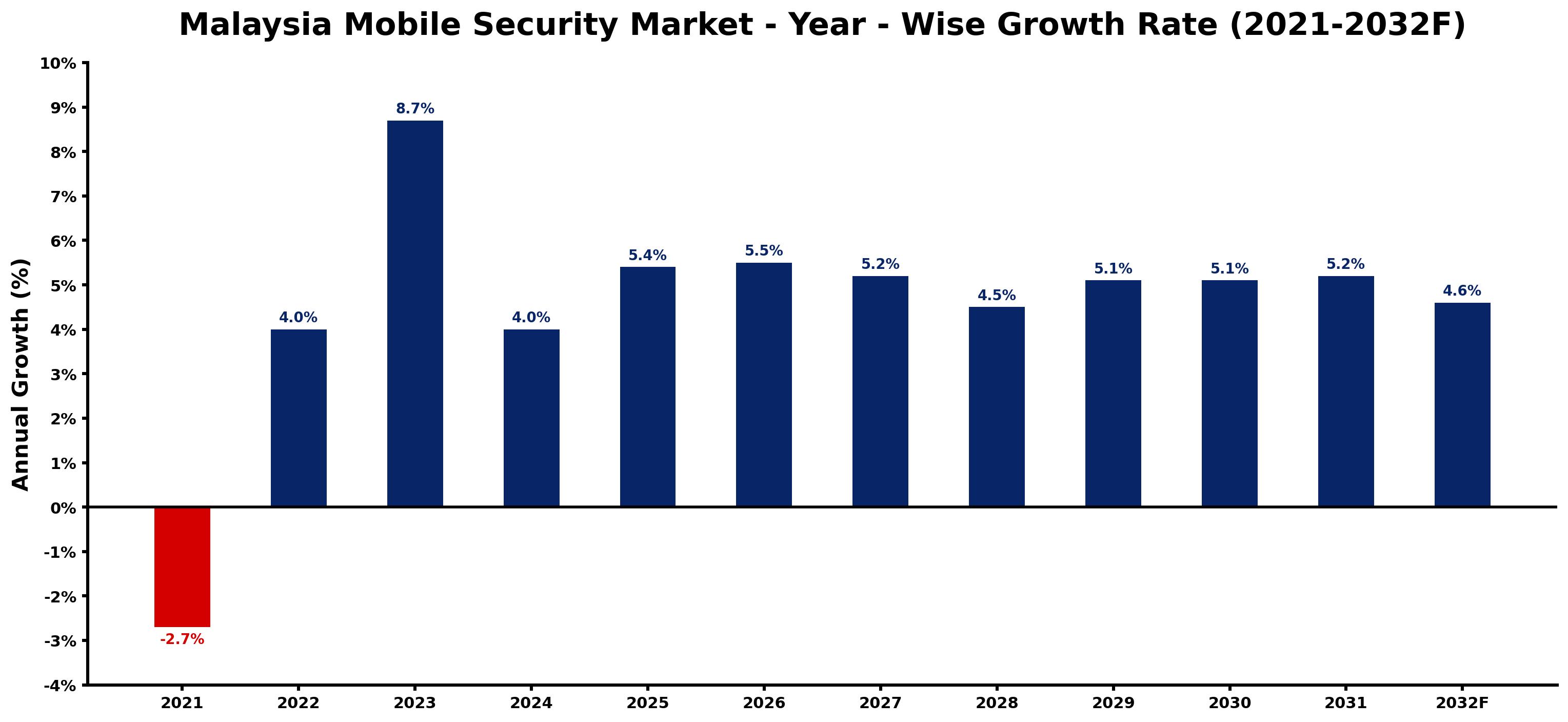
The table below presents the year‑wise growth rates along with the key drivers influencing the market
| Year | Growth Rate | Major Drivers |
| 2021 | -2.7% | Restricted MCMC regulations on mobile security solutions. |
| 2022 | 4.0% | National Cyber Security Policy's mobile identity focus |
| 2023 | 8.7% | Increased smartphone adoption driving security needs |
| 2024 | 4.0% | Government mandate for biometric authentication in apps |
| 2025 | 5.4% | Growing fintech sector requiring mobile security solutions |
| 2026 | 5.5% | Rise in cyber threats targeting mobile platforms |
| 2027 | 5.2% | Digital Malaysia initiative enhancing cybersecurity investments |
| 2028 | 4.5% | Enhanced data protection regulations boosting mobile security |
| 2029 | 5.1% | Consumer awareness campaigns promoting mobile security solutions |
| 2030 | 5.1% | Increased demand for secure e-commerce applications |
| 2031 | 5.2% | Adoption of 5G technology demanding better mobile security |
| 2032 | 4.6% | Growth in remote work increasing mobile device vulnerabilities |
Note: Market size estimations and growth projections presented in this report are based on 6Wresearch's proprietary forecasting methodology, utilizing the latest available industry data, government publications, and primary research inputs.
Malaysia Mobile Security Market Key Takeaways
Below are some of the specific key takeaways from the market, including:
- The increasing integration of mobile devices in business operations is driving demand for security solutions.
- The rise of remote work has heightened the urgency for protecting mobile endpoints from cyber threats.
- The market is challenged by a variety of mobile operating systems, complicating the development of universal solutions.
- The need for robust security measures aligns with the rollout of advanced mobile technologies like 5G.
- Local players are enhancing the market with region-specific solutions and expertise.
Evaluation of Restraints in Malaysia Mobile Security Market
Fragmentation remains a significant hurdle for the Malaysia Mobile Security market. With a plethora of mobile devices and operating systems in circulation, developing security measures that are both comprehensive and effective is a daunting task. This diversity makes it challenging to create one-size-fits-all solutions. on top of that, businesses adopting BYOD policies are caught in a bind; they must enforce strong security protocols while also maintaining a frictionless user experience.
Malaysia Mobile Security Market Trends
Several trends are shaping the future of mobile security in Malaysia. The shift towards remote working has increased the focus on endpoint security, as more employees rely on mobile devices to conduct business. Additionally, the incorporation of artificial intelligence and machine learning technologies into mobile security solutions is helping organizations proactively identify and respond to threats.
The emergence of 5G technology is also significant, promising enhanced data speeds and connectivity. However, it brings new security challenges that need addressing. As these technologies develop, the demand for adaptive and layered security solutions will continue to grow.
Malaysia Mobile Security Market Opportunities
The potential for growth in the Malaysia Mobile Security market is substantial, particularly with the increasing reliance on mobile devices for business operations. Companies looking to invest in mobile security solutions can capitalize on the rising threats posed by cybercriminals. Enhanced mobile device management systems and AI-driven security solutions present avenues for significant investments.
With consumers becoming more aware of data privacy issues, businesses can differentiate themselves by adopting strong mobile security practices. Targeting industries with high data sensitivity, such as finance and healthcare, could lead to lucrative opportunities for mobile security providers.
Government Initiatives in the Malaysia Mobile Security Market
The Malaysian government is actively shaping the mobile security landscape through various initiatives aimed at improving cybersecurity and encouraging the adoption of secure mobile practices. Regulatory frameworks are being established to ensure data protection while promoting safe mobile technologies. The government recognizes the critical importance of safeguarding both personal and business data amid rising cyber threats.
- A recently completed initiative involves the introduction of a national cybersecurity strategy that sets guidelines for mobile security practices across all sectors.
- Current efforts are underway to launch a public awareness campaign focused on educating citizens about mobile security threats and best practices.
- A planned initiative expected to begin in late 2025 aims to enhance public sector mobile infrastructure security, emphasizing secure communications.
- Regulatory bodies are currently reviewing frameworks that could require businesses to adopt specific mobile security standards by 2026.
- The government is exploring partnerships with private firms to strengthen mobile security solutions tailored to local needs.
Future Insights of the Malaysia Mobile Security Market
Looking ahead to 2026-2032, the Malaysia Mobile Security market is positioned for steady growth. As businesses continue to integrate mobile technologies into their operations, security measures will need to evolve in tandem. Companies that proactively adapt their security strategies to address emerging threats, particularly from mobile malware and phishing attacks, will be well-positioned in this market.
Investment in mobile security will likely increase as the understanding of data protection deepens among Malaysian organizations. The development and deployment of advanced technologies, including AI and machine learning, will be crucial in shaping more effective and adaptive security solutions.
Malaysia Mobile Security Market Latest Developments
Over the past 12-14 months, the Malaysia Mobile Security market has seen a flurry of activities aimed at enhancing security frameworks. Industry participants are increasingly collaborating on solutions that tackle specific threats posed by mobile devices. These partnerships highlight a growing recognition of the need for comprehensive security strategies tailored to the unique challenges within the market.
- A major technology vendor launched a new mobile security application in Q1 2025 aimed at providing real-time threat detection and response capabilities.
- An ongoing project that began in early 2025 focuses on integrating AI technology into existing mobile security solutions to improve their effectiveness against advanced threats.
- By mid-2026, a regional operator plans to introduce enhanced encryption protocols for mobile transactions to bolster consumer confidence and data security.
- A collaborative initiative with several local firms is currently underway to develop specialized mobile security training programs targeting SMEs.
- Upcoming in 2026, a new regulatory requirement is expected to mandate annual security audits for mobile applications in high-risk sectors.
Malaysia Mobile Security Market - Key Attractiveness of the Report
- 10 Years of Market Numbers
- Historical Data Starting from 2022 to 2025
- Base Year: 2025
- Forecast Data until 2032
- Key Performance Indicators Impacting the Market
- Major Upcoming Developments and Projects
Key Highlights of the Report:
- Malaysia Mobile Security Market Outlook
- Market Size of Malaysia Mobile Security Market, 2025
- Forecast of Malaysia Mobile Security Market, 2032
- Historical Data and Forecast of Malaysia Mobile Security Revenues & Volume for the Period 2022-2032F
- Malaysia Mobile Security Market Trend Evolution
- Malaysia Mobile Security Market Drivers and Challenges
- Malaysia Mobile Security Price Trends
- Malaysia Mobile Security Porter's Five Forces
- Malaysia Mobile Security Industry Life Cycle
- Historical Data and Forecast of Malaysia Mobile Security Market Revenues & Volume By End User for the Period 2022-2032F
- Historical Data and Forecast of Malaysia Mobile Security Market Revenues & Volume By Individual for the Period 2022-2032F
- Historical Data and Forecast of Malaysia Mobile Security Market Revenues & Volume By Enterprise (Solution (Authentication, Application Security, & Device Security), Service) for the Period 2022-2032F
- Historical Data and Forecast of Malaysia Mobile Security Market Revenues & Volume By Deployment Mode for the Period 2022-2032F
- Historical Data and Forecast of Malaysia Mobile Security Market Revenues & Volume By On-premises for the Period 2022-2032F
- Historical Data and Forecast of Malaysia Mobile Security Market Revenues & Volume By Cloud for the Period 2022-2032F
- Historical Data and Forecast of Malaysia Mobile Security Market Revenues & Volume By Organization Size for the Period 2022-2032F
- Historical Data and Forecast of Malaysia Mobile Security Market Revenues & Volume By Small and Medium-Sized Enterprises (SMEs) for the Period 2022-2032F
- Historical Data and Forecast of Malaysia Mobile Security Market Revenues & Volume By Large Enterprises for the Period 2022-2032F
- Historical Data and Forecast of Malaysia Mobile Security Market Revenues & Volume By Vertical for the Period 2022-2032F
- Historical Data and Forecast of Malaysia Mobile Security Market Revenues & Volume By BFSI for the Period 2022-2032F
- Historical Data and Forecast of Malaysia Mobile Security Market Revenues & Volume By Telecom & IT for the Period 2022-2032F
- Historical Data and Forecast of Malaysia Mobile Security Market Revenues & Volume By Retail for the Period 2022-2032F
- Historical Data and Forecast of Malaysia Mobile Security Market Revenues & Volume By Healthcare for the Period 2022-2032F
- Historical Data and Forecast of Malaysia Mobile Security Market Revenues & Volume By Government & Defense for the Period 2022-2032F
- Historical Data and Forecast of Malaysia Mobile Security Market Revenues & Volume By Manufacturing for the Period 2022-2032F
- Historical Data and Forecast of Malaysia Mobile Security Market Revenues & Volume By Others for the Period 2022-2032F
- Historical Data and Forecast of Malaysia Mobile Security Market Revenues & Volume By Operating System for the Period 2022-2032F
- Historical Data and Forecast of Malaysia Mobile Security Market Revenues & Volume By iOS for the Period 2022-2032F
- Historical Data and Forecast of Malaysia Mobile Security Market Revenues & Volume By Android for the Period 2022-2032F
- Malaysia Mobile Security Import Export Trade Statistics
- Market Opportunity Assessment By End User
- Market Opportunity Assessment By Deployment Mode
- Market Opportunity Assessment By Organization Size
- Market Opportunity Assessment By Vertical
- Market Opportunity Assessment By Operating System
- Malaysia Mobile Security Top Companies Market Share
- Malaysia Mobile Security Competitive Benchmarking By Technical and Operational Parameters
- Malaysia Mobile Security Company Profiles
- Malaysia Mobile Security Key Strategic Recommendations






































