Malaysia Molded Pulp Packaging Market Size, Share & Growth Rate
The Malaysia Molded Pulp Packaging Market was estimated at USD 417 Million in 2025 and is projected to reach USD 546 Million by 2032, growing at a CAGR of 3.9% from 2026 to 2032. This growth is driven by increasing demand across the food and beverage sector, coupled with heightened awareness about sustainability. As businesses and consumers alike prioritize eco-friendly packaging solutions, molded pulp's versatility in various applications—including electronics and consumer goods—positions it well for continued expansion.
Malaysia Molded Pulp Packaging Market Year-wise Growth Rate and Key Drivers
This graph highlights how the Malaysia Molded Pulp Packaging Market has steadily grown over the years, supported by major growth factors.
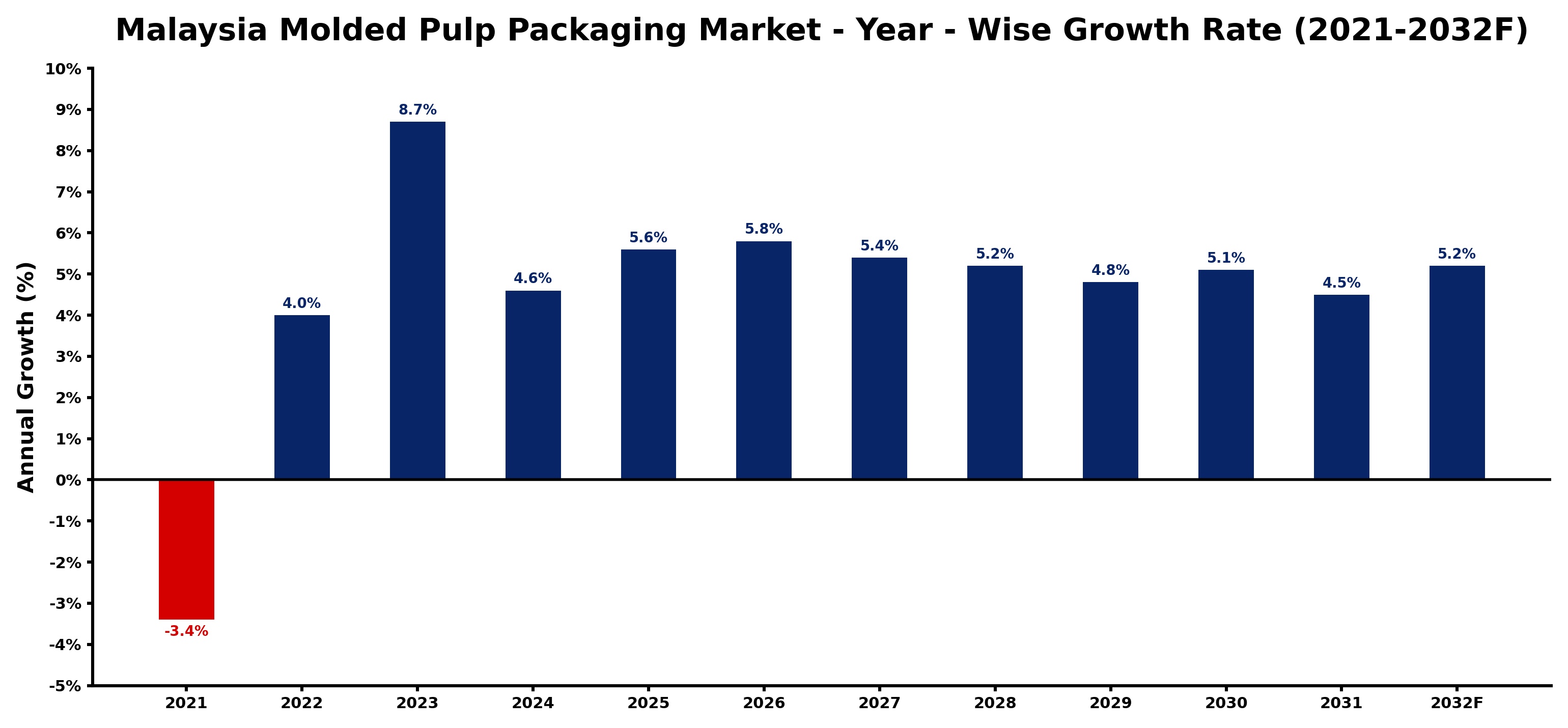
The table below presents the year‑wise growth rates along with the key drivers influencing the market
| Year | Growth Rate | Major Drivers |
| 2021 | -3.4% | Rapid growth in telecom and data center sectors |
| 2022 | 4.0% | Increasing industrial infrastructure investments |
| 2023 | 8.7% | Expansion of transportation and logistics networks |
| 2024 | 4.6% | Government infrastructure modernization initiatives |
| 2025 | 5.6% | Government infrastructure modernization initiatives |
| 2026 | 5.8% | Government infrastructure modernization initiatives |
| 2027 | 5.4% | Expansion of commercial construction activities |
| 2028 | 5.2% | Expansion of transportation and logistics networks |
| 2029 | 4.8% | Increasing industrial automation investments |
| 2030 | 5.1% | Rising electricity demand across industries |
| 2031 | 4.5% | Rising electricity demand across industries |
| 2032 | 5.2% | Rising electricity demand across industries |
Note - Market size estimations and growth projections presented in this report are based on 6Wresearch's advanced forecasting approach, validated with industry datasets as of June 2026.
Malaysia Molded Pulp Packaging Market Synopsis
In recent years, the Malaysia molded pulp packaging market has experienced significant momentum, largely fueled by a shift towards sustainable practices. However, as the market approaches 2025, it faces the challenge of scaling production to meet the growing demand from multiple sectors. The future landscape indicates a robust push towards innovation and custom solutions, setting the stage for dynamic growth opportunities.
As businesses adapt to evolving consumer preferences, molded pulp packaging is emerging as a favorable option. This is particularly relevant in industries such as food and beverages, where environmental concerns are paramount. The ongoing transition towards more responsible consumption patterns is expected to significantly enhance market prospects in the coming years.
Malaysia Molded Pulp Packaging Market Key Takeaways
- The molded pulp packaging market is on a positive growth trajectory driven by sustainability trends.
- Demand from food and beverage industries is a key driver, reflecting a broader shift towards eco-friendly solutions.
- Government policies favoring sustainable practices are further incentivizing market growth.
- Challenges in raw material sourcing and production scalability need to be addressed for sustained expansion.
- Key players are innovating to meet design and customization needs across various sectors.
Evaluation of Restraints in Malaysia Molded Pulp Packaging Market
Despite its growth potential, the Malaysia molded pulp packaging market faces several restraints. Chief among these is the challenge of scaling production efficiently. With demand surging, manufacturers must not only increase output but also ensure quality by sourcing sufficient recycled paper and agricultural waste. Additionally, the need for design and customization to meet diverse industry requirements can complicate the production process, necessitating innovative approaches to maintain competitiveness in the market.
Malaysia Molded Pulp Packaging Market Trends
Several key trends are shaping the molded pulp packaging market in Malaysia. Increasing consumer awareness about environmental issues is driving a preference for biodegradable and recyclable packaging solutions. Furthermore, advancements in technology are enhancing the production efficiency of molded pulp materials, allowing for greater design flexibility. There is also a notable uptick in collaboration between businesses and sustainability-focused organizations, leading to innovative packaging solutions that align with evolving market needs.
Malaysia Molded Pulp Packaging Market Opportunities
The molded pulp packaging sector presents genuine growth opportunities, particularly for companies willing to invest in sustainable production technologies. Expanding applications beyond traditional sectors, such as into automotive components and electronics, offers avenues for diversification. Moreover, capitalizing on government initiatives promoting eco-friendly practices can create a competitive advantage for stakeholders in this market.
Government Initiatives in the Malaysia Molded Pulp Packaging Market
The Malaysian government is actively promoting sustainable practices through various initiatives aimed at reducing plastic waste and enhancing environmental protection. Policies and incentives encouraging the use of recycled materials are fostering growth in the molded pulp packaging sector. Moreover, public spending on green projects creates a conducive environment for businesses focused on sustainable packaging solutions, effectively aligning public interests with market growth.
Future Insights of the Malaysia Molded Pulp Packaging Market
Looking ahead to 2026-2032, the Malaysia molded pulp packaging market is poised for significant evolution. The interplay of consumer demand for sustainable packaging and government support for eco-friendly initiatives will shape the landscape. As companies innovate in product design and material sourcing, the market is likely to witness accelerated growth, driven by both consumer preferences and regulatory frameworks. Businesses that adapt to these changes will find ample opportunities for advancement and profitability.
Malaysia Molded Pulp Packaging Market Latest Developments (May 2025 - June 2026)
Recent developments in the Malaysian molded pulp packaging market indicate a strong focus on sustainability. There has been a marked increase in partnerships among companies looking to enhance their eco-friendly offerings, particularly in food and beverage packaging. Additionally, technological advancements in production processes are facilitating better material efficiency and design capabilities, positioning manufacturers to meet the demands of a rapidly evolving marketplace.
Malaysia Molded Pulp Packaging Market - Key Attractiveness of the Report
- 10 Years of Market Numbers
- Historical Data Starting from 2022 to 2025
- Base Year: 2025
- Forecast Data until 2032
- Key Performance Indicators Impacting the Market
- Major Upcoming Developments and Projects
Key Highlights of the Report:
- Malaysia Molded Pulp Packaging Market Outlook
- Market Size of Malaysia Molded Pulp Packaging Market, 2025
- Forecast of Malaysia Molded Pulp Packaging Market, 2032
- Historical Data and Forecast of Malaysia Molded Pulp Packaging Revenues & Volume for the Period 2022-2032F
- Malaysia Molded Pulp Packaging Market Trend Evolution
- Malaysia Molded Pulp Packaging Market Drivers and Challenges
- Malaysia Molded Pulp Packaging Price Trends
- Malaysia Molded Pulp Packaging Porter's Five Forces
- Malaysia Molded Pulp Packaging Industry Life Cycle
- Historical Data and Forecast of Malaysia Molded Pulp Packaging Market Revenues & Volume By Source for the Period 2022-2032F
- Historical Data and Forecast of Malaysia Molded Pulp Packaging Market Revenues & Volume By Wood Pulp for the Period 2022-2032F
- Historical Data and Forecast of Malaysia Molded Pulp Packaging Market Revenues & Volume By Non-wood Pulp for the Period 2022-2032F
- Historical Data and Forecast of Malaysia Molded Pulp Packaging Market Revenues & Volume By Molded Type for the Period 2022-2032F
- Historical Data and Forecast of Malaysia Molded Pulp Packaging Market Revenues & Volume By Thick Wall for the Period 2022-2032F
- Historical Data and Forecast of Malaysia Molded Pulp Packaging Market Revenues & Volume By Transfer for the Period 2022-2032F
- Historical Data and Forecast of Malaysia Molded Pulp Packaging Market Revenues & Volume By Thermoformed for the Period 2022-2032F
- Historical Data and Forecast of Malaysia Molded Pulp Packaging Market Revenues & Volume By Processed for the Period 2022-2032F
- Historical Data and Forecast of Malaysia Molded Pulp Packaging Market Revenues & Volume By Product for the Period 2022-2032F
- Historical Data and Forecast of Malaysia Molded Pulp Packaging Market Revenues & Volume By Trays for the Period 2022-2032F
- Historical Data and Forecast of Malaysia Molded Pulp Packaging Market Revenues & Volume By End Caps for the Period 2022-2032F
- Historical Data and Forecast of Malaysia Molded Pulp Packaging Market Revenues & Volume By Bowls & Cups for the Period 2022-2032F
- Historical Data and Forecast of Malaysia Molded Pulp Packaging Market Revenues & Volume By Clamshells for the Period 2022-2032F
- Historical Data and Forecast of Malaysia Molded Pulp Packaging Market Revenues & Volume By Plates for the Period 2022-2032F
- Historical Data and Forecast of Malaysia Molded Pulp Packaging Market Revenues & Volume By Others for the Period 2022-2032F
- Malaysia Molded Pulp Packaging Import Export Trade Statistics
- Market Opportunity Assessment By Source
- Market Opportunity Assessment By Molded Type
- Market Opportunity Assessment By Product
- Malaysia Molded Pulp Packaging Top Companies Market Share
- Malaysia Molded Pulp Packaging Competitive Benchmarking By Technical and Operational Parameters
- Malaysia Molded Pulp Packaging Company Profiles
- Malaysia Molded Pulp Packaging Key Strategic Recommendations






































