Malaysia Mortar Market Summary
The malaysia mortar market was estimated at USD 306 Million in 2025 and is projected to reach USD 397 Million by 2032, growing at a CAGR of 5.4% from 2026 to 2032.
Malaysia Mortar Market Year-wise Growth Rate and Key Drivers
This graph highlights how the Malaysia Mortar Market has steadily grown over the past five years, supported by major growth factors.
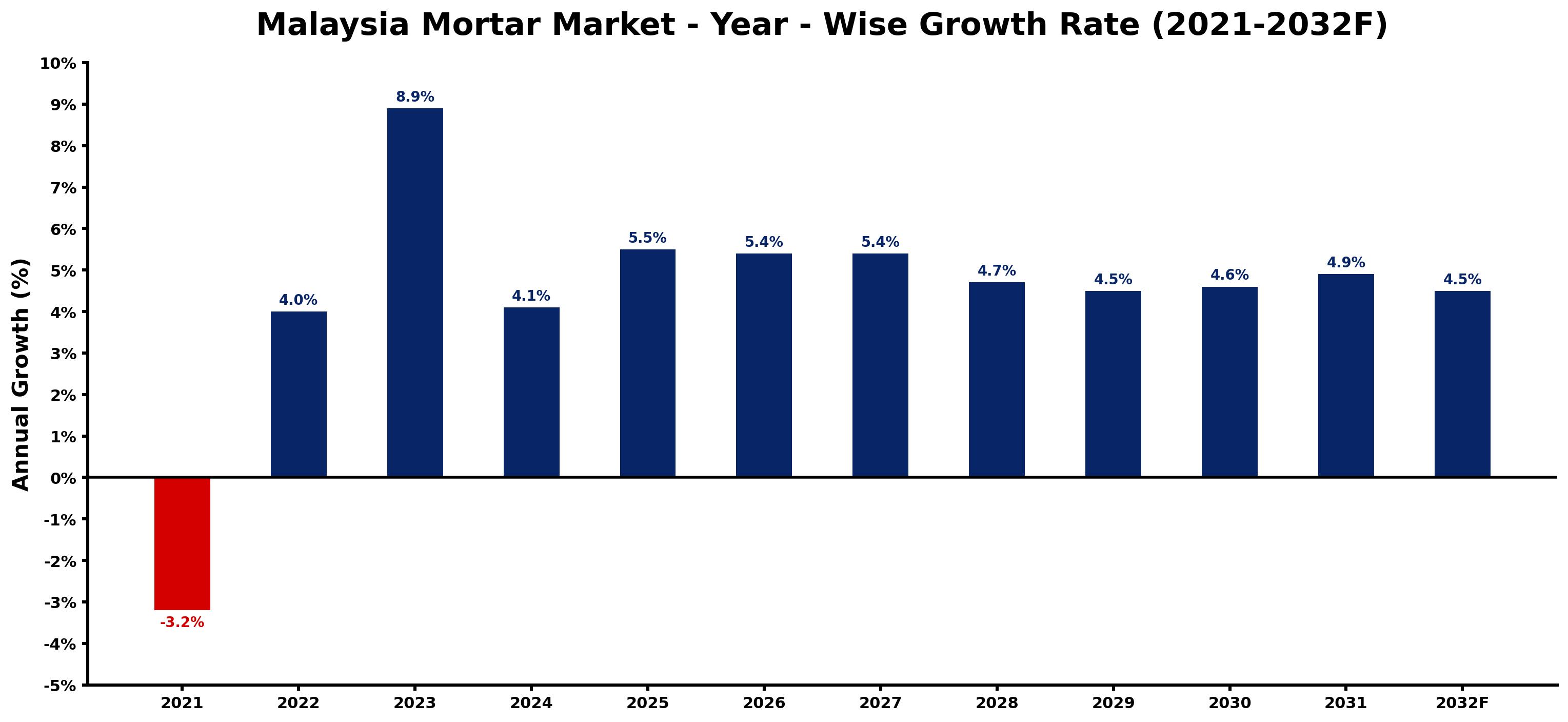
The table below presents the year wise growth rates along with the key drivers influencing the market
| Year | Growth Rate | Major Drivers |
| 2021 | -3.2% | A surge in alternative construction methods diminished the demand for traditional mortar products in 2021. |
| 2022 | 4.0% | Local suppliers expanded operations, enhancing distribution networks and improving market accessibility for customers. |
| 2023 | 8.9% | Sustainability trends prompted manufacturers to innovate with eco-friendly mortar formulations, attracting environmentally conscious buyers. |
| 2024 | 4.1% | Ongoing urbanization in major cities spurred numerous residential and commercial projects, increasing mortar usage. |
| 2025 | 5.5% | Technological advancements in production processes contributed to higher quality and lower costs of mortar products. |
| 2026 | 5.4% | Shifts in consumer preferences towards customized solutions prompted tailored mortar offerings from manufacturers. |
| 2027 | 5.4% | Increased foreign investments targeted infrastructure development, creating opportunities for mortar suppliers in various segments. |
| 2028 | 4.7% | Emerging construction techniques encouraged the adoption of specialized mortars, diversifying market applications significantly. |
| 2029 | 4.5% | Rural area developments expanded, creating new markets for mortar products beyond urban centers. |
| 2030 | 4.6% | Collaborations with construction firms led to innovative product launches, setting new market standards in performance. |
| 2031 | 4.9% | Economic recovery from global disruptions stimulated construction planning, further increasing mortar demand and market activities. |
| 2032 | 4.5% | Regional partnerships in Southeast Asia fostered competitive growth, positioning Malaysia as a mortar supply hub. |
Note - Market size estimations and growth projections presented in this report are based on 6Wresearch's advanced forecasting approach, validated with industry datasets as of June 2026.
Malaysia Mortar Market Synopsis
The Malaysia Mortar Market is projected to reach 5.4% and witness significant growth during the forecast period (2026-2032). Mortar plays a critical role in the construction industry, serving as an adhesive that binds various building materials such as bricks, stones, and concrete blocks. It also fills gaps in masonry walls, enhancing the strength and durability of constructed structures. The increased activity in the construction sector is a primary driver of mortar demand, as it is utilized across a wide range of applications, including flooring, wall plastering, pointing, and rendering. These applications not only contribute to the structural integrity of buildings but also enhance their aesthetic appeal. Furthermore, government initiatives aimed at infrastructure development are further propelling the application of mortars in both residential and non-residential construction projects throughout Malaysia.
Malaysia Mortar Market Growth Drivers
A variety of factors are influencing the growth trajectory of the Malaysia mortar market during the forecast period. Key drivers include:
- The robust expansion of the construction industry remains a crucial driver of demand for mortars, as increased construction activity directly correlates with the need for effective binding materials.
- Technological advancements in manufacturing processes are leading to the introduction of innovative mortar products. These new offerings boast superior properties, such as lower shrinkage cracking and increased adhesion capacity, which enhance their applicability and performance.
- The rise in disposable incomes among consumers is fostering a preference for cost-efficient construction solutions, which in turn bolsters the market for high-quality mortar products.
- Rising urbanization rates in Malaysia are pushing the demand for residential and commercial properties, thereby increasing the consumption of mortars in various applications.
- Government initiatives and policies promoting infrastructure development, such as roads, bridges, and public facilities, are expected to strengthen the market demand further, positioning mortar as an essential component in these projects.
Malaysia Mortar Market Challenges and Restraints
Despite the positive growth outlook for the Malaysia mortar market, several challenges may impede progress. Among these are:
- Fluctuations in raw material prices can adversely affect production costs, thereby impacting the pricing strategies for mortar products in the market.
- The construction sector is vulnerable to economic downturns, which can lead to delays or cancellations of projects, resulting in decreased demand for mortars.
- Environmental regulations pertaining to the use of cement and other materials in mortar production may limit market participants' operational flexibility and increase compliance costs.
- Competition from alternative binding materials and evolving consumer preferences may challenge traditional mortar market players to innovate continuously.
- The availability of skilled labor for the application of advanced mortar products may pose a constraint, especially in regions with labor shortages.
Malaysia Mortar Market Government Investment and Initiatives
The Malaysian government has been proactive in enhancing infrastructure through various initiatives and investments that benefit the mortar market. Key initiatives include:
- Public spending on infrastructure projects is expected to rise, with the government prioritizing the development of roads, public transport, and urban redevelopment, which directly impacts the demand for construction materials, including mortars.
- Investment in smart city projects across Malaysia has led to increased demand for advanced construction materials that meet modern building requirements, further boosting the mortar sector.
- Government subsidies and incentives for sustainable building practices encourage the use of eco-friendly mortar solutions, driving innovation and market growth.
- The promotion of public-private partnerships in the construction industry helps mobilize resources and shares risks, contributing to the successful execution of major infrastructure initiatives.
- Regulatory frameworks supporting skill development programs aim to enhance the capabilities of the workforce in the construction sector, directly benefiting mortar application practices.
Malaysia Mortar Market Latest Developments (May 2025 - June 2026)
Recent developments in the Malaysia mortar market reveal an evolving landscape characterized by innovation and adaptation. Over the period from May 2025 to June 2026:
- Manufacturers are increasingly focusing on product innovation, particularly in the development of smart mortars that can adapt to varying environmental conditions and improve structural performance.
- Sustainability trends are driving companies to explore alternative materials and eco-friendly components for mortar production, aligning with global initiatives for environmentally responsible construction.
- The rise of online procurement platforms is reshaping distribution channels for mortar products, allowing consumers and contractors to access a wider range of products more conveniently.
- Collaborative efforts among industry stakeholders are evident, with forums and workshops aimed at enhancing knowledge sharing and addressing common challenges within the mortar market.
- The push for digital transformation in the construction sector is prompting the adoption of advanced technologies such as automation and analytics in mortar manufacturing processes.
Malaysia Mortar Market - Key Attractiveness of the Report
- 10 Years of Market Numbers
- Historical Data Starting from 2022 to 2025
- Base Year: 2025
- Forecast Data until 2032
- Key Performance Indicators Impacting the Market
- Major Upcoming Developments and Projects
Key Highlights of the Report:
- Malaysia Mortar Market Outlook
- Market Size of Malaysia Mortar Market, 2025
- Forecast of Malaysia Mortar Market, 2032
- Historical Data and Forecast of Malaysia Mortar Revenues & Volume for the Period 2022-2032F
- Malaysia Mortar Market Trend Evolution
- Malaysia Mortar Market Drivers and Challenges
- Malaysia Mortar Price Trends
- Malaysia Mortar Porter's Five Forces
- Malaysia Mortar Industry Life Cycle
- Historical Data and Forecast of Malaysia Mortar Market Revenues & Volume By Type for the Period 2022-2032F
- Historical Data and Forecast of Malaysia Mortar Market Revenues & Volume By Wet Mixed Mortar for the Period 2022-2032F
- Historical Data and Forecast of Malaysia Mortar Market Revenues & Volume By Dry Mortar for the Period 2022-2032F
- Historical Data and Forecast of Malaysia Mortar Market Revenues & Volume By Application for the Period 2022-2032F
- Historical Data and Forecast of Malaysia Mortar Market Revenues & Volume By Construction Industry for the Period 2022-2032F
- Historical Data and Forecast of Malaysia Mortar Market Revenues & Volume By Home Decoration Industry for the Period 2022-2032F
- Historical Data and Forecast of Malaysia Mortar Market Revenues & Volume By Others for the Period 2022-2032F
- Malaysia Mortar Import Export Trade Statistics
- Market Opportunity Assessment By Type
- Market Opportunity Assessment By Application
- Malaysia Mortar Top Companies Market Share
- Malaysia Mortar Competitive Benchmarking By Technical and Operational Parameters
- Malaysia Mortar Company Profiles
- Malaysia Mortar Key Strategic Recommendations






































