Malaysia Multifunctional Composite Materials Market Summary
The malaysia multifunctional composite materials market was estimated at USD 492 Million in 2025 and is projected to reach USD 643 Million by 2032, growing at a CAGR of 5.7% from 2026 to 2032.
Malaysia Multifunctional Composite Materials Market Year-wise Growth Rate and Key Drivers
This graph highlights how the Malaysia Multifunctional Composite Materials Market has steadily grown over the past five years, supported by major growth factors.
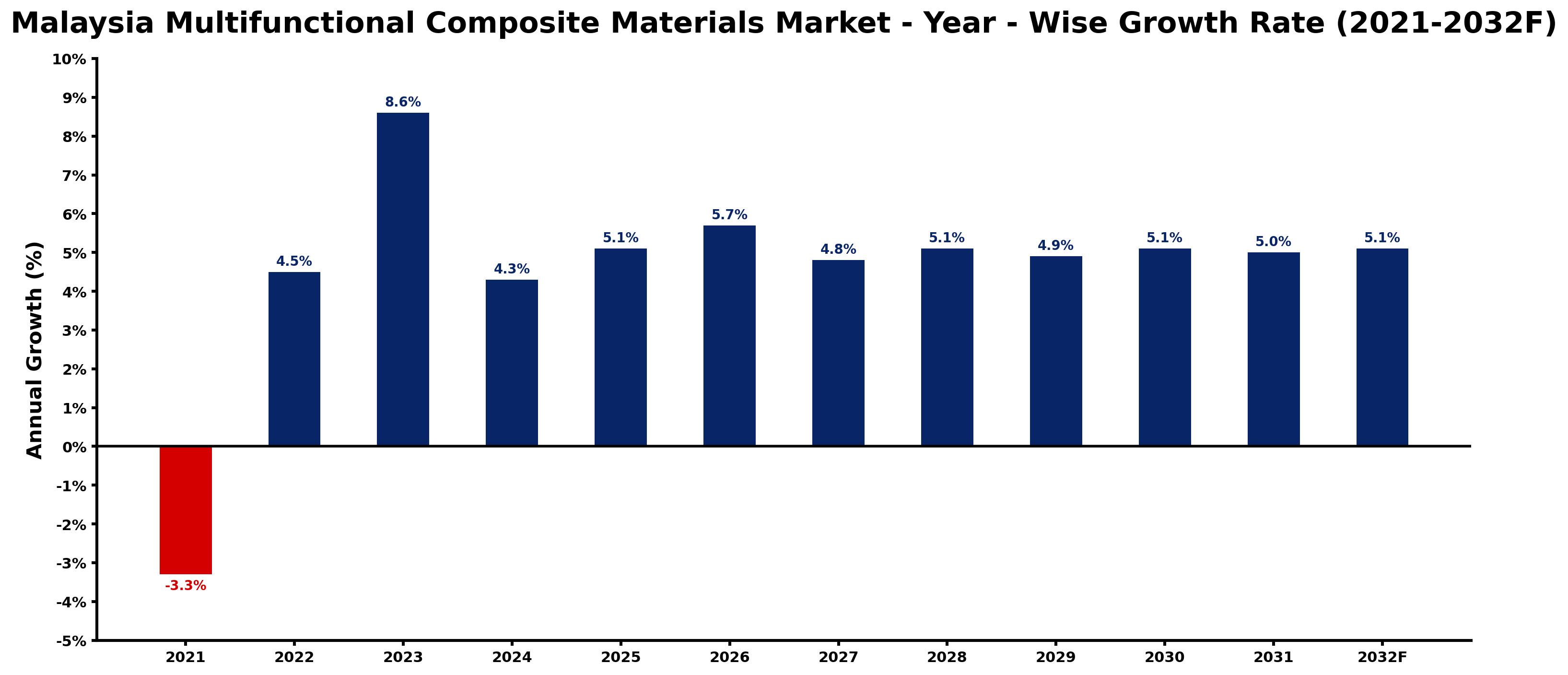
The table below presents the year wise growth rates along with the key drivers influencing the market
| Year | Growth Rate | Major Drivers |
| 2021 | -3.3% | Economic uncertainty prompted reduced investments in construction projects, negatively impacting demand for composite materials. |
| 2022 | 4.5% | Market players begin focusing on sustainability amid environmental concerns and product lifecycle. |
| 2023 | 8.6% | Technological breakthroughs enhance composite material performance across diverse industrial applications. |
| 2024 | 4.3% | Rising interest in renewable energy projects fuels demand for durable composite components. |
| 2025 | 5.1% | Collaborations between universities and industry drive innovation in multifunctional composites sector. |
| 2026 | 5.7% | Local manufacturing capabilities attract foreign investments, boosting market competitiveness significantly. |
| 2027 | 4.8% | Consumer preferences shift towards eco-friendly products, influencing material sourcing decisions. |
| 2028 | 5.1% | Emerging startups introduce niche applications, expanding the multifunctional composite material landscape. |
| 2029 | 4.9% | Global supply chain recovery post-pandemic enhances material availability and project timelines. |
| 2030 | 5.1% | Research institutions focus on advanced composites for aerospace, automotive, and marine sectors. |
| 2031 | 5.0% | Industry conferences showcase cutting-edge developments, fostering collaboration and knowledge sharing. |
| 2032 | 5.1% | Market maturity encourages diversification, leading to specialized applications and innovative solutions. |
Note - Market size estimations and growth projections presented in this report are based on 6Wresearch's advanced forecasting approach, validated with industry datasets as of June 2026.
Malaysia Multifunctional Composite Materials Market Synopsis
The Malaysia Multifunctional Composite Materials Market is projected to reach 5.7% and witness significant growth during the forecast period (2026-2032). This expansion is driven by several key factors, primarily the increasing deployment of advanced composite materials across various industries such as aerospace and defense, automotive, and construction. The technological advancements in material science have enabled the development of innovative products that exhibit enhanced properties, thereby offering cost efficiencies and improved performance to end-users. Additionally, government support through research and development initiatives is anticipated to further bolster the demand for multifunctional composite materials throughout this period.
Malaysia Multifunctional Composite Materials Market Growth Drivers
One of the most significant catalysts for the growth of the Malaysia Multifunctional Composite Materials Market is the escalating requirement for lightweight and durable materials in the aerospace and defense sectors. Aircraft and military applications are increasingly adopting composite materials to reduce weight while maintaining structural integrity, thus improving fuel efficiency and overall performance.
In the automotive industry, the shift towards electric vehicles (EVs) is another prominent driver. Manufacturers are integrating multifunctional composites to enhance vehicle performance, safety, and aesthetics. These materials contribute to reducing the overall weight of vehicles, which is crucial for improving battery efficiency and driving range.
The construction sector is also witnessing a growing trend in the usage of composite materials. As urbanization rates increase, the demand for robust and cost-effective building materials that comply with sustainable practices has surged. Multifunctional composites facilitate innovative designs while ensuring resilience against environmental stressors.
Technological innovations have been pivotal in driving market growth. The development of tailored composites with enhanced properties—such as fire resistance, thermal stability, and electrical conductivity—has resulted in novel applications across various industries, opening new avenues for growth.
Lastly, the increasing focus on sustainability and eco-friendly solutions among manufacturers has led to the incorporation of biodegradable and recyclables within composite materials, aligning with global sustainability goals.
Malaysia Multifunctional Composite Materials Market Challenges and Restraints
Despite the promising growth outlook for the Malaysia Multifunctional Composite Materials Market, certain challenges may impede this trajectory. One notable constraint is the high initial cost of advanced composite materials, which can deter widespread adoption among smaller enterprises that lack significant capital investment.
The complexity involved in the manufacturing processes of these materials presents another challenge. Issues related to scalability, quality control, and consistency in production can create barriers to market entry for new manufacturers.
Moreover, the relative novelty of multifunctional composites compared to traditional materials can lead to a lack of understanding of their properties and benefits among stakeholders, resulting in slower adoption rates.
Additionally, fluctuating raw material prices and supply chain disruptions may impact the pricing and availability of composites, posing a risk to market stability. The overall global economic climate further complicates these issues, as economic downturns can lead to decreased investment in innovative materials.
Finally, regulatory and compliance challenges in various industries concerning the environmental impact of materials can hinder market growth, as companies must navigate a complex landscape of standards and regulations.
Malaysia Multifunctional Composite Materials Market Government Investment and Initiatives
The Malaysian government has recognized the strategic importance of multifunctional composite materials in enhancing the nation's industrial competitiveness. Various initiatives have been undertaken to stimulate research and development within this sector. For instance, significant public spending has been directed towards universities and research institutions to foster innovation and education related to composite materials.
The government has also established industry-academia partnerships aimed at bridging the gap between theoretical research and practical application. These collaborations encourage the development of advanced composite solutions tailored to local needs and market demands.
Furthermore, incentives for companies investing in the production and application of multifunctional composites are available. Tax breaks, grants for R&D projects, and support for technology transfer initiatives are some of the measures being implemented to create a conducive environment for innovation.
In addition, the establishment of national standards and certifications for composite materials is being pursued to ensure quality and safety compliance, thus enhancing manufacturer confidence and consumer trust.
The overall focus on sustainable industrial development, which encompasses eco-friendly practices in the manufacturing of composite materials, is also a government priority, aligning with the global emphasis on sustainability.
Malaysia Multifunctional Composite Materials Market Latest Developments (May 2025 - June 2026)
Recent developments in the Malaysia Multifunctional Composite Materials Market highlight an ongoing trend towards innovation and sustainability. Initiatives focusing on eco-friendly composites have gained traction, as manufacturers seek to address the growing consumer demand for sustainable solutions. During this period, several collaborative projects between research institutions and industry stakeholders have emerged, aimed at developing new composite materials with enhanced performance characteristics and reduced environmental impact.
Furthermore, advancements in manufacturing technologies, such as automation and advanced materials processing techniques, have been implemented to improve efficiency and reduce costs in the production of multifunctional composites. This has enabled companies to offer more competitive pricing without compromising on quality.
The regulatory environment has also shown signs of evolution, with new standards being introduced to address the safety and performance of composite materials. These developments are expected to enhance market acceptance, particularly in highly regulated industries like aerospace and automotive.
Industry expos and conferences have increasingly focused on showcasing innovations within the composite materials sector, facilitating knowledge sharing and collaboration among players in the market. These events have become platforms for discussing the latest trends, regulatory challenges, and technological advancements.
Overall, the developments during this timeframe point towards a robust commitment to advancing the capabilities and applications of multifunctional composite materials in Malaysia.
Malaysia Multifunctional Composite Materials Market - Key Attractiveness of the Report
- 10 Years of Market Numbers
- Historical Data Starting from 2022 to 2025
- Base Year: 2025
- Forecast Data until 2032
- Key Performance Indicators Impacting the Market
- Major Upcoming Developments and Projects
Key Highlights of the Report:
- Malaysia Multifunctional Composite Materials Market Outlook
- Market Size of Malaysia Multifunctional Composite Materials Market, 2025
- Forecast of Malaysia Multifunctional Composite Materials Market, 2032F
- Historical Data and Forecast of Malaysia Multifunctional Composite Materials Revenues & Volume for the Period 2022-2032F
- Malaysia Multifunctional Composite Materials Market Trend Evolution
- Malaysia Multifunctional Composite Materials Market Drivers and Challenges
- Malaysia Multifunctional Composite Materials Price Trends
- Malaysia Multifunctional Composite Materials Porter's Five Forces
- Malaysia Multifunctional Composite Materials Industry Life Cycle
- Historical Data and Forecast of Malaysia Multifunctional Composite Materials Market Revenues & Volume By Product Type for the Period 2022-2032F
- Historical Data and Forecast of Malaysia Multifunctional Composite Materials Market Revenues & Volume By Carbon Fiber for the Period 2022-2032F
- Historical Data and Forecast of Malaysia Multifunctional Composite Materials Market Revenues & Volume By Fabrics/Reinforcements for the Period 2022-2032F
- Historical Data and Forecast of Malaysia Multifunctional Composite Materials Market Revenues & Volume By Prepregs/Resins for the Period 2022-2032F
- Historical Data and Forecast of Malaysia Multifunctional Composite Materials Market Revenues & Volume By Adhesives for the Period 2022-2032F
- Historical Data and Forecast of Malaysia Multifunctional Composite Materials Market Revenues & Volume By Honeycomb for the Period 2022-2032F
- Historical Data and Forecast of Malaysia Multifunctional Composite Materials Market Revenues & Volume By Other for the Period 2022-2032F
- Historical Data and Forecast of Malaysia Multifunctional Composite Materials Market Revenues & Volume By Applications for the Period 2022-2032F
- Historical Data and Forecast of Malaysia Multifunctional Composite Materials Market Revenues & Volume By Aerospace Industry for the Period 2022-2032F
- Historical Data and Forecast of Malaysia Multifunctional Composite Materials Market Revenues & Volume By Medical Industry for the Period 2022-2032F
- Historical Data and Forecast of Malaysia Multifunctional Composite Materials Market Revenues & Volume By Machinery Industry for the Period 2022-2032F
- Historical Data and Forecast of Malaysia Multifunctional Composite Materials Market Revenues & Volume By Achitechture Industry for the Period 2022-2032F
- Historical Data and Forecast of Malaysia Multifunctional Composite Materials Market Revenues & Volume By Other for the Period 2022-2032F
- Malaysia Multifunctional Composite Materials Import Export Trade Statistics
- Market Opportunity Assessment By Product Type
- Market Opportunity Assessment By Applications
- Malaysia Multifunctional Composite Materials Top Companies Market Share
- Malaysia Multifunctional Composite Materials Competitive Benchmarking By Technical and Operational Parameters
- Malaysia Multifunctional Composite Materials Company Profiles
- Malaysia Multifunctional Composite Materials Key Strategic Recommendations






































