Malaysia Music Recording Market Size, Share & Growth Rate
The Malaysia Music Recording Market was estimated at USD 157 Million in 2025 and is projected to reach USD 205 Million by 2032, growing at a CAGR of 3.9% from 2026 to 2032. This growth trajectory is largely driven by the increasing presence of digital streaming platforms, which have transformed how music is consumed and distributed. Additionally, a flourishing local talent pool and a surge in live performances are further enhancing demand for recording services and technology.
Malaysia Music Recording Market Year-wise Growth Rate and Key Drivers
This graph highlights how the Malaysia Music Recording Market has steadily grown over the years, supported by major growth factors.
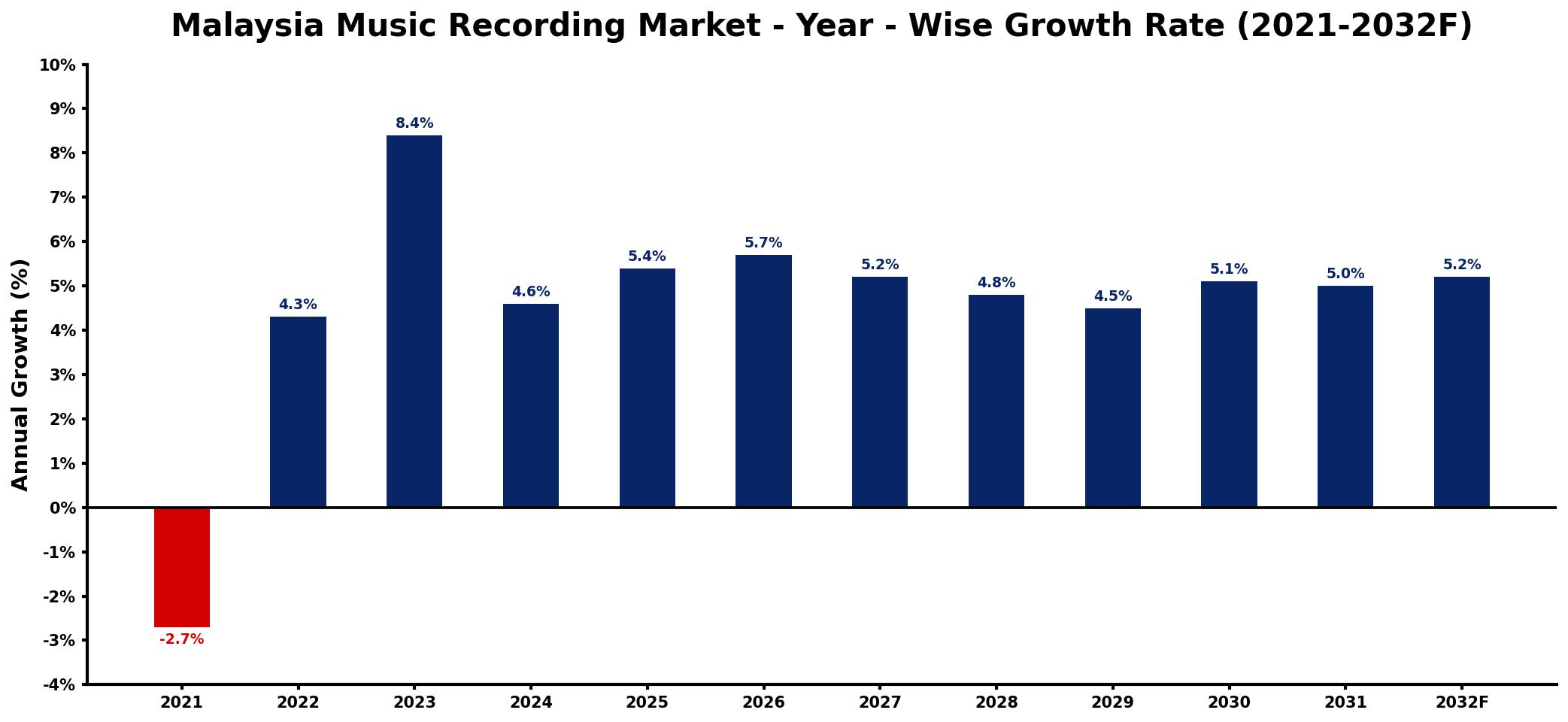
The table below presents the year‑wise growth rates along with the key drivers influencing the market
| Year | Growth Rate | Major Drivers |
| 2021 | -2.7% | decreased consumer spending on entertainment |
| 2022 | 4.3% | expansion of digital streaming services |
| 2023 | 8.4% | increase in live event attendance |
| 2024 | 4.6% | growth in artist collaborations |
| 2025 | 5.4% | increased domestic production output |
| 2026 | 5.7% | increased investment in talent development |
| 2027 | 5.2% | rising end-use demand growth |
| 2028 | 4.8% | growing regional consumption patterns |
| 2029 | 4.5% | expanding manufacturing base activity |
| 2030 | 5.1% | rise in local artist popularity |
| 2031 | 5.0% | growing commercial sector adoption |
| 2032 | 5.2% | strengthening international trade flows |
Note: Market size estimations and growth projections presented in this report are based on 6Wresearch's proprietary forecasting methodology, utilizing the latest available industry data, government publications, and primary research inputs.
Malaysia Music Recording Market Synopsis
The most powerful force currently shaping the Malaysia Music Recording Market is the digitalization of music distribution. As streaming services proliferate, they create unprecedented access for local artists to showcase their work on global platforms, thereby propelling the demand for professional recording facilities and expertise.
Moreover, the growing trend of independent artists opting for small recording studios is revitalizing the industry landscape. This shift towards local productions not only enhances the diversity of music available but also fosters a more intimate connection between artists and their audiences, contributing to a vibrant music scene.
Malaysia Music Recording Market Key Takeaways
- The market is experiencing robust growth driven by digital streaming and the rise of local talent.
- Independent artists are increasingly favoring smaller studios, boosting local production capabilities.
- High demand for live music recording equipment is emerging alongside the popularity of music festivals.
- Digital piracy remains a challenge, necessitating proactive measures from stakeholders.
- The pandemic has accelerated trends toward home recording solutions, influencing future purchasing decisions.
Evaluation of Restraints in Malaysia Music Recording Market
The Malaysia Music Recording Market is currently constrained by the pervasive issue of digital piracy, which significantly undermines revenue streams for artists and recording labels. This illegal distribution of music not only stifles the potential earnings of creators but also poses a long-term threat to the sustainability of the entire music ecosystem. Moreover, as consumer preferences continue to shift rapidly towards streaming platforms, the market faces the ongoing need for substantial investment in digital infrastructure and updated marketing strategies to capture audience engagement effectively.
Malaysia Music Recording Market Trends
Several key trends are shaping the Malaysia Music Recording Market today. Firstly, the integration of advanced technology in music production, such as artificial intelligence in sound engineering, is revolutionizing how music is recorded and produced. Additionally, there's a notable increase in collaborative projects between local and international artists, which enhances the global appeal of Malaysian music. Furthermore, the rise of experiential events, such as hybrid music festivals that combine live performances with virtual attendance, indicates a new frontier for audience engagement.
Malaysia Music Recording Market Opportunities
With a thriving local music scene and growing audience engagement, there are substantial opportunities for investment within the Malaysia Music Recording Market. The demand for high-quality audio equipment, particularly for live performances and recordings, presents a lucrative area for manufacturers and suppliers. Furthermore, the ongoing digital transformation opens avenues for new service offerings, such as online collaboration tools for artists and innovative platforms for independent musicians to distribute their music effectively. These opportunities, if capitalized upon, could yield significant growth for stakeholders in the industry.
Government Initiatives in the Malaysia Music Recording Market
The Malaysian government has initiated various policies and programs aimed at promoting the local music industry. These include grants and funding opportunities for emerging artists and music production companies, as well as initiatives aimed at enhancing the infrastructure necessary for music recording and distribution. Public spending on cultural events and music festivals has also increased, fostering a supportive environment for the growth of the music recording sector.
Future Insights of the Malaysia Music Recording Market
Looking ahead to 2026-2032, the Malaysia Music Recording Market is poised for continued expansion as it adapts to the evolving landscape shaped by digital trends. As more artists embrace technology and the integration of various music genres becomes commonplace, the market will likely witness a surge in innovation and creative collaboration. Additionally, as the industry addresses the challenges posed by piracy and invests in digital infrastructure, it can capitalize on the ongoing demand for diverse musical content.
Malaysia Music Recording Market Latest Developments (2025 - 2026)
Recent developments in the Malaysia Music Recording Market indicate a strong focus on adapting to post-pandemic realities. Many studios are enhancing their offerings to include remote recording capabilities, responding to the increased interest in home recording solutions. The landscape is also witnessing a spike in collaborations, both locally and internationally, as artists seek to expand their audience reach. Furthermore, the government continues to play a crucial role in promoting the industry through various initiatives aimed at enhancing visibility and funding for local artists.
Malaysia Music Recording Market - Key Attractiveness of the Report
- 10 Years of Market Numbers
- Historical Data Starting from 2022 to 2025
- Base Year: 2025
- Forecast Data until 2032
- Key Performance Indicators Impacting the Market
- Major Upcoming Developments and Projects
Key Highlights of the Report:
- Malaysia Music Recording Market Outlook
- Market Size of Malaysia Music Recording Market, 2025
- Forecast of Malaysia Music Recording Market, 2032
- Historical Data and Forecast of Malaysia Music Recording Revenues & Volume for the Period 2022-2032F
- Malaysia Music Recording Market Trend Evolution
- Malaysia Music Recording Market Drivers and Challenges
- Malaysia Music Recording Price Trends
- Malaysia Music Recording Porter's Five Forces
- Malaysia Music Recording Industry Life Cycle
- Historical Data and Forecast of Malaysia Music Recording Market Revenues & Volume By Type for the Period 2022-2032F
- Historical Data and Forecast of Malaysia Music Recording Market Revenues & Volume By Record Production for the Period 2022-2032F
- Historical Data and Forecast of Malaysia Music Recording Market Revenues & Volume By Music Publishers for the Period 2022-2032F
- Historical Data and Forecast of Malaysia Music Recording Market Revenues & Volume By Record Distribution for the Period 2022-2032F
- Historical Data and Forecast of Malaysia Music Recording Market Revenues & Volume By Sound Recording Studios for the Period 2022-2032F
- Historical Data and Forecast of Malaysia Music Recording Market Revenues & Volume By Application for the Period 2022-2032F
- Historical Data and Forecast of Malaysia Music Recording Market Revenues & Volume By Mechanical for the Period 2022-2032F
- Historical Data and Forecast of Malaysia Music Recording Market Revenues & Volume By Performance for the Period 2022-2032F
- Historical Data and Forecast of Malaysia Music Recording Market Revenues & Volume By Synchronization for the Period 2022-2032F
- Historical Data and Forecast of Malaysia Music Recording Market Revenues & Volume By Digital for the Period 2022-2032F
- Historical Data and Forecast of Malaysia Music Recording Market Revenues & Volume By Others for the Period 2022-2032F
- Historical Data and Forecast of Malaysia Music Recording Market Revenues & Volume By End-User for the Period 2022-2032F
- Historical Data and Forecast of Malaysia Music Recording Market Revenues & Volume By Individual for the Period 2022-2032F
- Historical Data and Forecast of Malaysia Music Recording Market Revenues & Volume By Commercial for the Period 2022-2032F
- Historical Data and Forecast of Malaysia Music Recording Market Revenues & Volume By Genre for the Period 2022-2032F
- Historical Data and Forecast of Malaysia Music Recording Market Revenues & Volume By Rock for the Period 2022-2032F
- Historical Data and Forecast of Malaysia Music Recording Market Revenues & Volume By Hip Hop for the Period 2022-2032F
- Historical Data and Forecast of Malaysia Music Recording Market Revenues & Volume By Pop for the Period 2022-2032F
- Historical Data and Forecast of Malaysia Music Recording Market Revenues & Volume By Jazz for the Period 2022-2032F
- Historical Data and Forecast of Malaysia Music Recording Market Revenues & Volume By Others for the Period 2022-2032F
- Malaysia Music Recording Import Export Trade Statistics
- Market Opportunity Assessment By Type
- Market Opportunity Assessment By Application
- Market Opportunity Assessment By End-User
- Market Opportunity Assessment By Genre
- Malaysia Music Recording Top Companies Market Share
- Malaysia Music Recording Competitive Benchmarking By Technical and Operational Parameters
- Malaysia Music Recording Company Profiles
- Malaysia Music Recording Key Strategic Recommendations






































