Malaysia Natural Fragrance Market Size, Share & Growth Rate
The Malaysia Natural Fragrance Market was estimated at USD 482 Million in 2025 and is projected to reach USD 625 Million by 2032, growing at a CAGR of 3.8% from 2026 to 2032. This growth trajectory is significantly driven by a notable shift in consumer preferences towards eco-friendly and non-synthetic scents. As awareness of sustainability and health impacts increases, Malaysian consumers are actively seeking natural alternatives in fragrances, which further fuels the market's expansion.
Malaysia Natural Fragrance Market Year-wise Growth Rate and Key Drivers
This graph highlights how the Malaysia Natural Fragrance Market has steadily grown over the years, supported by major growth factors.
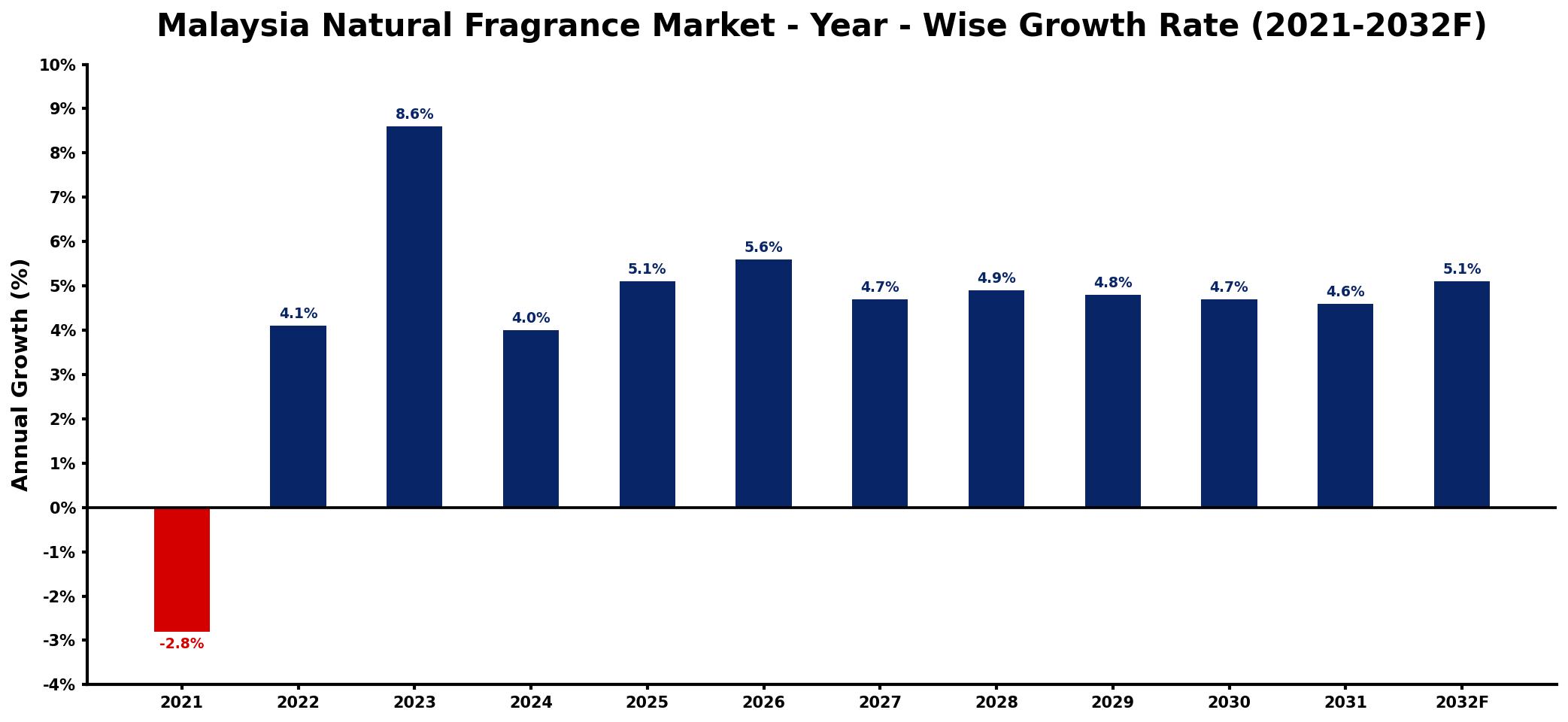
The table below presents the year‑wise growth rates along with the key drivers influencing the market
| Year | Growth Rate | Major Drivers |
| 2021 | -2.8% | Decreased consumer spending on luxuries |
| 2022 | 4.1% | Rising interest in sustainable products |
| 2023 | 8.6% | Growing demand for eco-friendly options |
| 2024 | 4.0% | Expansion of retail distribution channels |
| 2025 | 5.1% | Increased investment in product innovation |
| 2026 | 5.6% | Surge in online shopping platforms |
| 2027 | 4.7% | Enhanced marketing strategies for awareness |
| 2028 | 4.9% | Collaborations with lifestyle brands rising |
| 2029 | 4.8% | Increased focus on wellness trends |
| 2030 | 4.7% | Emergence of niche market segments |
| 2031 | 4.6% | Strengthening consumer loyalty programs |
| 2032 | 5.1% | Growing popularity of artisanal offerings |
Note: Market size estimations and growth projections presented in this report are based on 6Wresearch's proprietary forecasting methodology, utilizing the latest available industry data, government publications, and primary research inputs.
Malaysia Natural Fragrance Market Synopsis
The strongest force shaping the Malaysia Natural Fragrance Market is the burgeoning consumer demand for organic and natural scents. This inclination towards botanical ingredients resonates well with a population keen on maintaining a connection to nature and opting for cleaner, healthier products in their daily lives.
As the market matures, essential oils and natural fragrance compounds sourced from flowers and plants are gaining traction across various applications, particularly in perfumes, personal care, and household products. Local producers and suppliers are increasingly positioned to capitalize on this trend, offering innovative, sustainable products that align with consumer values.
Malaysia Natural Fragrance Market Key Takeaways
- The market is witnessing a significant transition towards natural ingredients, driven by consumer preferences for sustainability.
- Essential oils are increasingly being favored over synthetic fragrances in the personal care and home fragrance sectors.
- Local producers have ample opportunity to expand their offerings in the growing natural fragrance landscape.
- COVID-19 has reinforced the demand for natural products, highlighting resilience in the market.
- Challenges related to ingredient sourcing and competition from synthetic options remain, yet innovation and sustainability are key to overcoming them.
Evaluation of Restraints in Malaysia Natural Fragrance Market
Despite its growth potential, the Malaysia Natural Fragrance Market faces several constraints. One of the most pressing issues is the challenge of sustainably sourcing natural ingredients. Environmental factors and complex supply chains often impede consistent access to the high-quality raw materials needed for natural fragrances. Furthermore, the competition posed by synthetic fragrances, which frequently provide cost advantages and reliable scent profiles, complicates market dynamics. Balancing consumer desires for authenticity with practical considerations around pricing and availability remains a pivotal challenge for stakeholders in this industry.
Malaysia Natural Fragrance Market Trends
Several trends are currently shaping the demand for natural fragrances in Malaysia. One key trend is the increasing consumer education about the benefits of natural over synthetic ingredients, resulting in a heightened desire for transparency in product formulations. Another trend is the rise of clean beauty, where brands are increasingly focusing on natural fragrances that align with holistic health approaches. Moreover, eco-friendly packaging is gaining importance as part of broader sustainability practices. These trends indicate a robust shift towards products that not only smell good but also align with consumer values regarding health and the environment.
Malaysia Natural Fragrance Market Opportunities
The Malaysian market presents numerous growth and investment opportunities, particularly for businesses focusing on innovation in natural fragrance formulations. Emerging trends such as aromatherapy and wellness-related products provide avenues for expansion. Additionally, local producers can explore collaborations with international brands seeking to tap into the Southeast Asian market, leveraging local botanical sources. As the shift towards sustainability continues, companies prioritizing eco-friendly practices and social responsibility will likely attract a loyal consumer base.
Government Initiatives in the Malaysia Natural Fragrance Market
The Malaysian government has been active in promoting sustainability and the growth of the natural products sector through various initiatives. Policies aimed at encouraging the cultivation of native botanical species for fragrance production are being implemented. Furthermore, public spending on environmental programs and incentives for businesses that focus on sustainable practices support the broader natural fragrance market. These government initiatives are crucial in fostering an environment conducive to the growth of natural fragrance enterprises.
Future Insights of the Malaysia Natural Fragrance Market
Looking ahead to 2026-2032, the Malaysia Natural Fragrance Market is expected to continue its upward trajectory, driven by evolving consumer preferences and heightened awareness of health and wellness. The integration of technology in product development, including advancements in extraction and formulation techniques, is likely to enhance the quality and appeal of natural fragrances. The focus on sustainability will remain pivotal, shaping product offerings and brand strategies. Companies that can adeptly navigate these evolving dynamics will position themselves favorably for success in the growing market.
Malaysia Natural Fragrance Market Latest Developments (2025 - 2026)
Recent developments in the Malaysia Natural Fragrance Market indicate a strong push towards innovative product lines that emphasize sustainability. Brands are increasingly prioritizing transparency in ingredient sourcing and promoting eco-friendly practices. Furthermore, collaborations between local artisans and larger companies are on the rise, facilitating the exchange of traditional knowledge and modern fragrance trends. Overall, the market is evolving rapidly, reflecting broader consumer trends towards natural and organic products.
Malaysia Natural Fragrance Market - Key Attractiveness of the Report
- 10 Years of Market Numbers
- Historical Data Starting from 2022 to 2025
- Base Year: 2025
- Forecast Data until 2032
- Key Performance Indicators Impacting the Market
- Major Upcoming Developments and Projects
Key Highlights of the Report:
- Malaysia Natural Fragrance Market Outlook
- Market Size of Malaysia Natural Fragrance Market, 2025
- Forecast of Malaysia Natural Fragrance Market, 2032
- Historical Data and Forecast of Malaysia Natural Fragrance Revenues & Volume for the Period 2022-2032F
- Malaysia Natural Fragrance Market Trend Evolution
- Malaysia Natural Fragrance Market Drivers and Challenges
- Malaysia Natural Fragrance Price Trends
- Malaysia Natural Fragrance Porter's Five Forces
- Malaysia Natural Fragrance Industry Life Cycle
- Historical Data and Forecast of Malaysia Natural Fragrance Market Revenues & Volume By Ingredient for the Period 2022-2032F
- Historical Data and Forecast of Malaysia Natural Fragrance Market Revenues & Volume By Essential Oils for the Period 2022-2032F
- Historical Data and Forecast of Malaysia Natural Fragrance Market Revenues & Volume By Natural Extracts for the Period 2022-2032F
- Historical Data and Forecast of Malaysia Natural Fragrance Market Revenues & Volume By Type for the Period 2022-2032F
- Historical Data and Forecast of Malaysia Natural Fragrance Market Revenues & Volume By Top note for the Period 2022-2032F
- Historical Data and Forecast of Malaysia Natural Fragrance Market Revenues & Volume By Middle Note for the Period 2022-2032F
- Historical Data and Forecast of Malaysia Natural Fragrance Market Revenues & Volume By Base Note for the Period 2022-2032F
- Historical Data and Forecast of Malaysia Natural Fragrance Market Revenues & Volume By Application for the Period 2022-2032F
- Historical Data and Forecast of Malaysia Natural Fragrance Market Revenues & Volume By Fine Fragrances for the Period 2022-2032F
- Historical Data and Forecast of Malaysia Natural Fragrance Market Revenues & Volume By Personal Care & Cosmetics for the Period 2022-2032F
- Historical Data and Forecast of Malaysia Natural Fragrance Market Revenues & Volume By Household Care for the Period 2022-2032F
- Malaysia Natural Fragrance Import Export Trade Statistics
- Market Opportunity Assessment By Ingredient
- Market Opportunity Assessment By Type
- Market Opportunity Assessment By Application
- Malaysia Natural Fragrance Top Companies Market Share
- Malaysia Natural Fragrance Competitive Benchmarking By Technical and Operational Parameters
- Malaysia Natural Fragrance Company Profiles
- Malaysia Natural Fragrance Key Strategic Recommendations






































