Malaysia Non-ferrous Metal Market Summary
The malaysia non-ferrous metal market was estimated at USD 381 Million in 2025 and is projected to reach USD 497 Million by 2032, growing at a CAGR of 5.4% from 2026 to 2032.
Malaysia Non-ferrous Metal Market Year-wise Growth Rate and Key Drivers
This graph highlights how the Malaysia Non-ferrous Metal Market has steadily grown over the past five years, supported by major growth factors.
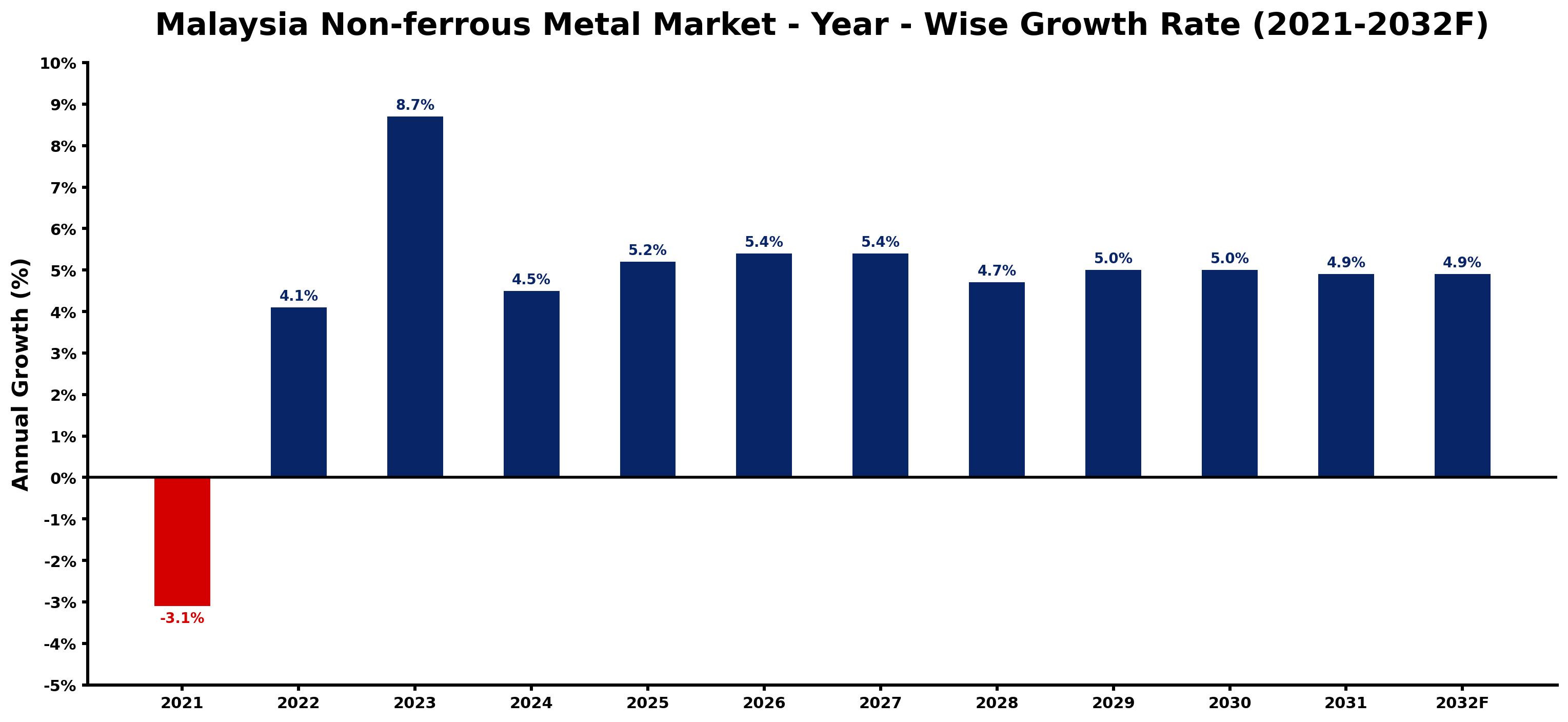
The table below presents the year wise growth rates along with the key drivers influencing the market
| Year | Growth Rate | Major Drivers |
| 2021 | -3.1% | Supply chain disruptions hindered production capacity, leading to reduced availability of nonferrous metals in the market. |
| 2022 | 4.1% | Emerging electric vehicle manufacturers increased copper and aluminum requirements significantly. |
| 2023 | 8.7% | Regional construction booms underscored steel's critical role in development across Malaysia. |
| 2024 | 4.5% | Shifts in energy policies highlighted the importance of non-ferrous metals for renewables. |
| 2025 | 5.2% | Technological innovations prompted demand for lightweight metals in transportation sectors. |
| 2026 | 5.4% | Global supply chain disruptions showcased the dependence on local non-ferrous sources. |
| 2027 | 5.4% | Increased recycling initiatives fostered a circular economy for non-ferrous materials. |
| 2028 | 4.7% | Expansion of electronics manufacturing raised the profile of rare metals in Malaysia. |
| 2029 | 5.0% | Collaborations between industries focused on sustainable non-ferrous metal production methods. |
| 2030 | 5.0% | Local mining operations aimed to meet the surging demand for various alloys. |
| 2031 | 4.9% | Growing regional economic stability encouraged foreign investments in Malaysian metal sectors. |
| 2032 | 4.9% | Rising awareness of sustainability trends shifted focus toward eco-friendly metal practices. |
Note - Market size estimations and growth projections presented in this report are based on 6Wresearch's advanced forecasting approach, validated with industry datasets as of June 2026.
Malaysia Non-ferrous Metal Market Synopsis
The Malaysia Non-ferrous Metal Market is projected to reach 5.4% and witness significant growth during the forecast period (2026-2032). Malaysia has established itself as a pivotal player in the non-ferrous metals sector in Southeast Asia, characterized by a consistent uptrend in both production and export capacities. This market's acceleration can be attributed to robust economic activity fueled by technological innovations and evolving consumer demands.
Malaysia Non-ferrous Metal Market Growth Drivers
A myriad of factors is propelling the growth of the Malaysia Non-ferrous Metal Market. The following elements are particularly influential:
- Infrastructure developments are increasingly prioritized, particularly in the transportation sector. This uptick leads to heightened demand for non-ferrous metals essential for construction and manufacturing.
- The automotive industry is experiencing a surge in aluminum utilization, driven by a shift towards lighter vehicles that enhance fuel efficiency and reduce emissions.
- Stringent environmental regulations are driving the need for more sustainable practices and materials, encouraging the use of non-ferrous metals known for their recyclability and low environmental impact.
- The transition towards electric vehicles (EVs) demands metals such as lithium, cobalt, and nickel, which are integral to battery production, suggesting that further growth in this segment is inevitable.
- Government incentives under the Economic Transformation Program (ETP) bolster investment in extraction and processing ventures, enhancing the overall attractiveness of the sector.
Malaysia Non-ferrous Metal Market Challenges and Restraints
Despite the promising growth trajectory, the Malaysia Non-ferrous Metal Market faces certain challenges. Key restraints include:
- Fluctuations in global commodity prices can adversely affect profitability and investment in the sector, making financial forecasting challenging.
- Competition from lower-cost producers in other countries may put pressure on local companies, necessitating innovation and efficiency improvements.
- Environmental concerns regarding mining and processing operations can lead to stricter regulations, potentially increasing operational costs and hindering production capabilities.
- Skill shortages in the workforce can impede technological advancements and operational efficiency within the industry, forming a significant barrier to sustained growth.
- Market volatility due to geopolitical tensions and trade policies may impact export capabilities, particularly concerning key markets like China.
Malaysia Non-ferrous Metal Market Government Investment and Initiatives
The Malaysian government is actively engaging in initiatives aimed at fostering the growth of the non-ferrous metals sector. Key strategies include:
- The Economic Transformation Program (ETP) emphasizes attracting investments in the mining and processing segments, creating a conducive environment for both local and foreign players.
- Public spending on infrastructure projects enhances demand for non-ferrous metals, directly benefiting this market segment.
- Support for research and development in metal processing technologies aims to boost productivity and sustainability within the industry.
- The government is fostering partnerships with private entities to promote innovation and technological advancements, ensuring Malaysia remains competitive in the global market.
- Sustainability initiatives are being integrated into governmental policies, encouraging environmentally responsible mining practices that align with global standards.
Malaysia Non-ferrous Metal Market Latest Developments (May 2025 - June 2026)
Recent developments in the Malaysia Non-ferrous Metal Market indicate a robust trajectory towards modernization and sustainability. During this period, increased government support for innovation in extraction technologies has been noted, alongside a rise in collaborations aimed at enhancing production efficiency. Furthermore, the emphasis on electric vehicle manufacturing has prompted strategic investments in metals critical for battery technologies. The government has also maintained a focus on balancing economic growth with stringent environmental standards, guiding companies towards adopting greener practices in their operations.
Malaysia Non-ferrous Metal Market - Key Attractiveness of the Report
- 10 Years of Market Numbers
- Historical Data Starting from 2022 to 2025
- Base Year: 2025
- Forecast Data until 2032
- Key Performance Indicators Impacting the Market
- Major Upcoming Developments and Projects
Key Highlights of the Report:
- Malaysia Non-ferrous Metal Market Outlook
- Market Size of Malaysia Non-ferrous Metal Market, 2025
- Forecast of Malaysia Non-ferrous Metal Market, 2032
- Historical Data and Forecast of Malaysia Non-ferrous Metal Revenues & Volume for the Period 2022-2032F
- Malaysia Non-ferrous Metal Market Trend Evolution
- Malaysia Non-ferrous Metal Market Drivers and Challenges
- Malaysia Non-ferrous Metal Price Trends
- Malaysia Non-ferrous Metal Porter's Five Forces
- Malaysia Non-ferrous Metal Industry Life Cycle
- Historical Data and Forecast of Malaysia Non-ferrous Metal Market Revenues & Volume By Types for the Period 2022-2032F
- Historical Data and Forecast of Malaysia Non-ferrous Metal Market Revenues & Volume By Aluminum for the Period 2022-2032F
- Historical Data and Forecast of Malaysia Non-ferrous Metal Market Revenues & Volume By Copper for the Period 2022-2032F
- Historical Data and Forecast of Malaysia Non-ferrous Metal Market Revenues & Volume By Lead for the Period 2022-2032F
- Historical Data and Forecast of Malaysia Non-ferrous Metal Market Revenues & Volume By Tin for the Period 2022-2032F
- Historical Data and Forecast of Malaysia Non-ferrous Metal Market Revenues & Volume By Nickel for the Period 2022-2032F
- Historical Data and Forecast of Malaysia Non-ferrous Metal Market Revenues & Volume By Titanium for the Period 2022-2032F
- Historical Data and Forecast of Malaysia Non-ferrous Metal Market Revenues & Volume By Zinc for the Period 2022-2032F
- Historical Data and Forecast of Malaysia Non-ferrous Metal Market Revenues & Volume By Applications for the Period 2022-2032F
- Historical Data and Forecast of Malaysia Non-ferrous Metal Market Revenues & Volume By Automobile Industry for the Period 2022-2032F
- Historical Data and Forecast of Malaysia Non-ferrous Metal Market Revenues & Volume By Electronic Power Industry for the Period 2022-2032F
- Historical Data and Forecast of Malaysia Non-ferrous Metal Market Revenues & Volume By Construction Industry for the Period 2022-2032F
- Historical Data and Forecast of Malaysia Non-ferrous Metal Market Revenues & Volume By Other for the Period 2022-2032F
- Malaysia Non-ferrous Metal Import Export Trade Statistics
- Market Opportunity Assessment By Types
- Market Opportunity Assessment By Applications
- Malaysia Non-ferrous Metal Top Companies Market Share
- Malaysia Non-ferrous Metal Competitive Benchmarking By Technical and Operational Parameters
- Malaysia Non-ferrous Metal Company Profiles
- Malaysia Non-ferrous Metal Key Strategic Recommendations






































