Malaysia Office Stationery Supplies Market Size, Share & Growth Rate
The Malaysia Office Stationery Supplies Market was estimated at USD 451 Million in 2025 and is projected to reach USD 588 Million by 2032, growing at a CAGR of 3.9% from 2026 to 2032. This growth trajectory is primarily driven by the increasing establishment of offices, particularly within the business process outsourcing (BPO) sector, alongside the rising demand for home office supplies fueled by remote work trends. As organizations and educational institutions adapt to hybrid models, the need for a diverse range of office stationery continues to expand.
Malaysia Office Stationery Supplies Market Year-wise Growth Rate and Key Drivers
This graph highlights how the Malaysia Office Stationery Supplies Market has steadily grown over the years, supported by major growth factors.
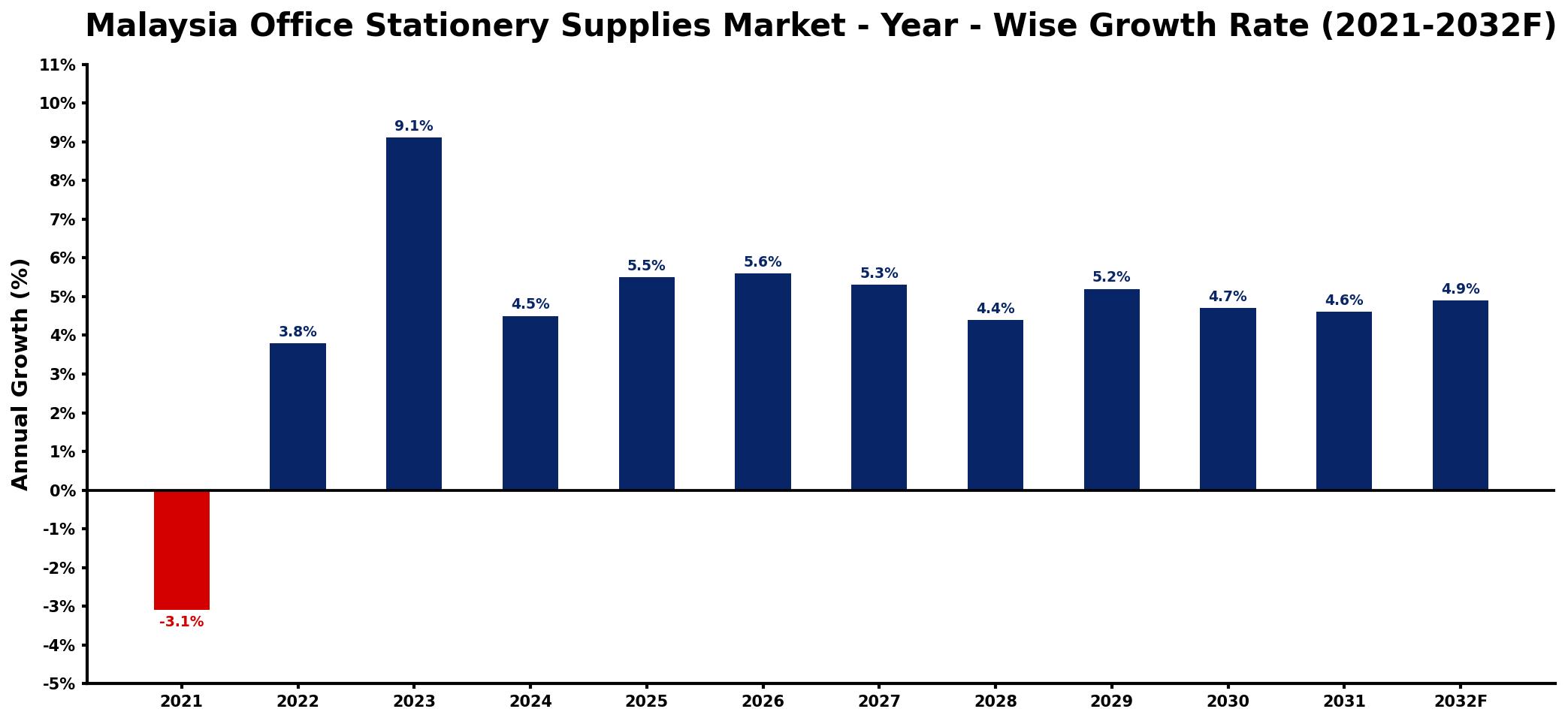
The table below presents the year‑wise growth rates along with the key drivers influencing the market
| Year | Growth Rate | Major Drivers |
| 2021 | -3.1% | decrease in corporate investments |
| 2022 | 3.8% | rise in remote work demand |
| 2023 | 9.1% | increase in educational institutions |
| 2024 | 4.5% | growth in small businesses |
| 2025 | 5.5% | expansion of e-commerce platforms |
| 2026 | 5.6% | higher demand for eco-friendly products |
| 2027 | 5.3% | increased pharmaceutical industry usage |
| 2028 | 4.4% | rising export shipment volumes |
| 2029 | 5.2% | growing automotive sector requirements |
| 2030 | 4.7% | increased capital investment inflows |
| 2031 | 4.6% | growing emerging market penetration |
| 2032 | 4.9% | stronger distribution network expansion |
Note: Market size estimations and growth projections presented in this report are based on 6Wresearch's proprietary forecasting methodology, utilizing the latest available industry data, government publications, and primary research inputs.
Malaysia Office Stationery Supplies Market Synopsis
The most significant force shaping the Malaysia Office Stationery Supplies Market is the digital transformation of workplaces, influencing how traditional stationery products are utilized. While digital solutions gain traction, the persistent requirement for essential supplies like paper and pens remains a cornerstone of daily operations in various sectors.
Additionally, the increasing number of educational institutions and the enhancement of digital learning tools have further diversified demand for stationery products. Companies are not only facing challenges but are also adapting to the evolving needs of both physical and remote workplaces by introducing innovative solutions that cater to this changing landscape.
Malaysia Office Stationery Supplies Market Key Takeaways
- The office stationery market is experiencing steady growth driven by the rise of remote work and digitalization.
- There is a persistent demand for traditional stationery supplies alongside innovative product offerings.
- The BPO sector's expansion has further supported the market through increased office setups.
- Market players are challenged to remain competitive while ensuring product quality and sustainability.
- Home office supplies are seeing a noticeable uptick in demand, shaping product development strategies.
Evaluation of Restraints in Malaysia Office Stationery Supplies Market
The market is not without its challenges. The shift toward remote work has significantly altered traditional purchasing patterns, leading to a reduction in demand for conventional office stationery. Companies face pressure to adapt quickly to these changes by innovating their product lines. Additionally, competition from e-commerce platforms and the proliferation of generic brands further complicate market dynamics, necessitating a strategic focus on brand differentiation and quality assurance to maintain customer loyalty in a crowded marketplace.
Malaysia Office Stationery Supplies Market Trends
Current trends in the Malaysia Office Stationery Supplies Market indicate a strong movement towards sustainability and environmentally friendly products. Consumers are increasingly seeking out options that minimize environmental impact, leading to the introduction of recycled materials in stationery items. Furthermore, as hybrid work environments become the norm, companies are enhancing their product offerings to include ergonomic office furniture and technology-integrated stationery, which cater to the evolving demands of remote and on-site workers alike.
Malaysia Office Stationery Supplies Market Opportunities
Growth opportunities lie in the development of tailored stationery solutions for niche segments such as educational institutions and home office setups. As remote work continues to solidify its place in the workforce, there is significant potential for companies to expand their product lines to include high-quality, multifunctional stationery. Additionally, tapping into the growing e-commerce channel can enhance market reach and accessibility, positioning businesses favorably in the competitive landscape.
Government Initiatives in the Malaysia Office Stationery Supplies Market
The Malaysian government has been proactive in fostering a conducive environment for businesses, particularly in the realm of education and entrepreneurship. Various initiatives aimed at enhancing digital infrastructure and promoting local manufacturing are expected to indirectly benefit the office stationery supplies market. Furthermore, public spending on educational programs continues to rise, creating additional demand for stationery and related supplies.
Future Insights of the Malaysia Office Stationery Supplies Market
Looking ahead to the period between 2026 and 2032, the Malaysia Office Stationery Supplies Market is poised for transformation. The increasing integration of technology in the workplace will push suppliers to innovate continually. Demand for customized, smart stationery products is likely to grow as businesses seek to improve productivity and efficiency in hybrid work settings. The emphasis on sustainability will remain a central theme, prompting companies to invest in greener alternatives and responsible sourcing practices.
Malaysia Office Stationery Supplies Market Latest Developments (2025 - 2026)
Recent developments within the Malaysia Office Stationery Supplies Market have showcased a heightened focus on innovation and sustainability. Companies are launching new product lines that incorporate eco-friendly materials and smart technology features. The competitive landscape has also shifted, with many players enhancing their online presence to adapt to changing consumer shopping habits and preferences. Additionally, partnerships between manufacturers and educational institutions are being formed to cater to the growing demand for tailored stationery solutions.
Malaysia Office Stationery Supplies Market - Key Attractiveness of the Report
- 10 Years of Market Numbers
- Historical Data Starting from 2022 to 2025
- Base Year: 2025
- Forecast Data until 2032
- Key Performance Indicators Impacting the Market
- Major Upcoming Developments and Projects
Key Highlights of the Report:
- Malaysia Office Stationery Supplies Market Outlook
- Market Size of Malaysia Office Stationery Supplies Market, 2025
- Forecast of Malaysia Office Stationery Supplies Market, 2032
- Historical Data and Forecast of Malaysia Office Stationery Supplies Revenues & Volume for the Period 2022-2032F
- Malaysia Office Stationery Supplies Market Trend Evolution
- Malaysia Office Stationery Supplies Market Drivers and Challenges
- Malaysia Office Stationery Supplies Price Trends
- Malaysia Office Stationery Supplies Porter's Five Forces
- Malaysia Office Stationery Supplies Industry Life Cycle
- Historical Data and Forecast of Malaysia Office Stationery Supplies Market Revenues & Volume By Product for the Period 2022-2032F
- Historical Data and Forecast of Malaysia Office Stationery Supplies Market Revenues & Volume By Desk Supplies for the Period 2022-2032F
- Historical Data and Forecast of Malaysia Office Stationery Supplies Market Revenues & Volume By Filing Supplies for the Period 2022-2032F
- Historical Data and Forecast of Malaysia Office Stationery Supplies Market Revenues & Volume By Binding Supplies for the Period 2022-2032F
- Historical Data and Forecast of Malaysia Office Stationery Supplies Market Revenues & Volume By Paper Products for the Period 2022-2032F
- Historical Data and Forecast of Malaysia Office Stationery Supplies Market Revenues & Volume By Other for the Period 2022-2032F
- Historical Data and Forecast of Malaysia Office Stationery Supplies Market Revenues & Volume By Application for the Period 2022-2032F
- Historical Data and Forecast of Malaysia Office Stationery Supplies Market Revenues & Volume By Office Building for the Period 2022-2032F
- Historical Data and Forecast of Malaysia Office Stationery Supplies Market Revenues & Volume By School for the Period 2022-2032F
- Historical Data and Forecast of Malaysia Office Stationery Supplies Market Revenues & Volume By Hospital for the Period 2022-2032F
- Malaysia Office Stationery Supplies Import Export Trade Statistics
- Market Opportunity Assessment By Product
- Market Opportunity Assessment By Application
- Malaysia Office Stationery Supplies Top Companies Market Share
- Malaysia Office Stationery Supplies Competitive Benchmarking By Technical and Operational Parameters
- Malaysia Office Stationery Supplies Company Profiles
- Malaysia Office Stationery Supplies Key Strategic Recommendations






































