Malaysia Oil And Fuel Filter Market Size, Share & Growth Rate
The Malaysia Oil And Fuel Filter Market was estimated at USD 167 Million in 2025 and is projected to reach USD 217 Million by 2032, growing at a CAGR of 3.8% from 2026 to 2032. This growth trajectory is primarily driven by stringent environmental regulations aimed at reducing emissions and enhancing fuel efficiency. As the automotive and industrial sectors expand, there is an increasing emphasis on high-quality filtration solutions to meet compliance and operational efficiency demands.
Malaysia Oil And Fuel Filter Market Year-wise Growth Rate and Key Drivers
This graph highlights how the Malaysia Oil And Fuel Filter Market has steadily grown over the years, supported by major growth factors.
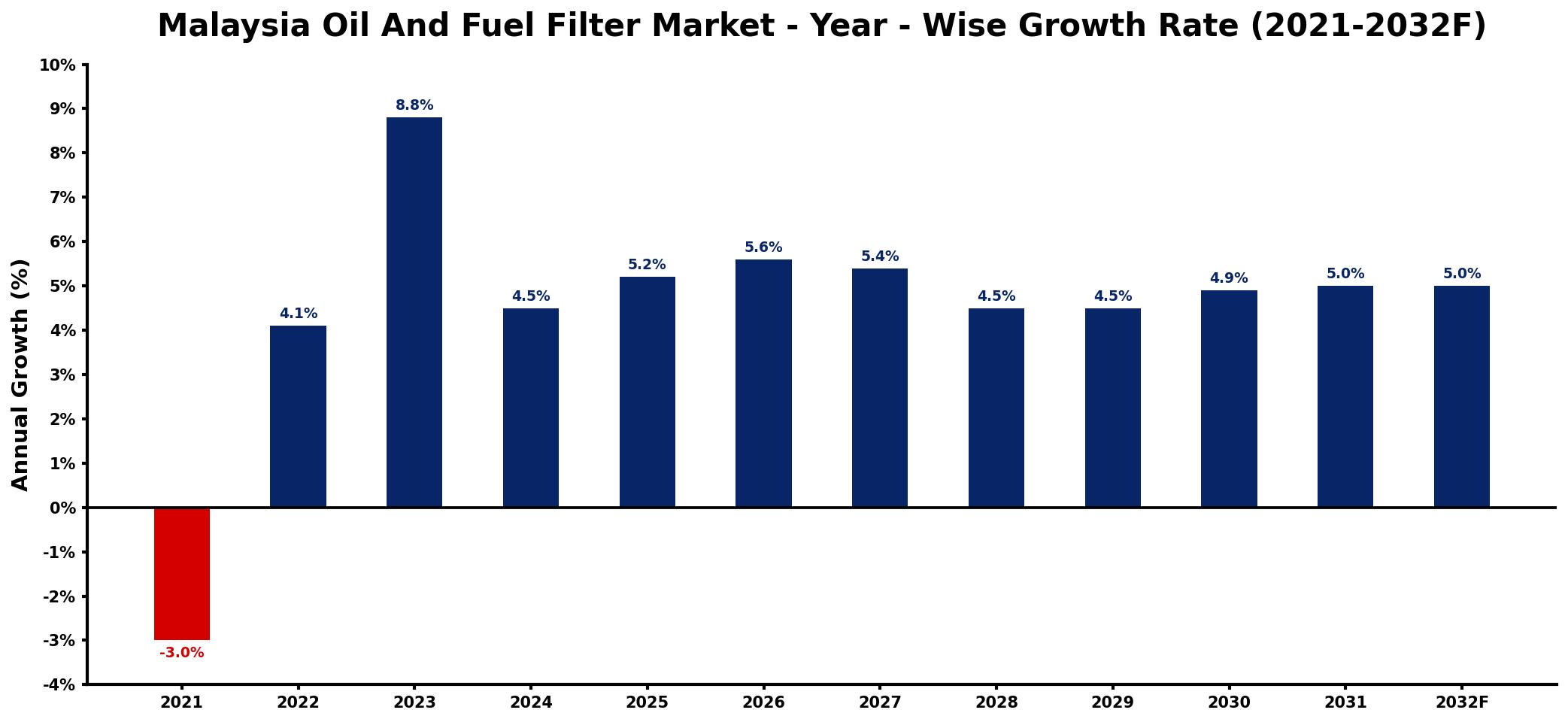
The table below presents the year‑wise growth rates along with the key drivers influencing the market
| Year | Growth Rate | Major Drivers |
| 2021 | -3.0% | decreased industrial production levels |
| 2022 | 4.1% | rising automotive manufacturing demand |
| 2023 | 8.8% | expanding renewable energy investments |
| 2024 | 4.5% | increased transportation infrastructure projects |
| 2025 | 5.2% | growing consumer electronics sector |
| 2026 | 5.6% | enhanced environmental regulations enforcement |
| 2027 | 5.4% | accelerated urban development initiatives |
| 2028 | 4.5% | boosted agricultural mechanization trends |
| 2029 | 4.5% | growing international trade activities |
| 2030 | 4.9% | expanding electric vehicle adoption |
| 2031 | 5.0% | increased focus on sustainability efforts |
| 2032 | 5.0% | growing demand for energy efficiency |
Note: Market size estimations and growth projections presented in this report are based on 6Wresearch's proprietary forecasting methodology, utilizing the latest available industry data, government publications, and primary research inputs.
Malaysia Oil And Fuel Filter Market Synopsis
The oil and fuel filter market in Malaysia is experiencing a noteworthy shift towards advanced filtration technologies. Key sectors, including automotive and marine, are adopting high-performance filters that ensure optimal machinery operation and environmental compliance. This transition is propelled by a growing public consciousness regarding the need for maintenance to maximize equipment lifespan.
As manufacturers innovate in response to market needs, eco-friendly filter options are gaining traction. These developments are essential for navigating the challenges posed by disposable filter waste, which has drawn the scrutiny of regulators and environmental advocates alike.
Malaysia Oil And Fuel Filter Market Key Takeaways
- Growing emphasis on environmental regulations is spurring demand for high-performance filters.
- Increased awareness of maintenance extends the life of automotive and industrial equipment.
- Manufacturers are innovating to offer cost-effective, eco-friendly filtration solutions.
- The recovery of the automotive sector post-COVID-19 is expected to boost market growth.
- Investment in advanced filtration technologies will be a key factor for industry players.
Evaluation of Restraints in Malaysia Oil And Fuel Filter Market
Despite its promising growth, the Malaysia oil and fuel filter market contends with several restraints. The increasing focus on sustainability has led to heightened scrutiny of disposable filters, necessitating a shift towards sustainable alternatives. This requires significant investment in research and development from manufacturers. Moreover, the entry of counterfeit and low-quality filters can undermine consumer trust and pose risks to equipment performance. Economic fluctuations and shifting consumer preferences may also create complexities in market forecasting and inventory management.
Malaysia Oil And Fuel Filter Market Trends
Several trends are currently shaping the Malaysia oil and fuel filter market. Notably, the integration of IoT technologies in filtration systems is gaining traction, facilitating real-time monitoring and enhancing operational efficiency. Additionally, the shift towards electric vehicles and hybrid models is prompting manufacturers to develop specialized filters that align with these evolving technologies. There is also a growing demand for filters that not only perform efficiently but are also designed with sustainable materials, reflecting a broader industry shift toward eco-conscious practices.
Malaysia Oil And Fuel Filter Market Opportunities
The future of the Malaysia oil and fuel filter market presents several compelling opportunities. The push for greener energy sources and cleaner automotive solutions offers a fertile ground for innovation in filter technologies. As the government reinforces its commitment to reducing emissions, there will be increased opportunities for manufacturers that can meet high environmental standards. Furthermore, the ongoing modernization of industrial equipment and facilities is likely to drive demand for more efficient and specialized filtration solutions.
Government Initiatives in the Malaysia Oil And Fuel Filter Market
The Malaysian government has rolled out various initiatives aimed at promoting environmental sustainability and energy efficiency. Programs aimed at reducing carbon emissions are encouraging businesses to adopt cleaner technologies, including advanced oil and fuel filtration systems. Public investments in infrastructure modernization and upgrades in the transportation sector are anticipated to enhance the demand for high-quality filtration solutions. This regulatory support is crucial in fostering market growth and encouraging manufacturers to innovate.
Future Insights of the Malaysia Oil And Fuel Filter Market
Looking ahead to 2026-2032, the Malaysia oil and fuel filter market is expected to evolve in response to growing environmental consciousness and technological advancements. Manufacturers will increasingly focus on product innovation, particularly in developing filters that enhance performance while being environmentally friendly. As the automotive landscape shifts towards more electric and hybrid vehicles, the demand for specialized filtration systems tailored for these applications will likely surge, positioning the market for continued growth.
Malaysia Oil And Fuel Filter Market Latest Developments (2025 - 2026)
Recent developments in the Malaysia oil and fuel filter market indicate a robust push towards innovation and sustainability. Manufacturers are increasingly integrating advanced materials and eco-friendly designs into their product lines to meet regulatory standards and consumer expectations. Additionally, there is a noticeable trend toward collaborative partnerships among industry players and technology firms, aimed at accelerating the development of smart filtration solutions.
Malaysia Oil And Fuel Filter Market - Key Attractiveness of the Report
- 10 Years of Market Numbers
- Historical Data Starting from 2022 to 2025
- Base Year: 2025
- Forecast Data until 2032
- Key Performance Indicators Impacting the Market
- Major Upcoming Developments and Projects
Key Highlights of the Report:
- Malaysia Oil And Fuel Filter Market Outlook
- Market Size of Malaysia Oil And Fuel Filter Market, 2025
- Forecast of Malaysia Oil And Fuel Filter Market, 2032
- Historical Data and Forecast of Malaysia Oil And Fuel Filter Revenues & Volume for the Period 2022-2032F
- Malaysia Oil And Fuel Filter Market Trend Evolution
- Malaysia Oil And Fuel Filter Market Drivers and Challenges
- Malaysia Oil And Fuel Filter Price Trends
- Malaysia Oil And Fuel Filter Porter's Five Forces
- Malaysia Oil And Fuel Filter Industry Life Cycle
- Historical Data and Forecast of Malaysia Oil And Fuel Filter Market Revenues & Volume By Vehicle Type for the Period 2022-2032F
- Historical Data and Forecast of Malaysia Oil And Fuel Filter Market Revenues & Volume By Passenger Car for the Period 2022-2032F
- Historical Data and Forecast of Malaysia Oil And Fuel Filter Market Revenues & Volume By LCV (Light Commercial Vehicle) for the Period 2022-2032F
- Historical Data and Forecast of Malaysia Oil And Fuel Filter Market Revenues & Volume By HCV (Heavy Commercial Vehicle) for the Period 2022-2032F
- Historical Data and Forecast of Malaysia Oil And Fuel Filter Market Revenues & Volume By Sales Channel for the Period 2022-2032F
- Historical Data and Forecast of Malaysia Oil And Fuel Filter Market Revenues & Volume By OEM for the Period 2022-2032F
- Historical Data and Forecast of Malaysia Oil And Fuel Filter Market Revenues & Volume By Ftermarket for the Period 2022-2032F
- Historical Data and Forecast of Malaysia Oil And Fuel Filter Market Revenues & Volume By Filter Type for the Period 2022-2032F
- Historical Data and Forecast of Malaysia Oil And Fuel Filter Market Revenues & Volume By Oil Filter for the Period 2022-2032F
- Historical Data and Forecast of Malaysia Oil And Fuel Filter Market Revenues & Volume By Fuel Filter for the Period 2022-2032F
- Historical Data and Forecast of Malaysia Oil And Fuel Filter Market Revenues & Volume By Filter Media for the Period 2022-2032F
- Historical Data and Forecast of Malaysia Oil And Fuel Filter Market Revenues & Volume By Cellulose for the Period 2022-2032F
- Historical Data and Forecast of Malaysia Oil And Fuel Filter Market Revenues & Volume By Synthetic-laminated for the Period 2022-2032F
- Historical Data and Forecast of Malaysia Oil And Fuel Filter Market Revenues & Volume By Pure Glass for the Period 2022-2032F
- Malaysia Oil And Fuel Filter Import Export Trade Statistics
- Market Opportunity Assessment By Vehicle Type
- Market Opportunity Assessment By Sales Channel
- Market Opportunity Assessment By Filter Type
- Market Opportunity Assessment By Filter Media
- Malaysia Oil And Fuel Filter Top Companies Market Share
- Malaysia Oil And Fuel Filter Competitive Benchmarking By Technical and Operational Parameters
- Malaysia Oil And Fuel Filter Company Profiles
- Malaysia Oil And Fuel Filter Key Strategic Recommendations






































