Malaysia Oil & Gas Pumps Market Size, Share & Growth Rate
The Malaysia Oil & Gas Pumps Market was estimated at USD 351 Million in 2025 and is projected to reach USD 457 Million by 2032, growing at a CAGR of 3.8% from 2026 to 2032. This growth trajectory is propelled by a combination of expanding oil and gas infrastructure and increasing investments in energy-efficient technologies. Additionally, as Malaysia aims to modernize its energy sector, the demand for specialized pumping solutions in oil extraction and transportation is on the rise.
Malaysia Oil & Gas Pumps Market Year-wise Growth Rate and Key Drivers
This graph highlights how the Malaysia Oil & Gas Pumps Market has steadily grown over the years, supported by major growth factors.
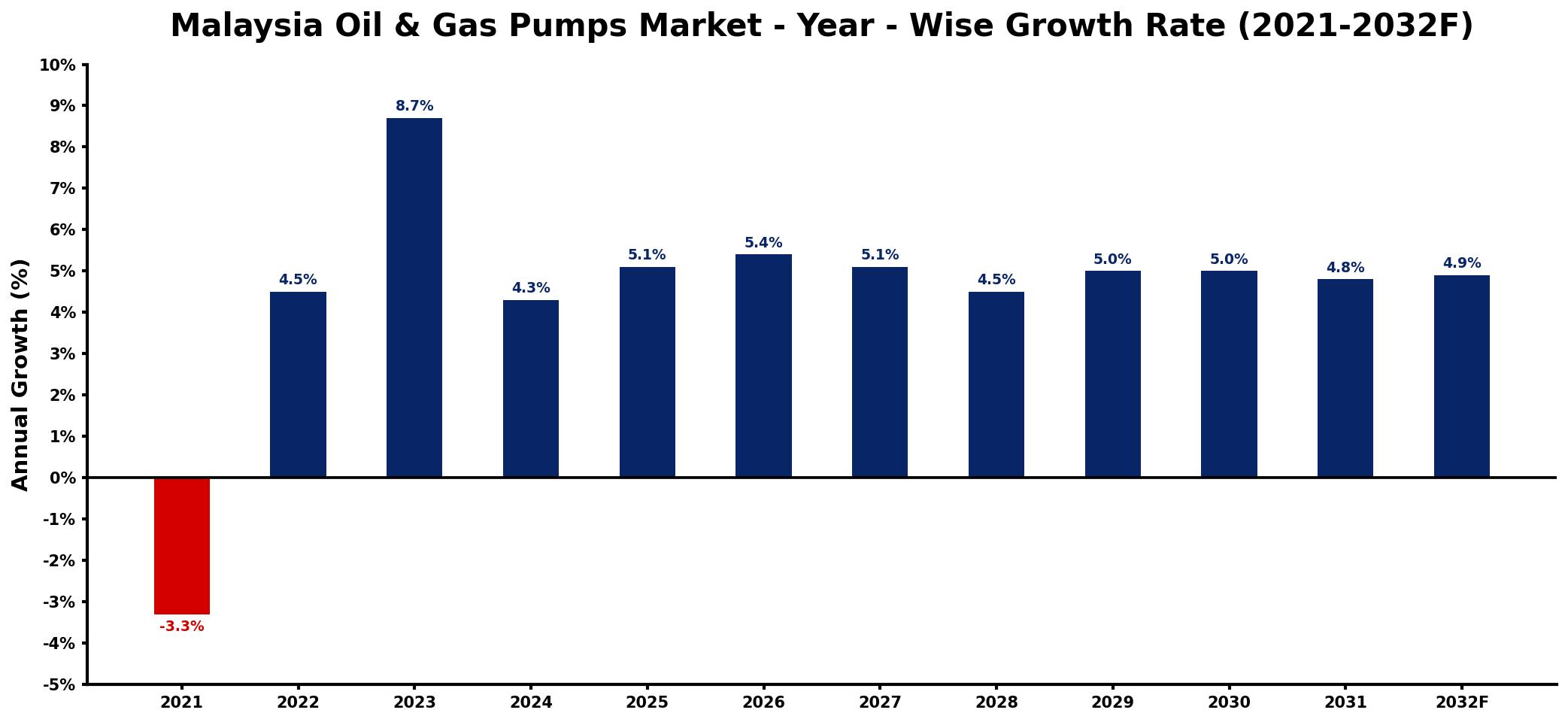
The table below presents the year‑wise growth rates along with the key drivers influencing the market
| Year | Growth Rate | Major Drivers |
| 2021 | -3.3% | decreased industrial activity levels |
| 2022 | 4.5% | renewed investments in infrastructure |
| 2023 | 8.7% | rising energy sector projects |
| 2024 | 4.3% | increased manufacturing output demand |
| 2025 | 5.1% | growing urban development initiatives |
| 2026 | 5.4% | expansion of renewable energy projects |
| 2027 | 5.1% | surge in construction activities |
| 2028 | 4.5% | enhanced transportation network investments |
| 2029 | 5.0% | strengthened international trade partnerships |
| 2030 | 5.0% | innovation in energy efficiency solutions |
| 2031 | 4.8% | growing demand for automation |
| 2032 | 4.9% | increased capital investment inflows |
Note: Market size estimations and growth projections presented in this report are based on 6Wresearch's proprietary forecasting methodology, utilizing the latest available industry data, government publications, and primary research inputs.
Malaysia Oil & Gas Pumps Market Synopsis
The strongest force shaping the Malaysia Oil & Gas Pumps Market today is the ongoing transition towards more sustainable energy practices, which is driving demand for advanced pumping solutions. As Malaysia diversifies its energy portfolio, the need for reliable and efficient pumps in both traditional and renewable segments becomes critical.
Moreover, technological innovations are revolutionizing the market dynamics. Companies are increasingly focusing on developing energy-efficient pumps and digital monitoring systems that align with both environmental objectives and operational efficiency. This evolution reflects the industry's adaptability and commitment to meeting modern challenges.
- The market is projected to grow steadily due to rising infrastructure investments.
- Technological advancements are facilitating the adoption of energy-efficient pumping systems.
- Market players are innovating to address environmental sustainability and efficiency.
- The sector is rebounding from COVID-19 challenges, positioning itself for future growth.
- Demand for specialized pumps continues to rise due to evolving extraction and processing needs.
The Malaysia Oil & Gas Pumps Market is currently experiencing several constraints that could temper its growth. One significant limitation is the inherent volatility of oil prices, which directly impacts exploration and production activities. When oil prices fluctuate, companies may scale back investments in new pump systems, leading to unpredictable demand patterns. Additionally, the complexities of maintaining specialized pumps in remote or offshore locations can present logistical challenges, exacerbating operational costs and hindering market expansion.
Several current and emerging trends are shaping the Malaysia Oil & Gas Pumps Market. A notable trend is the shift towards digitalization, with increasing adoption of IoT technologies for real-time monitoring and maintenance. This allows operators to enhance efficiency and reduce downtime. Furthermore, theres a growing emphasis on sustainability, with companies prioritizing eco-friendly pump solutions to align with global environmental standards. As efficiency becomes paramount, the integration of smart technologies into pumping systems will likely redefine operational landscapes in the near future.
Opportunities for growth in the Malaysia Oil & Gas Pumps Market are ripe, particularly in the realm of renewable energy integration. As the country works to balance its energy mix, innovative pump solutions that facilitate the extraction and processing of biofuels or alternative energy sources may see substantial demand. Additionally, the push for modernizing existing infrastructure presents a significant opportunity for companies specializing in advanced pumping technologies. The increasing focus on energy efficiency provides a clear pathway for investments in new, environmentally friendly pump systems.
The Malaysian government has been actively promoting policies aimed at enhancing the efficiency and sustainability of the oil and gas sector. Incentives for adopting advanced technologies and environmentally friendly practices are being offered, creating a conducive environment for innovation. Additionally, public spending on energy infrastructure development indicates strong governmental support for bolstering the countrys oil and gas operations, which in turn benefits the pumps market.
Looking forward to the period from 2026 to 2032, the Malaysia Oil & Gas Pumps Market is poised for growth as it adapts to changing energy dynamics and technological advancements. The focus will likely shift toward enhancing operational efficiencies and sustainability initiatives. As companies seek to modernize their operations, the demand for smart, energy-efficient pumps is expected to accelerate. This evolution will be crucial as Malaysia continues to address both domestic energy needs and international sustainability commitments.
Recent developments in the Malaysia Oil & Gas Pumps Market highlight a resurgence in activity following the pandemic downturn. Companies are exploring new partnerships to develop innovative pumping solutions aimed at increasing efficiency and reducing environmental impacts. Additionally, regulatory shifts promoting green technology adoption are prompting market players to enhance their offerings, resulting in a more competitive landscape.
- 10 Years of Market Numbers
- Historical Data Starting from 2022 to 2025
- Base Year: 2025
- Forecast Data until 2032
- Key Performance Indicators Impacting the Market
- Major Upcoming Developments and Projects
Key Highlights of the Report:
- Malaysia Oil & Gas Pumps Market Outlook
- Market Size of Malaysia Oil & Gas Pumps Market, 2025
- Forecast of Malaysia Oil & Gas Pumps Market, 2032
- Historical Data and Forecast of Malaysia Oil & Gas Pumps Revenues & Volume for the Period 2022-2032F
- Malaysia Oil & Gas Pumps Market Trend Evolution
- Malaysia Oil & Gas Pumps Market Drivers and Challenges
- Malaysia Oil & Gas Pumps Price Trends
- Malaysia Oil & Gas Pumps Porter's Five Forces
- Malaysia Oil & Gas Pumps Industry Life Cycle
- Historical Data and Forecast of Malaysia Oil & Gas Pumps Market Revenues & Volume By Type for the Period 2022-2032F
- Historical Data and Forecast of Malaysia Oil & Gas Pumps Market Revenues & Volume By Submersible Pumps for the Period 2022-2032F
- Historical Data and Forecast of Malaysia Oil & Gas Pumps Market Revenues & Volume By Non-submersible Pumps for the Period 2022-2032F
- Historical Data and Forecast of Malaysia Oil & Gas Pumps Market Revenues & Volume By Pump Type for the Period 2022-2032F
- Historical Data and Forecast of Malaysia Oil & Gas Pumps Market Revenues & Volume By Centrifugal Pump for the Period 2022-2032F
- Historical Data and Forecast of Malaysia Oil & Gas Pumps Market Revenues & Volume By Positive Displacement Pump for the Period 2022-2032F
- Historical Data and Forecast of Malaysia Oil & Gas Pumps Market Revenues & Volume By Cryogenic Pump for the Period 2022-2032F
- Historical Data and Forecast of Malaysia Oil & Gas Pumps Market Revenues & Volume By Application for the Period 2022-2032F
- Historical Data and Forecast of Malaysia Oil & Gas Pumps Market Revenues & Volume By Upstream for the Period 2022-2032F
- Historical Data and Forecast of Malaysia Oil & Gas Pumps Market Revenues & Volume By Midstream for the Period 2022-2032F
- Historical Data and Forecast of Malaysia Oil & Gas Pumps Market Revenues & Volume By Downstream for the Period 2022-2032F
- Malaysia Oil & Gas Pumps Import Export Trade Statistics
- Market Opportunity Assessment By Type
- Market Opportunity Assessment By Pump Type
- Market Opportunity Assessment By Application
- Malaysia Oil & Gas Pumps Top Companies Market Share
- Malaysia Oil & Gas Pumps Competitive Benchmarking By Technical and Operational Parameters
- Malaysia Oil & Gas Pumps Company Profiles
- Malaysia Oil & Gas Pumps Key Strategic Recommendations






































