Malaysia Oilfield Air Drilling Market Size, Share & Growth Rate
The Malaysia Oilfield Air Drilling Market was estimated at USD 606 Million in 2025 and is projected to reach USD 907 Million by 2032, growing at a CAGR of 5.9% from 2026 to 2032. The growth trajectory of this market is fundamentally driven by the increasing demand for cost-effective drilling solutions that enhance operational efficiency. As exploration activities intensify in Malaysia's oilfields, particularly in challenging geological landscapes, air drilling's advantages—such as reduced formation damage and improved drilling speed—are propelling its adoption.
Malaysia Oilfield Air Drilling Market Year-wise Growth Rate and Key Drivers
This graph highlights how the Malaysia Oilfield Air Drilling Market has steadily grown over the years, supported by major growth factors.
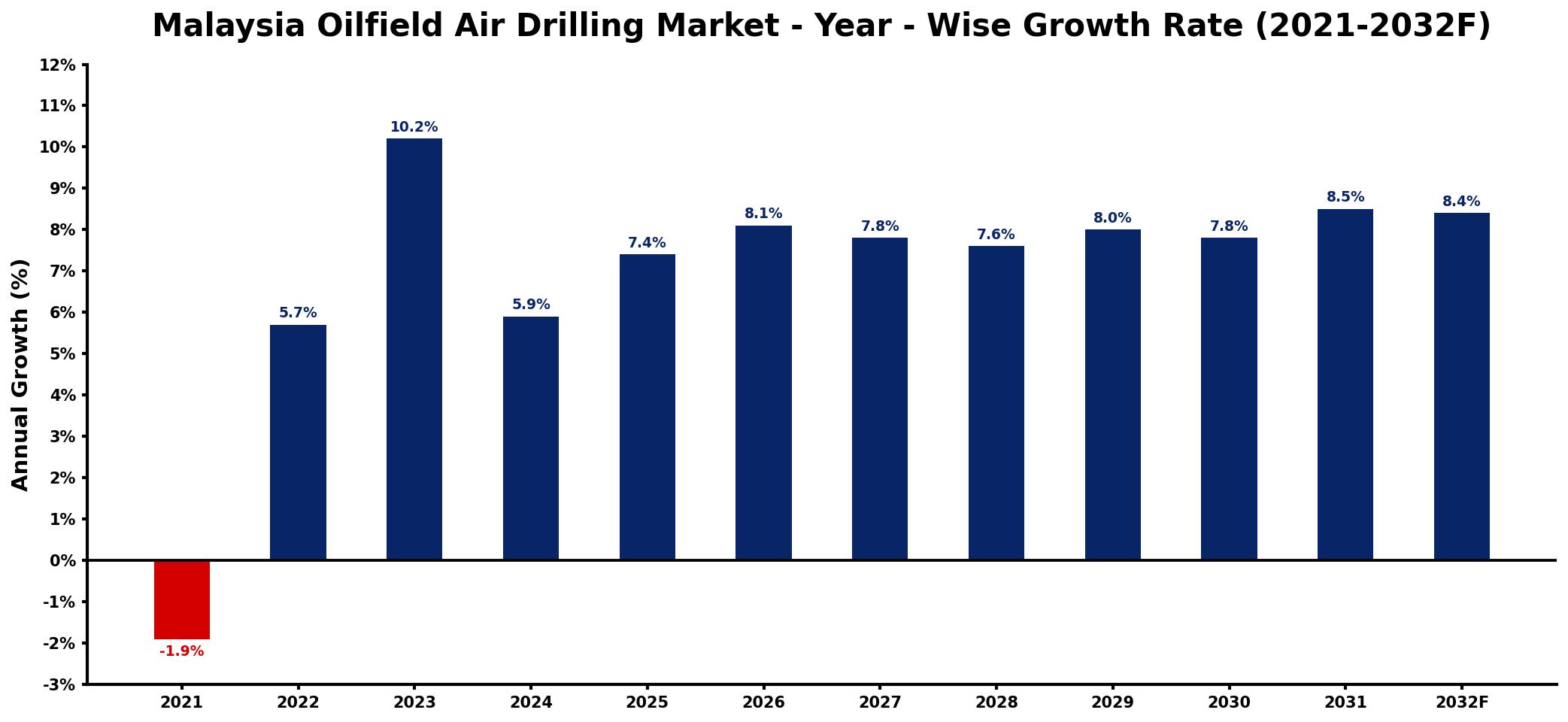
The table below presents the year‑wise growth rates along with the key drivers influencing the market
| Year | Growth Rate | Major Drivers |
| 2021 | -1.9% | decreased investment in energy sector |
| 2022 | 5.7% | rising demand for energy efficiency |
| 2023 | 10.2% | growing interest in sustainable technologies |
| 2024 | 5.9% | increased exploration activities worldwide |
| 2025 | 7.4% | expansion of renewable energy projects |
| 2026 | 8.1% | strengthening regulations on emissions |
| 2027 | 7.8% | advancements in technological innovations |
| 2028 | 7.6% | stronger distribution network expansion |
| 2029 | 8.0% | increased global energy consumption |
| 2030 | 7.8% | growing focus on energy security |
| 2031 | 8.5% | enhanced collaboration among stakeholders |
| 2032 | 8.4% | increased investments in infrastructure |
Note: Market size estimations and growth projections presented in this report are based on 6Wresearch's proprietary forecasting methodology, utilizing the latest available industry data, government publications, and primary research inputs.
Malaysia Oilfield Air Drilling Market Synopsis
In recent years, Malaysia has witnessed a growing interest in advanced drilling techniques, particularly air drilling, due to its ability to lower operational costs and expedite drilling timelines. The region's complex geological formations necessitate innovative methods that not only preserve resource integrity but also enhance the overall efficiency of drilling operations.
As the oil and gas sector grapples with environmental concerns, air drilling emerges as an environmentally friendly alternative. By significantly reducing waste and emissions compared to traditional methods, air drilling aligns well with Malaysia's commitment to sustainable resource management, making it an attractive option for operators.
Malaysia Oilfield Air Drilling Market Key Takeaways
- The Malaysia oilfield air drilling market is on a growth path, driven by technological advancements and increasing exploration activities.
- Air drilling techniques offer notable advantages, including faster drilling times and reduced environmental impact.
- Key players in the sector are focusing on enhancing their service offerings through innovative technologies and improved equipment.
- The market is characterized by a competitive landscape, with continuous demand for innovation to maintain market position.
- Regulatory pressures regarding environmental impacts are pushing companies to adopt more sustainable drilling practices.
Evaluation of Restraints in Malaysia Oilfield Air Drilling Market
The Malaysia oilfield air drilling market faces significant restraints, primarily due to the intricate geological challenges and environmental conditions prevalent in the region. Offshore and deep-water drilling operations often encounter harsh weather, making the execution of air drilling projects both technically demanding and financially burdensome. Moreover, stringent environmental regulations concerning emissions and waste management add layers of complexity to operational protocols. As such, companies must navigate these challenges effectively to leverage the benefits of air drilling fully.
Malaysia Oilfield Air Drilling Market Trends
Several trends are shaping the Malaysia oilfield air drilling market, including the rise of digital technologies and automation in drilling processes. Operators are increasingly integrating sophisticated software solutions to optimize drilling parameters and enhance real-time data analysis. Additionally, as sustainability takes center stage, there is a noticeable shift towards equipment that minimizes environmental footprints, aligning drilling practices with national and global sustainability goals. Moreover, strategic partnerships and collaborations within the sector are becoming common as companies strive to enhance their technological capabilities and market reach.
Malaysia Oilfield Air Drilling Market Opportunities
The market presents lucrative opportunities for growth as the industry continuously seeks to explore untapped reserves while optimizing existing fields. The integration of advanced technologies, such as AI and machine learning, into air drilling practices offers pathways to enhance efficiency further. Additionally, with global oil prices showing signs of recovery, there is renewed interest in expanding drilling activities in Malaysia. Investment in research and development to advance air drilling equipment and techniques is likely to yield significant returns, positioning early adopters favorably within the market.
Government Initiatives in the Malaysia Oilfield Air Drilling Market
The Malaysian government has been proactive in promoting sustainable practices within the oil and gas sector, introducing policies and incentives aimed at encouraging the adoption of environmentally friendly drilling methods, including air drilling. Public spending on infrastructure aimed at supporting the oil and gas industry also contributes to creating a conducive environment for technological advancements. Additionally, regulatory frameworks are being developed to ensure that air drilling operations align with national environmental goals, fostering a collaborative effort between governmental bodies and industry stakeholders.
Future Insights of the Malaysia Oilfield Air Drilling Market
Looking ahead to 2026-2032, the Malaysia oilfield air drilling market is expected to experience robust growth fueled by both technological advancements and strategic shifts in exploration and production methodologies. As the industry adapts to evolving demands for efficiency and sustainability, the integration of state-of-the-art technologies will be pivotal. Continuous investment in air drilling capabilities will not only optimize operational costs but also bolster the region's competitiveness in the global oil and gas landscape.
Malaysia Oilfield Air Drilling Market Latest Developments (2025 - 2026)
Recent developments within the Malaysia oilfield air drilling market indicate a strong push towards innovation. Companies are focusing on upgrading their air drilling technologies to improve performance and minimize environmental impact. Moreover, strategic collaborations among industry players are emerging, enhancing service offerings and enabling knowledge sharing. These initiatives signal a positive trend towards improved efficiency and sustainability in drilling operations across the region.
Malaysia Oilfield Air Drilling Market - Key Attractiveness of the Report
- 10 Years of Market Numbers
- Historical Data Starting from 2022 to 2025
- Base Year: 2025
- Forecast Data until 2032
- Key Performance Indicators Impacting the Market
- Major Upcoming Developments and Projects
Key Highlights of the Report:
- Malaysia Oilfield Air Drilling Market Outlook
- Market Size of Malaysia Oilfield Air Drilling Market, 2025
- Forecast of Malaysia Oilfield Air Drilling Market, 2032
- Historical Data and Forecast of Malaysia Oilfield Air Drilling Revenues & Volume for the Period 2022-2032F
- Malaysia Oilfield Air Drilling Market Trend Evolution
- Malaysia Oilfield Air Drilling Market Drivers and Challenges
- Malaysia Oilfield Air Drilling Price Trends
- Malaysia Oilfield Air Drilling Porter's Five Forces
- Malaysia Oilfield Air Drilling Industry Life Cycle
- Historical Data and Forecast of Malaysia Oilfield Air Drilling Market Revenues & Volume By Type for the Period 2022-2032F
- Historical Data and Forecast of Malaysia Oilfield Air Drilling Market Revenues & Volume By Dust for the Period 2022-2032F
- Historical Data and Forecast of Malaysia Oilfield Air Drilling Market Revenues & Volume By Aerated fluid for the Period 2022-2032F
- Historical Data and Forecast of Malaysia Oilfield Air Drilling Market Revenues & Volume By Foam for the Period 2022-2032F
- Historical Data and Forecast of Malaysia Oilfield Air Drilling Market Revenues & Volume By Mist for the Period 2022-2032F
- Historical Data and Forecast of Malaysia Oilfield Air Drilling Market Revenues & Volume By Nitrogen membrane for the Period 2022-2032F
- Malaysia Oilfield Air Drilling Import Export Trade Statistics
- Market Opportunity Assessment By Type
- Malaysia Oilfield Air Drilling Top Companies Market Share
- Malaysia Oilfield Air Drilling Competitive Benchmarking By Technical and Operational Parameters
- Malaysia Oilfield Air Drilling Company Profiles
- Malaysia Oilfield Air Drilling Key Strategic Recommendations






































