Malaysia Optical Lens Market Size Growth Rate
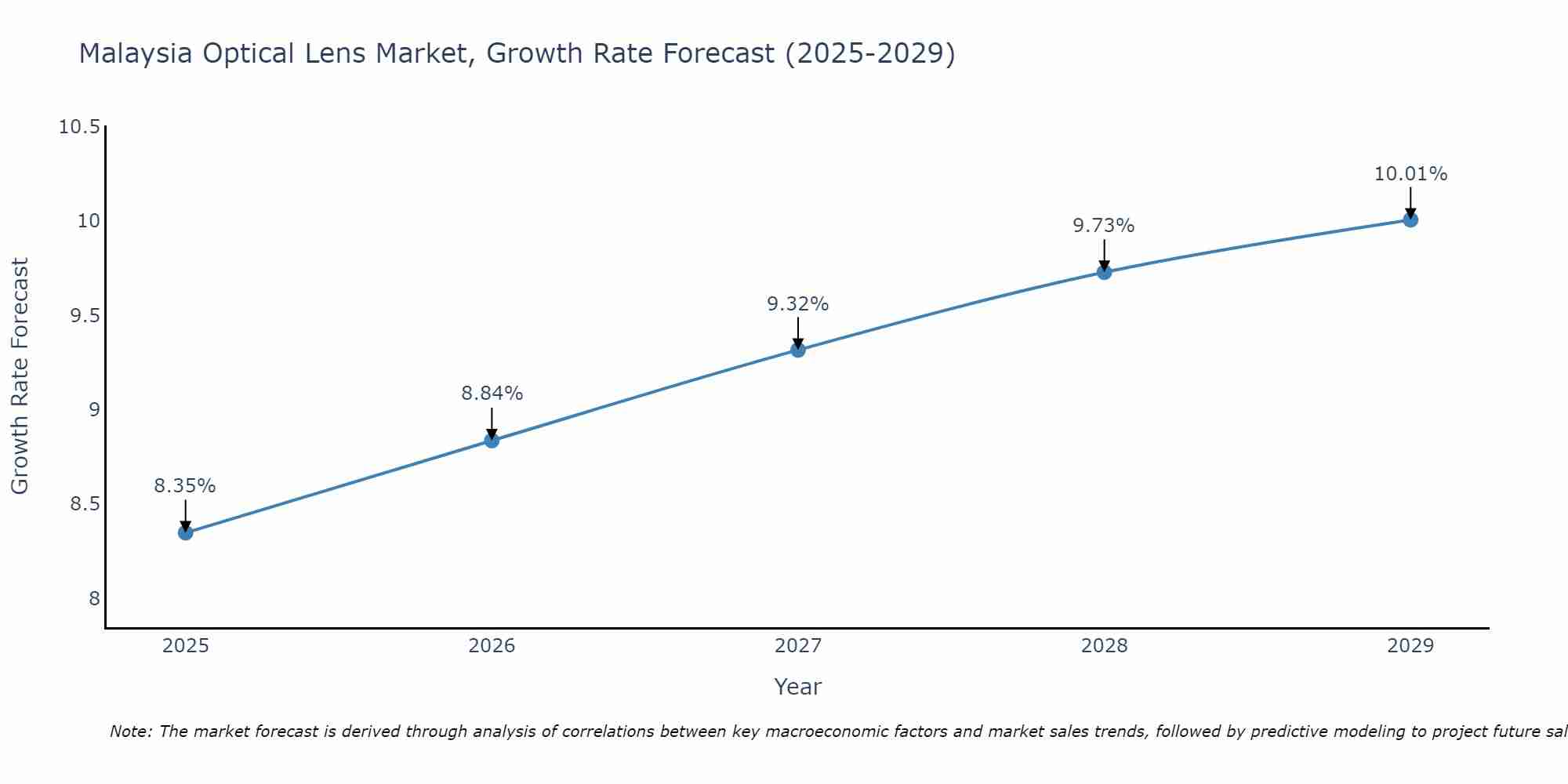
The Malaysia Optical Lens Market is poised for steady growth rate improvements from 2025 to 2029. The growth rate starts at 8.35% in 2025 and reaches 10.01% by 2029.
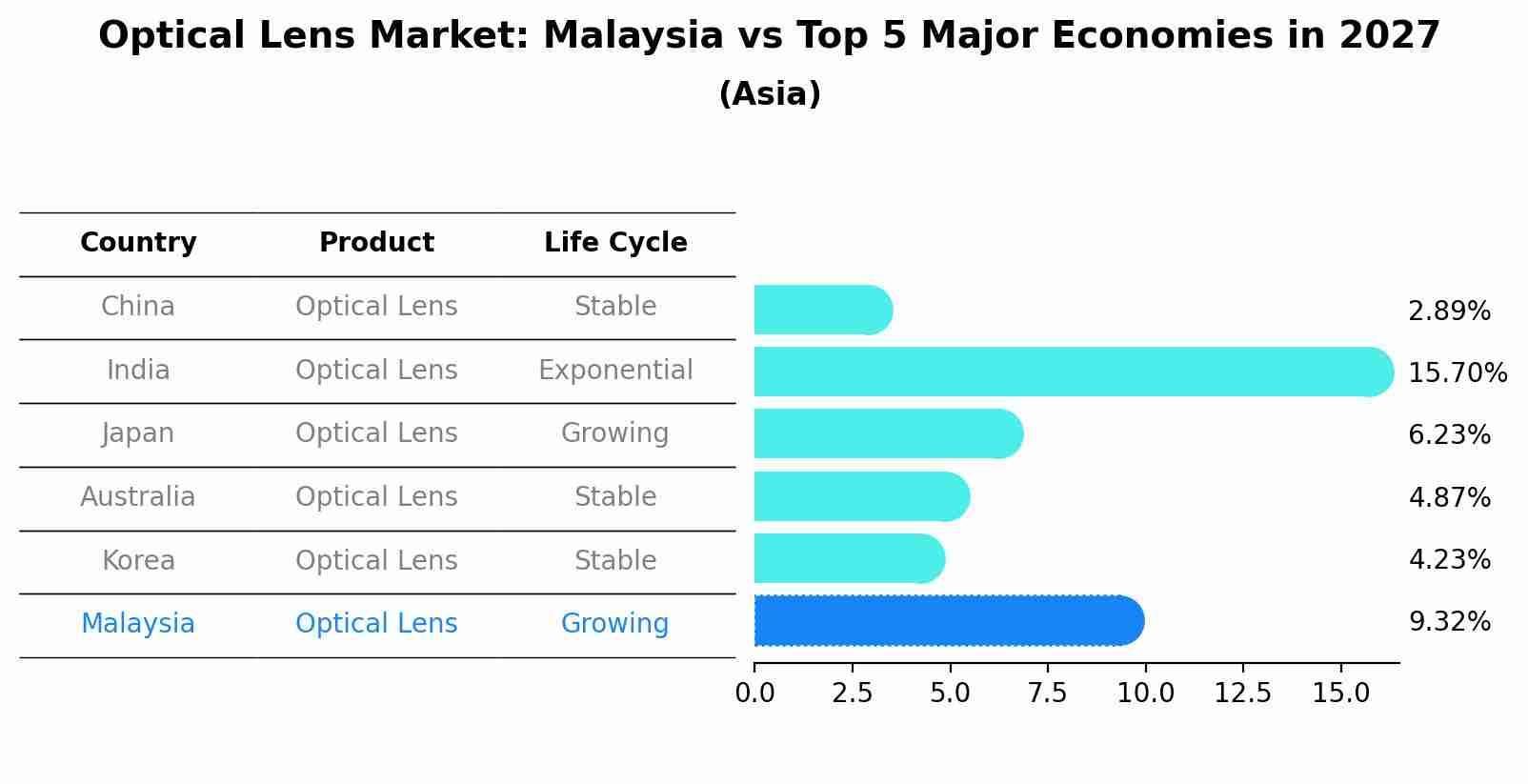
Optical Lens Market: Malaysia vs Top 5 Major Economies in 2027 (Asia)
Malaysia's Optical Lens market is anticipated to experience a growing growth rate of 9.32% by 2027, reflecting trends observed in the largest economy China, followed by India, Japan, Australia and South Korea.
Malaysia Optical Lens Market Synopsis
The optical lens market in Malaysia is witnessing steady growth, propelled by rising awareness about vision correction and an expanding consumer base. There is a notable trend towards specialized lenses, including those for astigmatism and presbyopia. Furthermore, advancements in lens materials and coatings are influencing consumer preferences, contributing to market expansion.
Drivers of the Market
The optical lens market in Malaysia is experiencing a steady upward trajectory, with several factors contributing to this positive outlook. Firstly, an increasing prevalence of vision-related disorders, including myopia and presbyopia, is driving the demand for optical lenses. This trend is further amplified by the rising use of digital screens and electronic devices, which has led to an uptick in cases of digital eye strain. Moreover, advancements in lens manufacturing technologies, such as freeform lens design and high-index materials, are offering consumers a wider range of options for vision correction. Additionally, a growing trend towards fashionable eyewear and the desire for customizable lens solutions is stimulating market growth. The increasing adoption of contact lenses and a rising awareness of the importance of regular eye check-ups are also contributing factors.
Challenges of the Market
The optical lens market in Malaysia is projected to grow as the demand for eyeglasses and contact lenses continues to rise. Consumers are increasingly seeking customizable and high-quality lenses. Challenges include competition from online retailers and the need for regular eye examinations to update prescriptions.
COVID-19 Impact on the Market
The optical lens market in Malaysia is influenced by the increasing number of individuals requiring corrective eyewear and the rising popularity of fashion-oriented eyeglasses. The COVID-19 pandemic impacted the market as optical stores faced closures and supply chain disruptions. Nevertheless, the demand for prescription eyewear persisted, and online sales channels gained prominence. The market is expected to recover and grow as consumer confidence returns.
Key Players in the Market
The optical lens market in Malaysia is experiencing growth owing to the increasing use of eyewear, including prescription glasses and contact lenses. Key players like EssilorLuxottica, HOYA Corporation, and Nikon Corporation are manufacturing high-quality optical lenses to cater to the diverse needs of consumers. The growing awareness of eye health and the fashion-conscious consumer base are driving demand for premium optical lenses. Moreover, technological advancements, such as anti-reflective coatings and blue-light filtering, are shaping the market`s landscape.
Key Highlights of the Report:
- Malaysia Optical Lens Market Outlook
- Market Size of Malaysia Optical Lens Market, 2024
- Forecast of Malaysia Optical Lens Market, 2031
- Historical Data and Forecast of Malaysia Optical Lens Revenues & Volume for the Period 2021-2031
- Malaysia Optical Lens Market Trend Evolution
- Malaysia Optical Lens Market Drivers and Challenges
- Malaysia Optical Lens Price Trends
- Malaysia Optical Lens Porter's Five Forces
- Malaysia Optical Lens Industry Life Cycle
- Historical Data and Forecast of Malaysia Optical Lens Market Revenues & Volume By Type for the Period 2021-2031
- Historical Data and Forecast of Malaysia Optical Lens Market Revenues & Volume By Converging Lenses for the Period 2021-2031
- Historical Data and Forecast of Malaysia Optical Lens Market Revenues & Volume By Diverging Lenses for the Period 2021-2031
- Historical Data and Forecast of Malaysia Optical Lens Market Revenues & Volume By Application for the Period 2021-2031
- Historical Data and Forecast of Malaysia Optical Lens Market Revenues & Volume By Ophthalmic for the Period 2021-2031
- Historical Data and Forecast of Malaysia Optical Lens Market Revenues & Volume By Microscopy for the Period 2021-2031
- Historical Data and Forecast of Malaysia Optical Lens Market Revenues & Volume By Laser Processing for the Period 2021-2031
- Historical Data and Forecast of Malaysia Optical Lens Market Revenues & Volume By Imaging for the Period 2021-2031
- Historical Data and Forecast of Malaysia Optical Lens Market Revenues & Volume By End-User for the Period 2021-2031
- Historical Data and Forecast of Malaysia Optical Lens Market Revenues & Volume By Consumer Electronics for the Period 2021-2031
- Historical Data and Forecast of Malaysia Optical Lens Market Revenues & Volume By Defense for the Period 2021-2031
- Historical Data and Forecast of Malaysia Optical Lens Market Revenues & Volume By Healthcare for the Period 2021-2031
- Historical Data and Forecast of Malaysia Optical Lens Market Revenues & Volume By Life Sciences for the Period 2021-2031
- Historical Data and Forecast of Malaysia Optical Lens Market Revenues & Volume By Others for the Period 2021-2031
- Malaysia Optical Lens Import Export Trade Statistics
- Market Opportunity Assessment By Type
- Market Opportunity Assessment By Application
- Market Opportunity Assessment By End-User
- Malaysia Optical Lens Top Companies Market Share
- Malaysia Optical Lens Competitive Benchmarking By Technical and Operational Parameters
- Malaysia Optical Lens Company Profiles
- Malaysia Optical Lens Key Strategic Recommendations






































