Malaysia Ore & Alloys Market Size, Share & Growth Rate
The Malaysia Ore & Alloys Market was estimated at USD 236 Million in 2025 and is projected to reach USD 308 Million by 2032, growing at a CAGR of 3.9% from 2026 to 2032. This trajectory is primarily driven by the expanding demand for high-performance alloys in the automotive and construction sectors, which are pivotal in shaping Malaysia's industrial landscape. Furthermore, the push towards innovative and sustainable production methodologies is anticipated to bolster the market, aligning with global trends toward eco-friendly practices.
Malaysia Ore & Alloys Market Year-wise Growth Rate and Key Drivers
This graph highlights how the Malaysia Ore & Alloys Market has steadily grown over the years, supported by major growth factors.
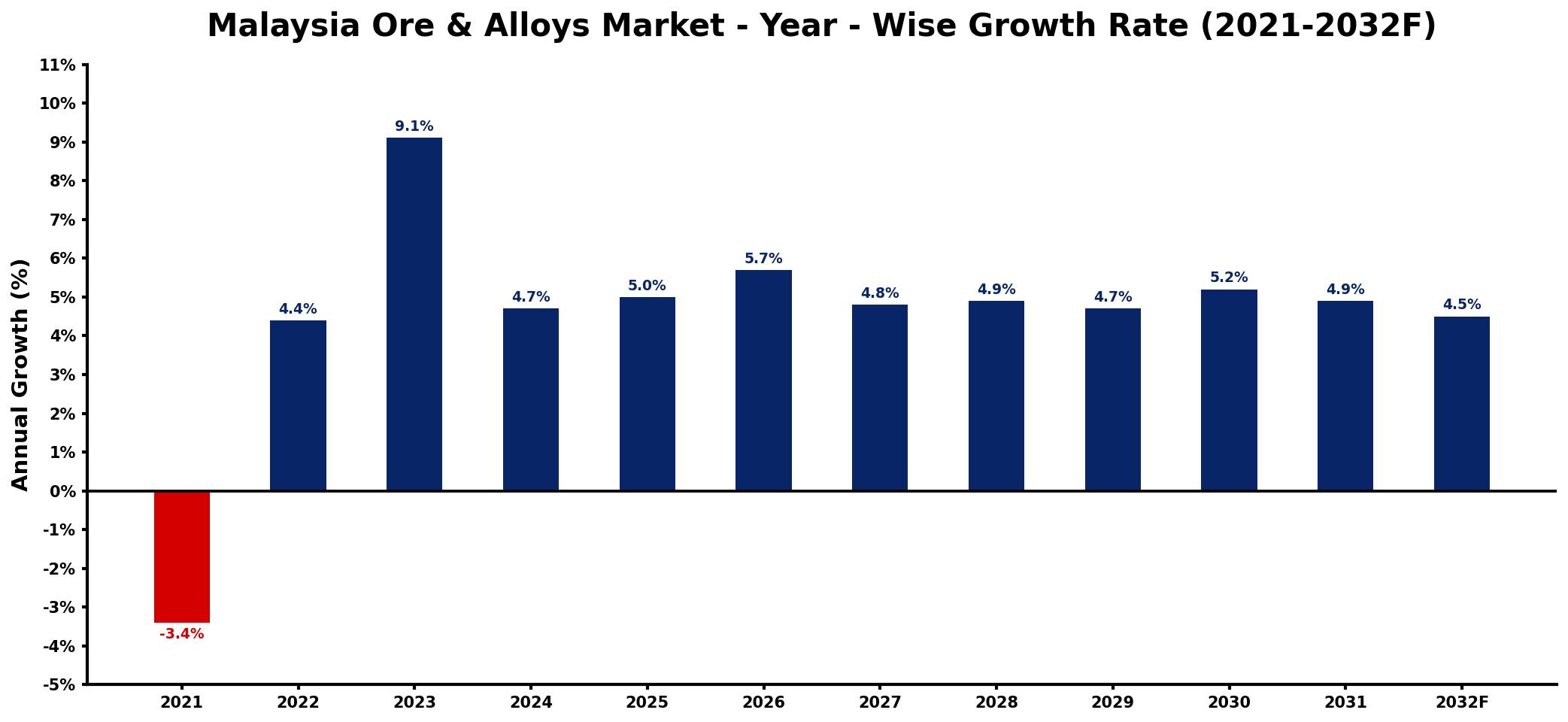
The table below presents the year‑wise growth rates along with the key drivers influencing the market
| Year | Growth Rate | Major Drivers |
| 2021 | -3.4% | decreased industrial manufacturing activity |
| 2022 | 4.4% | rising demand from construction sector |
| 2023 | 9.1% | increased investments in infrastructure |
| 2024 | 4.7% | growing automotive production requirements |
| 2025 | 5.0% | expansion of renewable energy projects |
| 2026 | 5.7% | higher demand from electronics industry |
| 2027 | 4.8% | increased exports to regional markets |
| 2028 | 4.9% | rising consumer electronics demand |
| 2029 | 4.7% | strengthening of mining sector investments |
| 2030 | 5.2% | growing urbanization and housing projects |
| 2031 | 4.9% | increased government infrastructure spending |
| 2032 | 4.5% | expansion in transportation sector needs |
Note: Market size estimations and growth projections presented in this report are based on 6Wresearch's proprietary forecasting methodology, utilizing the latest available industry data, government publications, and primary research inputs.
Malaysia Ore & Alloys Market Synopsis
The Malaysia Ore & Alloys market has witnessed steady growth, bolstered by consistent demand for alloys in both local and international markets. As countries ramp up infrastructure projects, the need for quality alloys remains robust, ensuring a pivotal role for Malaysia in the global supply chain.
Looking ahead, the market is set to evolve in response to emerging trends such as advanced alloy formulations and stricter environmental regulations. These dynamics promise to transform production practices and open avenues for more efficient, sustainable operations within the industry.
- Demand for ore alloys is closely tied to the global steel industry, particularly in construction and automotive sectors.
- Sustainable production methods and innovative alloy formulations are shaping the market's future landscape.
- The market is expected to grow steadily, supported by government initiatives and infrastructure investments.
- Market resilience during COVID-19 highlights its essential role in the manufacturing and industrial sectors.
- Price fluctuations in raw materials and trade policies will influence market dynamics going forward.
Despite positive momentum, the Malaysia Ore & Alloys market faces several restraints that could limit its growth. Fluctuations in global demand for alloy metals can create volatility in production and pricing. Furthermore, maintaining quality control and consistency in alloy composition remains a critical challenge, as variations can affect performance in key applications. Trade restrictions and tariffs on alloy materials further complicate the landscape, potentially raising production costs and hindering competitiveness in the international arena.
Current trends indicate a growing emphasis on sustainable manufacturing practices, driving innovations in alloy formulations that enhance performance while minimizing environmental impact. Additionally, increased automation and technological advancements in production processes are expected to improve efficiency and reduce costs, positioning Malaysia as a competitive player in the global ore alloys market. Furthermore, the push for lightweight materials in the automotive sector presents new opportunities for the development of high-strength, low-weight alloys.
There are significant growth opportunities within the Malaysia Ore & Alloys market, particularly in the realm of research and development for advanced alloys. Investment in innovative production techniques that prioritize sustainability can yield long-term benefits, catering to the rising global demand for greener alternatives. Additionally, strategic partnerships with international stakeholders could enhance Malaysia's export capabilities, thus expanding its market reach and solidifying its position in the global supply chain.
The Malaysian government has implemented various initiatives aimed at bolstering the manufacturing sector, including the ore alloys market. Policies promoting green technology and sustainable practices are paving the way for more environmentally friendly production processes. Public spending on infrastructure projects is also set to elevate demand for high-performance alloys, while incentives for technological innovation encourage industry players to adopt advanced manufacturing techniques.
As we look towards 2026-2032, the Malaysia Ore & Alloys market is poised for continued growth driven by an influx of infrastructure projects and evolving consumer demands for sustainable solutions. The shift towards advanced alloy technologies and the industry's commitment to environmental regulations will likely foster innovation and market adaptability. By aligning production capabilities with global trends, Malaysia can enhance its competitiveness while meeting the rising requirements of both domestic and international clients.
Recent developments in the Malaysia Ore & Alloys market reflect a strong commitment to innovation and sustainability. Many companies are pivoting towards advanced alloy production techniques that focus on efficiency and reduced environmental impact. Moreover, collaborations with international firms have surfaced, aiming to enhance technology transfer and market access. These trends suggest a proactive approach among Malaysian manufacturers to adapt to global market shifts and consumer expectations.
- 10 Years of Market Numbers
- Historical Data Starting from 2022 to 2025
- Base Year: 2025
- Forecast Data until 2032
- Key Performance Indicators Impacting the Market
- Major Upcoming Developments and Projects
Key Highlights of the Report:
- Malaysia Ore & Alloys Market Outlook
- Market Size of Malaysia Ore & Alloys Market, 2025
- Forecast of Malaysia Ore & Alloys Market, 2032
- Historical Data and Forecast of Malaysia Ore & Alloys Revenues & Volume for the Period 2022-2032F
- Malaysia Ore & Alloys Market Trend Evolution
- Malaysia Ore & Alloys Market Drivers and Challenges
- Malaysia Ore & Alloys Price Trends
- Malaysia Ore & Alloys Porter's Five Forces
- Malaysia Ore & Alloys Industry Life Cycle
- Historical Data and Forecast of Malaysia Ore & Alloys Market Revenues & Volume By Product Type for the Period 2022-2032F
- Historical Data and Forecast of Malaysia Ore & Alloys Market Revenues & Volume By Chrome Ore for the Period 2022-2032F
- Historical Data and Forecast of Malaysia Ore & Alloys Market Revenues & Volume By Manganese Ore for the Period 2022-2032F
- Historical Data and Forecast of Malaysia Ore & Alloys Market Revenues & Volume By Ferro-chrome for the Period 2022-2032F
- Historical Data and Forecast of Malaysia Ore & Alloys Market Revenues & Volume By Ferro-manganese for the Period 2022-2032F
- Historical Data and Forecast of Malaysia Ore & Alloys Market Revenues & Volume By Ferro-nickel for the Period 2022-2032F
- Historical Data and Forecast of Malaysia Ore & Alloys Market Revenues & Volume By Ferro- Silicon for the Period 2022-2032F
- Historical Data and Forecast of Malaysia Ore & Alloys Market Revenues & Volume By Silico-manganese for the Period 2022-2032F
- Historical Data and Forecast of Malaysia Chrome Ore Ore & Alloys Market Revenues & Volume By Others for the Period 2022-2032F
- Historical Data and Forecast of Malaysia Ore & Alloys Market Revenues & Volume By Application for the Period 2022-2032F
- Historical Data and Forecast of Malaysia Ore & Alloys Market Revenues & Volume By Automobiles for the Period 2022-2032F
- Historical Data and Forecast of Malaysia Ore & Alloys Market Revenues & Volume By Surgical Tools for the Period 2022-2032F
- Historical Data and Forecast of Malaysia Ore & Alloys Market Revenues & Volume By Aerospace Industry for the Period 2022-2032F
- Historical Data and Forecast of Malaysia Ore & Alloys Market Revenues & Volume By Buildings for the Period 2022-2032F
- Historical Data and Forecast of Malaysia Ore & Alloys Market Revenues & Volume By Others for the Period 2022-2032F
- Malaysia Ore & Alloys Import Export Trade Statistics
- Market Opportunity Assessment By Product Type
- Market Opportunity Assessment By Application
- Malaysia Ore & Alloys Top Companies Market Share
- Malaysia Ore & Alloys Competitive Benchmarking By Technical and Operational Parameters
- Malaysia Ore & Alloys Company Profiles
- Malaysia Ore & Alloys Key Strategic Recommendations






































