Malaysia Organic Fruits And Vegetables Market Size, Share & Growth Rate
The Malaysia Organic Fruits And Vegetables Market was estimated at USD 265 Million in 2025 and is projected to reach USD 343 Million by 2032, growing at a CAGR of 3.8% from 2026 to 2032. This upward trajectory is primarily driven by an increasingly health-conscious population, eager for pesticide-free and environmentally sustainable food options. Furthermore, heightened consumer awareness regarding the nutritional benefits of organic produce, alongside a burgeoning middle-class demographic with greater disposable incomes, is fueling market expansion.
Malaysia Organic Fruits And Vegetables Market Year-wise Growth Rate and Key Drivers
This graph highlights how the Malaysia Organic Fruits And Vegetables Market has steadily grown over the years, supported by major growth factors.
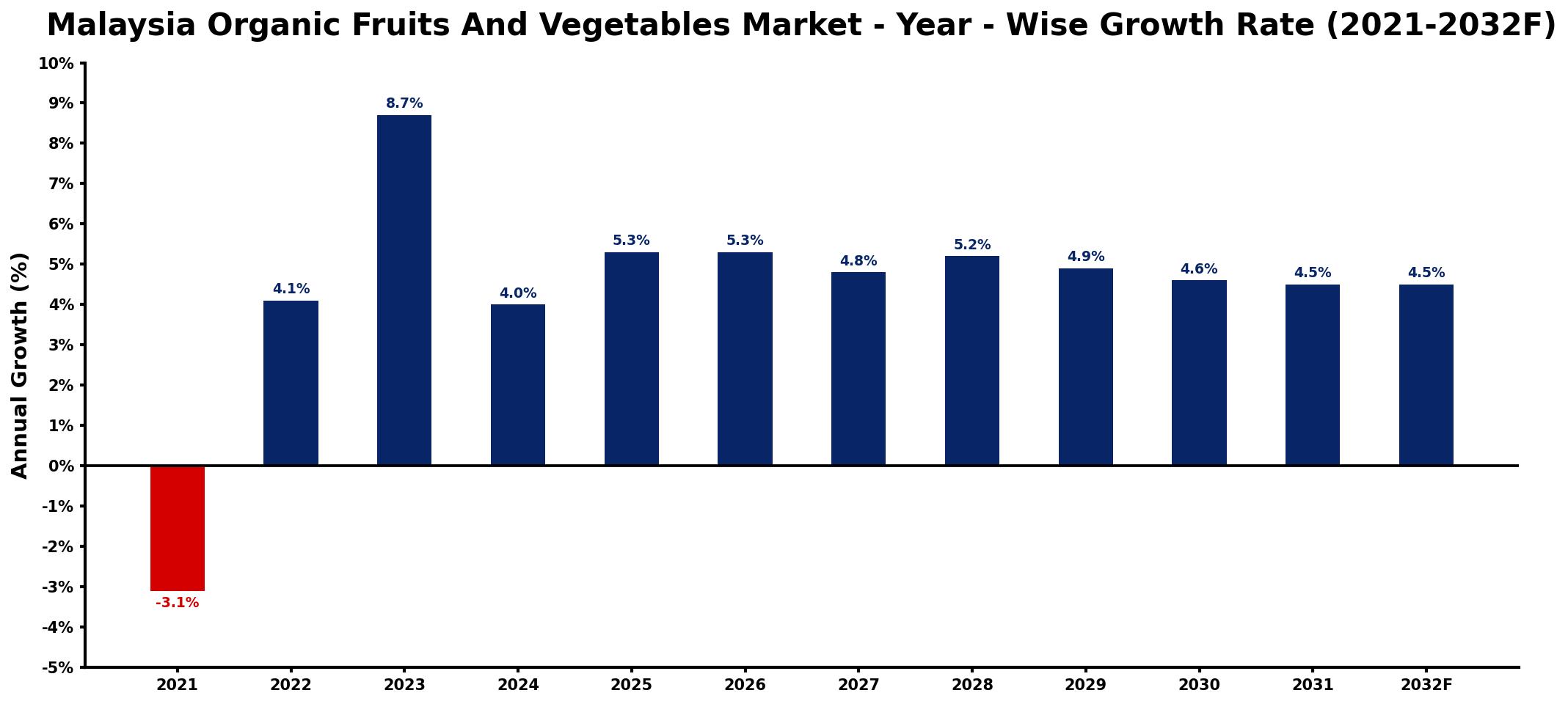
The table below presents the year‑wise growth rates along with the key drivers influencing the market
| Year | Growth Rate | Major Drivers |
| 2021 | -3.1% | Supply chain disruptions affecting availability |
| 2022 | 4.1% | Increased consumer health consciousness |
| 2023 | 8.7% | Rising demand for sustainable practices |
| 2024 | 4.0% | Expansion of local farming initiatives |
| 2025 | 5.3% | Growth in eco-friendly packaging solutions |
| 2026 | 5.3% | Higher investment in agricultural technology |
| 2027 | 4.8% | Increase in urban farming projects |
| 2028 | 5.2% | Strengthening of local farmer cooperatives |
| 2029 | 4.9% | Wider distribution networks emerging |
| 2030 | 4.6% | Enhanced marketing for health benefits |
| 2031 | 4.5% | Collaboration between retailers and suppliers |
| 2032 | 4.5% | Development of community supported agriculture |
Note: Market size estimations and growth projections presented in this report are based on 6Wresearch's proprietary forecasting methodology, utilizing the latest available industry data, government publications, and primary research inputs.
Malaysia Organic Fruits And Vegetables Market Synopsis
The Malaysia Organic Fruits And Vegetables Market has gained significant momentum in recent years, propelled by a shift in consumer preferences towards healthier eating habits. However, as the market continues to grow, it faces hurdles that could temper its pace, including supply chain complexities and the high cost of organic products. The balance between expanding awareness and the practical challenges of accessing organic produce will be pivotal for future growth.
A diverse range of organic fruits and vegetables is cultivated across Malaysia, supported by a robust framework of farmer's markets and specialized organic stores. The increasing adoption of online shopping platforms has also broadened the market's reach, enabling consumers from various demographics to easily access organic options, thereby reinforcing the upward trend in market growth.
Malaysia Organic Fruits And Vegetables Market Key Takeaways
- The market is expected to maintain a steady growth rate, primarily driven by health awareness and consumer demand for organic produce.
- Online shopping is becoming a significant channel for organic fruits and vegetables, expanding accessibility for consumers nationwide.
- Government initiatives are increasingly supporting organic farming practices to enhance sustainability and productivity.
- Challenges related to pricing and quality regulations persist, influencing consumer purchasing decisions in the organic segment.
- Strong potential exists for expanding organic farming through innovative agricultural practices and technology.
Evaluation of Restraints in Malaysia Organic Fruits And Vegetables Market
Despite the promising growth trajectory, the Malaysia Organic Fruits And Vegetables Market grapples with several constraints that could impede its potential. Limited arable land for organic farming restricts the scale of production, particularly as the demand for organic products continues to rise. Additionally, the higher price point of organic fruits and vegetables compared to their conventional counterparts poses a significant barrier to wider consumer adoption. The industry must also navigate the complexities of maintaining stringent quality standards amid growing consumer expectations. Addressing these challenges through enhanced practices, education, and sustainable agricultural techniques will be crucial for market players.
Malaysia Organic Fruits And Vegetables Market Trends
Current trends in the Malaysia Organic Fruits And Vegetables Market are increasingly influenced by a growing interest in sustainable food practices and health consciousness. The rise of urban gardening and local sourcing initiatives speaks to a broader societal shift towards self-sufficiency and environmental responsibility. Moreover, innovations in e-commerce are reshaping how consumers purchase organic products, with a notable increase in subscription models and direct-to-consumer sales. These trends reflect a significant change in buying habits, indicating that consumers are seeking not only quality but also convenience in their food choices.
Malaysia Organic Fruits And Vegetables Market Opportunities
The future of the Malaysia Organic Fruits And Vegetables Market is ripe with opportunities for growth and investment. As consumers increasingly demand transparency in sourcing and production, there is a significant opening for businesses that can demonstrate ethical practices and high-quality standards. Innovations in organic farming techniques, including hydroponics and permaculture, represent exciting avenues for increasing yield while ensuring sustainability. Additionally, collaboration with local farms to create community-supported agriculture (CSA) models could further enhance the market's reach and consumer engagement.
Government Initiatives in the Malaysia Organic Fruits And Vegetables Market
The Malaysian government has taken notable steps to support the organic agriculture sector through various policies and programs. Initiatives aimed at promoting sustainable farming practices include grants for organic certification and training programs for farmers. Additionally, government efforts to enhance infrastructure for organic supply chains are expected to strengthen market accessibility. The commitment to developing organic farming is evident, with public spending directed towards research and development in organic methodologies, which will likely benefit the sector moving forward.
Future Insights of the Malaysia Organic Fruits And Vegetables Market
Looking ahead to the period between 2026 and 2032, the Malaysia Organic Fruits And Vegetables Market is poised for continued growth, supported by evolving consumer behaviors and an emphasis on health and sustainability. As more consumers integrate organic options into their diets, market players will need to adapt by improving product availability and fostering consumer trust through education and quality assurance. Additionally, the ongoing digital transformation of the retail landscape is likely to reshape consumer interactions with organic products, further solidifying their place in Malaysian diets.
Malaysia Organic Fruits And Vegetables Market Latest Developments (2025 - 2026)
Recent developments in the Malaysia Organic Fruits And Vegetables Market indicate a strong commitment to enhancing organic farming practices. New partnerships between local farmers and technology providers have emerged, focused on improving yield and sustainability through innovative solutions. Additionally, consumer education campaigns are being launched to raise awareness about the benefits of organic produce, while e-commerce platforms are investing in user-friendly features to streamline the shopping experience. The momentum for organic products is evident, as more retailers adapt to consumer demands and preferences.
Malaysia Organic Fruits And Vegetables Market - Key Attractiveness of the Report
- 10 Years of Market Numbers
- Historical Data Starting from 2022 to 2025
- Base Year: 2025
- Forecast Data until 2032
- Key Performance Indicators Impacting the Market
- Major Upcoming Developments and Projects
Key Highlights of the Report:
- Malaysia Organic Fruits And Vegetables Market Outlook
- Market Size of Malaysia Organic Fruits And Vegetables Market, 2025
- Forecast of Malaysia Organic Fruits And Vegetables Market, 2032
- Historical Data and Forecast of Malaysia Organic Fruits And Vegetables Revenues & Volume for the Period 2022-2032F
- Malaysia Organic Fruits And Vegetables Market Trend Evolution
- Malaysia Organic Fruits And Vegetables Market Drivers and Challenges
- Malaysia Organic Fruits And Vegetables Price Trends
- Malaysia Organic Fruits And Vegetables Porter's Five Forces
- Malaysia Organic Fruits And Vegetables Industry Life Cycle
- Historical Data and Forecast of Malaysia Organic Fruits And Vegetables Market Revenues & Volume By Product Type for the Period 2022-2032F
- Historical Data and Forecast of Malaysia Organic Fruits And Vegetables Market Revenues & Volume By Organic Fruits for the Period 2022-2032F
- Historical Data and Forecast of Malaysia Organic Fruits And Vegetables Market Revenues & Volume By Organic Vegetables for the Period 2022-2032F
- Historical Data and Forecast of Malaysia Organic Fruits And Vegetables Market Revenues & Volume By Form for the Period 2022-2032F
- Historical Data and Forecast of Malaysia Organic Fruits And Vegetables Market Revenues & Volume By Fresh for the Period 2022-2032F
- Historical Data and Forecast of Malaysia Organic Fruits And Vegetables Market Revenues & Volume By Frozen for the Period 2022-2032F
- Historical Data and Forecast of Malaysia Organic Fruits And Vegetables Market Revenues & Volume By End User for the Period 2022-2032F
- Historical Data and Forecast of Malaysia Organic Fruits And Vegetables Market Revenues & Volume By Residential for the Period 2022-2032F
- Historical Data and Forecast of Malaysia Organic Fruits And Vegetables Market Revenues & Volume By Commercial for the Period 2022-2032F
- Historical Data and Forecast of Malaysia Organic Fruits And Vegetables Market Revenues & Volume By Distribution Channel for the Period 2022-2032F
- Historical Data and Forecast of Malaysia Organic Fruits And Vegetables Market Revenues & Volume By Supermarket for the Period 2022-2032F
- Historical Data and Forecast of Malaysia Organic Fruits And Vegetables Market Revenues & Volume By Hypermarket for the Period 2022-2032F
- Historical Data and Forecast of Malaysia Organic Fruits And Vegetables Market Revenues & Volume By Convenience Store for the Period 2022-2032F
- Historical Data and Forecast of Malaysia Organic Fruits And Vegetables Market Revenues & Volume By Online Sale Channel for the Period 2022-2032F
- Historical Data and Forecast of Malaysia Organic Fruits And Vegetables Market Revenues & Volume By Others for the Period 2022-2032F
- Malaysia Organic Fruits And Vegetables Import Export Trade Statistics
- Market Opportunity Assessment By Product Type
- Market Opportunity Assessment By Form
- Market Opportunity Assessment By End User
- Market Opportunity Assessment By Distribution Channel
- Malaysia Organic Fruits And Vegetables Top Companies Market Share
- Malaysia Organic Fruits And Vegetables Competitive Benchmarking By Technical and Operational Parameters
- Malaysia Organic Fruits And Vegetables Company Profiles
- Malaysia Organic Fruits And Vegetables Key Strategic Recommendations






































