Malaysia Packaging Trays Market Summary
The malaysia packaging trays market was estimated at USD 220 Million in 2025 and is projected to reach USD 285 Million by 2032, growing at a CAGR of 5.0% from 2026 to 2032.
Malaysia Packaging Trays Market Year-wise Growth Rate and Key Drivers
This graph highlights how the Malaysia Packaging Trays Market has steadily grown over the past five years, supported by major growth factors.
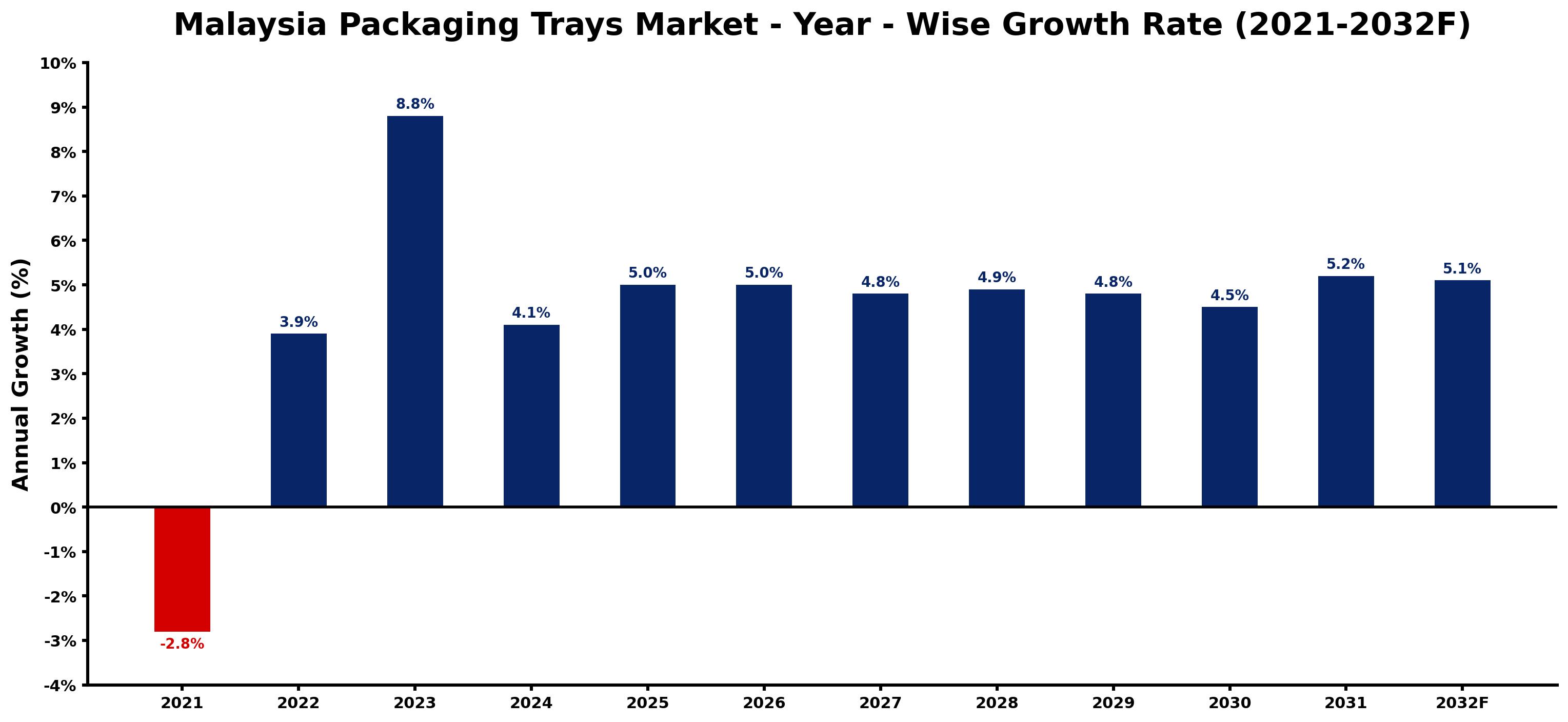
The table below presents the year wise growth rates along with the key drivers influencing the market
| Year | Growth Rate | Major Drivers |
| 2021 | -2.8% | Supply chain disruptions from the pandemic severely impacted production capabilities and led to shortages in packaging materials. |
| 2022 | 3.9% | Emerging e-commerce channels prompted investments in sustainable packaging materials. |
| 2023 | 8.8% | Consumer preferences shifted towards eco-friendly options, influencing tray designs and materials. |
| 2024 | 4.1% | The food service industry's expansion necessitated versatile and durable packaging trays. |
| 2025 | 5.0% | Technological innovations in manufacturing processes enhanced production efficiency and product quality. |
| 2026 | 5.0% | Rising disposable income levels motivated consumers to opt for premium packaging choices. |
| 2027 | 4.8% | Local brands increasingly focused on sustainable practices, reshaping competitive market dynamics. |
| 2028 | 4.9% | Corporate responsibility initiatives led to a focus on recyclable and biodegradable materials. |
| 2029 | 4.8% | Retailer collaborations aimed to streamline supply chains, improving tray distribution efficiency. |
| 2030 | 4.5% | Investment in automation technologies revolutionized production capacities and reduced costs. |
| 2031 | 5.2% | Market diversification strategies encouraged development of specialized packaging solutions. |
| 2032 | 5.1% | Consumer education on sustainability created demand for environmentally considerate packaging options. |
Note - Market size estimations and growth projections presented in this report are based on 6Wresearch's advanced forecasting approach, validated with industry datasets as of June 2026.
Malaysia Packaging Trays Market Synopsis
The Malaysia Packaging Trays Market is projected to reach 5.0% and witness significant growth during the forecast period (2026-2032). Growth in this sector is anticipated at a compound annual growth rate (CAGR) of 5.4%, driven primarily by a surge in demand from the food and beverage industry. Health-conscious consumers increasingly recognize the benefits of disposable packaging, contributing to a shift towards convenience products, including ready meals and pre-packaged foods. Additionally, the expanding retail sector in Malaysia plays a significant role in propelling the market for packaging trays.
Malaysia Packaging Trays Market Growth Drivers
A variety of factors contribute to the growth of the Malaysia Packaging Trays Market. These include:
- The food and beverage industry is a major driver of market demand, as companies strive to optimize packaging solutions that ensure product safety and appeal to consumer preferences.
- Increased consumer awareness about the health benefits of using disposable items is leading to higher adoption rates of packaging trays, especially in the context of hygiene and convenience.
- Shifts in consumer behavior towards ready-to-eat and pre-packaged meals, alongside the busy lifestyles of modern consumers, are further bolstering demand for packaging trays.
- The retail sector in Malaysia is experiencing rapid growth, with new outlets and online platforms resulting in heightened demand for efficient packaging solutions to maintain product quality.
- Technological advancements in the field of sustainable packaging, including biodegradable and recyclable materials, are expected to open new avenues for innovation and market growth.
Malaysia Packaging Trays Market Trends and Opportunities
The Malaysia Packaging Trays Market is witnessing several key trends that present lucrative opportunities for stakeholders:
- There is an increasing trend towards eco-friendly packaging solutions, with consumers preferring products that minimize environmental impact.
- Smart packaging technology is gaining traction, with innovations that enhance product tracking and preservation leading to improved consumer experiences.
- The rise of e-commerce is compelling companies to adopt more robust packaging solutions that protect products during transit while maintaining aesthetic appeal.
- Customizable packaging trays for various food types are becoming increasingly popular, allowing businesses to differentiate their products in a competitive market.
- Collaboration between packaging companies and food manufacturers is likely to intensify, fostering the development of specialized packaging solutions tailored to specific market needs.
Malaysia Packaging Trays Market Challenges and Restraints
While the prospects for the Malaysia Packaging Trays Market appear promising, several challenges may hinder growth:
- Fluctuations in raw material prices can affect production costs, creating challenges for manufacturers in maintaining profit margins.
- Regulatory changes, particularly with respect to environmental policies, may require significant adjustments in packaging design and material usage.
- Competition from alternative packaging solutions, such as glass and metal containers, could pose a threat to the market share of packaging trays.
- Consumer preferences are evolving rapidly, necessitating continuous innovation to keep up with market demands and trends.
- Supply chain disruptions, exacerbated by global events, can impact the availability of materials and timely delivery of packaging products.
Malaysia Packaging Trays Market Government Investment and Initiatives
The Malaysian government recognizes the significance of the packaging industry as a contributor to economic growth and sustainability. Various initiatives and public investments are being implemented to support the Malaysia Packaging Trays Market:
- Government policies are increasingly prioritizing sustainable practices, encouraging the use of biodegradable and recyclable materials within the packaging sector.
- Incentives for companies investing in innovative packaging technologies are being introduced to foster industry growth and competitiveness.
- Public spending on infrastructure improvements facilitates better logistics for packaging manufacturers and suppliers, enhancing supply chain efficiency.
- Collaboration with research and development institutions is being promoted to advance packaging technologies and address industry challenges.
- Awareness campaigns by government agencies aim to educate businesses and consumers on the importance of sustainable packaging solutions.
Malaysia Packaging Trays Market Latest Developments (May 2025 - June 2026)
Recent developments within the Malaysia Packaging Trays Market indicate a dynamic evolution driven by industry trends and consumer preferences:
- There has been a noticeable increase in the adoption of sustainable materials, with businesses transitioning towards environmentally friendly alternatives.
- Innovations in smart packaging technologies are being integrated into packaging solutions, enhancing the consumer experience and product safety.
- Partnerships between manufacturers and food industry stakeholders have intensified, aimed at creating customized packaging solutions tailored to market demands.
- The impact of online shopping continues to reshape packaging requirements, with an emphasis on durable and appealing packaging to attract consumers.
- Regulatory changes related to waste management and recycling have prompted companies to reevaluate their packaging strategies to comply with new standards.
Malaysia Packaging Trays Market - Key Attractiveness of the Report
- 10 Years of Market Numbers
- Historical Data Starting from 2022 to 2025
- Base Year: 2025
- Forecast Data until 2032
- Key Performance Indicators Impacting the Market
- Major Upcoming Developments and Projects
Key Highlights of the Report:
- Malaysia Packaging Trays Market Outlook
- Market Size of Malaysia Packaging Trays Market, 2025
- Forecast of Malaysia Packaging Trays Market, 2032F
- Historical Data and Forecast of Malaysia Packaging Trays Revenues & Volume for the Period 2022-2032F
- Malaysia Packaging Trays Market Trend Evolution
- Malaysia Packaging Trays Market Drivers and Challenges
- Malaysia Packaging Trays Price Trends
- Malaysia Packaging Trays Porter's Five Forces
- Malaysia Packaging Trays Industry Life Cycle
- Historical Data and Forecast of Malaysia Packaging Trays Market Revenues & Volume By Material Types for the Period 2022-2032F
- Historical Data and Forecast of Malaysia Packaging Trays Market Revenues & Volume By PET for the Period 2022-2032F
- Historical Data and Forecast of Malaysia Packaging Trays Market Revenues & Volume By PVC for the Period 2022-2032F
- Historical Data and Forecast of Malaysia Packaging Trays Market Revenues & Volume By Polypropylene for the Period 2022-2032F
- Historical Data and Forecast of Malaysia Packaging Trays Market Revenues & Volume By Others for the Period 2022-2032F
- Historical Data and Forecast of Malaysia Packaging Trays Market Revenues & Volume By Forms for the Period 2022-2032F
- Historical Data and Forecast of Malaysia Packaging Trays Market Revenues & Volume By Flexible for the Period 2022-2032F
- Historical Data and Forecast of Malaysia Packaging Trays Market Revenues & Volume By Semi-Flexible for the Period 2022-2032F
- Historical Data and Forecast of Malaysia Packaging Trays Market Revenues & Volume By End-users for the Period 2022-2032F
- Historical Data and Forecast of Malaysia Packaging Trays Market Revenues & Volume By Industrial for the Period 2022-2032F
- Historical Data and Forecast of Malaysia Packaging Trays Market Revenues & Volume By Food & Beverages for the Period 2022-2032F
- Historical Data and Forecast of Malaysia Packaging Trays Market Revenues & Volume By Retail for the Period 2022-2032F
- Historical Data and Forecast of Malaysia Packaging Trays Market Revenues & Volume By Cosmetic & Personal Care for the Period 2022-2032F
- Historical Data and Forecast of Malaysia Packaging Trays Market Revenues & Volume By Others for the Period 2022-2032F
- Malaysia Packaging Trays Import Export Trade Statistics
- Market Opportunity Assessment By Material Types
- Market Opportunity Assessment By Forms
- Market Opportunity Assessment By End-users
- Malaysia Packaging Trays Top Companies Market Share
- Malaysia Packaging Trays Competitive Benchmarking By Technical and Operational Parameters
- Malaysia Packaging Trays Company Profiles
- Malaysia Packaging Trays Key Strategic Recommendations






































