Malaysia Paint Stripper Market Size, Share & Growth Rate
The Malaysia Paint Stripper Market was estimated at USD 1412 Million in 2025 and is projected to reach USD 2126 Million by 2032, growing at a CAGR of 6.0% from 2026 to 2032. This promising trajectory is significantly driven by ongoing urban renovation projects and the rebound of the automotive sector post-pandemic. The demand for efficient and effective paint removal solutions in various applications such as restoration and refurbishment is expected to sustain market stability.
Malaysia Paint Stripper Market Year-wise Growth Rate and Key Drivers
This graph highlights how the Malaysia Paint Stripper Market has steadily grown over the years, supported by major growth factors.
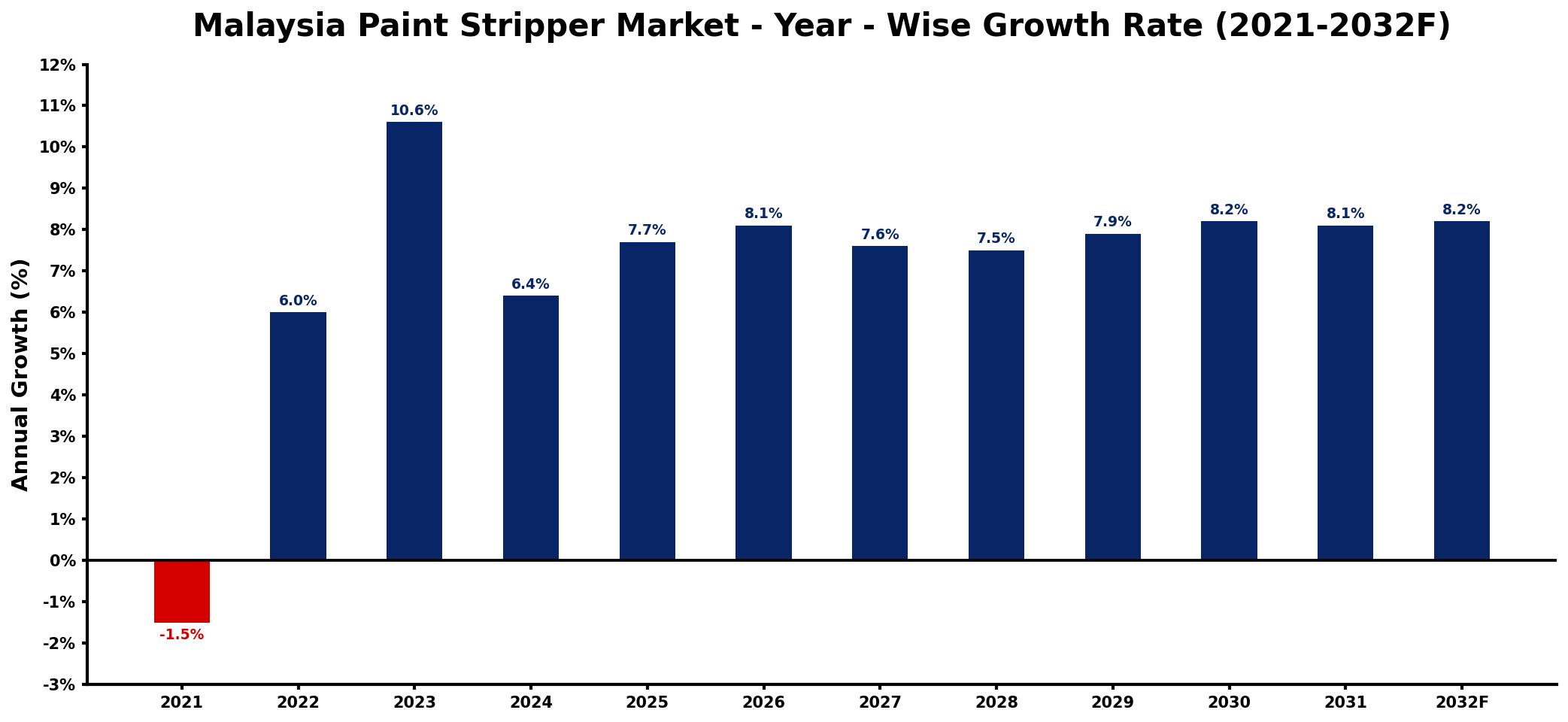
The table below presents the year‑wise growth rates along with the key drivers influencing the market
| Year | Growth Rate | Major Drivers |
| 2021 | -1.5% | decreased construction activity levels |
| 2022 | 6.0% | growing renovation and remodeling projects |
| 2023 | 10.6% | increased demand for eco-friendly solutions |
| 2024 | 6.4% | expansion of automotive refurbishment services |
| 2025 | 7.7% | strengthening international trade flows |
| 2026 | 8.1% | growth in commercial maintenance services |
| 2027 | 7.6% | surge in industrial cleaning applications |
| 2028 | 7.5% | strengthened regulations on hazardous materials |
| 2029 | 7.9% | increased investments in manufacturing sectors |
| 2030 | 8.2% | greater focus on sustainability initiatives |
| 2031 | 8.1% | enhanced product offerings from suppliers |
| 2032 | 8.2% | increased capital investment inflows |
Note: Market size estimations and growth projections presented in this report are based on 6Wresearch's proprietary forecasting methodology, utilizing the latest available industry data, government publications, and primary research inputs.
Malaysia Paint Stripper Market Synopsis
In Malaysia, the paint stripper market is primarily shaped by the robust construction and automotive industries. As infrastructure development and renovation projects accelerate, the need for reliable paint stripping solutions is increasingly evident. This trend indicates a strong future demand for products that comply with evolving safety and environmental standards.
Furthermore, the market is witnessing a shift towards eco-friendly alternatives, driven by both consumer preferences and regulatory pressures. Companies are innovating formulations to enhance performance while minimizing environmental impact, thus redefining traditional market dynamics.
Malaysia Paint Stripper Market Key Takeaways
- Urban renovation and automotive sectors are key drivers of market growth.
- Demand for eco-friendly and safer paint stripper formulations is on the rise.
- Market stability is projected despite challenges related to hazardous chemical regulations.
- Post-pandemic recovery is expected to further bolster demand for paint strippers.
- Key stakeholders are focusing on innovation to meet environmental compliance and consumer preferences.
Evaluation of Restraints in Malaysia Paint Stripper Market
While the Malaysia Paint Stripper Market shows promise, several constraints may hinder its full potential. The increasing emphasis on sustainable practices and eco-friendly products may limit the availability of traditional formulations that are prevalent in the market. Regulatory restrictions on hazardous chemicals are also tightening, leading manufacturers to reformulate products, which can result in increased operational costs. As a result, companies must balance product efficacy with compliance, presenting a unique challenge that could impact growth trajectories.
Malaysia Paint Stripper Market Trends
Current trends indicate a growing interest in biodegradable and environmentally safe paint strippers. Consumers are becoming more environmentally conscious, thus prompting manufacturers to prioritize sustainable materials and processes. Additionally, technological advancements are enhancing the efficiency and effectiveness of paint removal solutions, with innovations focused on reducing application times and improving safety for users. Digital marketing strategies are also on the rise, allowing businesses to reach a broader audience and educate them on new products.
Malaysia Paint Stripper Market Opportunities
Investors and stakeholders in the Malaysia Paint Stripper Market should look for growth opportunities within eco-friendly formulations and innovative technologies. The increasing popularity of DIY home improvement projects offers a substantial market segment for user-friendly paint strippers. Additionally, collaborations with construction companies for large-scale projects could yield significant demand. Expanding distribution channels to include e-commerce platforms can also enhance market reach and visibility.
Government Initiatives in the Malaysia Paint Stripper Market
The Malaysian government is actively promoting environmental sustainability through various initiatives, which may indirectly benefit the paint stripper market. Policies aimed at reducing industrial emissions and enhancing safety regulations are guiding manufacturers towards safer product formulations. Public investments in infrastructure development and renovation projects are also expected to provide opportunities for market growth, fostering an environment conducive to innovation and compliance with environmental standards.
Future Insights of the Malaysia Paint Stripper Market
Looking ahead to 2026-2032, the Malaysia Paint Stripper Market is poised for a period of robust growth. As construction activities gain momentum and the automotive sector stabilizes, demand for efficient paint stripping solutions will likely rise. Continued emphasis on environmental responsibility will push manufacturers to innovate further, ensuring that products not only meet performance expectations but also align with regulatory requirements. The market landscape is expected to become increasingly competitive, highlighting the importance of adaptability and innovation.
Malaysia Paint Stripper Market Latest Developments (2025 - 2026)
Recent developments within the Malaysia Paint Stripper Market indicate a shift towards more sustainable and effective formulations, as industry players seek to align with environmental policies. Collaborative efforts between manufacturers and regulatory bodies have emerged, aiming to ensure compliance and enhance product safety. Additionally, innovations in application technologies are gaining traction, optimizing user experiences and efficiency in paint removal processes.
Malaysia Paint Stripper Market - Key Attractiveness of the Report
- 10 Years of Market Numbers
- Historical Data Starting from 2022 to 2025
- Base Year: 2025
- Forecast Data until 2032
- Key Performance Indicators Impacting the Market
- Major Upcoming Developments and Projects
Key Highlights of the Report:
- Malaysia Paint Stripper Market Outlook
- Market Size of Malaysia Paint Stripper Market, 2025
- Forecast of Malaysia Paint Stripper Market, 2032
- Historical Data and Forecast of Malaysia Paint Stripper Revenues & Volume for the Period 2022-2032F
- Malaysia Paint Stripper Market Trend Evolution
- Malaysia Paint Stripper Market Drivers and Challenges
- Malaysia Paint Stripper Price Trends
- Malaysia Paint Stripper Porter's Five Forces
- Malaysia Paint Stripper Industry Life Cycle
- Historical Data and Forecast of Malaysia Paint Stripper Market Revenues & Volume By Product Type for the Period 2022-2032F
- Historical Data and Forecast of Malaysia Paint Stripper Market Revenues & Volume By Caustic Paint Stripper for the Period 2022-2032F
- Historical Data and Forecast of Malaysia Paint Stripper Market Revenues & Volume By Solvent-based Paint Stripper for the Period 2022-2032F
- Historical Data and Forecast of Malaysia Paint Stripper Market Revenues & Volume By Biochemical Paint Stripper for the Period 2022-2032F
- Historical Data and Forecast of Malaysia Paint Stripper Market Revenues & Volume By End-Users for the Period 2022-2032F
- Historical Data and Forecast of Malaysia Paint Stripper Market Revenues & Volume By Vehicle Maintenance for the Period 2022-2032F
- Historical Data and Forecast of Malaysia Paint Stripper Market Revenues & Volume By Aerospace for the Period 2022-2032F
- Historical Data and Forecast of Malaysia Paint Stripper Market Revenues & Volume By Renovations for the Period 2022-2032F
- Historical Data and Forecast of Malaysia Paint Stripper Market Revenues & Volume By Furniture Refinishing for the Period 2022-2032F
- Historical Data and Forecast of Malaysia Paint Stripper Market Revenues & Volume By Industrial Repairs for the Period 2022-2032F
- Historical Data and Forecast of Malaysia Paint Stripper Market Revenues & Volume By Others for the Period 2022-2032F
- Malaysia Paint Stripper Import Export Trade Statistics
- Market Opportunity Assessment By Product Type
- Market Opportunity Assessment By End-Users
- Malaysia Paint Stripper Top Companies Market Share
- Malaysia Paint Stripper Competitive Benchmarking By Technical and Operational Parameters
- Malaysia Paint Stripper Company Profiles
- Malaysia Paint Stripper Key Strategic Recommendations






































